Philippine–American War (1899–1902): Causes, Battles and Civilian Deaths
Why Filipino independence led to a war with the United States and how civilians were affected.
The Philippine–American War began on February 4, 1899, when fighting erupted between U.S. occupation forces and Filipino troops pursuing independence after Spain’s defeat. Emilio Aguinaldo led the First Philippine Republic, while the United States asserted sovereignty under the Treaty of Paris. The conflict shifted from conventional battles to guerrilla warfare; U.S. President Theodore Roosevelt declared the main war ended in July 1902, but resistance continued afterward. Military and civilian deaths were extensive.
This sourced history covers the First Philippine Republic, U.S. occupation, military campaigns, casualties and long-term political consequences.
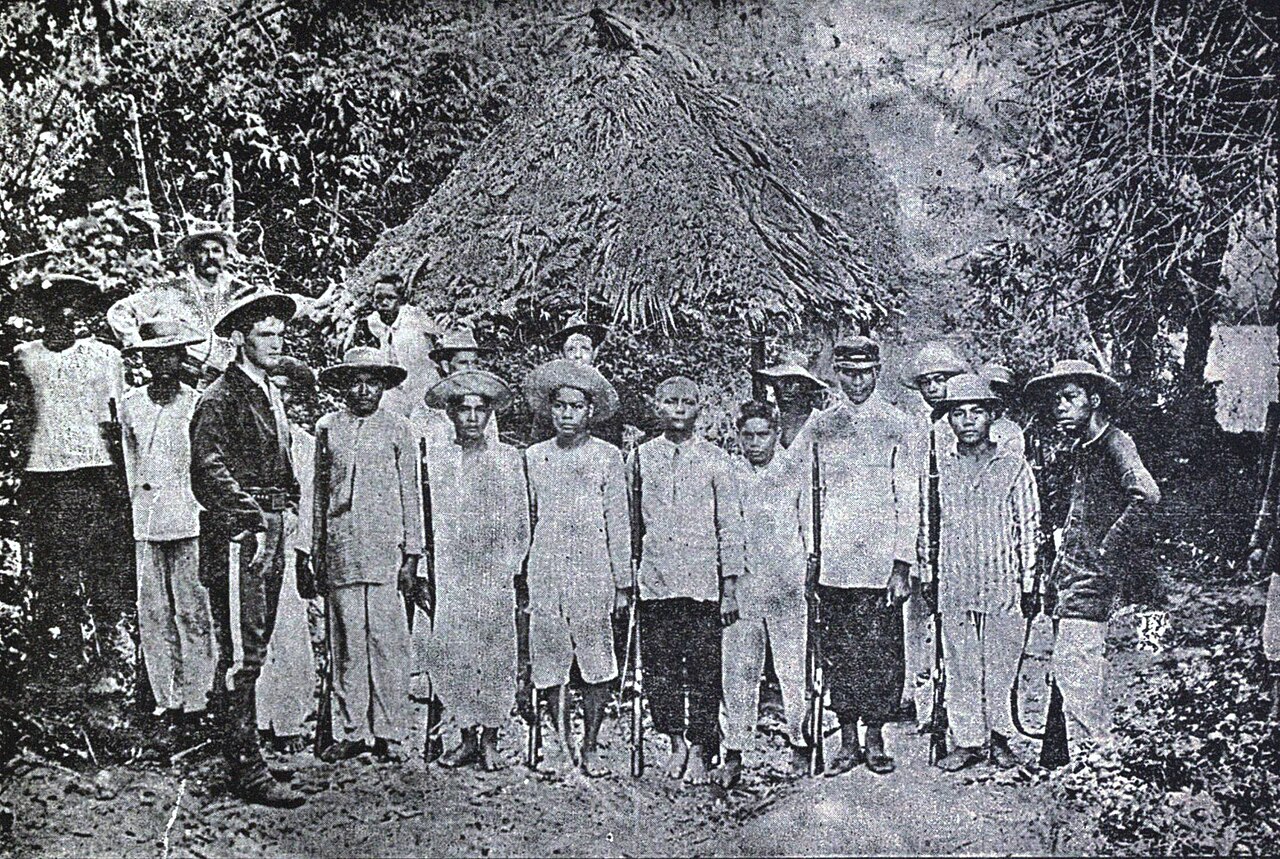
On this page — 25 topics
What was the Philippine–American War?
The Philippine–American War was a conflict between United States forces and Filipinos seeking national independence after Spanish colonial rule. Fighting began near Manila in February 1899, soon after Spain ceded the islands to the United States under the December 1898 Treaty of Paris. Filipino leaders had already declared independence and formed institutions of their own. U.S. officials asserted a right to govern the archipelago, and the two positions could not be reconciled. Initial large-scale battles gave way to guerrilla warfare and harsh counterinsurgency operations. President Theodore Roosevelt declared the main conflict concluded in 1902, but armed resistance and coercive military campaigns continued in several areas afterward.
Why did the Philippines seek independence?
Filipino resistance to Spanish colonial rule had developed well before the United States entered the war against Spain in 1898. Reformers and revolutionaries criticized political exclusion, abuses of colonial authority and restrictions on economic and social life. The revolution of 1896 and leadership of people including José Rizal and Emilio Aguinaldo shaped the movement, though they held differing positions and methods. Aguinaldo’s forces renewed their campaign as Spanish power weakened. They expected independence to follow victory, not a transfer to another foreign government. Their aspirations were therefore distinct from American claims that occupation would bring orderly administration or political education.
Who was Emilio Aguinaldo?
Emilio Aguinaldo was a Filipino revolutionary leader and president of the First Philippine Republic. His military and political career developed in the struggle against Spain, and he played a central part in the proclamation of Philippine independence on June 12, 1898. In January 1899 a republican government was inaugurated at Malolos. After fighting with the United States began, Aguinaldo became the best-known national leader of resistance, though Filipino commanders exercised local authority and did not always agree on strategy. American forces captured him in 1901. His biography should not erase the many other political figures, soldiers and civilians who supported independence or experienced the war.
What happened during the Spanish–American War?
During the Spanish–American War of 1898, a U.S. naval squadron defeated Spain’s Pacific fleet at Manila Bay on May 1. Filipino revolutionary forces also advanced against Spanish positions. The relationship between U.S. and Filipino leaders contained cooperation against Spain but uncertainty about the islands’ political future. When American troops occupied Manila, competing claims of authority became increasingly difficult to manage. The Treaty of Paris was negotiated between the United States and Spain, not between an independent Philippine government and the United States. The dispute that followed was therefore connected with the 1898 war but was a separate armed conflict over self-government.
What did the Treaty of Paris decide?
On December 10, 1898, Spain and the United States signed a treaty ending their war. It transferred Spanish claims over the Philippines to the United States, with an American payment of twenty million dollars. Filipino independence leaders had not consented to the transfer, and the treaty did not settle their aspirations. Washington viewed it as a legal basis for new sovereignty, while Filipinos who had fought Spain considered themselves entitled to govern their country. The political contradiction was central to the war that began weeks later. The treaty also dealt with Cuba, Puerto Rico and Guam, but the Philippines became the scene of a particularly prolonged and destructive struggle over colonial rule.
What was the First Philippine Republic?
The First Philippine Republic was established under Aguinaldo’s leadership, with its government inaugurated at Malolos in January 1899. It had developed from revolutionary institutions built during the struggle against Spain and sought international recognition. Its leaders promoted a constitutional system and national independence, despite serious practical challenges in coordinating diverse islands and regions. American officials declined to recognize it as a sovereign government. The republic’s existence matters because the war was not simply a campaign to suppress an unorganized collection of bandits. U.S. troops confronted a political movement with its own institutions, military forces and claims to legitimacy, even though those institutions were tested severely by invasion and internal disagreements.
Why did fighting break out on February 4, 1899?
A violent encounter occurred near Manila on the evening of February 4 when U.S. and Filipino forces faced each other across contested positions. American soldiers opened fire in an incident that escalated into wider fighting, and the following day brought major battles. Interpretations of the precise first exchange differ in some accounts, but the deeper cause was the incompatible political claims of occupation and independence. The clash preceded the U.S. Senate’s ratification of the Treaty of Paris on February 6. Its timing is historically significant but does not mean the war was merely an accident. Both armed forces had been operating under increasing tension as American authorities prepared to establish control.
What happened in the Battle of Manila?
On February 4–5, 1899, U.S. troops attacked and defeated Filipino positions around Manila, pushing resistance away from the urban center. U.S. artillery and infantry had advantages in weapons and organization, while Filipino forces fought in a landscape that included suburbs, roads and waterways. The opening battle weakened Filipino hopes of preventing a rapid American advance near the capital, but it did not destroy the independence movement. Fighting spread elsewhere, and Filipino soldiers reorganized for subsequent campaigns. Manila was not the only theater. As American forces moved into the countryside, military control became difficult to establish without the participation or submission of local communities.
How did the first phase of the war develop?
During 1899 the United States conducted campaigns to defeat organized Filipino armies and occupy strategic towns and transport lines. American troops captured important positions, while Filipino commanders withdrew, regrouped and attempted to preserve their movement. Battles occurred across Luzon and other regions, with local conditions affecting how forces operated. The U.S. Army could often win conventional engagements, but holding territory and supplying isolated garrisons presented longer-term challenges. Civilians had to navigate competing demands for food, labor and allegiance. The transition from large formations to dispersed resistance did not mean the war became less destructive; it often brought military pressure into villages and farming communities.
Why did Filipino fighters use guerrilla tactics?
As U.S. forces captured towns and defeated larger formations, Filipino resistance increasingly used smaller mobile groups, local intelligence, ambushes and attacks on supply or communication routes. Guerrilla warfare allowed fighters familiar with the terrain to continue operating despite disadvantages in artillery and conventional equipment. It also made it harder for American troops to distinguish armed opponents from civilians, contributing to collective punishment and coercive practices. The strategy was not used uniformly throughout the archipelago. Different commanders and communities made choices based on resources, geography and loyalties. Understanding these variations is important rather than imagining a single centrally controlled insurgency operating in the same way across every island.
Who were the American commanders?
U.S. military command included General Elwell S. Otis in the early period and later General Arthur MacArthur Jr., among officers responsible for campaigns and occupation policy. Local commanders had substantial influence over how troops treated communities and suspected resistance supporters. President William McKinley set the broad policy of asserting American sovereignty, while Theodore Roosevelt inherited the conflict when he took office in 1901. American leaders portrayed their mission in varying terms, including public order and benevolent assimilation. Yet those political claims cannot substitute for studying military orders, operations and the treatment of civilians. The chain of command mattered because counterinsurgency policy differed between regions and phases.
What was benevolent assimilation?
In December 1898 McKinley issued a proclamation associated with the policy of benevolent assimilation, stating that American authority should be extended to the islands while promising protections and benefits. U.S. officials presented the program as a form of trusteeship or political improvement. Many Filipinos regarded it as a refusal to recognize their already declared independence. The language was especially controversial because the United States was itself a republic that claimed to value self-government. Evaluating the policy requires comparing public declarations with actual military occupation, censorship, restrictions and violence. The proclamation was issued before the February 1899 opening of the Philippine–American War, illustrating how the basic sovereignty dispute preceded open battle.
How did the war affect Filipino civilians?
Civilians suffered deaths from disease, hunger and direct military violence as well as loss of homes, farms and access to markets. The destruction of crops and disruption of local supply systems contributed to severe hardship. In some areas U.S. forces concentrated residents in controlled zones or restricted movement while pursuing guerrillas. These policies were justified as necessary to separate fighters from supporters but could expose families to deprivation and disease. Filipino civilians also experienced coercion from forces seeking food, shelter or intelligence. Historical estimates of civilian deaths are substantial and uncertain, and the human cost cannot be reduced to the number of soldiers killed in conventional engagements.
What happened at Balangiga in 1901?
On September 28, 1901, Filipino fighters attacked a U.S. Army detachment at Balangiga on Samar, killing many American soldiers. The assault was followed by an especially harsh American military campaign on the island, including orders and operations later criticized for brutality toward civilians. General Jacob H. Smith became notorious for instructions associated with the campaign and was subjected to court-martial proceedings. The Samar episode shows how violent guerrilla operations and counterinsurgency could produce escalating retaliation. It also requires careful treatment of sources: local Filipino perspectives are essential, and particular quotations or casualty figures should be traced to documented testimony rather than repeated as myths.
Why is the Samar campaign controversial?
American forces pursuing resistance on Samar used coercive measures including destruction of property and pressure on civilian populations. Accounts of the campaign became politically contentious in the United States, where congressional investigations and press reports raised questions about the conduct of soldiers. Some officials defended hard measures as necessary against guerrilla warfare, while critics argued that they were incompatible with American ideals and basic protections for civilians. The episode was not typical of every U.S. unit’s actions, but it is central to assessing the character of the conflict. A serious history should acknowledge both the initial violence at Balangiga and the punitive campaign that followed.
How was Aguinaldo captured?
American forces under Brigadier General Frederick Funston captured Aguinaldo in March 1901 at Palanan in northern Luzon through an operation involving Filipino scouts and a deception intended to reach his headquarters. His capture dealt a major blow to the central republican leadership and encouraged the United States to declare that organized resistance was weakening. However, it did not instantly end armed opposition throughout the islands. Other Filipino commanders continued fighting, and local conflicts persisted. Aguinaldo later took an oath of allegiance to the United States. The episode is important because it distinguishes the capture of the most famous leader from the much more complicated process of enforcing control over a vast archipelago.
How many soldiers were killed?
The U.S. House of Representatives’ historical account cites an estimate of approximately 20,000 Filipino revolutionaries and 4,200 American troops who died in combat during the war. These numbers depend on the dates and categories being counted and should not be treated as exact universal totals. Military casualties also included soldiers wounded or incapacitated by disease. Filipino losses are especially difficult to reconstruct because records were incomplete and fighting continued after the formal 1902 end. For comparison, civilian deaths are estimated separately and on a much larger scale. Combining all the figures into one unsupported number hides important differences between battle deaths, illness and wider disruption.
How many civilians died?
A frequently cited State Department estimate, reproduced in U.S. House historical material, suggests that more than 200,000 Filipino civilians died from starvation, disease or violence connected with the war. Other historical research proposes different figures depending on geography, time period and whether deaths during later operations are included. The number is therefore an estimate, not a precise final census. Civilian mortality reflected disrupted agriculture, population displacement, conflict and epidemics, rather than one single battlefield event. The scale demonstrates why accounts confined to U.S. military victories misrepresent the war. Families and communities suffered effects continuing long after the principal military campaigns ended.
When did the war officially end?
On July 4, 1902, President Theodore Roosevelt issued an amnesty and declared the insurrection largely ended, a date often used as the official conclusion of the Philippine–American War. However, fighting and armed resistance continued in some regions for years. The distinction is important because military campaigns against the Moro peoples in the southern Philippines had distinct political and historical circumstances, even though they occurred under continued U.S. rule. Using 1899–1902 as the main war dates is standard, but it does not imply that all Filipinos accepted colonial government in July 1902. The end of a formal conflict and the end of resistance are not the same.
How did Americans debate imperialism?
The acquisition of the Philippines generated major debate in the United States over whether overseas empire was consistent with the country’s republican principles. Supporters argued that American control would bring security, trade and education, while opponents in the Anti-Imperialist League warned that governing people without their consent violated the ideals of self-government. Racist assumptions influenced arguments on multiple sides of the debate, making it important to examine the language and interests of particular speakers. The dispute connected domestic politics to conditions in Asia and helped shape the election of 1900. Neither political faction can stand in for the voices of Filipino people seeking independence.
What was the long-term outcome?
The United States established colonial government in the Philippines and later developed institutions that included limited elected representation. The Philippine Assembly convened in 1907, and the Jones Act of 1916 promised eventual independence. The islands remained under American sovereignty until 1946, except during the Japanese occupation of World War II. This longer chronology matters because the 1898 Treaty of Paris did not immediately create a self-governing Philippine state and the 1902 proclamation did not resolve the sovereignty question. The war’s legacies include debates over citizenship, education, political rights, historical memory and the relationships between the Philippines and the United States.
Where can readers verify the history?
The State Department’s Office of the Historian provides a concise diplomatic chronology and distinguishes the 1902 proclamation from later resistance. The Philippine National Commission for Culture and the Arts publishes a narrative from the national independence perspective. The U.S. House of Representatives’ historical essay includes detailed context and qualified casualty estimates. These sources do not always use the same terminology—older American records often call Filipino independence fighters insurgents—so reading them comparatively matters. Combining Philippine and American historical research provides a fuller record than a purely military summary of United States operations.
Philippine–American War timeline
| Date | Event |
|---|---|
| June 12, 1898 | Philippine independence proclaimed. |
| December 10, 1898 | Spain cedes Philippines to United States in Treaty of Paris. |
| January 1899 | First Philippine Republic inaugurated at Malolos. |
| February 4, 1899 | Fighting erupts around Manila. |
| 1899–1900 | American forces advance; Filipino resistance increasingly uses guerrilla methods. |
| March 1901 | Aguinaldo captured at Palanan. |
| September 1901 | Balangiga attack followed by brutal Samar campaign. |
| July 4, 1902 | Roosevelt declares main war ended; fighting continues elsewhere. |
| 1946 | Philippines achieves independence from United States. |