Fall of Richmond (April 1865): Confederate Evacuation, Fires and Lincoln’s Visit
The Confederate capital fell after Petersburg’s defenses collapsed, leaving fires, damaged infrastructure and a transformed city.
Richmond, the Confederate capital, fell to Union forces on April 3, 1865, after Robert E. Lee’s defenses around Petersburg became untenable. Confederate officials and soldiers evacuated on the night of April 2, and fires set to destroy military supplies spread into parts of the city. Union troops entered the following morning. President Abraham Lincoln visited Richmond on April 4, only days before his assassination.
A source-based guide to the sequence, commanders, decisions and historical consequences.
On this page — 20 topics
When did Richmond fall?
Union soldiers entered Richmond, Virginia, on April 3, 1865, after Confederate leaders and troops had evacuated the capital during the previous night. The city’s fall was closely connected to the military collapse of the Petersburg front. Lee informed Confederate authorities on April 2 that the army could no longer defend both Petersburg and Richmond.
The occupation was a major symbolic moment because Richmond had served as the Confederate capital for most of the Civil War. Yet it was not the formal end of all Confederate military resistance. Lee’s army retreated west, and other commands remained active. Separating the city’s fall from the later surrender at Appomattox helps clarify the war’s final days.
Why was Richmond the Confederate capital?
Richmond became the Confederate capital in 1861 after the government moved from Montgomery, Alabama. The city was an important industrial and transportation center, with railroads, factories and the Tredegar Iron Works. Its location near the northern front gave the Confederate leadership access to military operations while also making it vulnerable to Union attack.
Holding Richmond carried political and symbolic importance beyond the value of its factories and roads. It represented the center of Confederate governmental authority. Nevertheless, defending the capital depended on a functioning army and supply system, so military pressure against Petersburg could make Richmond impossible to hold even without a direct assault on the city center.
Why did Petersburg matter to Richmond’s defense?
Petersburg lay south of Richmond and connected important rail lines that supplied the Confederate army and capital. For many months Grant’s Union armies sought to sever those connections, extending their lines around Petersburg and forcing Lee to defend an increasingly large perimeter. The Confederates could not sustain the capital if the transport routes failed.
The April 1 Union victory at Five Forks exposed the South Side Railroad, and a general assault on April 2 broke critical positions. Lee could no longer hold the old defense. Understanding the supply routes explains why Richmond fell after a battle west of Petersburg rather than because of a single dramatic storming of its downtown buildings.
What happened on April 2?
Union troops attacked the Petersburg defenses and broke through important sectors of Lee’s line. Confederate resistance continued in some places, but the wider military position had deteriorated beyond recovery. Lee advised Jefferson Davis that Petersburg and Richmond needed to be evacuated rather than risk entrapment.
The government and military prepared to withdraw, arranging transport for officials, soldiers and supplies. Civilians learned that the authorities who had controlled the city were leaving. As the night progressed, confusion, fire and fear spread through Richmond, setting the scene for Union entry the next morning.
How did Jefferson Davis leave Richmond?
Confederate president Jefferson Davis received word that the capital could no longer be defended. He and other officials evacuated by train rather than surrender the government in Richmond. The administration attempted to continue operating elsewhere as Lee’s army withdrew toward the west.
The departure underscored the breakdown of Confederate control of the capital. Officials hoped to preserve governmental authority even after losing the city, but military events moved rapidly against them. Davis’s flight was part of a wider evacuation involving civil servants, soldiers and civilians, each facing different choices about whether and how to leave.
Why did fires break out in the city?
During the evacuation, Confederate authorities ordered certain military supplies, tobacco and other materials destroyed rather than leave them for Union forces. The fires spread beyond intended targets, damaging commercial districts and infrastructure. The nighttime evacuation added confusion and made the flames difficult to contain.
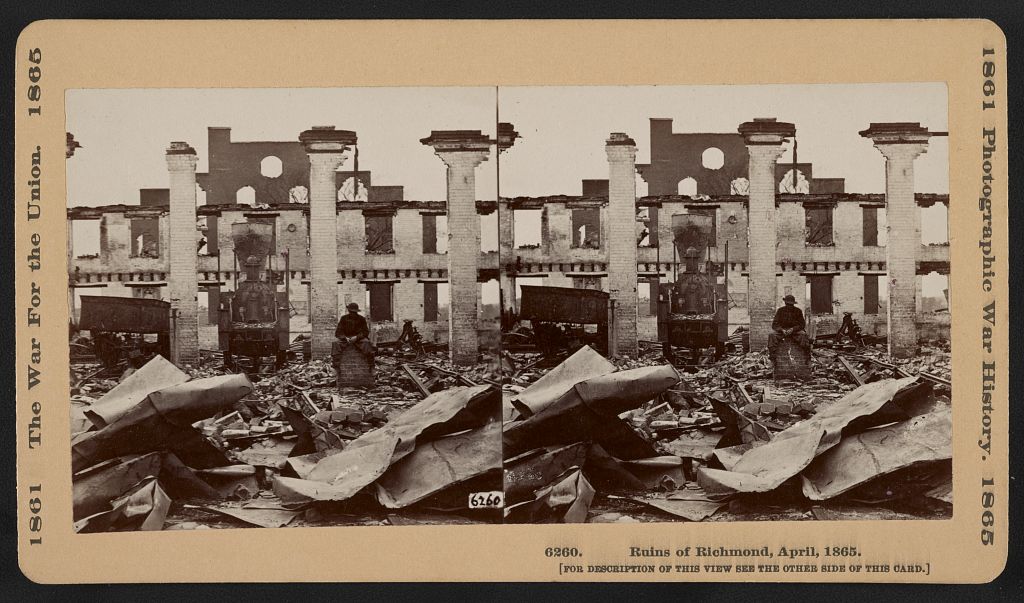
It is historically misleading to say that Union troops burned Richmond as they entered, or that every fire had one simple cause. The major destructive fire began during Confederate withdrawal and spread through parts of the city. Contemporary photographs preserve evidence of ruined buildings, but do not by themselves tell the entire story of how individual fires started.
What was damaged in Richmond?
Fires affected warehouses, commercial buildings and railroad-related facilities in sections of Richmond. Bridges and transport infrastructure were also damaged during Confederate withdrawal. Historic photographs taken afterward show damaged locomotives, brick shells and streets filled with rubble, illustrating the destruction suffered by parts of the capital.
The entire city was not burned to the ground, and many residential neighborhoods and important buildings survived. Generalizations that Richmond had become nothing but ashes obscure both the extent and the limits of damage. Reconstruction of transport and commerce would nonetheless require considerable labor and resources as the war ended.
Who entered Richmond on April 3?
Union troops under Major General Godfrey Weitzel entered Richmond on the morning of April 3. The arrival marked the end of Confederate control of the city. Federal soldiers worked to establish order, safeguard remaining stores and respond to fires and other immediate problems left by the evacuation.
The occupation was not merely a parade through deserted streets. Residents remained in the city, while enslaved people faced the transformation of their legal position and former Confederate supporters faced an uncertain future. Union authorities had to govern a major population center amid damage, shortages and political upheaval.
How did formerly enslaved people experience the fall?
For enslaved people in Richmond, the collapse of Confederate authority created immediate possibilities for freedom and changes in everyday life. Many welcomed Union forces and understood that the end of the slaveholding government could alter their families’ prospects profoundly.
Freedom did not instantly deliver equal wages, land, political rights or protection against violence. The transition required difficult decisions about work, mobility, family reunification and security. Their experiences belong at the center of Richmond’s fall, because slavery had been fundamental to the Confederacy and its military defeat carried consequences far beyond symbolic flags.
When did Abraham Lincoln visit Richmond?
President Abraham Lincoln visited Richmond on April 4, 1865, the day after Union soldiers entered. His appearance in the former Confederate capital became one of the war’s most memorable scenes. He encountered residents and newly freed Black Americans in a city undergoing rapid change.
The visit took place while Lee’s army remained in the field, so Lincoln was not attending a formal peace celebration after all fighting had ended. It offered a striking image of federal authority returning to a place that had symbolized the rebellion. The president would be assassinated ten days later.
What did Lincoln’s visit mean politically?
Lincoln’s presence demonstrated that the United States had regained control of the Confederate capital. It also carried profound meaning for people who had been enslaved and who now saw the leader associated with emancipation walking through their city. Later accounts remembered emotional celebrations and symbolic gestures.
Some details of individual encounters were recorded or embellished in later retellings, so historians should compare accounts carefully. The political significance is not dependent on every anecdote being exact. Lincoln’s visit embodied military victory and the difficult task of transforming a former slaveholding capital into part of a reunited nation.
Did Richmond’s fall end the war?
No. Lee’s army was moving west in the hope of finding supplies and a route to join other Confederate forces. Union armies pursued him, and additional battles occurred during the retreat. Lee surrendered the Army of Northern Virginia at Appomattox Court House on April 9, six days after Richmond’s occupation.
Other Confederate armies surrendered later in April and May. The fall of the capital was a decisive blow and a major sign of Confederate collapse, but the process of disbanding forces and restoring civil government took longer. A reliable timeline separates the occupation of cities, military surrender and the legal and political aftermath.
What happened to the Confederate government afterward?
Davis and other officials attempted to relocate and continue their government as federal armies advanced. They moved through parts of the South, but the loss of Richmond and the decline of Confederate military power made effective governance increasingly impossible. The administration could not restore the transportation and communications network it needed.
The collapse was gradual rather than a single ceremony in Richmond. Davis’s party continued traveling after Lee’s surrender until federal authorities captured him in Georgia in May. Confederate institutions stopped functioning as a coherent national government even while some officials hoped to resist longer.
What do historical photographs show?
Period photographs of Richmond’s ruins document the physical consequences of the evacuation fires and damaged infrastructure. They provide direct visual evidence of buildings and rail facilities in the weeks after Union occupation. The featured image records railroad damage, not a live scene of the fires burning.
Photographs also have limits. They show specific places selected by the camera operator, not the condition of every neighborhood. A citywide conclusion should be checked against maps, written reports and other contemporary evidence. Labelling a photograph accurately protects readers from confusing Richmond’s 1865 damage with scenes from unrelated battles or later disasters.
How did Richmond’s fall lead into Reconstruction?
The occupation raised immediate questions about political authority, labor and the future of the formerly enslaved population. Federal officials and soldiers now governed a city whose institutions had been shaped by Confederate policy and slavery. Rebuilding transport and restoring economic activity were necessary but far from sufficient.
Reconstruction would involve constitutional amendments, struggles over citizenship and voting, and conflict between different visions of Southern society. The surrender of armies did not answer those questions. Our Reconstruction guide follows the political developments that emerged after the war.
Why is the fall of Richmond important today?
Richmond’s fall demonstrates the connection between military supply systems and political power. A capital could survive years of attack while its army maintained the surrounding defenses, yet collapse quickly when those military and logistical foundations failed. The city became the stage for a dramatic change from Confederate government to Union occupation.
The event also reminds historians to distinguish symbols from lived experiences. Soldiers captured an important capital, but residents faced fire, disruption, emancipation and uncertain futures. The transition was both a decisive Union success and the beginning of a prolonged struggle over what the postwar United States would become.
Fall of Richmond 1865 timeline
These dates distinguish the main stages of the operation from the consequences that came afterward.
| Date | Event |
|---|---|
| April 1, 1865 | Five Forks victory threatens Lee’s South Side Railroad route. |
| April 2, daytime | Union assault breaks key portions of the Petersburg defenses. |
| April 2, evening | Confederate leaders evacuate Petersburg and Richmond. |
| April 2–3, night | Military-related fires spread in Richmond. |
| April 3, morning | Union troops occupy Richmond and Petersburg. |
| April 4 | Abraham Lincoln visits Richmond. |
| April 9 | Lee surrenders at Appomattox. |
| April 14–15 | Lincoln is assassinated and dies. |
Frequently asked questions
When did it happen? April 2–4, 1865.
Where did it happen? Richmond, Virginia.
Who were the main figures? Lincoln, Lee, Weitzel.
What was the outcome? Union occupation of Richmond. The sections above explain the result in context.
How does it fit into the war? Our Civil War overview provides the wider timeline.
Historical sources and further reading
This guide uses National Park Service research and period images; factual claims and interpretations are distinguished from later artistic impressions.