Chinese Exclusion Act of 1882: Causes, Rules, Effects and Repeal
How the United States restricted Chinese immigration, why the policy expanded and what repeal changed.
The Chinese Exclusion Act was signed into law on May 6, 1882, by President Chester A. Arthur. It suspended the immigration of Chinese laborers for ten years and prohibited Chinese immigrants from naturalizing. Later laws extended and tightened the restrictions. Congress repealed the exclusion acts in 1943, though a small immigration quota remained.
This guide distinguishes the original 1882 rules from later amendments, explains their effects on families and documents their legal legacy.
On this page — 25 topics
What was the Chinese Exclusion Act of 1882?
The Chinese Exclusion Act was a federal law signed by President Chester A. Arthur on May 6, 1882. It suspended immigration of Chinese laborers for ten years and barred Chinese immigrants from becoming naturalized United States citizens. The law singled out a national and ethnic group for restrictions at a time when Chinese immigrants had already helped build railroads, work mines and develop communities across the American West. It was a major turning point in United States immigration policy because exclusion became a national legal system backed by documentary inspections, federal officers and increasingly restrictive rules. The law’s original ten-year term did not mean the policy ended in 1892.
Why did Congress pass the law?
The law grew from anti-Chinese movements, especially in California and other western states. White workers and political organizers blamed Chinese immigrants for low wages, scarce employment and changes in local communities. Economic instability after the Panic of 1873 intensified these arguments, but economic hardship alone does not explain the policy. Organized racial prejudice, violent campaigns, discriminatory local ordinances and electoral pressure played crucial roles. Chinese workers became scapegoats for problems with wider causes. Legislators presented exclusion as protecting labor and public order while overlooking the contributions and rights of people already living in the United States.
What did the original 1882 law prohibit?
The statute suspended the arrival of Chinese laborers for ten years, covering skilled and unskilled workers and those employed in mining. It also prohibited Chinese immigrants from naturalizing as United States citizens. Its restrictions were more specific than a universal ban on every person born in China. Certain exempt classes, including merchants, students, teachers, travelers and diplomatic personnel, could seek admission if they met demanding certification requirements. In practice, determining eligibility could be extremely difficult, and federal officials often subjected people to detailed scrutiny. The National Archives’ transcription provides the statutory wording needed to distinguish legal categories from popular shorthand.
Was every Chinese immigrant banned?
No. The original act primarily targeted laborers and created narrow pathways for certain nonlaborers. But those exemptions should not be mistaken for equal access. A merchant or student had to demonstrate a qualifying status through documents and immigration procedures that could be restrictive, inconsistent and burdensome. Rules changed in later legislation, making travel especially risky for Chinese residents who wanted to visit family abroad and return. Some Chinese immigrants were already legally living in the United States when the law passed. It is therefore important to distinguish attempted entry, rights of existing residents, eligibility for naturalization and the increasingly elaborate enforcement system built over subsequent decades.
Why were Chinese laborers singled out?
Chinese immigrants had become highly visible in western mining towns, agriculture, domestic service, manufacturing and railroad construction. Their work was important to the region’s growth, including the building of the Central Pacific Railroad. Yet racial stereotypes portrayed them as unassimilable, threatening or permanently foreign. Employers’ use of low-paid workers and the insecurity of other laborers generated real disputes, but restrictive policy did not address underlying inequalities in bargaining power or employment conditions. Instead, it used ancestry to determine who could enter the country. The law demonstrates how an economic argument can be translated into legislation that allocates rights unequally by group membership.
How did railroad construction relate to exclusion?
Thousands of Chinese workers helped construct the Central Pacific portion of the first transcontinental railroad, completed in 1869. Their contributions included grading, tunneling, laying track and performing dangerous work across the Sierra Nevada. Railroad completion did not protect Chinese communities against later discrimination. After construction, workers sought opportunities in towns, mines, farming and service occupations. Anti-Chinese campaigns increasingly depicted these communities as competitors rather than recognizing their contribution to regional infrastructure. The railroad’s history and the 1882 law thus show two different aspects of nineteenth-century expansion: reliance on migrant labor to transform the economy and political efforts to restrict the same population’s future movement and rights.
What was the Burlingame Treaty?
The United States and Qing China concluded the Burlingame Treaty in 1868, which recognized the benefits of migration and affirmed certain principles of mutual movement and residence. It did not create modern immigration rights, but it reflected an earlier diplomatic attitude more favorable to mobility. By the late 1870s, domestic pressure for restriction had increased substantially. American policymakers sought to change treaty arrangements so they could limit immigration while avoiding a complete diplomatic rupture. This history matters because the Chinese Exclusion Act did not emerge in a vacuum: it represented a shift from a bilateral framework acknowledging migration toward a federal policy of racial restriction, and that shift affected relations between the two countries.
What changed with the Angell Treaty of 1880?
The Angell Treaty revised the earlier United States–China agreement. It allowed the United States to regulate, limit or suspend the coming of Chinese laborers under specified circumstances, rather than preserving the broader openness associated with 1868. The 1882 statute then used the new diplomatic arrangement to impose a ten-year laborer suspension. The legal sequence helps explain why the act’s formal title referred to treaty stipulations concerning the Chinese. It also shows that international agreements and domestic legislation interacted: congressional restrictions were defended partly through changes negotiated with China. However, treating the treaty as a justification for racial discrimination would confuse the government’s legal argument with the moral consequences of its policy.
Who signed the Chinese Exclusion Act?
President Chester A. Arthur signed the act on May 6, 1882. Congress had been debating severe restrictions, and an earlier proposal for a twenty-year suspension faced presidential opposition. The final ten-year measure was enacted under intense political pressure. It would be misleading to suggest Arthur alone invented the policy or that its enactment reflected unanimous national opinion. Anti-Chinese activists, state politicians, labor organizers and members of Congress had campaigned for restrictions over many years. Other Americans opposed exclusion, sometimes invoking treaty commitments, commercial relations or constitutional principle. The resulting law nevertheless institutionalized a deeply discriminatory approach to immigration at federal level.
How did Chinese residents prove their status?
Exclusion increased the importance of certificates, travel records, witness testimony and detailed identification. Chinese people who were allowed to travel had to demonstrate that they belonged to an exempt category or satisfied requirements applicable to returning residents. Federal officials could challenge documents, investigate employment and question family relationships. These procedures generated enormous archival collections, including photographs, correspondence and case files. For modern family historians, the records can be unusually informative precisely because enforcement was so intrusive. A file’s detailed description of a person should therefore be read as evidence produced within a discriminatory bureaucracy, not as neutral proof that all applicants were attempting fraud.
What was the Scott Act of 1888?
The Scott Act of 1888 made the exclusion system more restrictive by preventing many Chinese laborers who had left the United States from returning, including people who had previously obtained certificates authorizing reentry. Its retroactive effects disrupted family plans and travel. Thousands of people were affected by legal expectations that changed while they were abroad. The law became the subject of constitutional challenge, notably in Chae Chan Ping v. United States (1889), often called the Chinese Exclusion Case. The Supreme Court upheld the federal government’s broad authority to exclude noncitizens, a decision with long-lasting importance for the development of American immigration law.
What did the Geary Act of 1892 do?
Congress extended exclusion through the Geary Act in 1892, adding stringent registration and documentation requirements for Chinese residents. People could face deportation for failing to possess a required certificate of residence, with limited exceptions and contested rules of proof. Chinese communities organized resistance and challenged the law in court. The legislation demonstrated that exclusion was evolving beyond restricting new arrivals into a system that placed people already living in the United States under continuing surveillance. A ten-year suspension initially described as temporary had thus become the foundation for a more intrusive regulatory structure. The restrictions continued to be extended and eventually made indefinite.
How long did Chinese exclusion last?
The original ten-year suspension began in 1882, but the central exclusion system persisted for more than sixty years. Congress renewed and strengthened restrictions in 1892 and the early twentieth century, with the policy becoming effectively indefinite. The laws were repealed in 1943 through the Magnuson Act, during World War II. Repeal did not produce unrestricted Chinese immigration: a very small quota and other limits remained. The State Department’s history explains the wartime diplomatic circumstances, including the need to strengthen relations with China, then an American ally against Japan. Later immigration reforms altered the system further.
How did the law affect families?
Restrictions separated families by making it difficult or impossible for laborers to bring spouses and children into the country. Men who had migrated for work could spend many years without seeing relatives overseas. People who left to visit families risked being denied reentry, especially as the rules changed. The unequal gender composition of early migration patterns and the difficulty of family reunification shaped Chinese American communities for generations. These effects are not adequately captured by a chart of annual arrivals. Family letters, immigration files and oral histories show how decisions made in Washington affected marriages, childhoods, household income and the continuity of community institutions.
What happened to Chinese American businesses?
Chinese American merchants operated shops, restaurants, laundries and other businesses serving their own neighborhoods and wider communities. Some were exempt from the laborer ban, but proving merchant status could become a difficult legal and administrative issue. Anti-Chinese violence and discriminatory local rules also threatened businesses independently of federal immigration law. Chinatown districts provided economic opportunities, social networks and support organizations, yet they were sometimes portrayed through hostile stereotypes. The act contributed to restrictions on mobility and family connections that affected business continuity. A balanced history recognizes the economic resilience of Chinese American communities while documenting the structural disadvantages imposed on them.
How did exclusion affect San Francisco?
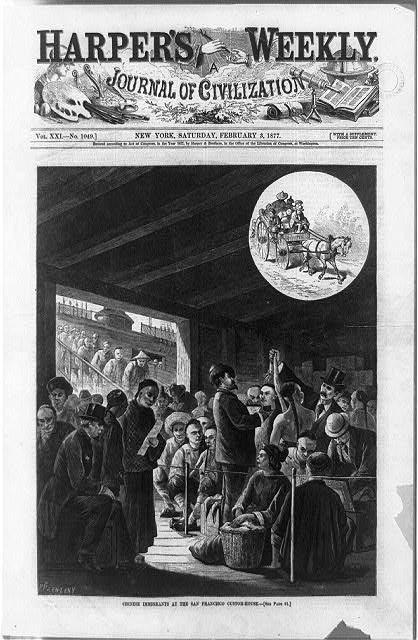
San Francisco was a central port of entry for Chinese migration and a major location for enforcement. Immigrants and returning residents encountered customs officers, later immigration inspectors, document checks and legal challenges. The 1877 illustration included with this article depicts inspection at the custom-house before the exclusion statute was enacted; it helps show the earlier arrival experience but should not be mislabeled as a photograph of 1882 enforcement. San Francisco’s Chinatown became a hub of community organization and political resistance. The city’s history illustrates both the growth of Chinese American life and the federal, state and local policies that sought to constrain it.
Was Angel Island involved in the original 1882 law?
The immigration station at Angel Island in San Francisco Bay did not open until 1910, nearly three decades after the original exclusion act. It became closely associated with enforcement of Chinese exclusion and other immigration restrictions in the twentieth century. Officials detained and questioned migrants, sometimes for lengthy periods, scrutinizing family relationships and claimed exempt status. Poems carved into barracks walls convey the emotional experience of confinement. The National Park Service explains the station’s operation. Its history belongs in a long-term account of exclusion but should not be inserted into a chronology of events occurring in 1882 itself.
Did Chinese immigrants challenge the laws?
Yes. Chinese residents, merchants, family associations and lawyers repeatedly challenged exclusion measures through petitions, diplomatic appeals and the courts. Litigation addressed questions such as the rights of returning residents, the authority of Congress and the citizenship of people born in the United States. An especially important later decision was United States v. Wong Kim Ark in 1898, affirming birthright citizenship for a man born in San Francisco to Chinese parents who were subjects of China and domiciled in the United States. These challenges show that immigrant communities were legal and political actors, not merely passive subjects of restrictive law.
How was birthright citizenship different from naturalization?
The Chinese Exclusion Act restricted naturalization for Chinese immigrants, but that did not automatically remove the constitutional citizenship of every person of Chinese ancestry. The Fourteenth Amendment’s citizenship clause and the 1898 Wong Kim Ark ruling protected birthright citizenship under the circumstances addressed by the Court. This distinction is important because nationality, place of birth, immigration status and ability to naturalize are different legal questions. A Chinese immigrant barred from naturalization and a child born in the United States could therefore have different citizenship positions. Our Fourteenth Amendment guide explains the amendment’s constitutional origins after the Civil War.
Why was the law repealed in 1943?
By World War II, China was an important ally of the United States against Japan. The continued existence of a racially discriminatory exclusion law undermined American diplomatic claims and became a propaganda opportunity for Japan. Congress repealed the exclusion acts in December 1943 through legislation often called the Magnuson Act. The measure also permitted Chinese immigrants to become naturalized citizens, although an extremely small quota continued to limit new immigration. The repeal was significant but incomplete. It did not erase discrimination experienced by earlier generations, and major changes to the wider immigration quota system would not occur until subsequent federal reforms.
Why does the Chinese Exclusion Act matter today?
The 1882 act established a durable precedent for federal immigration restriction based explicitly on national and ethnic origin. Its enforcement produced identity documents, detention procedures, court cases and a specialized immigration bureaucracy. The law shaped Chinese American family histories and influenced later restrictions affecting other Asian groups. It also raises enduring historical questions about who belongs to the national community and whether labor-market fears justify denying rights to an entire population. Studying the actual text, amendments and case files is more informative than repeating the simplified claim that all Chinese people were excluded in 1882 and everything changed immediately in 1943.
Chinese Exclusion Act timeline
| Year | Development |
|---|---|
| 1868 | Burlingame Treaty acknowledges migration between the United States and China. |
| 1880 | Angell Treaty allows limits on Chinese labor immigration. |
| May 6, 1882 | President Chester A. Arthur signs the Chinese Exclusion Act. |
| 1888 | Scott Act blocks return of many Chinese laborers who left the country. |
| 1892 | Geary Act renews exclusion and adds residence documentation requirements. |
| 1898 | Wong Kim Ark decision affirms birthright citizenship in the case before the Court. |
| 1902–1904 | Exclusion restrictions are extended without a fixed ten-year endpoint. |
| December 1943 | Magnuson Act repeals the Chinese exclusion laws but retains a small quota. |
Frequently asked questions
Who signed the act? Chester A. Arthur on May 6, 1882.
Was immigration from China totally prohibited? The original law barred Chinese laborers; limited nonlaborer categories remained eligible under restrictive conditions.
Why was the law enacted? Organized anti-Chinese prejudice, labor-market anxieties and political pressure in the American West.
When did exclusion end? The federal exclusion acts were repealed in 1943, but immigration quotas remained.
Was Angel Island already operating in 1882? No. Its immigration station opened in 1910.
Historical sources and further reading
The primary statute, federal records and historical interpretation listed below provide the basis for this chronology. In particular, later amendments should not be confused with provisions of the original 1882 act.
- National Archives — Chinese Exclusion Act, 1882
- Library of Congress — Chinese Exclusion Act primary documents
- National Archives — Asian and Pacific immigration records
- National Archives — Chinese immigration research guide
- National Park Service — Angel Island Immigration Station
- Office of the Historian — Repeal, 1943
- Library of Congress — Chinese immigrants at the custom-house, 1877