Rural Electrification Administration (1935): How Electricity Reached American Farms
Why most rural homes lacked electric service in the early 1930s, how Roosevelt’s REA financed cooperatives and what changed under the Rural Electrification Act of 1936.
Quick answer
President Franklin D. Roosevelt established the Rural Electrification Administration (REA) by Executive Order 7037 on May 11, 1935. The agency initially used emergency relief authority to finance electric service in areas where private utilities had often been unwilling to build expensive distribution lines. The Rural Electrification Act of May 20, 1936 supplied a longer-lasting statutory basis for lending. Farmer-owned electric cooperatives became major borrowers, extending service to many rural households. The program offered financing, not free electricity to every farm, and rural access grew over subsequent decades.
Key facts
On this page
- Why rural America lacked electricity in the 1930s
- Private utilities and the cost of long distribution lines
- The Tennessee Valley Authority was not the same agency
- Executive Order 7037 on May 11, 1935
- Morris L. Cooke and the first project approvals
- How farmer-owned electric cooperatives worked
- The Rural Electrification Act of May 20, 1936
- Why long-term loans mattered more than one-time grants
- How electric power changed everyday farm work
- Rural communities, schools and small businesses
- Who benefited first, and who remained outside the network?
- The long legacy of rural electrification
- Timeline
- Frequently asked questions
- Sources
Why rural America lacked electricity in the 1930s
By the 1930s electricity had become familiar in many American cities, but rural households often remained without dependable service. Power companies generally earned revenue by supplying many customers along relatively short lines, making densely settled neighborhoods attractive places to invest. Farms were more widely separated, so serving a few households could require miles of poles, wires and maintenance. A private utility that needed to recover those costs from a small number of customers might set high prices or decline to extend its network.
The result was a substantial divide between urban and rural daily life. Electric lighting, refrigeration, powered pumps and household appliances were increasingly available in towns while many farmers relied on kerosene lamps, hand pumps and labor-intensive methods. Not every rural family lived the same way: some had private generating systems or obtained electricity from nearby utilities. But the pattern was strong enough to become a national issue as policymakers considered how modern infrastructure should be shared.
Private utilities and the cost of long distribution lines
The economics of rural electrification were difficult because electricity had to be transmitted and distributed before customers could use it. Power plants might generate enough electricity to supply more households, yet building the local network could remain expensive. The costs of poles, conductors, transformers and maintenance were spread across comparatively few customers. Utilities sometimes argued that rural demand would not justify the necessary investment without high connection fees or rates.
Farm families and reformers disagreed with the assumption that countryside service was inherently too costly to pursue. They believed that long-term financing, cooperative ownership and wider adoption of electric machinery could make systems sustainable over time. Many also considered electricity an essential improvement in living standards rather than a luxury product that should be limited to the most profitable locations. Those arguments became the foundation for the REA’s loan-based approach.
The Tennessee Valley Authority was not the same agency
The Tennessee Valley Authority, created in 1933, had already pursued power generation, transmission and regional development in the Tennessee River basin. It demonstrated the potential role of federal investment and public power, but its geographic focus was limited. A national program faced a different task: connecting scattered rural customers across many states, often far from TVA dams or infrastructure.
The Rural Electrification Administration was designed to address that wider distribution problem. It did not replace the TVA or directly take control of every power station in the country. Instead, it supported eligible local and regional borrowers in developing electric service. Some projects worked with publicly generated power, and others purchased wholesale electricity from existing companies. Distinguishing generation from local distribution helps explain how the two New Deal initiatives were related without being identical.
Executive Order 7037 on May 11, 1935
Roosevelt created the Rural Electrification Administration through Executive Order 7037 dated May 11, 1935. The order relied on authority associated with emergency relief appropriations and designated an administrator to develop the program. Morris L. Cooke, an engineer and advocate of public utility reform, became the first administrator. His previous work had explored how long-term credit could make rural power projects practical.
The founding order did not mean that crews immediately connected every farm to electricity. The new organization had to recruit experts, review applications, design financing terms and evaluate construction projects. Loan approvals depended on local organization and the capacity to build and operate a system. The administrative phase matters because an executive order creates authority but not miles of wire by itself. The first visible achievements resulted from negotiations and construction carried out after the agency was established.
Morris L. Cooke and the first project approvals
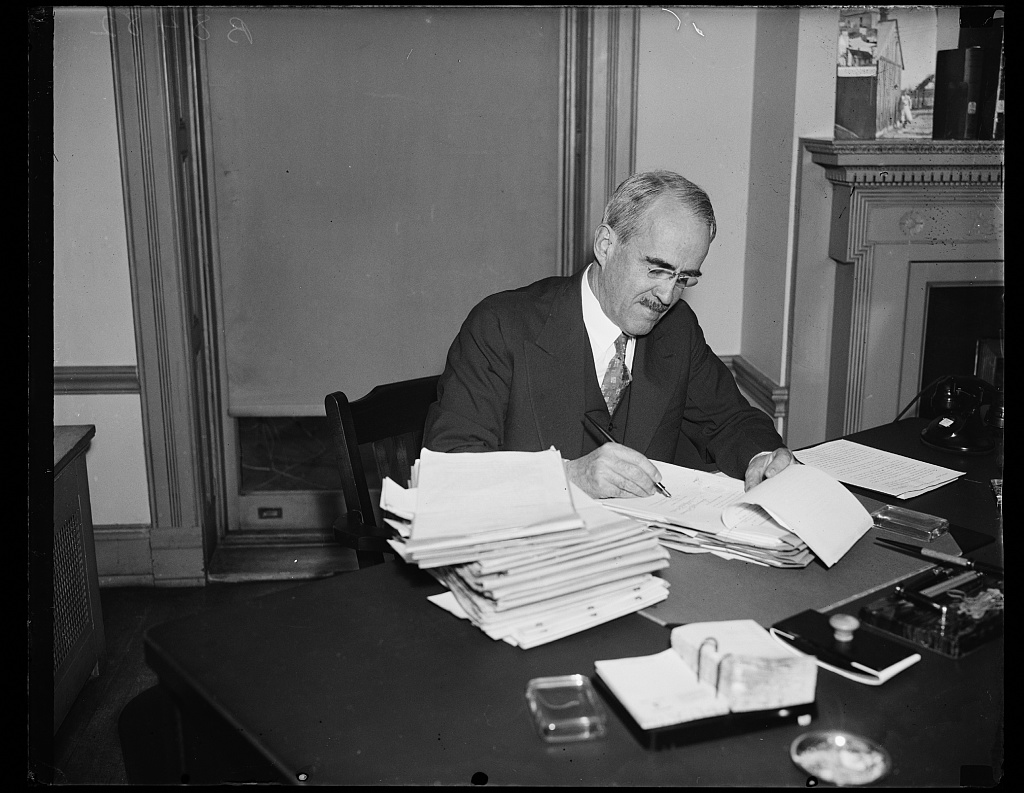
Cooke promoted practical engineering and public financing as ways to overcome the economics of rural distribution. Under his leadership the REA evaluated proposed lines in multiple states. On November 4, 1935, the agency announced approval of seven projects, described in a Library of Congress photograph showing Cooke and staff. The accompanying image records an actual stage of the program’s launch; its date is not a generic label attached to a modern utility photograph.
The catalog describes plans to bring power to thousands of rural homes through significant line construction, although contemporary captions vary in their projections. Such figures are promises or approvals, not completed connections on the day the photograph was taken. Reviewing the image alongside loan records allows readers to distinguish announcement, financing, construction and eventual service. That sequence is valuable for understanding how a federal infrastructure program becomes tangible in local communities.
How farmer-owned electric cooperatives worked
An electric cooperative is an organization owned by the customers or members it serves, rather than an ordinary investor-owned utility. Farmers and rural residents could organize, seek federal financing and create a system intended primarily to supply their own communities. The cooperative could borrow for construction, purchase electricity from a generating supplier, maintain distribution lines and collect charges from members to cover operating expenses and repay loans.
Cooperative ownership addressed a financial challenge: residents who expected to benefit from service could collectively support infrastructure that an outside investor might view as insufficiently profitable. But ownership did not remove costs or guarantee effortless success. Cooperatives needed leadership, technical expertise, maintenance and reliable billing. Local histories often show years of organizing before poles were erected, especially where initial membership or route design was difficult. The agency’s role was to improve access to credit, not to perform every local task itself.
The Rural Electrification Act of May 20, 1936
Congress passed the Rural Electrification Act on May 20, 1936, giving the program a clearer statutory basis beyond the original emergency order. The act authorized federal lending for the development of rural electric service and continued the national effort to reach underserved communities. USDA historical materials and the U.S. Code preserve the statute’s date and basic framework. It was a separate legal step from the agency’s creation the previous year.
This distinction helps prevent a frequent chronological error: saying the REA was first created by the Rural Electrification Act in 1936 or that Congress passed the 1936 act in May 1935. The order came first, followed by legislation the next year. Both milestones were essential. The first allowed an immediate program to begin; the second established more durable authority for a lending system that could support long construction schedules and repayment arrangements.
Why long-term loans mattered more than one-time grants
Connecting a farm might require substantial up-front investment that would be recovered gradually through electricity charges. Long-term financing allowed construction expenses to be spread across many years, reducing the immediate burden on rural borrowers. Federal loans helped make projects possible where commercial banks and utilities were unwilling to provide credit on acceptable terms. The government expected qualifying borrowers to repay loans with interest under program rules.
The model therefore differed from direct cash gifts to every household. Families still paid for electricity, internal wiring and appliances according to their circumstances, and cooperatives had financial obligations. A local project could face serious challenges if too few members connected or customers used little electricity. Policymakers hoped rising demand would support the business model, but the outcome depended on engineering quality, management and household income as well as the existence of a federal loan.
How electric power changed everyday farm work
Electric service allowed households to use lighting, refrigeration, washing machines, pumps and other equipment that could reduce manual labor and improve comfort. On farms, powered tools and motors offered opportunities for more efficient dairying, grain handling and water supply. The effects could be substantial because electricity changed not just one household task but the daily organization of work, food storage and communication.
Those improvements required additional purchases and adaptation. A family with a connection but little money for wiring or appliances might initially use only a few lights. Agricultural production also differed across regions, so equipment valuable to a dairy operation might not matter as much to a cotton farm. Household members experienced changes differently; women often performed domestic labor that electrification could alter significantly. The historical story is therefore about both wires and the economic ability to use what they carried.
Rural communities, schools and small businesses
The benefits extended beyond individual farmhouses. Electric service could assist rural schools, community buildings, stores and small enterprises. Reliable lighting made evening activities easier, while electric refrigeration and powered machinery created new business possibilities. Better communications and radio access could also reduce the isolation of some households. These changes unfolded gradually as lines reached more communities and local people learned to use the new infrastructure.
Electricity did not automatically solve rural poverty, land inequality or limited access to education. Families still depended on employment, farm prices, transport and local institutions. But electric service removed an important obstacle to everyday modernization in many places. The REA’s significance lies partly in demonstrating that a national financing policy and local organizations could overcome infrastructure gaps that a purely commercial approach had left unresolved.
Who benefited first, and who remained outside the network?
Not every rural household obtained service at the same time. Communities with strong cooperatives, favorable geography or borrowers able to meet program requirements could advance sooner. Remote areas, lower-income families, tenants and some communities facing discriminatory treatment could remain unserved or wait longer. Even when a cooperative planned a line, the ability to pay connection and wiring costs influenced whether individual homes joined.
Historical accounts sometimes summarize rural electrification using a dramatic national percentage increase. Those figures are useful, but dates and denominators matter: farms, rural households and all countryside dwellings are not identical populations. The National Archives holds maps and reports documenting where projects were built. They reveal a geographically uneven process that continued after the first New Deal legislation and beyond the Second World War.
The long legacy of rural electrification
Over subsequent decades cooperatives and other electricity providers expanded service across much of rural America. The original REA later developed within the Department of Agriculture’s rural utility framework, and federal rural infrastructure financing evolved as new needs arose. The Rural Electrification Act remained an important part of that institutional history even though technology, energy markets and government organization changed.
The agency’s history offers a case study in public loans and local ownership. It did not invent electricity or provide free power to every farm in 1935. Instead, it created and supported financial arrangements that allowed communities to build systems where the cost of serving dispersed customers had previously been a major barrier. Read alongside the TVA, the program illustrates how New Deal infrastructure policies could tackle different parts of the problem of bringing electric power to American homes.
Timeline
- 1920s: Electric service spreads in cities; much rural coverage remains limited
- 1933: Tennessee Valley Authority established
- May 11, 1935: Executive Order 7037 creates REA
- November 4, 1935: Morris Cooke approves seven projects
- May 20, 1936: Rural Electrification Act signed
- Late 1930s: Cooperatives expand distribution networks
- Post-1945: Rural service continues to grow
Frequently asked questions
When was the Rural Electrification Administration founded?
May 11, 1935, by President Franklin D. Roosevelt’s Executive Order 7037.
Was the Rural Electrification Act passed in 1935?
No. The agency began in 1935, and Congress passed the Rural Electrification Act on May 20, 1936.
Who led the original REA?
Morris L. Cooke was the first administrator.
Why did rural homes lack electricity?
Widely dispersed households made distribution lines expensive, and many private utilities were reluctant to build them.
What did an electric cooperative do?
It allowed rural members to own a distribution system, borrow for construction and pay for ongoing service.
Did the program provide free electricity?
No. It provided financing and support for eligible systems; customers still paid for service and other costs.
Was REA the same as the TVA?
No. The TVA was a regional power and development corporation created in 1933; the REA was a national rural electric lending program.