United States v. Cruikshank (1876): Colfax Massacre and Civil Rights
The 1873 Colfax Massacre and the 1876 Supreme Court limits on federal prosecution of private political violence.
United States v. Cruikshank (1876) arose from federal prosecutions after the Colfax Massacre in Louisiana, in which large numbers of Black citizens were killed. The Supreme Court held the federal indictments insufficient under its interpretation of constitutional rights, significantly limiting prosecutions of certain private civil-rights conspiracies.
Understand what happened at Colfax, what federal law attempted to protect and what the Court actually decided.
On this page — 21 topics
What was United States v. Cruikshank?
United States v. Cruikshank was a Supreme Court decision issued in 1876 concerning federal prosecutions that followed the Colfax Massacre in Louisiana. White armed groups had attacked a gathering of Black citizens during a dispute over local political authority in April 1873. Federal authorities brought charges under Reconstruction enforcement legislation, but the Supreme Court upheld the overturning of convictions because the indictments failed to state federal offenses in the form required by the Court’s constitutional interpretation. The ruling placed substantial limits on federal power to prosecute private conspiracies under the cited provisions. Its significance lies both in the narrow legal reasoning and in its practical effect on protecting Black political participation against organized racial violence after the Civil War.
What happened at Colfax in April 1873?
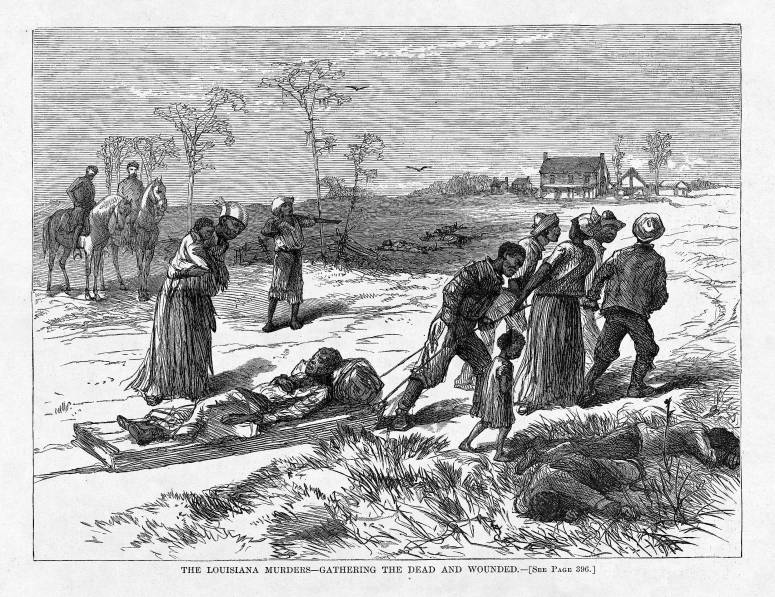
On Easter Sunday, April 13, 1873, a white armed force attacked Black men defending the courthouse in Colfax, Grant Parish, Louisiana. The violence grew from disputed local elections and competing political claims during Reconstruction. Many Black defenders were killed, including men who had surrendered or were no longer fighting. Historical estimates vary, but the massacre resulted in a large death toll, often described as more than one hundred Black victims. The event is remembered as a major act of racial terror intended to displace Republican authority and discourage Black political participation. The illustration accompanying this article is a contemporary engraving of the aftermath, not a photograph, and its details reflect the artist’s reconstruction of reported events.
Why was the Colfax courthouse contested?
Louisiana experienced disputed elections and competing state government claims in the early 1870s. In Grant Parish, supporters of rival political factions claimed authority over local offices and the courthouse. Black Republican residents organized to protect officials and the political rights secured under Reconstruction. White Democratic opponents and armed groups resisted the authority of that government. The conflict was not an ordinary legal disagreement that remained inside a courtroom; it escalated into a military-style attack. Understanding the courthouse’s significance helps explain why the massacre targeted people associated with Black political power. Local institutions were the practical places where voting rights and government authority were exercised, making their control intensely contested.
Who were the Black defenders?
Black citizens, many of them Republican supporters, gathered to defend the courthouse and the authority of officials they regarded as legitimate. Some possessed weapons and organized resistance against threatened attacks. Their action reflected the danger faced by Black political communities during Reconstruction, when constitutional rights could be challenged through violence. The defenders did not all share identical backgrounds or military experience. Some had lived through slavery, while others were veterans or younger men whose public roles had changed after emancipation. Historians caution against portraying them only as passive victims; they organized to protect political participation and community institutions. The attack nevertheless resulted in overwhelming loss of life and grave violations of their safety.
Who attacked the courthouse?
The attacking force consisted of armed white men hostile to the Republican officials and Black defenders. It formed part of a broader pattern of organized white supremacist violence in Louisiana after the Civil War. Some participants later became involved in groups associated with the White League, which attacked Reconstruction governments elsewhere in the state. The force outnumbered or outgunned the courthouse defenders and used coordinated assaults. It is important not to use the name Ku Klux Klan for every participant without evidence, because different organizations and local networks operated during Reconstruction. The attackers’ political objective, however, was clear: displacing Black-supported authority and demonstrating that violence could overturn the results of contested political processes.
How many people died?
The exact number of people killed at Colfax remains debated because contemporary reports were incomplete, partisan and sometimes contradictory. Historians often estimate around one hundred to one hundred fifty Black victims, with much smaller white losses. The National Park Service’s Reconstruction theme study notes that perhaps 150 African Americans died. The figures should not be presented as an exact roll of identified dead. Some victims were killed in the main attack, while others were killed after surrender or capture. That distinction matters because the massacre involved violence against people who were not simply participating in an ongoing firefight. The uncertainty of the precise total does not undermine the well-established fact that the attack was a major atrocity.
What did federal prosecutors do afterward?
The Grant administration pursued federal charges against some men associated with the massacre using enforcement legislation adopted to protect constitutional rights. These prosecutions reflected the federal government’s attempt to respond when state institutions could not or would not protect Black citizens. Officials faced significant evidentiary and procedural challenges, including the need to identify individual participants and state the particular rights allegedly violated. The cases eventually raised constitutional questions about which rights the federal government could protect directly and how a criminal indictment had to describe the offense. Successful prosecutions were difficult under the circumstances, and the Supreme Court’s later ruling further limited the use of the legal provisions relied upon.
What were the Enforcement Acts?
Congress enacted enforcement legislation in 1870 and 1871 to address voter intimidation, conspiracies and organized violence threatening Reconstruction rights. The Ku Klux Klan Act of 1871 formed part of this sequence. The laws sought to translate constitutional protections into tools for prosecution and federal intervention. Their application raised difficult questions about conduct by private groups rather than state officials. In the Colfax prosecutions, the government attempted to punish a conspiracy connected to the destruction of Black political rights. Cruikshank became a major test of those powers. Understanding this legal background prevents the misconception that the Supreme Court was reviewing a simple local murder prosecution under ordinary Louisiana criminal law.
When did the Supreme Court decide Cruikshank?
The Supreme Court issued its ruling on March 27, 1876. The case is reported at 92 U.S. 542 and is sometimes referred to simply as Cruikshank. The timing was significant: national commitment to Reconstruction enforcement was weakening, and the presidential election later that year would deepen political uncertainty. The ruling concerned the constitutional and procedural sufficiency of federal charges following the 1873 violence. It did not adjudicate every factual question about who killed which victims. Distinguishing the dates is essential: the massacre occurred in 1873, the legal proceedings developed afterward, and the Supreme Court’s major decision came nearly three years later. These are separate events that belong to the same historical sequence.
What did the Court decide about private violence?
The Court emphasized that the Fourteenth Amendment restricts state action rather than directly regulating all misconduct by private individuals. It also treated certain constitutional rights as protections against federal interference, not as direct sources of federal authority to prosecute every private infringement. The opinion found that the charges did not adequately establish violations of federal rights enforceable through the laws invoked. This was not a finding that private violence was legally permissible under every state law. State criminal law could still prohibit assault and murder. The serious consequence was that federal criminal enforcement under the challenged theory became much more difficult, particularly where state authorities were unwilling to prosecute racial terror.
How did the Fourteenth Amendment enter the case?
The Fourteenth Amendment’s Equal Protection Clause prohibits states from denying equal protection of the laws. Federal prosecutors argued that the conspiracy at Colfax violated constitutional rights, but the Court insisted on a more specific connection to state action or protected federal interests. The opinion therefore limited an important mechanism for national intervention against private violence. This approach interacted with later decisions interpreting federal civil-rights statutes. It should not be summarized as “the Fourteenth Amendment was repealed,” because the constitutional text remained in force and later legal doctrines developed differently. The key historical issue was how narrowly the Court interpreted the federal government’s authority to apply those protections in a particular prosecution.
Did the ruling involve the First and Second Amendments?
Yes. The opinion addressed claims involving rights of assembly and the keeping and bearing of arms. The Court reasoned that these protections, as then understood, restricted certain federal actions but did not automatically give Congress power to punish all private interference. Later constitutional law developed different interpretations, especially concerning application of rights against states. Readers should not transfer modern doctrine directly into the 1876 case. The relevance here was that prosecutors needed to identify rights Congress could protect under the charged federal statutes. The Court’s treatment of the amendments narrowed the legal theories available in the Colfax prosecution and made the decision important beyond the immediately disputed facts.
What happened to the convictions?
The Supreme Court’s decision sustained the setting aside of the federal convictions under review. It concluded that the criminal charges were legally insufficient for the asserted federal offenses. This outcome was widely understood as a serious setback for the effort to prosecute perpetrators of the Colfax violence. It did not prove that the massacre had not occurred or that the defendants were morally innocent. A judicial ruling on the sufficiency of an indictment is different from a historical investigation into events. Nonetheless, the practical effect mattered enormously because victims and their families had little prospect of obtaining federal accountability through the case. The decision became part of a broader pattern of weakening protection against Reconstruction-era racial terror.
Why did the decision matter for Black voting rights?
Black voting and political officeholding had expanded after the Civil War through state constitutions and the Fifteenth Amendment. But organized violence could prevent people from exercising those rights even where their legal eligibility was clear. Cruikshank limited federal prosecution under particular enforcement theories, creating additional obstacles to challenging armed conspiracies against political communities. Where state officials supported or tolerated white supremacist violence, reliance on ordinary state criminal enforcement could be ineffective. The case therefore affected the practical value of political rights, not only the wording of constitutional law. The problem was especially acute in places where the same groups contesting elections had substantial influence over local policing and courts.
How did this differ from the Civil Rights Cases of 1883?
Both cases limited certain federal civil-rights protections, but they arose from different events and statutory claims. Cruikshank followed mass political violence in Louisiana and concerned federal criminal prosecutions. The Civil Rights Cases involved congressional regulation of racial exclusion by private businesses through the Civil Rights Act of 1875. Both decisions emphasized constitutional distinctions involving state action and federal authority. They should not be described as the same case or as deciding identical questions about voting and accommodations. Together they help explain why postwar federal promises did not automatically produce lasting protection against either organized violence or everyday discrimination.
Was the massacre connected to the White League?
The Colfax violence preceded the formal emergence of the White League as a prominent Louisiana organization in 1874. Some perpetrators and allied political networks later participated in or helped shape white supremacist groups that attacked Republican governments. It would therefore be imprecise to say that the White League as a fully established organization carried out the 1873 attack. The connection is instead one of individuals, ideology and developing networks of political violence. Groups using force to overturn Reconstruction power did not always operate under one stable name. Historical accuracy requires identifying the organizations active on a particular date while recognizing the continuity of their objectives and methods.
What do period illustrations reveal?
An illustrated newspaper engraving published after the Colfax Massacre depicts the recovery of dead and wounded people in Louisiana. Such images are valuable evidence of how violence was reported to a national readership, but they also reflect artists’ choices and editorial politics. They are not direct photographs of the moment of killing. The illustration on this page is identified as historical artwork and should be considered alongside survivor testimony, federal investigation records and scholarly research. The National Park Service’s Reconstruction historical study discusses the Colfax courthouse and its significance. Visual material can make the event tangible without replacing careful documentary analysis.
Why is United States v. Cruikshank still studied?
The decision illustrates how the meaning of constitutional rights depends partly on the institutions allowed to enforce them. Congress had attempted to protect freedpeople and Black voters against conspiracy and terror, but the Supreme Court’s approach limited the federal legal response to private violence. The case also reveals the human stakes of abstract legal categories: the underlying event was a massacre connected to political control, not a theoretical classroom dispute. Studying Cruikshank alongside the Enforcement Acts, Colfax history and subsequent civil-rights cases helps explain the rollback of Reconstruction protections. It remains an important example of the gap between rights formally recognized by constitutional amendments and the ability to obtain protection or accountability in practice.
Colfax and Cruikshank timeline
| Date | Event |
|---|---|
| 1870–1871 | Federal Enforcement Acts expand protections against political violence. |
| April 13, 1873 | Colfax Massacre in Grant Parish, Louisiana. |
| 1873–1875 | Federal prosecutions and legal appeals follow. |
| March 27, 1876 | Supreme Court decides United States v. Cruikshank. |
| Late 1870s | Federal enforcement and Reconstruction governments weaken. |