Spanish–American War (1898): Causes, Battles, Timeline and Treaty of Paris
Why the war began, how its battles unfolded and how peace changed Cuba, Puerto Rico and the Philippines.
The Spanish–American War was fought in 1898 after a crisis over Spanish rule in Cuba. U.S. victories at Manila Bay, Santiago and other locations helped force an August armistice. The December 10 Treaty of Paris transferred Puerto Rico, Guam and the Philippines to the United States while Spain relinquished its claim to Cuba.
This history separates Cuban and Filipino independence movements from U.S. military intervention and explains the political consequences of the peace.
On this page — 27 topics
What was the Spanish–American War?
The Spanish–American War was a short conflict fought in 1898 between the United States and Spain, with major operations in Cuba, Puerto Rico and the Philippines. It arose from a longer struggle for Cuban independence and growing American interventionist pressure. The United States defeated Spanish forces at sea and on land, and an armistice ended major hostilities in August. The December Treaty of Paris transferred Puerto Rico, Guam and the Philippines to U.S. sovereignty, while Spain relinquished its claim to Cuba. The result transformed international politics, expanding American overseas power but also creating new conflicts over imperial rule and the right of people in former Spanish territories to govern themselves.
Why was Cuba seeking independence from Spain?
Cuban people had pursued independence through repeated struggles during the nineteenth century. A new major uprising began in 1895, involving leaders and organizations seeking to end Spanish colonial rule. José Martí was among the most influential advocates of an independent Cuba and died early in the conflict. Spanish authorities responded with military campaigns and policies that displaced large numbers of civilians, causing severe suffering. American newspapers covered the humanitarian crisis and the impact on U.S. economic interests. It would be misleading to begin the story only when American troops arrived in 1898. Cubans were already engaged in their own fight for independence and had political goals distinct from those of Washington.
What was Spanish reconcentration policy?
Spanish General Valeriano Weyler introduced harsh measures requiring rural Cuban civilians to relocate to controlled towns and camps, intended to deny insurgents food and local support. The policy caused widespread hardship amid inadequate supplies, sanitation and medical resources. Reports of civilian suffering inflamed opinion in the United States and strengthened interventionist arguments. Casualty estimates are difficult and should not be reduced to a single unsourced number. The policy was one of several factors that weakened Spain’s international standing and fueled American calls for action. But attention to Cuban experiences is important: the victims were not merely a pretext used in American political speeches, and Cuban independence remained the central issue for many participants.
What caused public pressure for U.S. intervention?
Newspapers, politicians, business interests, humanitarian advocates and Cuban supporters in the United States disagreed about how to respond to the conflict. Some demanded armed intervention to halt suffering or end Spain’s rule, while others feared war, its costs and the consequences of occupying foreign territory. American investors and merchants had interests in Cuba, and the island’s proximity to Florida made events highly visible. Sensational journalism amplified public emotion, but it was not the only cause. Diplomacy, political commitments and military calculations also shaped the administration’s choices. Explaining the war solely as the result of inflammatory headlines ignores both Cuban agency and wider strategic factors.
What was yellow journalism?
Yellow journalism is a term associated with sensational newspaper reporting designed to attract readers through dramatic headlines, striking illustrations and sometimes exaggerated claims. Rival newspapers in New York helped turn the Cuban crisis into a prominent public issue. The term is often linked to William Randolph Hearst and Joseph Pulitzer, but the idea that one newspaper owner personally caused the war is a simplistic legend. Reporting could be misleading, yet other publications also documented genuine suffering under Spanish policies. Readers should distinguish the demonstrated role of influential newspapers in shaping opinion from invented quotations and unsupported claims that journalism alone forced President McKinley to declare war.
What happened to the USS Maine?
The American battleship USS Maine was sent to Havana during a period of heightened tension and exploded in the harbor on February 15, 1898, killing more than 260 American sailors and marines. The cause of the explosion was disputed then and has remained the subject of investigations and later reassessments. Many Americans blamed Spain without conclusive proof, and the incident intensified support for intervention. Modern histories should not confidently identify Spanish sabotage as a settled fact. The sinking became a powerful political symbol, but the war’s origins also lay in Cuba’s independence struggle, U.S. foreign policy and growing demands to confront Spanish colonial rule.
Who was President William McKinley?
William McKinley was president of the United States during the 1898 crisis. He initially pursued diplomatic efforts and considered the risks of military action, but he eventually asked Congress for authority to intervene in Cuba. Congressional resolutions and the ensuing declaration of war followed in April. McKinley’s administration managed simultaneous operations across widely separated theaters and negotiated peace with Spain. His decisions were influenced by public opinion, lawmakers, military advisers and the developing international situation. He should not be presented as an all-powerful individual who personally directed every naval maneuver or battlefield assault. The war also raised lasting questions about whether American policy would support self-government or overseas empire.
When did the United States declare war?
Congress declared war on Spain on April 25, 1898, with the declaration recognizing that a state of war had existed since April 21. Naval actions and diplomatic steps had already escalated the crisis by the time the legislation passed. Histories sometimes list April 21 as the war’s start and others use April 25, depending on whether they refer to the recognized beginning of hostilities or the formal declaration. The distinction should be made explicit rather than treating one date as an obvious error. Significant fighting continued through the summer, and the major armistice protocol was signed on August 12. A final peace treaty followed in December.
What did the Teller Amendment promise?
The Teller Amendment was attached to the congressional resolution authorizing intervention in Cuba. It stated that the United States disclaimed an intention to exercise sovereignty over Cuba except for pacification and would leave the island’s government to its people when that task was complete. The language mattered because critics feared the United States might simply replace Spain as Cuba’s colonial ruler. But promises and later policies diverged in important ways. American military occupation continued after the war, and the Platt Amendment of 1901 imposed limits on Cuba’s independence and enabled further U.S. intervention. The story therefore includes both the initial pledge and the unequal relationship that developed.
What happened at the Battle of Manila Bay?
On May 1, 1898, a U.S. naval squadron under Commodore George Dewey attacked and defeated Spain’s Pacific naval force at Manila Bay in the Philippines. The battle was an overwhelming American naval victory and showed the global reach of modern warships. It also brought the United States into the complex Philippine independence struggle against Spain. Filipino forces under Emilio Aguinaldo pursued their own goals and did not simply become subordinate participants in an American conquest. The capture and occupation of Manila later raised questions about who would govern the islands after Spanish rule ended. The victory expanded the geographic and political stakes of a war originally associated most strongly with Cuba.
What role did Emilio Aguinaldo play?
Emilio Aguinaldo was a leader of the Philippine independence movement, whose forces had already challenged Spanish colonial authority. During the American naval campaign, Filipino insurgents renewed military operations and expected independence to follow Spain’s defeat. The relationship between Aguinaldo’s movement and U.S. leaders was complicated by competing promises and assumptions. The United States ultimately acquired the Philippines under the peace treaty, frustrating Filipino aspirations for sovereign government and contributing to the Philippine–American War beginning in 1899. It is misleading to describe Filipinos merely as spectators at Manila Bay or portray their resistance as beginning only after U.S. occupation. Their independence movement had its own history and leadership.
How did American troops fight in Cuba?
U.S. forces landed near Santiago de Cuba in June 1898 and worked with Cuban insurgents to isolate Spanish positions. The campaign included fighting at Las Guásimas, El Caney, Kettle Hill and San Juan Hill. American commanders faced difficult terrain, heat, disease and supply problems. Cuban forces provided intelligence and military assistance, though their contributions were often underplayed in contemporary U.S. celebration. The land campaign was not a single uninterrupted charge led by Theodore Roosevelt. Regular soldiers, volunteers, Black cavalrymen, artillery crews and Cuban fighters took part in distinct operations whose timing and tactical roles differed. The subsequent naval defeat of Spain’s fleet was crucial to forcing the surrender at Santiago.
What happened at San Juan Hill?
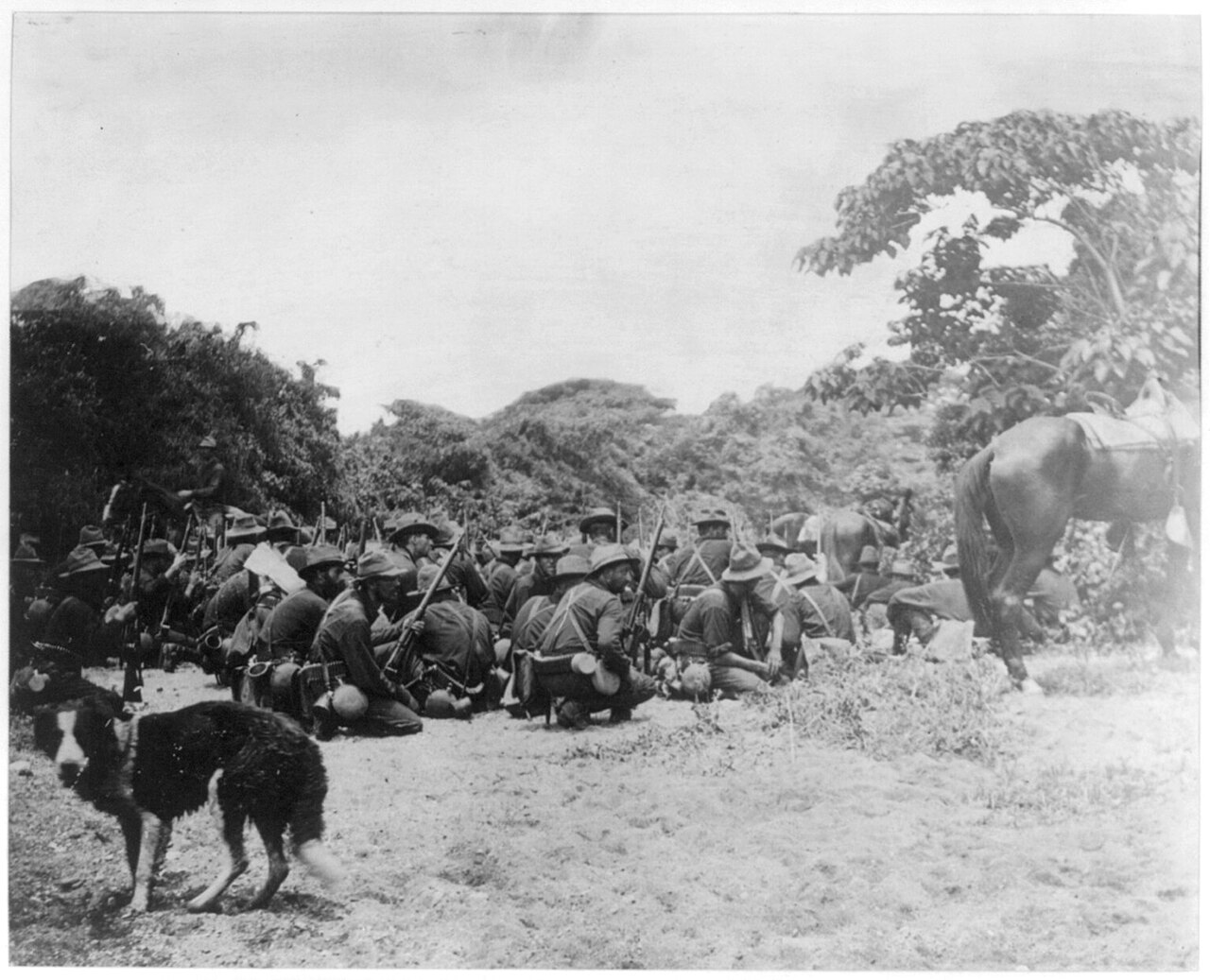
On July 1, U.S. troops attacked Spanish positions on elevated ground near Santiago, including Kettle Hill and San Juan Hill. The fighting involved both regular infantry and volunteer cavalry units that had dismounted for combat. The capture of the heights brought American forces closer to the city and helped tighten pressure on Spanish defenses. The picture accompanying this guide shows American infantry in San Juan Creek in a photograph identified by the Library of Congress as taken during the action. Such images need careful captions, since photographs do not document every instant or the exact movements of all units. San Juan Hill became famous because of Roosevelt, but many units contributed.
Who were the Rough Riders?
The First U.S. Volunteer Cavalry became popularly known as the Rough Riders. Theodore Roosevelt served as lieutenant colonel under Leonard Wood before taking a larger leadership role during the Cuban campaign. The unit included people from varied backgrounds and gained wide publicity through reports of the fighting around Kettle Hill. Popular accounts often merge the Rough Riders’ actions with all of the fighting at San Juan Hill. The regular U.S. Army and Black cavalry regiments made important contributions that should not be obscured by one famous officer’s later political career. The regiment’s distinctive image helped Roosevelt become a national hero, but the battle was a collective military undertaking.
What role did Black U.S. soldiers play?
African American regular army regiments, commonly called Buffalo Soldiers, served in the Cuban campaign and fought during the advances near Santiago. Their performance challenged racist assumptions despite the military’s segregation and discrimination. Units such as the Ninth and Tenth Cavalry were part of the operations in which the Rough Riders gained fame. They endured the same difficult conditions and enemy fire while receiving far less attention in many popular retellings. A historical account that credits Roosevelt and his volunteers with winning the fight alone erases these soldiers. Their participation also reflects the contradictory nature of an American war discussed in terms of freedom while racial inequality persisted at home.
What happened at the naval Battle of Santiago?
On July 3, 1898, Spanish warships under Admiral Pascual Cervera attempted to escape from Santiago harbor but were defeated by U.S. naval forces off the Cuban coast. The destruction of Spain’s Caribbean squadron made the defense of Santiago much harder to sustain and reinforced American control of nearby waters. This was a separate operation from the July 1 land battle over the hills, although the two were strategically connected. American ships and crews achieved the naval victory, while Cuban insurgents continued operations on land. By July 17 Spanish forces at Santiago had surrendered. The sequence demonstrates the importance of naval control in a campaign fought on an island with difficult inland transport.
Why was disease so deadly?
Heat, sanitation problems, limited medical resources and contagious illness placed heavy pressure on soldiers in the tropics. Many U.S. service members died of disease rather than enemy weapons, and public criticism followed the management of army camps and supplies. Yellow fever, malaria and other illnesses influenced strategic choices and the urgency of concluding operations. The war helped spur medical investigations and reforms, although the most famous research on mosquito transmission of yellow fever developed subsequently. The experience should not be reduced to an anecdote about uncomfortable uniforms or poor food. Disease affected combat readiness, transportation, hospitals and families receiving news of sick or dead relatives.
What happened in Puerto Rico?
American forces landed in Puerto Rico in July 1898 and advanced through parts of the island while Spanish troops resisted. Military operations there did not involve the same major battles as Santiago, but they were part of the wider conflict. Puerto Ricans held different opinions about Spain, the arrival of U.S. troops and the island’s political future. The Treaty of Paris transferred Puerto Rico to American sovereignty, and later legislation shaped its colonial government and citizenship. It is misleading to describe the island’s transfer as an uncomplicated voluntary decision by its inhabitants. Puerto Rican communities had their own history, aspirations and responses to changing external rule.
When did the fighting stop?
Spain and the United States agreed to a peace protocol on August 12, 1898, establishing an armistice that ended major hostilities. Communication delays meant that some operations did not fit neatly into a single instantaneous cease-fire. Formal peace negotiations continued in Paris, and the treaty was signed on December 10. The armistice date and treaty date represent different legal and military stages. Later disagreements over U.S. control in the Philippines became a new war rather than simply a continuation of the same Spanish army campaign. The difference matters when comparing casualty figures or deciding whether an event belongs to the Spanish–American War or the subsequent Philippine–American War.
What did the Treaty of Paris require?
The Treaty of Paris signed on December 10, 1898, ended the war between Spain and the United States. Spain relinquished its claims to Cuba and ceded Puerto Rico and Guam to the United States. The Philippines also passed to U.S. sovereignty, with the United States agreeing to pay Spain twenty million dollars under the treaty. The transfers did not mean Cuban or Filipino populations were given equal control over negotiations that determined their futures. Cuban independence followed an American occupation, while Philippine resistance to U.S. rule developed into a major armed conflict. The treaty marked a transformation in American overseas power and colonial responsibility.
Did Cuba become fully independent in 1898?
Cuba did not instantly become a fully sovereign republic on the treaty-signing date. Spanish authority ended, but the island remained under U.S. military occupation until the establishment of the Republic of Cuba in 1902. Even then, the Platt Amendment imposed conditions on Cuban independence and created a framework for American intervention. Cuban participants had fought for self-determination before the United States entered the war, so the final political settlement involved tensions between their aspirations and Washington’s strategic aims. The Teller Amendment’s earlier pledge should be considered alongside these subsequent restrictions. Describing Cuba as directly annexed by the United States would also be incorrect.
How did the war lead to the Philippine–American War?
Filipino independence leaders expected the end of Spanish rule to lead to their own government, but the U.S. decision to acquire the archipelago created a conflict over sovereignty. Fighting between Filipino and U.S. forces began in February 1899 and became the long and destructive Philippine–American War. The causes included disagreements over independence, imperial governance and the authority of the new American occupation. It is essential to distinguish the 1898 defeat of Spain from the separate struggle over Philippine self-government. The political outcome of the Spanish–American War cannot be understood solely through the brief military chronology because its colonial consequences produced resistance lasting far beyond December 1898.
Why is the war considered a turning point?
The war helped establish the United States as a major overseas power with possessions in the Caribbean and Pacific. It altered relations with Cuba, Puerto Rico, Guam and the Philippines and intensified debates within the United States about imperialism and self-government. Supporters celebrated military success and an expanded international role; critics warned that overseas rule conflicted with principles of consent and republican government. The conflict also revealed new demands on naval power, logistics and tropical medicine. It did not single-handedly invent American foreign involvement abroad, but it marked a conspicuous change in scale and responsibility. Its consequences are best understood through both the battles of 1898 and the political developments that followed.
Where can the war be researched?
The U.S. State Department’s Office of the Historian explains the diplomatic causes and treaty. The Library of Congress’s World of 1898 chronology documents events in Cuba, the Philippines and Washington, including Philippine independence activity. The Naval History and Heritage Command provides the naval campaign and treaty background. These resources should be read alongside Cuban, Puerto Rican and Filipino history, since official American sources often center U.S. decisions. Period photographs and newspapers are useful but require careful identification of dates, locations and the different perspectives of the people involved.
Spanish–American War timeline
| Date | Event |
|---|---|
| 1895 | Cuban independence struggle expands against Spanish rule. |
| February 15, 1898 | USS Maine explodes in Havana. |
| April 21–25 | Crisis escalates; Congress declares war and recognizes hostilities from April 21. |
| May 1 | Dewey defeats Spanish fleet at Manila Bay. |
| July 1 | Fighting at Kettle Hill and San Juan Hill near Santiago. |
| July 3 | Spanish fleet defeated off Santiago. |
| July 17 | Spanish forces at Santiago surrender. |
| August 12 | Armistice protocol ends major fighting. |
| December 10 | Treaty of Paris signed. |
| February 1899 | Philippine–American War begins. |