Battle of the Crater (1864): The Mine Explosion at Petersburg
An audacious mine explosion created a gap in Confederate lines, but the Union assault collapsed in confusion and violence.
The Battle of the Crater took place on July 30, 1864, during the Siege of Petersburg. Union engineers from the 48th Pennsylvania dug a mine under a Confederate fortification and detonated it, creating a huge breach. The attack failed when Union troops entered the crater instead of quickly advancing past it, allowing Confederate counterattacks to restore the line. Black Union soldiers also endured intense fighting and racial violence after capture.
A source-based guide to the sequence, commanders, decisions and historical consequences.
On this page — 19 topics
What happened at the Battle of the Crater?
The Battle of the Crater was a Union attempt to break Confederate lines during the prolonged struggle for Petersburg. A tunnel reached beneath a Confederate fortification known as Elliot’s Salient. Engineers packed the end of the mine with explosives, intending to destroy the works and give assaulting infantry an opening into the defensive system.
At about 4:45 a.m. on July 30, the charge exploded and created a dramatic gap. But the attacking formations failed to pass quickly around the excavation and exploit the broken line. Confederates recovered, counterattacked and inflicted heavy casualties. The operation is remembered as a combination of engineering ingenuity and catastrophic tactical execution.
Why was a mine proposed at Petersburg?
Initial Union attacks in June 1864 had failed to seize Petersburg, allowing Confederate defenders to strengthen extensive lines. At one point the opposing works stood only a short distance apart. Union soldiers in the 48th Pennsylvania Infantry, several of whom had civilian mining experience, proposed digging beneath a forward Confederate position.
The idea aimed to avoid the exposed ground that made ordinary assaults so dangerous. If the defenders’ parapet could be destroyed suddenly, infantry might pass through before surviving Confederate units formed another line. The plan required a reliable tunnel, a powerful explosion and disciplined soldiers ready to advance immediately. Without that final element, the breach would be useless.
Who built the tunnel?
Lieutenant Colonel Henry Pleasants directed miners from the 48th Pennsylvania Infantry. They excavated a long shaft and branching galleries beneath the Confederate position, working with improvised equipment and limited ventilation. Their experience as coal miners helped them solve practical problems that officers unfamiliar with underground work had doubted they could overcome.
The tunnel itself demonstrated considerable skill. Soldiers removed earth, supported the passage and dealt with air circulation in a confined space. These engineering achievements should be recognized separately from the failed assault that followed. The mine was a successful technical project in the limited sense that it reached the intended position and detonated as planned.
How was the explosive charge prepared?
After the galleries reached beneath the Confederate works, the Union placed a large quantity of gunpowder in chambers at the far end. The aim was to lift and destroy the fortification, its artillery and nearby troops. Soldiers packed and concealed parts of the tunnel to channel the explosion upward rather than letting much of its force escape back toward the entrance.
The explosion was scheduled to coordinate with the infantry advance. Difficulties with the fuse delayed the detonation, and volunteers entered the tunnel to correct the problem. That dangerous work further demonstrated how much depended on timing. The mine could open the position, but a delay in troop movement would allow defenders beyond the blast to organize resistance.
What happened at 4:45 a.m. on July 30?
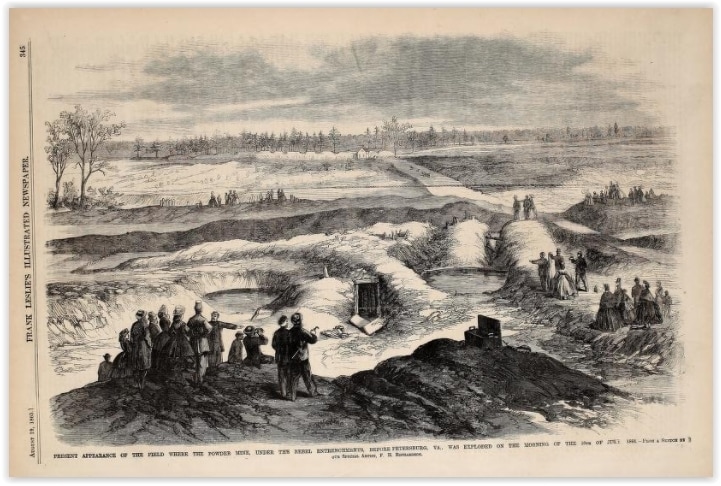
The mine detonated before dawn and tore apart the Confederate salient. The blast destroyed part of the works and killed or wounded defenders in its immediate path. Men on both sides were shocked by the noise and the enormous quantity of earth thrown into the air. The crater left a deep obstacle where the Confederate defense had stood.
For a brief interval the Union had a chance to move through the breach and seize ground beyond. Instead, attacking units lost direction and crowded into or around the excavation. The physical destruction had succeeded, but the arrangement of the infantry assault was already deteriorating. The tactical question became whether the initial advantage could be converted into sustained movement.
Why did Union troops enter the crater?
Many assaulting soldiers descended into the enormous hole rather than moving along its edges and toward the higher ground. The crater offered apparent shelter from Confederate fire but was difficult to climb out of. Units became mixed, orders were confused and men crowded into narrow spaces without effective routes forward.
The problem was not the mine’s failure to explode. It was the disorganization of the attack, the difficult terrain and the inability of officers to regain control. Some troops tried to advance beyond the hole, but the overall offensive lost momentum. Confederates on surrounding ground could fire into the crowded position, turning shelter into a trap.
What happened to the planned Black division?
A division of United States Colored Troops had trained for the assault and expected to play a leading role. Shortly before the battle, however, commanders changed the plan and selected a different unit to advance first. This decision is central to interpretations of the failure because preparation, training and command arrangements were disrupted.
Black soldiers eventually entered the fight after other Union formations had become entangled. They assaulted Confederate positions under terrible conditions and suffered severe casualties. The National Park Service notes that USCT troops advanced farther than some preceding formations. Their role must not be overlooked in a narrative dominated by the blast and the actions of white commanding officers.
Who directed the Confederate counterattack?
Confederate general William Mahone led an effective counterattack that pressed against Union positions near the crater. His troops moved to contain the breach, regain lost ground and force Union soldiers out of the excavated area. The defenders used their knowledge of the surrounding entrenchments and the concentration of trapped troops to their advantage.
As the morning progressed, the Confederates closed the gap and pushed into the crater itself. Some Union soldiers attempted to surrender. The battle then became a grim struggle in cramped ground where retreat and reinforcement were both difficult. By the end of the action the Confederate defensive line had been largely restored despite the enormous explosion.
What happened to captured Black soldiers?
The Battle of the Crater included atrocities against African American Union troops. Some Confederate soldiers killed Black prisoners after they had surrendered or were otherwise no longer fighting. Racial hostility and the Confederate effort to preserve slavery shaped their treatment; the violence was not an unavoidable by-product of ordinary combat alone.
Acknowledging these murders is essential to accurate history. It is misleading to present the battle only as a clever mining experiment gone wrong. United States Colored Troops fought for the Union in a conflict tied directly to slavery and emancipation, and they faced distinctive dangers if captured. The historical record requires treating racial violence as part of the event.
Was the battle tactically successful for either side?
The mine did exactly what Union planners had hoped in one respect: it destroyed a portion of Confederate defenses. Yet the offensive failed to gain the larger objective. Confederate soldiers regained positions and prevented an operational breakthrough, leaving the lines around Petersburg essentially intact at the end of the day.
This distinction is important because it avoids calling the entire plan foolish in hindsight. An ingenious engineering method cannot compensate for poor coordination or the wrong deployment of troops. The Confederate victory came through recovery and counterattack, not through preventing the underground explosion. The result was a missed Union opportunity during a lengthy siege.
How many casualties were there?
The National Park Service describes almost ten hours of fighting and roughly 5,500 combined casualties. This estimate includes killed, wounded, missing and captured soldiers, not only deaths. Figures vary by the categories used, and casualties among Black Union units require particular attention because of killings that occurred after some had surrendered.
Numbers communicate the scale of the disaster, but they do not explain its mechanism. The important facts are how many troops entered confined terrain, why commanders could not reorganize them and how defenders gained positions overlooking the crater. Historians should distinguish verified figures from dramatic claims that every man in the hole was killed.
What happened to Ambrose Burnside afterward?
Ambrose E. Burnside commanded the Union IX Corps, whose troops carried out the assault. The operation brought severe criticism of his leadership and of decisions made before and during the attack. Burnside was removed from command following the failure. Responsibility was also debated among other senior officers involved in planning and supervising the action.
Retrospective accounts sometimes simplify the matter by assigning the failure entirely to one person. The sequence involved disputes about which troops should lead, how orders were communicated and what reserves could achieve. A careful analysis separates the proven breakdown of command from claims about individual motives that may be harder to establish.
Did the battle end the siege?
No. Petersburg remained in Confederate hands after July 30, and the Union army continued operations against the city’s roads and railroads. The siege-like campaign lasted until April 1865. The Crater was an especially visible failure, but it was only one of many engagements within the broader Petersburg struggle.
Grant’s armies continued extending positions westward and interrupting transport routes. In the final months, attacks at Fort Stedman, Five Forks and other locations helped bring down the Confederate defense. To see how the mine fits into those events, follow the Petersburg siege timeline rather than treating the battle as a separate war.
Why is the Crater an important example of Civil War warfare?
The operation demonstrates that battlefield technology and engineering can open opportunities without deciding how soldiers use them. Explosives removed a portion of the earthworks, but the attackers needed clear orders, training, coordination and a route beyond the breach. Those operational requirements were not met.
It also exposes the central place of race and slavery in the war. African American soldiers had trained for difficult duties, fought courageously and then faced violence from enemies who viewed them differently from white prisoners. An account that combines engineering, command failure and the experience of Black troops is more accurate than one focused only on the enormous hole.
What can visitors learn at Petersburg today?
Petersburg National Battlefield preserves the site of the Crater and the surrounding landscape of earthworks. Visitors can see how close the lines were, why the tunnel seemed possible and why the resulting cavity was a difficult place from which to fight. Maps and interpretive signs help connect modern terrain with the positions used in 1864.
The National Park Service’s historical material also discusses African American troops and the killings of Black prisoners. Reading those explanations before visiting prevents an overly celebratory interpretation of the mine. The Crater remains significant not as a curiosity of military engineering alone, but as evidence of a traumatic and complex struggle.
Battle of the Crater 1864 timeline
These dates distinguish the main stages of the operation; the consequences often continued beyond the moment of battle.
| Date | Event |
|---|---|
| June 1864 | Union armies establish siege lines around Petersburg. |
| Late June–July | 48th Pennsylvania miners excavate under Elliot’s Salient. |
| July 30, 4:45 a.m. | The mine explodes. |
| July 30, morning | Union formations attack but become trapped. |
| July 30, later | Confederate troops counterattack; Black soldiers face murderous violence. |
| After July 30 | Union failure prolongs the Petersburg campaign. |
Frequently asked questions
When did it happen? July 30, 1864.
Where did it take place? Petersburg, Virginia.
Who commanded the principal forces? Burnside, Mahone, Grant.
What was the outcome? Confederate victory. The sections above explain the tactical result and the wider consequences.
How does it fit into the Civil War? For a broader chronology see the American Civil War guide.
Historical sources and further reading
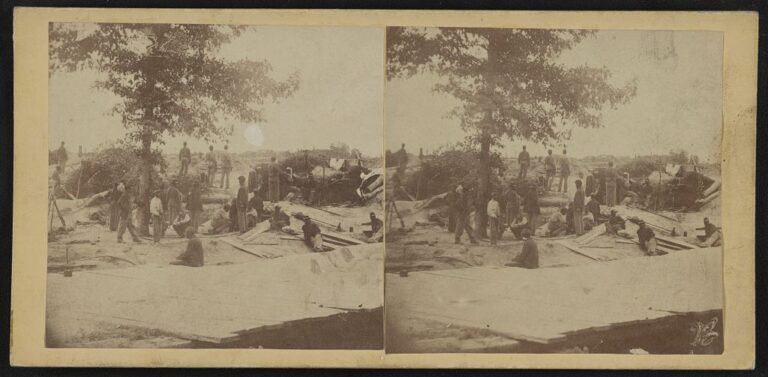
The account uses National Park Service historical interpretation and Library of Congress records. Images are identified as contemporary photographs or later historical representations where applicable.