Slaughter-House Cases (1873): Fourteenth Amendment and Citizenship Rights
How a Louisiana slaughterhouse franchise led the Court to define the constitutional rights of national citizenship narrowly.
In the Slaughter-House Cases of 1873, the Supreme Court upheld Louisiana’s slaughterhouse franchise by a 5–4 vote. The majority, written by Justice Samuel F. Miller, narrowly interpreted the Fourteenth Amendment’s Privileges or Immunities Clause, limiting its use against state restrictions.
Explore the business dispute, public-health rationale, Court’s legal reasoning and its place in Reconstruction law.
On this page — 20 topics
What were the Slaughter-House Cases?
The Slaughter-House Cases were a group of United States Supreme Court disputes decided in April 1873 concerning a Louisiana law regulating slaughterhouses around New Orleans. Butchers challenged a state-created exclusive franchise, arguing that it violated constitutional protections, including provisions of the Thirteenth and Fourteenth Amendments. The Court upheld the Louisiana arrangement by a five-to-four vote. Justice Samuel Freeman Miller wrote the majority opinion, adopting a narrow interpretation of the Fourteenth Amendment’s Privileges or Immunities Clause. The result became highly significant for Reconstruction-era constitutional law because it limited one potential route for federal protection of citizens’ rights against state interference. Although the underlying business dispute involved slaughterhouses, the constitutional principles debated by the justices had consequences far beyond the meat trade.
Why were New Orleans slaughterhouses regulated?
Nineteenth-century New Orleans faced serious public health challenges, including waste and polluted water associated with slaughtering animals close to populated areas. Louisiana legislators wanted operations concentrated in a designated district with oversight intended to improve sanitary conditions. The 1869 law established a company with exclusive authority to operate the central facilities where butchers would conduct their business. Supporters described the arrangement as a response to dangerous conditions, while opponents argued that it gave a private company an unjustified monopoly and threatened their livelihoods. The conflict involved both legitimate public-health concerns and contested economic advantages. Understanding those motives helps explain why a dispute about municipal sanitation turned into a Supreme Court case over the meaning of the Constitution after the Civil War.
What was the Crescent City company?
The Crescent City Live-Stock Landing and Slaughter-House Company received an exclusive franchise under Louisiana legislation to operate central slaughtering facilities in the New Orleans area. Other butchers could continue their occupation by using the authorized facility, subject to charges and conditions, but they lost freedom to slaughter wherever they preferred. The company and the state defended the arrangement as a regulation designed to protect health. Competing butchers saw the exclusive privilege as an improper restraint on trade and a benefit to one firm. The exact legal arrangement matters: it was not a federal monopoly imposed by Congress, and it did not abolish the occupation of butcher altogether. The constitutional challenge arose from the terms and exclusivity of the state-created franchise.
Who challenged the Louisiana law?
Independent butchers and associated organizations brought litigation against the franchise system. They argued that the monopoly imposed an unacceptable burden on their right to pursue an ordinary occupation. Their lawyers invoked the recently ratified Reconstruction Amendments in an effort to obtain federal constitutional protection from state economic regulation. The litigants were not generally bringing a racial discrimination case on behalf of formerly enslaved workers, which makes the constitutional context unusual. The same amendments adopted to address slavery and citizenship were now being cited in a dispute over a commercial trade. The case therefore raised a broader question about whether federal citizenship rights could protect many forms of individual liberty against state governments.
What did the Fourteenth Amendment say?
Ratified in 1868, the Fourteenth Amendment contains a Privileges or Immunities Clause, a Due Process Clause and an Equal Protection Clause, along with citizenship provisions and additional sections. The butchers relied on interpretations of these constitutional guarantees to challenge Louisiana’s law. Their argument treated the freedom to pursue a lawful occupation as a right worthy of national protection. The Court disagreed that the cited constitutional language invalidated the franchise. This mattered because the amendment was still relatively new, and courts were determining how far it altered the relationship between state and federal governments. Our Fourteenth Amendment guide explains the amendment’s clauses separately, avoiding the common mistake of reducing every question to equal protection alone.
What is the Privileges or Immunities Clause?
The Privileges or Immunities Clause says that no state shall make or enforce a law abridging the privileges or immunities of citizens of the United States. Supporters of a broad interpretation argued that it could provide national protection for many basic rights, including some civil liberties previously treated as matters of state law. The Slaughter-House majority interpreted the phrase much more narrowly. It emphasized rights arising specifically from national citizenship rather than treating the clause as a comprehensive national guarantee of all rights enjoyed by state citizens. That distinction limited how litigants could use the clause against state regulations. It became one of the most debated features of the decision and later constitutional scholarship.
How did the Court distinguish two kinds of citizenship?
Justice Miller’s majority opinion drew a distinction between citizenship of the United States and citizenship of a particular state. The opinion interpreted the Fourteenth Amendment as protecting certain rights tied to national citizenship without transferring general responsibility for ordinary civil rights from the states to the federal government. That narrow reading rejected the butchers’ effort to use the Privileges or Immunities Clause against the slaughterhouse franchise. The distinction was technically important and carried broad implications because many rights affecting work, property and daily life had long been administered by state governments. The majority believed a wider interpretation might radically alter the federal system. Critics replied that such narrowness left the amendment less capable of protecting individual freedoms.
Who wrote the majority opinion?
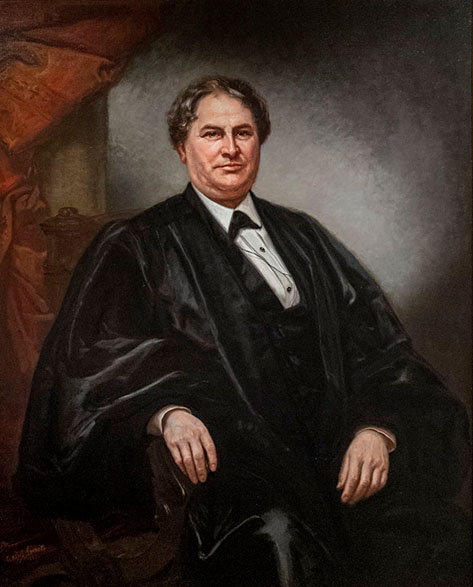
Associate Justice Samuel Freeman Miller wrote for the five-member majority. Appointed by Abraham Lincoln in 1862, Miller had served on the Court during the Civil War and the early Reconstruction period. His opinion tried to interpret the new constitutional amendment in a way that preserved substantial state authority. It recognized the national purpose of protecting formerly enslaved people but resisted a sweeping transfer of civil-rights oversight to federal courts. The historical portrait accompanying this guide shows Miller rather than the slaughterhouses themselves, because his constitutional reasoning is the decision’s enduring subject. A judicial portrait does not illustrate the litigants’ workplaces, so it must be identified accurately as an image of the opinion’s author.
What was the Supreme Court’s vote?
The decision was five to four. The narrow margin demonstrates that the justices were divided over the meaning of the Reconstruction Amendments. The majority upheld the state law, while dissenting justices favored broader protections for the occupational rights asserted by the butchers. Unlike a unanimous opinion, the decision left a substantial contemporaneous record of disagreement about the Fourteenth Amendment’s role. Later histories often emphasize Justice Miller and Justice Stephen J. Field because their positions sharply illustrate competing constitutional philosophies. But there were multiple dissents, each offering arguments that should be read in its own terms. The five-to-four outcome became important because the majority’s interpretation shaped subsequent constitutional reasoning despite the close split.
What did Justice Stephen Field argue?
Justice Stephen J. Field dissented and favored a more expansive understanding of the rights protected from state interference. He questioned whether government could grant one company an exclusive franchise that effectively restrained others from pursuing a lawful trade. Field’s argument placed stronger emphasis on individual liberty and economic freedom than the majority accepted under the Fourteenth Amendment. Other dissenting justices offered related but distinct reasoning. The disagreement was not a modern left-right division; the justices debated the structure of federalism and rights using nineteenth-century legal concepts. The dissents became important in later scholarship because they preserved a vision of national constitutional protection broader than the rule the Court actually adopted.
Did the Court decide a racial equality dispute?
The specific dispute arose from economic regulation of slaughtering animals, not from a Black citizen’s challenge to racial segregation. However, the Court’s interpretation of constitutional amendments adopted after slavery affected the tools available for civil-rights claims. The majority discussed the Reconstruction Amendments’ central historical purpose while taking a narrow view of one clause. This is why legal historians study the case as a key early Reconstruction decision even though the plaintiffs were butchers. It would be inaccurate to say the Court directly authorized segregation in 1873. Later cases concerning equal protection, voting and public accommodations raised separate legal questions, sometimes building on the broader trend toward limited federal constitutional intervention.
How did the decision affect federal power?
By refusing to read the Privileges or Immunities Clause as a broad guarantee of ordinary civil rights, the Court preserved a considerable role for states in defining and regulating many matters. Some critics contend that the interpretation greatly reduced the clause’s potential to protect individuals, including Black Americans, from hostile state governments. Other scholars emphasize the federalism concerns that shaped the majority opinion. The legal effect was not that the Fourteenth Amendment became entirely meaningless. Due process and equal protection remained in the text and later acquired considerable force through judicial interpretation. Nevertheless, Slaughter-House redirected constitutional development toward other clauses, because the route through privileges or immunities was sharply constrained.
Did it invalidate the Fourteenth Amendment?
No. The Fourteenth Amendment remained part of the Constitution, and the Supreme Court did not repeal or erase its citizenship, due-process or equal-protection provisions. The majority interpreted one important clause narrowly, making it harder to use that language as a general federal protection against state interference. This distinction is essential: a court decision interpreting a constitutional text is not equivalent to the political process required to amend the Constitution. In later decades other parts of the Fourteenth Amendment became central to civil-rights litigation. Readers should therefore resist claims that the 1873 Court simply abolished Reconstruction rights in one judgment. Its effect was substantial but specific, and it interacted with many subsequent laws and decisions.
What was the connection to the Civil Rights Cases of 1883?
Both decisions belong to the early constitutional interpretation of the Reconstruction Amendments, but they addressed different laws and conduct. Slaughter-House concerned a Louisiana state franchise and the right to pursue an occupation. The Civil Rights Cases of 1883 concerned federal authority to regulate private racial discrimination in public accommodations. Together they illustrate the limits the Court placed on some broad readings of national enforcement power in the postwar period. It would be incorrect to say that Slaughter-House itself struck down the Civil Rights Act of 1875, because that statute did not yet exist when the butchers’ case was decided. Chronology and legal subject matter must remain distinct.
How did later courts use other Fourteenth Amendment clauses?
As the Privileges or Immunities Clause remained narrowly interpreted, litigants increasingly relied on due process and equal protection in cases involving state regulation and civil rights. These clauses acquired complex and changing meanings through later Supreme Court decisions. The development was gradual, and not all cases promoted racial equality; some protected economic interests or upheld discriminatory state laws. The broader constitutional history includes late-nineteenth-century cases and twentieth-century decisions that substantially expanded federal protection of individual rights. Slaughter-House helps explain why the precise wording of a constitutional claim matters. The Fourteenth Amendment contains several different legal commands, and their interpretation did not follow one simple continuous path after ratification.
What can the original opinion tell researchers?
The case is reported at 83 U.S. (16 Wall.) 36, and the full decision is available through the Library of Congress and legal databases. Reading the majority and dissenting opinions reveals what the litigants argued about Louisiana’s law, citizenship and economic liberty. The Library of Congress report is an authoritative historic source. Secondary summaries are useful for orientation, but they can omit crucial distinctions between the clauses of the Fourteenth Amendment. The case title is often styled Slaughter-House Cases, with a hyphen, although other references use Slaughterhouse Cases. Both identify the same 1873 decision. The key is to connect each statement about the ruling to its actual constitutional reasoning.
Why are the Slaughter-House Cases still studied?
The decision was one of the first major Supreme Court interpretations of the Fourteenth Amendment after the Civil War. It exposed disagreement over whether the amendment transformed national citizenship into a broad source of rights enforceable against states. Its narrow construction of privileges or immunities shaped later constitutional litigation and remains a subject of debate among legal historians. The original conflict over public health and a slaughterhouse franchise also illustrates how constitutional meaning can emerge from everyday economic disputes rather than direct contests over voting or race. It is important precisely because of that combination: an ordinary commercial controversy produced a lasting rule about federalism and citizenship during the struggle to define freedom after slavery.
Slaughter-House Cases timeline
| Date | Event |
|---|---|
| 1868 | Fourteenth Amendment ratified. |
| 1869 | Louisiana creates exclusive slaughterhouse franchise. |
| April 1873 | Supreme Court upholds law by 5–4 majority. |
| 1883 | Separate Civil Rights Cases decision limits public-accommodations protections. |
| Later decades | Due process and equal protection develop through new cases. |