Civil Rights Act of 1866: Citizenship, Rights and Johnson’s Veto
What the first major federal postwar civil-rights statute protected and why Congress overrode Andrew Johnson.
The Civil Rights Act became law on April 9, 1866, when Congress overrode President Andrew Johnson’s veto. It defined national citizenship under its original terms and guaranteed specified equal civil rights concerning contracts, property and court proceedings. It did not establish nationwide voting rights.
Explore the law’s exact rights, the veto and override, the Black Codes and the Fourteenth Amendment.
On this page — 20 topics
What was the Civil Rights Act of 1866?
The Civil Rights Act of 1866 was a federal law passed during Reconstruction to define national citizenship and protect specified civil rights against racial discrimination. It became law on April 9, 1866, when the House of Representatives joined the Senate in overriding President Andrew Johnson’s veto. The measure declared that people born in the United States and not subject to a foreign power, excluding “Indians not taxed” under its original wording, were citizens. It also established equal rights concerning contracts, courts, property and legal protection. The act was a response to the discrimination faced by formerly enslaved people, especially the Black Codes. It was a major advance, but not a guarantee that equality would be enforced immediately in every community.
Why did Congress pass it after the Civil War?
The Confederacy’s defeat and the Thirteenth Amendment ended legal slavery, but Southern state governments adopted restrictions on freedpeople’s employment, testimony and movement. Members of Congress feared that emancipation could be undermined if states retained the power to deny basic civil status through discriminatory legislation. Republicans in the Thirty-Ninth Congress also confronted President Johnson’s relatively lenient approach to readmitting former Confederate states. The act was an attempt to establish national legal standards against racial discrimination in essential civil matters. It reflected the claim that United States citizenship carried rights that a state government could not simply withhold on racial grounds. Black community activism, petitions and evidence of violence helped make these questions politically urgent, even though Black Americans were not yet represented equally in Congress.
Who introduced the bill?
Senator Lyman Trumbull of Illinois, chairman of the Senate Judiciary Committee, introduced the legislation in January 1866. He believed the Thirteenth Amendment gave Congress a foundation for preventing practices that continued slavery’s disabilities under other names. The measure was debated by Republicans and Democrats, with disagreements over citizenship, the powers of federal courts and the extent of national authority over state law. Some moderate Republicans supported it even while questioning other Reconstruction proposals. Debates recorded in the Congressional Globe provide evidence that lawmakers did not all share identical theories. Rather than treating the act as one individual’s achievement, historians examine a legislative coalition that formed in response to Black Codes and the deteriorating relationship between Congress and the presidency.
When exactly did it become law?
The legislative process unfolded over several months. Trumbull introduced the bill in January 1866; the Senate and House approved versions of it before Johnson issued a veto on March 27. The Senate voted to override the veto on April 6, and the House completed the override on April 9. That final vote made the measure law despite presidential opposition. The dates matter because some summaries mistakenly identify March 27 or the first congressional passage as the enactment date. The House of Representatives’ historical office records the April 9 override, while the original enrolled law is preserved by the National Archives. This is an example of the constitutional checks-and-balances process having an immediate effect on the legal position of millions of people.
What did the act say about citizenship?
The law declared citizenship for qualifying people born in the United States regardless of race, color or previous condition of slavery. Its original language also included exclusions rooted in nineteenth-century federal treatment of Indigenous peoples; it should not be paraphrased as an unrestricted modern citizenship rule covering every person without qualification. The provision was intended to overturn the idea that Black Americans could be excluded from national citizenship, associated prominently with the Supreme Court’s 1857 Dred Scott decision. The act’s citizenship guarantee was later given constitutional support by the Fourteenth Amendment. Distinguishing the original statutory wording from the amendment’s text is important when explaining how national citizenship developed through legislation and constitutional change.
Which rights were protected?
The act protected specified civil rights, including the right to make and enforce contracts, sue and be parties in legal proceedings, give evidence, inherit property and purchase, lease, sell, hold or convey property. It also promised equal benefit of laws protecting persons and property and equal punishment under law. These guarantees responded to common forms of discrimination in postwar state statutes and local courts. They did not amount to an explicit general guarantee of every future category of civil right. For example, the statute did not establish universal suffrage or a comprehensive system of school integration. Reading the original text carefully avoids projecting later civil-rights legislation backward onto a law enacted in 1866.
Why were contracts so important?
Millions of formerly enslaved people needed to earn wages and establish households without the control of a slaveholder. Landowners often still possessed farms, housing and access to credit, while workers had few resources. Equal legal capacity to make contracts could make the difference between being treated as a person able to negotiate and being confined by a rule that limited employment choices. But formal contract rights did not create equal bargaining power or guarantee that employers paid what they owed. Some workers continued to face coercive agreements and unequal local enforcement. The act supplied a basis for challenging racial discrimination in contractual rights, while the Freedmen’s Bureau and courts dealt with practical disputes on the ground.
What did the law mean for court testimony?
A person denied the right to testify or bring a lawsuit could struggle to recover unpaid wages, protect property or report violence. The Civil Rights Act addressed unequal legal standing by guaranteeing citizens equal rights to sue, be parties and give evidence. This was directly relevant to states in which discriminatory rules restricted Black witnesses, especially in proceedings involving white defendants. Yet enforcing the principle could be difficult when judges, juries and local officials opposed Reconstruction. Federal legal mechanisms were designed to provide remedies, but they depended on officials willing and able to act. The distinction between writing a right into federal law and securing it in everyday court proceedings is a central theme of the entire Reconstruction era.
Did it give Black Americans the right to vote?
No. The Civil Rights Act of 1866 addressed civil status and defined rights concerning courts, contracts and property, but it did not establish a nationwide right to vote. Voting remained a separate and intensely contested issue. Congress later passed the Reconstruction Acts, which imposed voting-related conditions on Southern state governments, and the Fifteenth Amendment was ratified in 1870 to prohibit denial of voting rights on specified racial grounds. Women’s suffrage was not guaranteed by the 1866 act either. Describing the act as a general voting-rights statute would obscure why further constitutional amendments and enforcement legislation were necessary. It is better to distinguish civil rights, political rights and practical enforcement while showing how they were connected.
Why did Andrew Johnson veto the bill?
Johnson argued that the law exceeded constitutional limits and extended federal authority too far into matters traditionally governed by states. His March 27 veto message challenged the legislation’s citizenship provisions and questioned Congress’s power to impose such uniform rules. Supporters replied that the end of slavery and the documented discrimination of Southern laws justified federal intervention. The dispute was not merely procedural: different views of race, citizenship and national power shaped it. Johnson’s veto intensified tensions with Republicans who already distrusted his restoration policy. By overriding him, Congress signaled that it intended to direct Reconstruction more forcefully and that presidential opposition would not necessarily stop major civil-rights legislation.
How did Congress override Johnson’s veto?
An override requires two-thirds support in both houses of Congress. The Senate voted to override the Civil Rights Act veto on April 6, 1866, followed by the House on April 9. The House’s historical office reports a vote of 122 to 41. The successful override was a landmark in the confrontation between the Thirty-Ninth Congress and President Johnson. It proved that a congressional majority was prepared to legislate on national civil rights without the president’s approval. The votes also reflected party division: Republican support was overwhelmingly favorable, while many Democrats opposed the measure. The constitutional process matters because the law’s existence depended on Congress exercising a specific power rather than simply appealing to presidential cooperation.
How was the law connected to the Thirteenth Amendment?
The Thirteenth Amendment, ratified in December 1865, prohibited slavery and involuntary servitude except as criminal punishment after conviction. Congress viewed the amendment’s enforcement power as authority to address laws and practices that imposed continuing disabilities associated with slavery. The Civil Rights Act was one of the first major efforts to implement that interpretation. But constitutional scholars and contemporary lawmakers disagreed about how far the amendment permitted Congress to regulate state civil law. Those uncertainties contributed to the effort to place citizenship and equal protection on an additional constitutional foundation. Understanding this sequence explains why a statutory guarantee in 1866 was followed by the Fourteenth Amendment in 1868 rather than being treated as the final settlement.
How did the Fourteenth Amendment build on the act?
The Fourteenth Amendment, ratified in July 1868, established constitutional citizenship language and prohibited states from denying due process or equal protection of the laws. It gave more secure constitutional status to core principles at issue in the 1866 debate. The wording of the act and amendment is not identical, and the amendment contains additional provisions concerning representation, rebellion and public debt. Nevertheless, both emerged from concern that state governments could deny Black residents equal civil status. The Fourteenth Amendment guide examines these clauses in detail. Readers should not assume ratification erased discrimination; further statutes, federal intervention and litigation remained necessary.
Was the act enforced successfully?
The measure created legal standards and avenues for federal action, but enforcement was uneven. Black citizens and their allies encountered opposition from local courts, employers and white supremacist groups. Federal officials had limited resources and political commitment shifted over the following years. Nevertheless, the statute mattered as a legal foundation for asserting equal civil status and contesting explicitly discriminatory treatment. Its significance cannot be judged only by whether every lawsuit succeeded or every Southern law changed immediately. The act influenced later federal civil-rights law and judicial interpretation. The difference between formal rights and their enforcement also helps explain why the government adopted the Reconstruction Acts of 1867 and the Enforcement Acts of the early 1870s.
How was the 1866 act different from the 1964 law?
The Civil Rights Act of 1964 addressed discrimination in areas such as public accommodations, employment and federally funded programs through a complex framework of titles and enforcement bodies. The 1866 law focused more narrowly on national citizenship and equal rights in contracts, property and legal proceedings. They were enacted nearly a century apart in very different constitutional and political contexts. Both were responses to racial discrimination, but one should not be described as merely an earlier version containing every modern protection. Our Civil Rights Act of 1964 guide covers the later law. Comparing the two shows both continuity in the struggle for equal legal status and substantial changes in federal legislative power.
What do the original documents show?
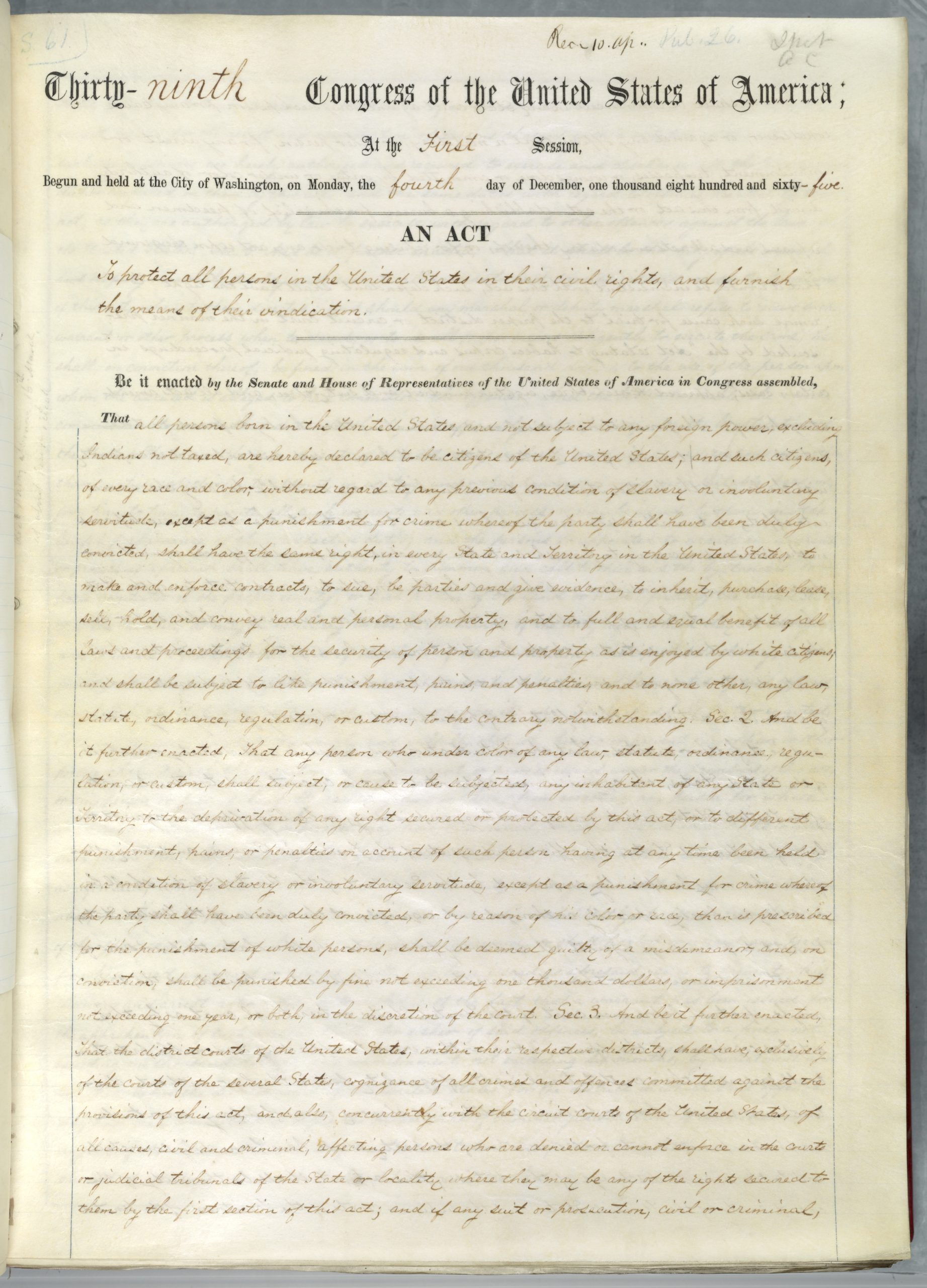
The enrolled Civil Rights Act survives in the National Archives, and its original language can be compared with the published version in the Statutes at Large. The House historical office documents the veto override, while the official statutory volume reproduces the enacted text at 14 Stat. 27. These sources help correct several misconceptions: the law had a precise citizenship definition, it did not grant suffrage, and it became law through an override. They also remind researchers to distinguish the first draft of a bill, the final enrolled act and a later historian’s summary. For legal history, small differences of wording can change an interpretation.
Why is this law a Reconstruction milestone?
The act marked a decisive shift from relying entirely on individual state governments to asserting a national definition of certain civil rights. Its supporters recognized that emancipation alone would not protect workers, families and property owners if local laws excluded them from courts or refused to recognize contracts. It also became an important political confrontation that helped move Reconstruction toward congressional control. The law did not eliminate white supremacist violence or economic inequality, and subsequent generations continued to contest its meaning. Its lasting importance rests in establishing the principle that citizenship could carry protections enforceable against racially discriminatory state rules. That principle shaped the Fourteenth Amendment and later debates over the federal government’s responsibility for equal rights.
Civil Rights Act of 1866 timeline
| Date | Event |
|---|---|
| January 5, 1866 | Lyman Trumbull introduces the Senate bill. |
| March 27, 1866 | Andrew Johnson vetoes the legislation. |
| April 6, 1866 | Senate overrides Johnson’s veto. |
| April 9, 1866 | House overrides the veto; the act becomes law. |
| July 1868 | Fourteenth Amendment is ratified. |