Agricultural Marketing Act of 1929: Federal Farm Board and Farm Prices
Why Hoover created the Federal Farm Board, what its $500 million revolving fund meant, and why efforts to stabilize prices struggled in the Depression.
Quick answer
The Agricultural Marketing Act became law on June 15, 1929, when President Herbert Hoover approved a federal program to strengthen farmer cooperatives and stabilize agricultural marketing. It created the Federal Farm Board and authorized a $500 million revolving fund, to be appropriated in stages rather than paid immediately to individual farmers. The board supported cooperative marketing and stabilization efforts, especially for wheat and cotton. Falling world demand and the Great Depression overwhelmed much of the program’s ability to support prices.
Key facts
On this page
- Why farmers needed help before the 1929 crash
- How farm relief became a national political dispute
- The law of June 15, 1929
- What the Federal Farm Board was supposed to do
- What the $500 million revolving fund meant
- Cooperatives and the stabilization corporations
- Wheat, cotton and the price collapse
- How the stock market crash changed the situation
- How the Farm Board differed from the New Deal
- What became of the Farm Board?
- Why the Agricultural Marketing Act remains important
- Timeline
- FAQs
- Sources
Why farmers needed help before the 1929 crash
American agriculture faced severe price and income difficulties during the 1920s even while parts of the urban economy were expanding. Farmers had increased production during World War I when export demand was high, and many borrowed money to buy land, machinery or additional acreage. After the war, European production recovered and demand conditions changed, leaving some growers with substantial debt and falling commodity prices. A broad account that says agriculture entered depression only after the stock market crash in October 1929 therefore misses an important part of the decade.
Farm income depended on crop yields, domestic consumption, export markets and access to credit. Weather might make one season difficult, while widespread production and falling prices could reduce revenues even in a year with a good harvest. The resulting distress put pressure on federal politicians to consider new ways of organizing sales and stabilizing commodity markets. Hoover supported cooperative methods that would help farmers market products more effectively while avoiding some more direct proposals for government-funded export subsidies.
How farm relief became a national political dispute
During the 1920s farm organizations, legislators and presidents debated the best way to support agriculture. Some lawmakers advocated the McNary–Haugen approach, which proposed government-supported purchases and exports of surplus commodities financed partly by an equalization fee. President Calvin Coolidge vetoed versions of that plan. Hoover favored a different strategy emphasizing cooperation among growers and a federal board that could support organized marketing and reduce inefficiencies.
Disagreements were not simply between farmers wanting help and city residents opposing it. Agricultural regions and producers sold different commodities, faced different export markets and held different views about how the government should intervene. Grain farmers, cotton producers and livestock businesses did not necessarily benefit from the same scheme. The 1929 law attempted to offer a national framework that could coordinate multiple programs without requiring Congress to fix a single legally guaranteed price for all produce.
The law of June 15, 1929
Herbert Hoover signed the Agricultural Marketing Act on June 15, 1929, several months before the October stock market collapse. The American Presidency Project preserves Hoover’s statement on enactment, and the original legislation was Public Law No. 10 of the 71st Congress, at 46 Stat. 11. This chronology matters: it was a response to longstanding agricultural problems, not a New Deal program enacted after Franklin Roosevelt became president.
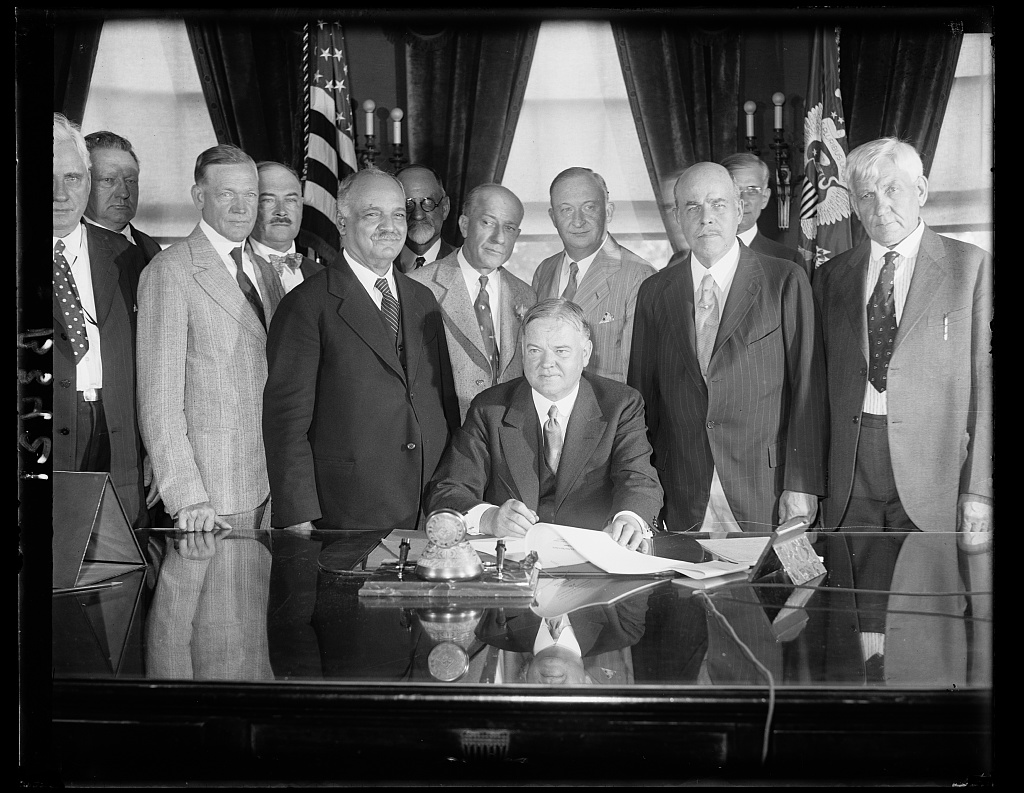
The photograph accompanying this article records Hoover signing the farm bill with congressional officials standing nearby. It is a primary visual document of the event, rather than a generic photograph of American agriculture. Images of signings can verify who attended and how a moment was presented to the press, though they cannot by themselves reveal the complete economic consequences of the resulting law. To explain the program, readers need the statute and later reports of the Farm Board’s operations.
What the Federal Farm Board was supposed to do
The act established the Federal Farm Board to strengthen cooperative marketing and help achieve more stable conditions for agriculture. The board could work with farmer organizations, support cooperative associations and oversee financial assistance for operations intended to improve the handling and sale of commodities. The aim was not simply to buy every farmer’s harvest at a permanent guaranteed price. Instead, advocates hoped better organized marketing could reduce wasteful competition and smooth disruptions between supply and demand.
The board’s national position allowed it to cooperate across regions, but it could not command weather, global trade, technological productivity or the decisions of every grower. Cooperative marketing depends on participants working together and on buyers continuing to have the means to purchase goods. Even before the Depression deepened, critics questioned whether the board would have enough influence over national commodity markets to prevent price declines. Those limitations became more apparent when demand collapsed.
What the $500 million revolving fund meant
The act authorized a $500 million revolving fund for Farm Board purposes, but the authorization should not be confused with an immediate $500 million transfer to all farmers. Congress appropriated money in stages. In June 1929 Hoover requested an initial $150 million appropriation for the fund plus a smaller amount for administration. Later requests and appropriations added to the resources available for loans and other operations. A revolving fund meant that repayments and proceeds could help finance subsequent activity within statutory limits.
The fund was meant to support market organization and credit operations, not provide a one-time personal cash payment to each person operating a farm. It could be used for qualifying loans or advances, including work through cooperatives and stabilization arrangements. This distinction matters when comparing programs across the 1920s and 1930s. The Federal Farm Loan Act of 1916 had addressed long-term farm mortgages, while the 1929 law addressed marketing and commodity stabilization.
Cooperatives and the stabilization corporations
Farmer cooperatives allow producers to coordinate storage, processing or sale rather than acting only as isolated sellers. The Farm Board’s program tried to strengthen such organizations and assist marketing on a larger scale. It also supported stabilization corporations associated with major commodities, particularly grain and cotton. These entities could purchase or hold stocks in an effort to reduce sudden downward pressure on prices when harvests or market conditions produced large supplies.
Holding commodities could postpone sales, but it also entailed expenses and financial risks. Stocks needed storage and maintenance, while farmers continued producing more output. If world demand did not recover, releasing accumulated inventories could renew pressure on prices. The program therefore depended on circumstances beyond the board’s immediate control. A stabilization corporation was not a mechanism for legally abolishing every market fluctuation, and a loan to it was not equivalent to a payment guaranteeing individual farmers a profit.
Wheat, cotton and the price collapse
Wheat and cotton were two important areas of board activity because both depended heavily on large-scale production and changing trade conditions. Federal funds helped finance stabilization operations that sought to hold surpluses off the market. Yet agricultural prices continued to decline as the Depression spread and international trade contracted. Inventories accumulated, and the financial position of holding organizations deteriorated. The board faced the difficult choice between continuing support and disposing of stocks without further depressing prices.
These outcomes demonstrate a basic problem for commodity stabilization: a temporary inventory strategy is less effective when falling demand and overproduction persist for years. Moreover, one commodity’s market cannot be understood from the conditions facing a completely different crop. Historians examine the board’s wheat and cotton operations separately before drawing conclusions about the whole institution. The fact that the program failed to maintain prices should not be taken as proof that every cooperative loan was useless.
How the stock market crash changed the situation
The October 1929 crash began a wider financial crisis whose effects spread over subsequent years. Banking difficulties, falling incomes and reduced industrial production weakened domestic demand, while foreign markets also deteriorated. Farmers already struggling with debt found that crops might bring too little revenue to cover obligations. The Farm Board had been created to address agricultural marketing problems, but it now operated amid a national and international contraction that far exceeded the circumstances anticipated by many of its sponsors.
The Great Depression involved financial instability, falling prices and unemployment, not just one bad harvest or one policy decision. Attributing the entire agricultural price collapse to the Farm Board would confuse the agency’s efforts with the economic environment in which it worked. The more defensible historical assessment is that the board did not achieve the ambitious stabilization outcomes hoped for in 1929 and became an example of the limits of its particular intervention strategy.
How the Farm Board differed from the New Deal
After Franklin Roosevelt took office in 1933, Congress enacted the Agricultural Adjustment Act, which pursued different approaches to farm income and production. Those New Deal policies should not be projected backward onto Hoover’s Federal Farm Board. The earlier board emphasized cooperatives, revolving credit and commodity stabilization without the same general production-control program later associated with the AAA. Distinguishing the laws makes it possible to see policy change rather than treating all federal farm relief as one continuous statute.
New Deal reforms were also controversial and subject to legal and economic disputes of their own. The existence of later laws does not establish that government involvement began in 1933. The 1929 act demonstrates that Hoover’s administration attempted significant intervention before the worst Depression years, although it rejected some alternatives that later policymakers would consider. The long history of farm relief is therefore a sequence of experiments with differing institutional designs and assumptions.
What became of the Farm Board?
The Farm Board’s stabilization activity eventually wound down as its limitations became evident and federal agricultural policy changed. The Farm Credit Administration, created in 1933, took over certain surviving agricultural credit and cooperative functions as the government reorganized its institutions. This transition did not mean that every loan disappeared or that the federal government stopped addressing agricultural finance. Functions were altered and reassigned while new programs were developed.
Historical accounts often describe the board simply as a failure. It is fair to say that its core price-stabilization ambitions were not realized, and the losses and stock accumulation were serious. But a fuller evaluation distinguishes failed efforts to maintain market prices from institutional contributions to cooperative finance and the later debate about farm policy. Congress learned from the practical problems of an agency working through voluntary cooperation in markets whose collapse it could not prevent.
Why the Agricultural Marketing Act remains important
The act was a major pre-New Deal effort to address agricultural distress through federal finance and cooperation. It created an institution and authorized substantial capital before the 1929 market collapse, showing that American farm problems had become politically urgent well ahead of the Great Depression. Its attempt to support commodity prices faced economic conditions that quickly became far worse than officials had anticipated.
The historical lesson is not that farmers could never benefit from organized marketing or that a revolving fund always solves price problems. Rather, the act reveals how policy instruments can be overwhelmed when supply, demand, credit and trade deteriorate together. Reading it alongside the Fordney–McCumber Tariff and the Smoot–Hawley Tariff places farm relief within broader interwar economic policy.
Timeline
- 1920s: Farm prices and debts produce repeated relief demands
- June 15, 1929: Hoover signs Agricultural Marketing Act
- June 1929: Initial appropriation sought for Farm Board
- October 1929: Stock market collapses
- 1930–1932: Stabilization efforts struggle amid price declines
- 1933: Farm programs reorganized and new policies introduced
Frequently asked questions
When was the Agricultural Marketing Act passed?
June 15, 1929, under President Herbert Hoover.
Did it create the Federal Farm Board?
Yes. The board supported cooperatives and efforts to stabilize agricultural marketing.
Was $500 million immediately given to farmers?
No. The act authorized a revolving fund subject to congressional appropriations and qualifying uses, not a universal cash payment.
What commodities received stabilization attention?
Wheat and cotton were prominent examples.
Was it part of Roosevelt’s New Deal?
No. It was enacted in 1929 under Hoover, years before Roosevelt’s 1933 inauguration.
Did the Farm Board end the farm depression?
No. Major commodity prices continued falling as the wider Depression deepened.