Indian Reorganization Act of 1934: Tribal Self-Government and the End of Allotment
Why Congress reversed the allotment policy in 1934, what tribal governments could choose under the Wheeler–Howard Act and where the Indian New Deal fell short.
Quick answer
The Indian Reorganization Act (IRA), also called the Wheeler–Howard Act, was signed on June 18, 1934. It halted further allotment of reservation lands under the general policy associated with the Dawes Act and authorized ways to restore land to tribal ownership. It encouraged tribal constitutional governments and offered tools for economic development. Tribal communities could accept or reject important reorganization provisions. The law represented a major shift in federal policy, but its administration and the standardized constitutions it promoted remained controversial.
Key facts
On this page
- The federal policy that the 1934 act reversed
- The 1928 Meriam Report and demands for reform
- John Collier and the ‘Indian New Deal’
- The law Congress enacted on June 18, 1934
- Ending new allotment and protecting trust lands
- Restoring land to tribal ownership
- Tribal constitutions and governing councils
- Why some tribal nations rejected the IRA
- Credit, education and economic development
- Limitations involving Oklahoma and Alaska
- The long debate about self-determination
- Why the Indian Reorganization Act still matters
- Timeline
- Frequently asked questions
- Sources
The federal policy that the 1934 act reversed
During the late nineteenth century the federal government pursued an allotment policy that divided significant parts of communally held reservation land into individual parcels. The Dawes Act of 1887 was a central part of that program. Land classified as surplus could then be opened to non-Native settlement, and tribal communities suffered major losses of land and control over resources. Those policies were associated with efforts to force assimilation by changing land ownership and community institutions.
The effects were not identical for every nation or reservation, because treaties, land tenure and federal decisions varied. Yet fragmentation of land ownership, loss of territory and the weakening of economic bases were widespread consequences. Some Native families held individual allotments while the federal government maintained trust responsibilities. By the early 1930s critics argued that the system had not delivered prosperity and had undermined tribal life. The Indian Reorganization Act emerged as a proposed reversal rather than a minor administrative adjustment.
The 1928 Meriam Report and demands for reform
The 1928 study commonly called the Meriam Report documented serious problems in federal Indian administration, including poverty, inadequate medical care, weak educational opportunities and the failures of assimilation-oriented policies. It was prepared by the Institute for Government Research and drew on field investigations. The report encouraged a reconsideration of whether the federal government should continue policies that weakened tribal communities while failing to improve living standards.
Native advocates had long challenged dispossession and federal paternalism before the report appeared. The inquiry helped bring administrative evidence into national policy debate, but it did not invent Indigenous criticism of allotment. Some reformers supported better schools and health services; others emphasized control over land and the ability of nations to govern themselves. The New Deal-era legislation took shape within that broader history of Indigenous advocacy, federal investigation and political disagreement.
John Collier and the ‘Indian New Deal’
John Collier became commissioner of Indian Affairs under President Franklin D. Roosevelt in 1933. He argued for stronger tribal cultural life, community government and the protection of reservation lands. His reform agenda became known as the Indian New Deal. Collier’s background in social reform influenced how he viewed Indigenous communities, and he sought legislation that would reverse some of the damage associated with allotment and forced assimilation.
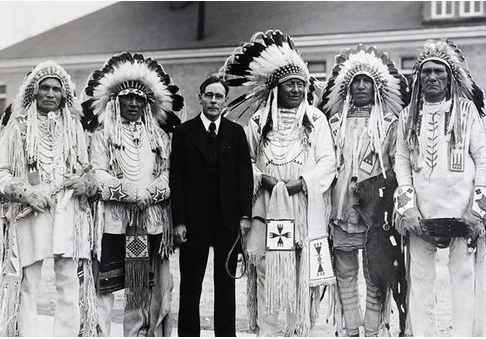
Collier was influential but not universally supported. Native leaders and communities disagreed about federal policies, including whether government-drafted tribal constitutions would strengthen their own authority or place it in an unfamiliar structure. The photograph accompanying this article shows Collier with Blackfeet leaders in 1934, illustrating contact between the administration and tribal representatives. It does not establish that every leader or every tribal nation approved of the proposed reforms.
The law Congress enacted on June 18, 1934
The Indian Reorganization Act was signed into law on June 18, 1934, during Roosevelt’s presidency. Its official text appeared at 48 Stat. 984 and addressed conservation and development of Native lands, tribal organization, credit and related subjects. Senator Burton K. Wheeler and Representative Edgar Howard were principal congressional sponsors, giving rise to its alternative name Wheeler–Howard Act. The final version followed debate over how far the federal government should intervene in tribal governance.
The law was not one broad constitutional guarantee of unrestricted sovereignty. It contained specific mechanisms, definitions and limits, and significant powers remained with federal authorities. Moreover, the legislation did not operate in precisely the same way for every Native nation across the country. Understanding its actual provisions helps explain both its importance and later criticisms. The Indian Citizenship Act of 1924, enacted ten years earlier, addressed a different question: U.S. citizenship rather than this reorganization of land and tribal government.
Ending new allotment and protecting trust lands
Among the act’s fundamental changes was the discontinuation of further allotment of lands in Indian reservations under the general allotment policy. This was a turning point because dividing land into individual holdings had enabled fragmentation and the opening of supposedly surplus territory to outsiders. The law also addressed the extension of existing trust periods, helping prevent automatic transitions that might expose land to alienation under earlier arrangements.
Ending future allotment did not automatically return every acre lost over the previous half century. Land already sold or transferred to private ownership could not simply be restored by declaring allotment over. Restoration depended on statutory powers, available funds, ownership and subsequent administrative decisions. The distinction between stopping additional loss and recovering past loss is essential when assessing what the IRA accomplished for particular tribal communities.
Restoring land to tribal ownership
The act authorized federal officials to acquire certain lands for Native Americans and to place lands in trust under statutory rules. It also provided avenues to restore some surplus reservation lands to tribal ownership. Those mechanisms offered practical ways to strengthen the economic base of communities that had lost territory. Land supports housing, agriculture, natural resources and the exercise of governmental responsibilities, so these provisions went beyond symbolism.
Restoration was complicated by competing property claims and differences between nations. Acquisition authority did not imply that every desired parcel could be purchased, that every tribe received the same allocation or that land returned without negotiation. Later disputes over the Secretary of the Interior’s authority and eligibility under the statute demonstrate its continuing legal significance. The National Archives preserves land and reservation records that help trace specific administrative outcomes.
Tribal constitutions and governing councils
The IRA encouraged tribal nations to organize governments under written constitutions approved through a prescribed process. Some communities chose to establish councils and administrative bodies drawing on models recognized by the federal government. Supporters argued that formally acknowledged institutions could strengthen collective decision-making and enable governments to manage property or conduct business. The act also permitted certain federally chartered business organizations.
Critics argued that standardized constitutions sometimes displaced or constrained traditional governance practices. Some Indigenous nations already possessed established systems of authority that did not resemble American municipal government, and an imposed model could create new divisions. The ability to hold an election did not remove every concern about federal influence. It is therefore more accurate to say the IRA offered a particular framework for reorganization than to claim it restored every nation to unrestricted traditional self-government.
Why some tribal nations rejected the IRA
Congress included a procedure for tribal communities to vote on whether important provisions would apply to them. Some nations accepted the framework and developed constitutions or business charters; others rejected it or criticized its conditions. Rejection could reflect strong existing institutions, dissatisfaction with federal administration, the details of the voting rules or concerns that the proposed form of government would not represent community traditions.
The National Archives holds ballots and other records from these elections, including examples from the Oneida community in 1936. Historical summaries sometimes quote one nationwide number of tribes accepting and another rejecting the law, but the exact totals depend on which groups and later votes are counted. The key fact is that acceptance was not universal. Examining individual tribal records is more reliable than implying a single shared Indigenous opinion about the reform.
Credit, education and economic development
The IRA also included provisions intended to support tribal economic activity, including a revolving credit fund and authority for certain educational assistance. The aim was to make community enterprises and individual economic opportunities more sustainable while reducing reliance on earlier paternalistic systems. Credit could support organizations seeking to manage land and resources collectively, although eligibility and approval depended on federal rules.
Those tools could not undo decades of economic loss immediately. Communities differed in their access to markets, infrastructure and capital, and federal assistance remained limited relative to the scale of need. Administrative oversight could slow decisions or give officials substantial influence over economic choices. The act therefore mixed genuine new opportunities with continuing federal control. Its impact has to be judged through specific projects and tribal experiences rather than assuming every new program succeeded.
Limitations involving Oklahoma and Alaska
The original 1934 statute had important geographic exceptions and special rules. Congress later addressed related questions through separate measures, including the Oklahoma Indian Welfare Act of 1936 and legislation affecting Alaska Native communities. These laws were not identical to the original IRA, and their provisions applied in different jurisdictions. A claim that the same tribal reorganization rules instantly operated unchanged for all Native peoples in every territory would be historically misleading.
The varying legal arrangements also show why modern discussions of IRA eligibility require attention to dates, federal recognition, statutory text and subsequent court interpretation. Different nations had different treaties and administrative histories. A general guide can explain the 1934 framework, but research about one particular nation should consult its own election records, constitution, land history and relevant later amendments.
The long debate about self-determination
The Indian Reorganization Act marked a shift away from an explicit program of breaking up reservations and requiring assimilation as a route to individual property ownership. It acknowledged the continuing role of tribal governments and allowed new legal tools to protect and develop land. For many people, those changes represented an important reversal of an older federal policy that had produced devastating losses.
At the same time, the reform remained a federal program designed partly by non-Native officials. Critics questioned whether its constitutional models and oversight requirements gave nations enough freedom to define their own governance. Later termination policies of the 1950s and self-determination measures adopted in subsequent decades reveal that national policy remained contested. The IRA was a turning point within an ongoing relationship, not the final settlement of Indigenous sovereignty.
Why the Indian Reorganization Act still matters
The law’s legacy is visible in questions about tribal trust land, constitutions and the status of Native governmental institutions. It created tools that some nations used to strengthen their land bases and political organization, and it ended a major part of the allotment policy. But the law did not reverse every earlier loss, and its government-approved constitutions were not universally accepted.
An accurate history reads the original act alongside the Dawes Act, the 1924 citizenship law and tribal records documenting the decisions people made in the 1930s. Together they show a transition from allotment and assimilation toward an imperfect framework of recognized tribal government, shaped by both federal policy and Indigenous political choices.
Timeline
- 1887: General Allotment (Dawes) Act enacted
- 1928: Meriam Report exposes federal policy failures
- 1933: John Collier becomes Indian Affairs commissioner
- June 18, 1934: Wheeler–Howard Act signed
- 1934–1936: Tribal elections and constitutional decisions
- 1936: Oklahoma Indian Welfare Act and Alaska-related extensions
- 1950s onward: Further policy controversies over termination and self-determination
Frequently asked questions
When was the Indian Reorganization Act signed?
June 18, 1934.
What was its other name?
The Wheeler–Howard Act, also called part of the Indian New Deal.
Did it end the Dawes Act allotment policy?
It ended further allotment of reservation lands under the general policy but did not automatically recover land previously lost.
Did it allow tribal governments?
It provided a framework for written tribal constitutions, councils and certain business charters.
Did every tribe accept it?
No. Communities held elections, and some accepted while others rejected the reorganization provisions.
Was it the same as the Indian Citizenship Act of 1924?
No. The 1924 law addressed U.S. citizenship; the 1934 law addressed land and tribal organization.