Battle of Cedar Creek (1864): Sheridan’s Return and Early’s Defeat
A surprise predawn Confederate victory was overturned by a Union counterattack on the same day.
The Battle of Cedar Creek was fought on October 19, 1864, near Middletown, Virginia. Confederate general Jubal Early surprised and routed parts of the Union Army of the Shenandoah at dawn. Union general Philip Sheridan returned from Winchester, helped rally the retreating troops and launched an afternoon counterattack that defeated Early’s force. The Union victory effectively ended major Confederate operations in the Shenandoah Valley.
A source-based guide to the sequence, commanders, decisions and historical consequences.
On this page — 20 topics
What was the Battle of Cedar Creek?
Cedar Creek was the final major battle of Philip Sheridan’s 1864 campaign in Virginia’s Shenandoah Valley. Confederate troops under Jubal Early attacked the Union army at dawn while some federal formations were still encamped. Their surprise gained considerable ground and created a serious crisis for the defenders.
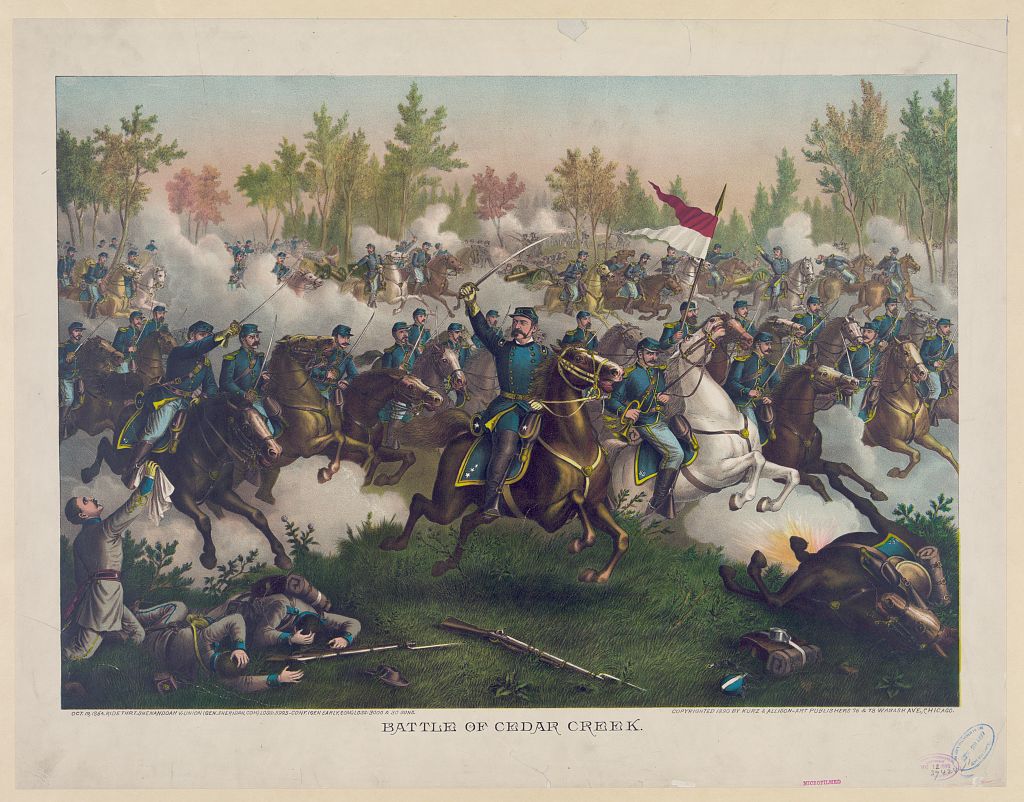
The battle’s outcome changed during the same day. Sheridan returned to the field, Union soldiers reorganized and a strong afternoon attack drove Early’s troops back. The result destroyed much of the Confederates’ ability to mount large operations in the Valley. Its drama has inspired many historical paintings, but the event must be reconstructed from reports, geography and timing.
Where was Cedar Creek fought?
The fighting took place near Cedar Creek, Belle Grove Plantation and Middletown in the northern Shenandoah Valley. Streams, roads and high ground shaped both the Confederate approach and the Union retreat. The Valley Turnpike was an especially important route for moving large bodies of troops through the region.
The battlefield was not one small clearing. Opposing forces fought across a wide area that contained camps, farms and road crossings. The National Park Service preserves parts of this landscape and identifies features including the historic turnpike crossing. Understanding those locations makes sense of how a predawn surprise developed into a major retreat and counterattack.
Why did Jubal Early decide to attack?
Early had suffered defeats at Third Winchester and Fisher’s Hill in September and was under pressure from Sheridan’s larger Union army. His forces needed a result that could restore confidence and potentially disrupt federal control of the Valley. A surprise attack against scattered camps offered a chance that an open battle might not.
Confederate officers examined Union positions and found a route that could allow troops to approach with reduced warning. Their plan relied on darkness, terrain and coordinated movement by separate formations. Although risky, it gave the Confederates a chance to concentrate against vulnerable federal units before the entire Union force could respond.
What was Sheridan’s position before the battle?
Sheridan commanded the Army of the Shenandoah but was away from the battlefield at the opening of the Confederate assault. Horatio Wright had responsibility for the field army’s immediate command. The army was positioned near Cedar Creek following weeks of victories and operations that had damaged Confederate resources.
Some Union soldiers believed Early was too weak to mount another major blow. This sense of security contributed to the effectiveness of the surprise, although no single attitude explains the early collapse. The dispositions of camps, the placement of pickets and the terrain of the attack routes all mattered more than a simple claim that everyone was sleeping carelessly.
How did the Confederates approach at night?
Early’s plan used difficult movement by multiple units in darkness and mist. Confederate troops crossed streams and followed routes that reduced the chance of being seen from Union positions. The approach required guides and careful timing. Even small delays or unexpected resistance could have spoiled surprise.
The use of night movement enabled a smaller force to threaten a larger army. Confederate units attacked before daylight and caught parts of the federal line in confusion. Their success was a reminder that reconnaissance, terrain and initiative could offset numerical disadvantages temporarily, even late in a war when Union forces held substantial overall superiority.
What happened during the predawn attack?
Confederate soldiers struck Union camps and drove some federal formations from their positions before an organized defense could be formed. The VIII and XIX Corps suffered especially serious disruption. Equipment, guns and camps were lost as Union troops fell back to avoid being surrounded or destroyed.
This early phase was a genuine Confederate success. It was not merely an unsuccessful attack that historians later exaggerated to create a dramatic story. Early’s soldiers had broken federal positions and pushed large numbers of men northward. The central question became whether the Confederates could reorganize and press the advantage before Sheridan’s army recovered.
Why did the Union army retreat?
The Confederate assaults disrupted the federal front at several points, causing units to lose communication and fall back along roads and fields. Some officers attempted to form new lines, while others struggled to find their soldiers. The movement of artillery and supply wagons increased confusion on crowded routes.
Retreat did not mean every Union unit dissolved. Parts of the army continued to resist, delaying Confederate advances and giving commanders time to reorganize. A realistic account of Cedar Creek must acknowledge both panic and organized defense, because the ability of certain formations to hold together helped make the afternoon reversal possible.
Where was Philip Sheridan during the attack?
Sheridan had spent the night in Winchester, north of the battlefield, following travel and military consultations. When news of the fighting reached him, he rode toward Cedar Creek. Later commemorations emphasized the dramatic ride and its inspirational effect on the army.
The return mattered because Sheridan was the recognized commander and could coordinate a fresh effort. Yet it would be inaccurate to assume the federal army had done nothing before his arrival. Wright and other officers were trying to stabilize the line. The battle was ultimately won by many units acting together, not by one rider alone.
Did Sheridan arrive at 10:30 a.m.?
The National Park Service’s account of the historic Valley Turnpike crossing places Sheridan’s arrival at approximately 10:30 a.m. Contemporary descriptions and later recollections may differ in detail about precisely where he met particular troops. Such variation is unsurprising during a fast-moving battle.
The more important point is that Sheridan reached the army after the predawn collapse but before its afternoon offensive. He helped rally units and coordinate the response. Exact minute-by-minute claims about speeches and meetings should be treated cautiously unless supported by credible documentary evidence.
What was happening in Early’s army at midday?
Early’s men had fought hard, marched through difficult ground and captured substantial Union property. As the morning progressed, parts of the Confederate force became scattered or lost their immediate offensive momentum. Officers faced the problem of reorganizing men while the Union army formed a new defensive line.
Later Confederate accounts debated whether the troops halted too soon or could have pursued more effectively. Such debates should not obscure the complexity of maintaining control of an advancing army. The success of an initial surprise does not guarantee reserves, ammunition and communications will be sufficient to turn it into a permanent victory.
How did the Union counterattack unfold?
By the afternoon, Union infantry and cavalry had regained enough organization to move forward. Sheridan directed a broad attack against Confederate positions, while mounted forces threatened flanks and retreat routes. Early’s exhausted men were unable to hold the gains secured in the morning.
The Confederate line gave way and the retreat became increasingly disorderly. Captured equipment was recovered, and the Union force reoccupied critical ground. Cedar Creek therefore stands out as a battle in which the tactical situation reversed dramatically within hours, making the sequence of morning and afternoon decisions especially important.
Who won the Battle of Cedar Creek?
The Union won. Although Early’s army achieved initial surprise and serious tactical success, it failed to hold the battlefield by the end of October 19. Sheridan’s troops counterattacked, recovered lost positions and forced the Confederates into retreat. The result left the Confederate army in the Valley greatly weakened.
Labeling the battle a Union victory does not erase the disaster at dawn or the severe losses on both sides. Nor should the early Confederate gains be presented as a near-certain final victory ruined by one error. Both armies made decisions and faced constraints that changed throughout the day.
How many casualties occurred?
The National Park Service’s battle database lists an estimate of 7,682 combined casualties, including killed, wounded, captured and missing. Other NPS campaign materials use somewhat different totals because of source and counting differences. Readers should therefore identify which dataset and dates an estimate covers.
The casualties were substantial in a campaign already marked by severe battles at Winchester and Fisher’s Hill. A casualty was not necessarily a death, and numbers from the entire Valley Campaign should not be substituted for those of Cedar Creek. The scale of losses helps explain why the Confederates could not recover their former operational strength.
Why did Cedar Creek affect the 1864 election?
The battle occurred less than three weeks before the presidential election. Lincoln had faced criticism over the war’s human cost, while the Union’s capture of Atlanta and victories in the Valley strengthened hopes that victory was achievable. Cedar Creek offered another dramatic example of federal military success.
The election cannot be reduced to a single engagement. Political parties, soldier voting, emancipation and events elsewhere all mattered. Nevertheless, the timing made Sheridan’s victory politically significant. The news weakened arguments that the Union campaign was hopeless and contributed to the improved wartime atmosphere in which Lincoln won reelection.
What happened to Jubal Early afterward?
Early’s army remained in the Valley after Cedar Creek but was unable to restore the strategic position it had held earlier in 1864. Subsequent military pressure and the destruction of resources limited Confederate options. The campaign effectively ended the threat of another major Confederate offensive northward from the Valley.
Early continued serving for a period, but the defeat damaged his command and reputation. The Union could redirect some attention toward operations elsewhere as the war entered its final months. The battle therefore mattered not just for casualties on October 19 but also for the military freedom it gave federal commanders.
How is Cedar Creek remembered today?
The battlefield is part of Cedar Creek and Belle Grove National Historical Park, which interprets military movements, the Valley Turnpike and the civilian landscape. Visitors can study how troops used roads, streams and ridges, rather than relying entirely on later dramatic art depicting Sheridan’s return.
The site also explains how Union destruction of Valley resources affected civilians before the battle. Seeing the wider context helps distinguish a powerful story of battlefield recovery from a complete account of the campaign. Cedar Creek is both a famous reversal of fortune and an episode in a war whose consequences reached far beyond the soldiers who fought.
Battle of Cedar Creek 1864 timeline
These dates separate the turning points in the campaign or battle from its longer consequences.
| Date | Event |
|---|---|
| October 17 | Confederate officers reconnoiter Union positions from Signal Knob. |
| October 18, night | Confederate troops begin a difficult concealed approach. |
| October 19, before dawn | Early’s units cross Cedar Creek and attack federal camps. |
| October 19, morning | Union troops retreat through and beyond Middletown. |
| October 19, late morning | Sheridan reaches the battlefield from Winchester. |
| October 19, afternoon | Union troops counterattack and drive off Early’s force. |
| November 8 | Lincoln wins the presidential election. |
Frequently asked questions
When did it happen? October 19, 1864.
Where did it happen? Middletown, Virginia.
Who were the main commanders? Sheridan, Early, Wright.
What was the outcome? Union victory after reversal. The sections above distinguish initial battlefield events from the final outcome.
How does it fit into the war? Our Civil War overview explains the larger chronology.
Historical sources and further reading
Sources draw on National Park Service battlefield research and preserved period documents; historical images are identified as contemporary or later artwork.