Atlantic Charter of 1941: Roosevelt, Churchill and the Eight Principles
What Roosevelt and Churchill announced on August 14, 1941, how the eight Atlantic Charter principles shaped Allied goals and why self-determination remained contested.
Quick answer
The Atlantic Charter was a joint statement issued on August 14, 1941, by U.S. President Franklin D. Roosevelt and British Prime Minister Winston Churchill after meeting near Newfoundland. It outlined eight principles for a future international order, including no territorial expansion, no imposed border changes, self-government, economic cooperation, freedom from fear and want, freedom of the seas and the disarmament of aggressive nations. The United States was not yet formally at war. The charter was not a signed treaty, and the gap between its self-determination ideals and colonial rule became a major point of debate.
Key facts
On this page
- Why Roosevelt and Churchill met in August 1941
- The secret Atlantic Conference near Newfoundland
- Why the charter was issued on August 14
- Principle 1: no territorial aggrandizement
- Principles 2 and 3: borders and the right to choose government
- Principle 4: access to trade and raw materials
- Principle 5: economic cooperation and better labor standards
- Principle 6: peace and freedom from fear and want
- Principle 7: freedom of the seas
- Principle 8: disarmament and collective security
- Why colonial subjects questioned the self-government pledge
- The charter’s relationship with the United Nations
- Why the Atlantic Charter remains significant
- Timeline
- FAQs
- Sources
Why Roosevelt and Churchill met in August 1941
In the summer of 1941 Britain remained at war against Nazi Germany, while the United States had not formally entered World War II. Germany had conquered much of western Europe and invaded the Soviet Union in June. The Battle of the Atlantic threatened essential shipping, and Allied officials feared that continuing German expansion would destabilize the international order. President Roosevelt had already arranged extensive assistance for Britain, but a personal meeting with Churchill offered an opportunity to coordinate strategy and describe shared objectives.
The two leaders had to balance immediate military concerns with a longer question: what kind of peace should follow a defeat of the Axis powers? Neither country could know the outcome of the war, and the United States remained politically divided about military intervention. The conference therefore combined practical diplomacy with statements of principle intended for international audiences. The published charter was one result, not the only subject on the agenda.
The secret Atlantic Conference near Newfoundland
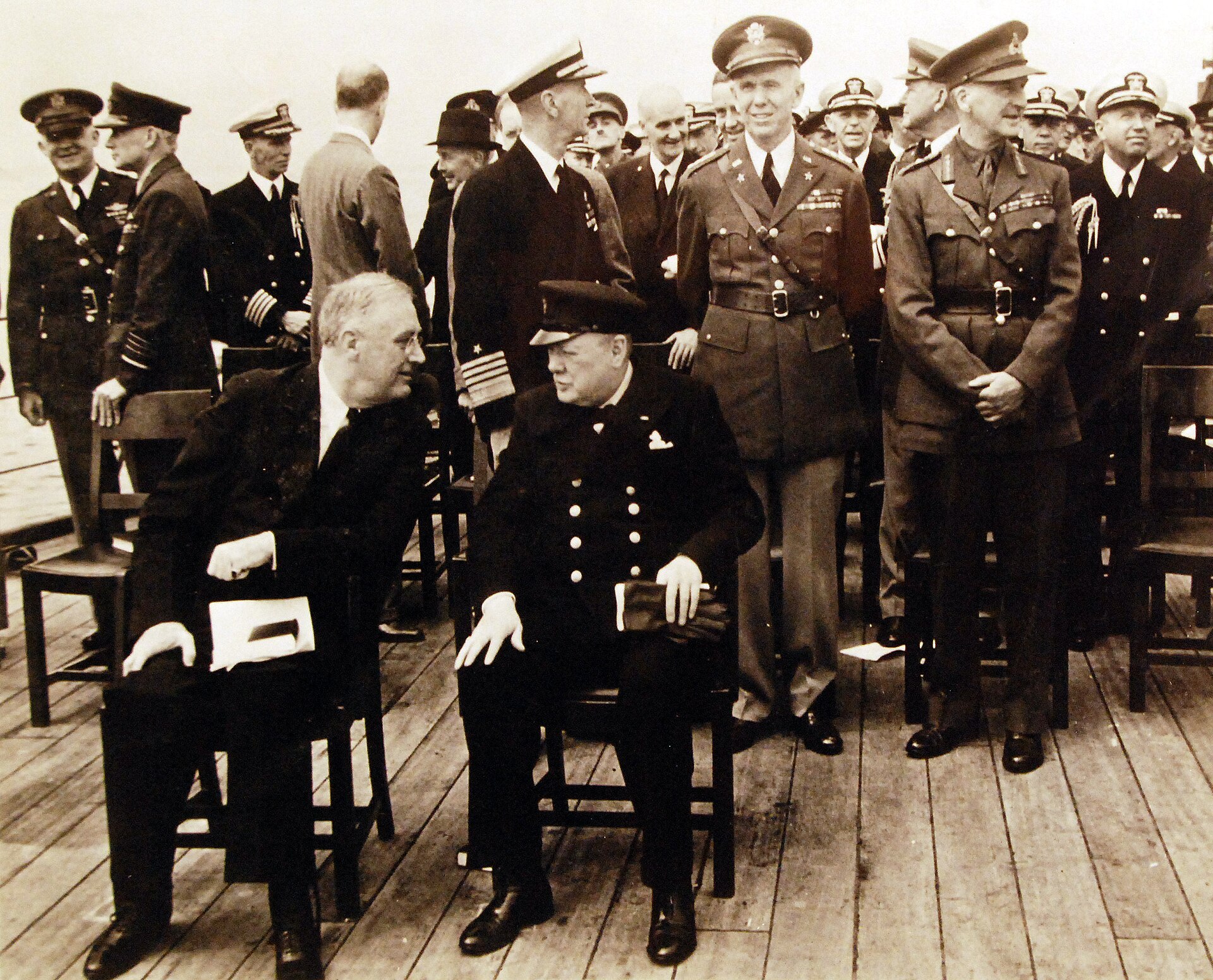
Roosevelt and Churchill met aboard naval vessels in Placentia Bay, Newfoundland, then part of a British dominion. The conference took place from approximately August 9 to August 12, 1941. Churchill traveled aboard the battleship HMS Prince of Wales, while Roosevelt met him from the American cruiser USS Augusta. Senior naval, military and diplomatic advisers participated in discussions about the war and the future.
The public did not initially know the details of the meeting. The leaders’ secrecy reflected wartime security and the sensitivity of talks involving a nation not yet officially at war. Contemporary U.S. Navy photographs show the men aboard the ships, including their attendance at a shared religious service. The image accompanying this article belongs to that conference, but it does not depict a formal document-signing event, because the charter was announced as a joint declaration.
Why the charter was issued on August 14
The eight principles were made public on August 14, 1941, after the meeting had concluded. That is the correct date commonly assigned to the Atlantic Charter. The statement described aims that Roosevelt and Churchill believed could support a more stable world, including arrangements for borders, trade and security. Although it later acquired the familiar name Atlantic Charter, the original document was a declaration of principles rather than a conventional bilateral treaty requiring ratification.
That difference matters because readers sometimes assume both leaders sat down to sign a binding constitution for the postwar world. The statement did not itself establish a world government or require every principle to be enforced immediately by a court. Its importance lay in its public articulation of values and its influence on other Allied declarations. Those ideals were powerful, but interpretation and implementation depended on later political decisions.
Principle 1: no territorial aggrandizement
The first principle declared that the United States and Britain sought no territorial enlargement for themselves. This directly contrasted with aggressive conquest and the redrawing of borders by force. It also served a diplomatic purpose: countries resisting Axis expansion needed reassurance that an Allied victory would not merely exchange one system of empire-building for another.
However, the statement did not automatically dissolve existing colonial empires. Britain’s global possessions remained a central issue when people asked whether the principle applied to territories already governed by European powers. A promise not to seek new territory was easier to make than a general commitment to relinquish old imperial holdings. The tension between those ideas shaped later criticism of the charter.
Principles 2 and 3: borders and the right to choose government
The second principle opposed territorial changes that did not reflect the freely expressed wishes of the people concerned. The third recognized the right of peoples to choose their form of government and supported restoration of sovereign rights and self-government to those deprived of them by force. These statements provided a moral and political critique of military occupation and imposed rule.
Yet ‘peoples’ and ‘self-government’ could be interpreted differently depending on context. Anti-colonial activists heard a promise relevant to their own societies, while Churchill was reluctant to apply the same language automatically to Britain’s colonies. The charter’s force depended in part on this ambiguity. It became influential precisely because people outside Europe could invoke its words against imperial structures that the original governments were not immediately prepared to dismantle.
Principle 4: access to trade and raw materials
The fourth principle supported access, on equal terms and with due regard for existing obligations, to international trade and raw materials needed for prosperity. Wartime blockades, imperial preferences and economic disputes had demonstrated how trade policy could become a source of political tension. Roosevelt’s administration believed a more open international economy could reduce some causes of future conflict.
The principle did not immediately abolish tariffs, preferential trading systems or every treaty governing commerce. British and American policymakers held different views about existing imperial arrangements. Its significance was as a foundation for future discussions about economic order rather than a self-executing trade agreement. Later negotiations, including those connected to Lend-Lease and postwar financial institutions, developed these themes through much more detailed arrangements.
Principle 5: economic cooperation and better labor standards
The fifth principle called for broader economic cooperation intended to improve labor standards, economic advancement and social security. This language reflected memories of mass unemployment and the instability associated with the Great Depression. The leaders presented peace as something more than the absence of armed conflict. A functioning international order also needed conditions in which ordinary people could pursue work and security.
The statement did not prescribe one global minimum wage or establish an immediate international welfare system. It expressed goals that would require domestic legislation and international agreements. The social language is particularly notable alongside the U.S. Fair Labor Standards Act of 1938 and the New Deal’s emphasis on social protection. These were related ideas, not identical legal programs.
Principle 6: peace and freedom from fear and want
The sixth principle envisioned a peace after the destruction of Nazi tyranny in which nations could live within secure boundaries and people could experience freedom from fear and want. It linked international security to social conditions, suggesting that a stable peace required both protection from aggression and freedom from extreme deprivation.
The language echoed Roosevelt’s Four Freedoms address of January 1941, especially his emphasis on freedom from fear and freedom from want. Yet the Atlantic Charter did not guarantee that all populations would immediately attain those conditions. War, colonial inequalities and postwar political conflict remained formidable obstacles. The principle is best understood as an influential aspiration that guided public debate and later institutional planning.
Principle 7: freedom of the seas
The seventh principle stated that a future peace should allow all people to navigate seas and oceans without hindrance. Maritime access was particularly significant during the Battle of the Atlantic, when submarines, blockades and naval warfare endangered merchant shipping. The U.S. and British economies depended on overseas transport, and wartime experience gave the principle immediate practical relevance.
Freedom of the seas was a longstanding diplomatic concept rather than an invention of August 1941. Disagreements persisted about wartime searches, blockades and the rights of neutral vessels. The charter’s language did not settle every aspect of maritime law, but it reinforced a shared commitment to a postwar trading and security environment less vulnerable to arbitrary force.
Principle 8: disarmament and collective security
The eighth principle rejected the use of force as a way to settle international disputes and envisaged the disarmament of aggressor nations while a wider security system developed. It followed the collapse of interwar efforts to prevent expansionist wars through treaties and the League of Nations. Roosevelt and Churchill recognized that defeating the Axis would not automatically make a future war impossible.
The charter did not establish an international police force or a completed United Nations Security Council in 1941. Those institutions and their powers were debated in later years. The eighth principle supplied a direction for postwar security policy rather than a finished enforcement blueprint. Its influence can be traced through later wartime declarations and the creation of the United Nations in 1945.
Why colonial subjects questioned the self-government pledge
People living under European colonial rule could interpret the self-determination principle as relevant to their own demands for independence. In India and elsewhere, anti-colonial leaders questioned why the right to choose a government should apply to occupied European nations but not automatically to Asian or African peoples governed by empires. Churchill resisted interpretations that would immediately transform British imperial relationships.
The contradiction mattered because it revealed limits in the claim that Allied ideals were universally shared or applied. The Atlantic Charter contributed to anti-colonial political arguments even though its authors did not agree on every implication. A historically accurate account should neither dismiss the declaration as meaningless nor claim it instantly promised independence on a fixed timetable to every colonial territory.
The charter’s relationship with the United Nations
On January 1, 1942, twenty-six governments signed the Declaration by United Nations, endorsing common purposes associated with the Atlantic Charter while committing themselves to the fight against the Axis. The declaration marked an important step in Allied political coordination. The term ‘United Nations’ at that stage described a wartime coalition, not yet the permanent international organization established in 1945.
The charter’s principles also informed later discussions over international security, economic cooperation and sovereign equality. But the UN Charter of 1945 was a separate negotiated legal instrument with its own founding conference and ratification process. The Atlantic Charter was an ideological and diplomatic precursor, not the constitutional text of the later organization.
Why the Atlantic Charter remains significant
The Atlantic Charter emerged when Britain was at war and the United States was still formally neutral. Its eight points connected wartime resistance with a vision of postwar borders, trade, social welfare and security. Those aspirations supplied language that later Allied governments and anti-colonial activists could use, sometimes for purposes the original leaders had not fully anticipated.
An accurate history distinguishes the August conference, the August 14 announcement, the December 1941 U.S. entry into war and the January 1942 Declaration by United Nations. It also acknowledges the gap between universal ideals and continued imperial rule. The document is important because it helped frame later international debates rather than because every principle was immediately realized.
Timeline
- March 1941: U.S. Lend-Lease Act signed
- June 1941: Germany invades the Soviet Union
- August 9–12, 1941: Roosevelt and Churchill meet near Newfoundland
- August 14, 1941: Atlantic Charter published
- December 1941: United States enters World War II
- January 1, 1942: Declaration by United Nations signed
- 1945: United Nations established by separate charter
Frequently asked questions
What was the Atlantic Charter?
An eight-point statement of wartime and postwar principles issued by Roosevelt and Churchill.
When was it announced?
August 14, 1941.
Where did the leaders meet?
On naval vessels at Placentia Bay, Newfoundland.
How many principles were there?
Eight.
Was the charter a treaty?
No. It was a joint policy statement rather than a signed and ratified bilateral treaty.
Had the U.S. joined World War II?
No. America entered after Pearl Harbor in December 1941.
Did it promise immediate independence to every colony?
No. The meaning of self-government for existing colonies was disputed.
Did it create the United Nations in 1941?
No. It influenced later Allied declarations and the organization formally founded in 1945.