Selective Service Act of 1917: World War I Draft, Registration and Exemptions
How the United States organized the World War I draft, which men registered and how local boards decided who served.
Quick answer
President Woodrow Wilson signed the Selective Service Act on May 18, 1917, soon after U.S. entry into World War I. It required registration for military service by men in specified age groups, initially 21 through 30, and established a system of local civilian draft boards and selection. The first nationwide registration was June 5, 1917. Registration did not automatically mean induction, and the draft age range expanded during 1918.
Key facts
On this page
- Why the United States needed a draft in 1917
- The law signed on May 18, 1917
- Who had to register in the first round?
- The first registration day: June 5, 1917
- Why a draft lottery was used
- Local draft boards and their powers
- Exemptions, deferments and dependency
- Conscientious objection and opposition to conscription
- Racial inequality and the operation of the draft
- How the registration age range expanded in 1918
- How the World War I draft differed from the Civil War draft
- Why the Selective Service Act matters in history
- Timeline
- FAQ
- Sources
Why the United States needed a draft in 1917
On April 6, 1917, the United States entered the First World War. Its existing military forces were not large enough for the manpower demands that leaders anticipated if American troops were to be deployed overseas on a large scale. Voluntary enlistment remained important, but military planners and lawmakers argued that relying only on volunteers would not provide a sufficiently large, predictable force. Congress therefore considered a method of compulsory selection that could expand the army while distributing obligations across communities and industries.
The decision reopened a longstanding debate about military service in a republic. Supporters of conscription emphasized the demands of war and concerns that recruiting only volunteers might produce unequal burdens. Opponents questioned compulsory service, federal authority and the effects on families and workplaces. The United States had experience with Civil War drafts, but the 1917 system was not simply the same legislation used in 1863. Lawmakers designed a new nationwide registration and selection structure for the industrial-age conflict.
The law signed on May 18, 1917
President Woodrow Wilson signed the Selective Service Act on May 18, 1917. The statute gave the president authority to raise forces through selective military service and established the legal basis for registering men within defined ages. The National Archives describes the act as part of the temporary expansion of the military establishment during World War I. It should not be confused with the permanent modern Selective Service System or treated as a law that automatically conscripted every adult American.
The wording ‘selective service’ was important to the policy’s advocates. Unlike an indiscriminate call for every eligible man to report immediately to a training camp, the framework required men to register and then allowed selection based on administrative procedures and the military’s manpower needs. Registration created a record of those potentially liable for service; induction was a subsequent step. This legal distinction explains why the number of registrants was much higher than the number actually drafted.
Who had to register in the first round?
The original law required registration of men aged 21 through 30 in the specified categories. The obligation was not confined only to men who already held full U.S. citizenship. The statute addressed male citizens and certain noncitizens, including people who had declared their intention to become citizens, with distinctions concerning alien enemies and other legal statuses. Eligibility to register, legal liability for draft selection and actual eligibility for military service were not identical questions.
Women were not required to register under the World War I law, even though many served the war effort through nursing, clerical work, industry and organizations supporting soldiers. Men within the age range could not simply ignore registration because they believed they would later qualify for an exemption. The legal process began with an obligation to supply information and then moved to classification. Readers researching a specific ancestor should separate the presence of a registration card from evidence that the person entered the armed forces.
The first registration day: June 5, 1917
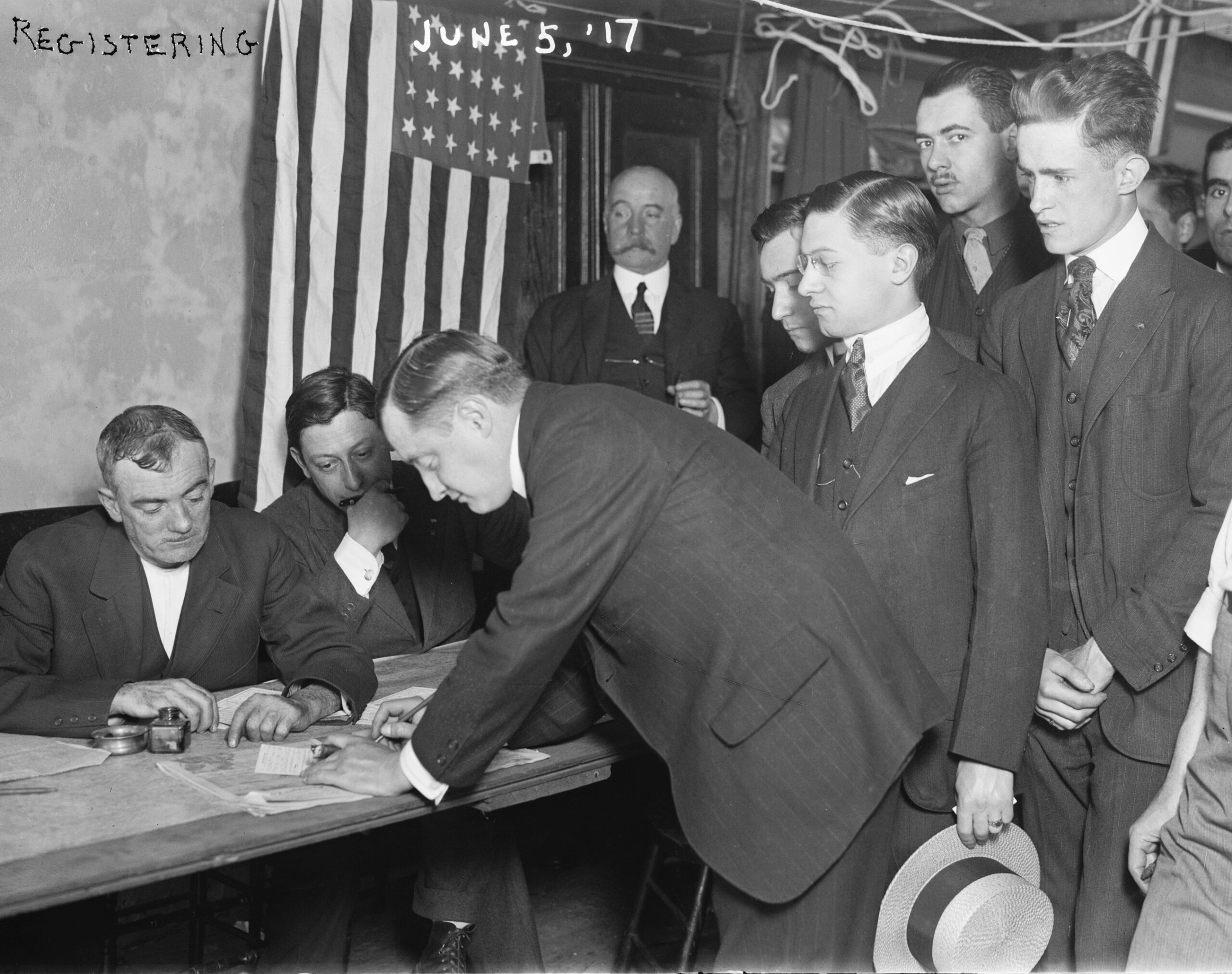
On June 5, 1917, registration offices across the country received men who were liable to register under the initial proclamation. Local officials gathered personal details, including name, age, residence, employment and other information relevant to classification. Photographs of the day show queues of civilian men, office staff and documents. The image accompanying this article depicts registration in New York City; it is evidence of the process at one location rather than an illustration of every community’s experience.
The registration became a major demonstration of the state’s administrative reach. Officials needed to coordinate forms, publicity and procedures across a large country with different languages, occupations and distances. Some men lived far from a central office, while others needed to record their status when away from home. The first registration was not the last, because later legislation brought additional ages into the system. Family historians therefore need to know which registration date applies to a person they are researching.
Why a draft lottery was used
The Selective Service system used a national drawing of numbers to help determine the order in which registered men might be called. The first major lottery took place on July 20, 1917, in Washington. Numbers alone did not decide every individual’s final status, because local boards also considered classifications, exemptions and whether a man was physically qualified. The drawing established an order of potential selection while the classification process determined which men actually became available for induction.
Historical descriptions sometimes say the draft was purely random. That claim misses important parts of the mechanism. Registration order and lottery numbers mattered, but a man’s family responsibilities, occupation, health, citizenship status and administrative classification could affect whether or when he served. The system was designed to combine selection with assessments of the nation’s other needs, including maintaining essential civilian work. Those decisions could be controversial and varied by locality.
Local draft boards and their powers
Local civilian draft boards were central to administration. Working within state structures and under federal supervision, they reviewed registrants and determined classifications. This decentralized arrangement drew on knowledge of communities, employers and families. It also presented risks because officials might apply procedures inconsistently or be influenced by local relationships. Federal rules existed, but they were implemented by many individuals across the country rather than a single desk in Washington.
Registrants could be required to submit evidence about dependents, occupation or other circumstances. The Office of the Provost Marshal General oversaw the system during the war. An archive of registration cards can show that a man supplied identifying information, but it generally does not by itself reveal the complete decision made by a board. Other military or local records may be necessary to establish whether a person was deferred, exempted, inducted or never called.
Exemptions, deferments and dependency
The law and regulations allowed differentiated treatment for people whose circumstances made immediate military service inappropriate or contrary to identified national needs. These categories included considerations related to physical condition, dependent family members and particular occupations. Some men could be deferred because their work was regarded as important for agriculture, industry or other services. The precise classification system changed as administrators gained experience and lawmakers revised the rules.
These provisions were not merely a list of excuses. The country needed food, transport and industrial production as well as soldiers. Yet classification required difficult judgments about whose contribution was more important on the home front and whose family would suffer from removal of a wage earner. Such decisions could be contested and were shaped by social inequalities. A broad statement that all registered men had an identical likelihood of being drafted ignores this administrative dimension.
Conscientious objection and opposition to conscription
Some Americans opposed war on religious, ethical or political grounds. The World War I system contained provisions for certain conscientious objectors, but the scope of recognition was narrow and the treatment of objectors could be harsh. Religious affiliation and willingness to perform noncombatant service influenced how cases were handled. Not all objectors obtained an exemption, and refusal to comply with orders could lead to imprisonment or other penalties.
Opposition to conscription also became entangled with arguments about freedom of speech. The Espionage Act of 1917 penalized specified interference with military operations and recruiting, and later legal controversies examined whether anti-draft advocacy could fall within its provisions. These were different laws, enacted a month apart, with related but distinct purposes. The draft statute established the system of compulsory service; the espionage legislation addressed specified security and wartime interference offenses.
Racial inequality and the operation of the draft
Black men registered and served during the First World War, but they did so within a military and society shaped by segregation and discrimination. Many experienced unequal opportunities, restricted assignments and racist treatment. Local draft boards themselves operated within communities that differed sharply in voting rights and racial hierarchies. A registration law written in broad terms did not guarantee equal treatment at every stage of selection, training or deployment.
The war also occurred during the Great Migration, when large numbers of African Americans left the South seeking work, safety and new opportunities. The draft affected families already moving and negotiating new employment conditions. A complete history should consider both national mobilization and the experiences of people who served or were classified under unequal social circumstances. Aggregate registration numbers alone cannot communicate those differences.
How the registration age range expanded in 1918
Military requirements grew as the war continued. In 1918 Congress widened the age range, and later registration included men aged 18 through 45. This expansion means that the original 1917 requirement of ages 21–30 should not be presented as the rule for every registration card produced during the war. The National Archives distinguishes the various registration events and explains how the age limits changed. Those details are useful for researchers seeking records of relatives of different ages.
Chronology is crucial because a man who was not required to register in June 1917 might later be covered. Others reached the initial age threshold in the following year. A 1918 card and a 1917 card may therefore represent different statutory and administrative moments. Registration remained a step toward possible service, not proof of actual induction. The end of the conflict and demobilization then changed the system’s immediate wartime function.
How the World War I draft differed from the Civil War draft
During the Civil War, federal conscription produced major controversy, including the violent New York City Draft Riots of 1863. The 1917 system used a different national registration structure and selection process. It did not reproduce the Civil War’s controversial commutation provision, under which some men could pay a specified sum to avoid service. Comparing the systems highlights how federal officials adapted conscription to new political conditions and an industrial military.
The earlier draft had generated anger about inequality and forced service, and those issues did not disappear in 1917. But the design of local boards, classifications and a national lottery reflected attempts to organize mobilization more systematically. This historical comparison is more precise than saying American conscription had always operated the same way. Each draft must be evaluated under its own statute, rules and wartime conditions.
Why the Selective Service Act matters in history
The act made it possible to mobilize a much larger American army during the First World War. It also created a massive public record of men who were required to register, even when they never served. Those registration documents are now important sources for family and social history, recording names, addresses, occupations and other facts about millions of people. The records should be interpreted alongside the rules that produced them rather than treated as a roster of soldiers.
The law’s lasting significance lies in the tension between national military needs and individual obligations. It shows how a government can use local civilian administration for a nationwide wartime task, while exposing unequal treatment and controversies over exemption and dissent. The Selective Service Act is thus both a story about military mobilization and a source for understanding the changing relationship between citizens, noncitizens, communities and federal authority in 1917.
Timeline
- April 6, 1917: United States enters World War I
- May 18, 1917: Selective Service Act signed
- June 5, 1917: First major nationwide registration
- July 20, 1917: First national draft lottery
- 1918: Age range expanded to 18–45
- November 11, 1918: Armistice ends major fighting
Frequently asked questions
When was the Selective Service Act signed?
May 18, 1917, by President Woodrow Wilson.
When did first registration take place?
June 5, 1917.
What ages were required to register initially?
Men aged 21 through 30 under the original 1917 rules.
Was everyone who registered sent to war?
No. Registration created liability for potential selection, but classification, deferment, exemptions and military needs shaped induction.
What ages were covered by 1918?
The range was expanded in 1918 to include men aged 18 through 45.
How were men selected?
The system included a national lottery, local draft boards and administrative classifications.
Can a registration card prove someone served?
No. It proves registration; service records are needed to establish whether the person entered the military.
Sources and further reading
National Archives records and original wartime sources support the dates and distinctions explained in this historical guide.