Federal Farm Loan Act of 1916: How Federal Land Banks Changed Farm Credit
Why farmers demanded longer-term loans, how the twelve federal land banks were organized and what the 1916 law actually established.
Quick answer
President Woodrow Wilson signed the Federal Farm Loan Act on July 17, 1916. The act established a Federal Farm Loan Board and a system of twelve federal land banks to provide more dependable long-term mortgage credit to qualifying farmers. Farmers participated through local national farm loan associations, while the banks funded lending with farm loan bonds. The act was an early foundation of the Farm Credit System, not the creation of today’s Farm Credit Administration.
Key facts
On this page
- Why agricultural credit was a national problem
- The demands for rural-credit reform before 1916
- The signing of July 17, 1916
- The Federal Farm Loan Board and twelve land banks
- How national farm loan associations operated
- Where the money for loans came from
- Long-term mortgages and amortization
- Which farmers could benefit, and who could not?
- The first years and the pressure of changing markets
- How the Farm Credit Administration came later
- Why the Federal Farm Loan Act matters
- Timeline
- FAQ
- Sources
Why agricultural credit was a national problem
Farmers in the early twentieth century frequently needed large amounts of money before a harvest produced revenue. Buying land, drainage equipment, livestock and machinery required capital, but crop prices and yields could fluctuate widely. A farmer who borrowed from a short-term lender might need to renew a loan repeatedly or face repayment when the season had been poor. Access to credit also varied greatly by region, since local banks and private lenders operated in different market conditions. Reformers argued that agriculture needed financing that matched the long period required to make land productive rather than terms borrowed from ordinary commercial lending.
Land ownership was not distributed equally. Tenant farmers and sharecroppers faced different barriers from owners with substantial property to mortgage. Discrimination, local land markets and existing indebtedness shaped who could obtain favorable credit. For this reason the act is not accurately described as a universal promise of cheap loans to every farmer. It targeted a particular weakness in long-term real-estate financing and used mortgaged land as the basis for the new system. Understanding whom the law was designed to serve also helps explain the groups who could remain outside its benefits.
The demands for rural-credit reform before 1916
Proposals for cooperative land banks had circulated before Wilson’s administration. Farmers’ organizations, agricultural economists and lawmakers examined European models that pooled mortgage lending and issued bonds backed by land loans. Advocates wanted lower and more stable interest charges and financing structured over years rather than months. The concept was not that the Treasury would simply hand every applicant a grant. It was that borrowers, lenders and investors could be connected through institutions specifically built around agricultural mortgages.
Rural credit debates joined the era’s wider efforts to redesign financial institutions. The Panic of 1907 had highlighted weaknesses in the financial system, while the Federal Reserve Act of 1913 created a system of central banking. Yet general monetary reform did not resolve every long-term farm-mortgage problem. The 1916 act addressed a different financial task: making funds available to landowners who could offer qualified farm real estate as security.
The signing of July 17, 1916
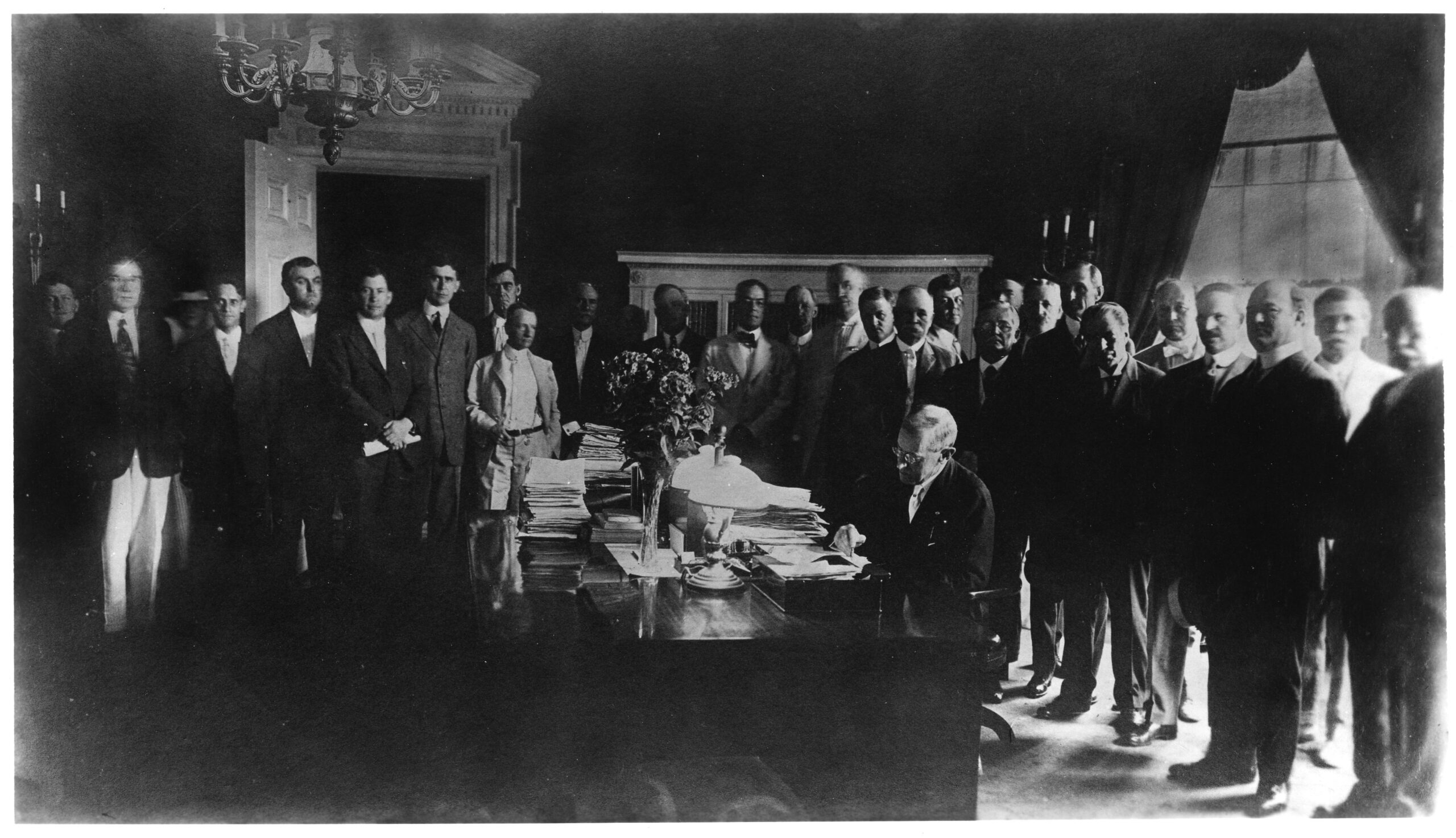
Wilson signed the Federal Farm Loan Act on July 17, 1916. A contemporary government photograph records the signing in an office surrounded by officials and supporters. The act created a Federal Farm Loan Board within the Treasury Department and authorized twelve federal land banks in districts across the continental United States. Its passage represented a federal response to sustained agricultural-credit campaigning, but the legislation did not establish a complete nationwide network the instant the president signed it.
The new board had to organize its offices, divide the country into districts, select land-bank locations and recruit personnel. The board’s first report, preserved in congressional records, describes the substantial administrative work that followed. A law establishing institutions can pass on one day while their capacity to serve customers develops over many months. Histories that place twelve fully functioning banks on July 17, without accounting for that startup period, turn a legislative milestone into an inaccurate description of implementation.
The Federal Farm Loan Board and twelve land banks
The Federal Farm Loan Board supervised the system’s early organization and operations. Each of the twelve federal land banks was assigned a district, providing a regional framework in a country with widely varying agricultural conditions. The design was intended to combine national credit access with institutions that could understand local farm mortgages. Because land values, crops and borrowing practices differed between regions, operating through a district network was a practical and political choice rather than a simple division for administrative convenience.
The 1916 banks were not twelve branches of today’s Federal Reserve, even though both systems were created in the same decade and used regional structures. The Federal Reserve’s responsibilities included currency and commercial banking liquidity. The federal land banks specialized in long-term agricultural real-estate credit. Comparing the two can clarify how policymakers tried to solve distinct financial problems by designing different institutions. It would be inaccurate to say the Federal Farm Loan Act established a general central bank or that the Federal Reserve acquired all farm mortgages.
How national farm loan associations operated
Local national farm loan associations linked borrowers to federal land banks. The arrangements involved qualifying farmers joining associations and participating in the capital structure under the rules of the act. Instead of negotiating exclusively with an unrelated private mortgage lender, members could become part of a cooperative lending framework. An association examined applications and served as a local connection to the regional bank, while loan approval and security requirements still mattered.
This feature was fundamental to the law’s attempt to create a sustainable system. Borrowers were not merely beneficiaries of government charity; they were participants in financial institutions that expected repayment. Mortgage security and association obligations also limited who could qualify. Farmers without sufficient qualifying land, or those caught in tenancy and debt relationships, could have fewer opportunities to benefit. The structure promised a new source of credit, not an automatic transformation of the agricultural social order.
Where the money for loans came from
The federal land banks could issue farm loan bonds supported by qualifying mortgage assets. Investors purchasing those bonds supplied funds for lending, while farmers repaid their mortgages over time. The arrangement aimed to connect the national investment market with agricultural land credit and reduce dependence on the fortunes of a single local lender. The federal government provided startup support for the institutions, but an investor-funded bond market was also central to the plan.
Loan terms, valuation limits and repayment provisions were prescribed by statute and administration. Those protections mattered to both investors and borrowers. If mortgages were carelessly valued, the bonds might lose credibility; if requirements were too strict, many farmers could remain unable to borrow. The success of the framework therefore depended on appraisal, supervision and economic conditions, not simply on the formal authorization to sell bonds. Such practical details are important when assessing the system’s historical significance.
Long-term mortgages and amortization
A distinctive goal was to make repayment more manageable over time. The system promoted long-term mortgages with scheduled payments that reduced principal as well as covering interest, rather than leaving a large sum due after a short interval. Such arrangements could make budgeting more predictable for qualifying landowners, particularly when compared with repeated short-term renewals. A farm’s annual income could still fluctuate, however, and a scheduled mortgage payment was not guaranteed to match the results of a poor harvest.
Amortization does not mean that credit was free or riskless. A borrower remained responsible for the debt, and foreclosure remained a possibility if obligations were not met. Interest rates, appraised land values and allowed purposes shaped loan eligibility. The statute had to balance the desire to help farmers with the need to reassure bond purchasers. That balance explains why the act created a supervised lending mechanism rather than simply capping every rural loan rate regardless of risk or security.
Which farmers could benefit, and who could not?
The land-bank model most directly addressed farmers able to provide qualifying agricultural real estate as collateral. Owner-operators seeking financing for land, improvements and related approved needs could potentially use the system. Others, especially those without land, could not obtain the same form of mortgage credit simply by demonstrating that they worked in agriculture. Tenant farmers and sharecroppers often needed access to land and operating resources before they could even participate in an ownership-based system.
The distinction has particular importance for the post-Reconstruction South, where land tenure and debt relationships shaped rural opportunity. Our discussion of sharecropping after the Civil War and the crop-lien system explains some of the barriers that farm-credit reform alone could not remove. The 1916 act was important for the financing of owners, but it did not immediately undo racial exclusion, poverty or the unequal distribution of land.
The first years and the pressure of changing markets
Organizing banks and associations took time, and the new system confronted economic changes that the original framers could not completely foresee. World War I affected agricultural demand, prices and borrowing decisions. A period of attractive farm markets could encourage expansion, while later declines could make mortgage repayment more difficult. Credit institutions did not remove these uncertainties. They provided a means of financing that farmers and investors had to use within an unpredictable market.
The early Federal Farm Loan Board reported to Congress about the work of establishing the districts, organizing land banks and making the program operational. Those reports are valuable primary sources because they show the administrative sequence instead of attributing all achievements to the signing ceremony. They also remind readers that legal frameworks evolve. Subsequent statutes, economic crises and reorganizations changed the functions and oversight of the institutions founded in 1916.
How the Farm Credit Administration came later
The Farm Credit Administration was established in 1933, much later than the original 1916 law. It reorganized and supervised parts of a developing federal farm-credit framework during the Great Depression. Today’s Farm Credit System traces an important part of its history to the earlier land banks, but the organizations and regulatory arrangements have changed. The phrase ‘the Farm Credit Administration was created in 1916’ is therefore historically inaccurate.
The Farm Credit Administration’s own historical timeline distinguishes the 1916 Federal Farm Loan Act, the opening of the land banks and later federal reorganizations. That institutional continuity deserves attention without erasing the differences. Readers comparing the 1916 system with present-day agricultural lending should use current sources for modern eligibility and rates; a century-old act cannot serve as a contemporary lending guide.
Why the Federal Farm Loan Act matters
The 1916 act marked a major federal effort to make long-term agricultural mortgage credit more accessible and systematic. It used regional land banks, farmer associations, bond finance and federal supervision to address problems that general commercial banking had not solved. In that respect the law belongs beside other Progressive Era institutions, each designed for a distinct function: the Federal Reserve for monetary and banking arrangements, the ICC for transportation and the Farm Loan Board for agricultural mortgage credit.
The act’s legacy is also one of limits and adaptation. Landowners with acceptable security were positioned differently from tenants, while war and depression changed the economic setting. The modern Farm Credit System emerged through later legal changes rather than remaining frozen in 1916. Understanding those boundaries allows a more precise conclusion than saying the statute ‘solved farmers’ money problems’: it created a lasting institutional approach to a particular category of rural finance.
Timeline
- 1913: Federal Reserve Act signed
- July 17, 1916: Wilson signs Federal Farm Loan Act
- August 1916: Federal Farm Loan Board begins organization
- 1917: Federal land bank lending network develops
- 1920s: Farm credit institutions confront changing agricultural conditions
- 1933: Farm Credit Administration created
Frequently asked questions
When was the Federal Farm Loan Act signed?
July 17, 1916, by President Woodrow Wilson.
How many land banks did it create?
Twelve federal land banks, each serving a regional district.
Was it the same as the Federal Reserve Act?
No. The 1913 Federal Reserve Act focused on monetary and banking institutions; the 1916 law organized longer-term farm mortgage credit.
How were loans funded?
Federal land banks used mortgage-backed farm loan bonds, with government startup support and a supervised institutional structure.
Could all farm workers borrow?
No. The land-bank structure primarily served qualifying farmers with agricultural real estate as security.
Did it create the Farm Credit Administration?
No. The Farm Credit Administration was created in 1933, after the original land-bank system was established.
Sources and further reading
Selected primary records and specialist historical collections document the dates, people, and institutions discussed here.