Silent Parade of 1917: NAACP Protest on Fifth Avenue and Its Legacy
Why thousands of Black New Yorkers marched in silence after racist violence in East St. Louis and what they demanded.
Quick answer
On July 28, 1917, roughly 8,000–10,000 African American men, women and children joined the NAACP’s Silent Protest Parade on Fifth Avenue in New York City. The march condemned white mob violence, especially the killings in East St. Louis, Illinois, earlier that month, and demanded federal protection of Black Americans’ rights. Participants marched without speeches or chants while carrying signs that made their grievances clear.
Key facts
On this page
- Why the Silent Protest Parade happened
- The East St. Louis violence in July 1917
- The NAACP and the decision to march
- The route along Fifth Avenue
- Why women and children wore white
- The meaning of silence and banners
- James Weldon Johnson and Black leadership
- How newspapers and photographs recorded the march
- What the march demanded from government
- The longer civil-rights history of public marches
- Legacy of July 28, 1917
- Timeline
- Frequently asked questions
- Sources
Why the Silent Protest Parade happened
The Silent Protest Parade followed a period of racist violence in the United States, including the deadly attacks against Black residents in East St. Louis, Illinois, during the summer of 1917. The organizers wanted a national audience to confront a pattern in which African Americans could be attacked, driven from homes or denied legal protection despite constitutional promises of citizenship. The location was deliberate: Fifth Avenue was among the most visible thoroughfares in New York. Thousands of people walking there without chanting would make the injustice hard to overlook.
The NAACP had been established only a few years earlier. Its leaders viewed public education, political advocacy and legal action as connected strategies. A march could demonstrate disciplined solidarity while placing specific demands before the country. The procession was not a general celebration or a religious pilgrimage. It was a coordinated protest responding to racial terror and the perceived failure of authorities to protect Black lives.
The East St. Louis violence in July 1917
East St. Louis had experienced tensions involving labor, housing, racial discrimination and migration. In July 1917 white mobs attacked Black residents, killing people and burning homes and businesses. Historical estimates of the death toll vary because records were incomplete and some contemporary accounts minimized the scale of the violence. There is no need to assign one disputed total as if all researchers agree. The fact of widespread lethal attacks and the displacement of residents is established by the historical record.
The killings were shocking partly because they occurred during a period in which African Americans were moving to industrial cities for jobs and opportunities. Many families hoped to escape the violence and restrictions of Jim Crow in the South, yet faced dangerous racism elsewhere. The Great Migration was underway, and northern and midwestern communities were changing. The crisis in East St. Louis revealed that migration could not guarantee safety or equal treatment.
The NAACP and the decision to march
The National Association for the Advancement of Colored People drew on networks of churches, community organizations, journalists and civil-rights activists to organize the July procession. Its leadership had already challenged lynching and discriminatory treatment through campaigning and publicity. The founders’ longer goals included legal protections and equal political rights. Our article on the NAACP’s founding in 1909 explains how that institution formed in response to earlier racist violence.
Choosing a quiet procession did not mean the organizers avoided political confrontation. Rather, it expressed mourning, dignity and a public accusation that democratic institutions had failed their citizens. Participants carried signs about murders, injustice and the lack of protection. The method was meant to communicate seriousness and unity without giving hostile observers an easy pretext to dismiss the gathering as disorderly.
The route along Fifth Avenue
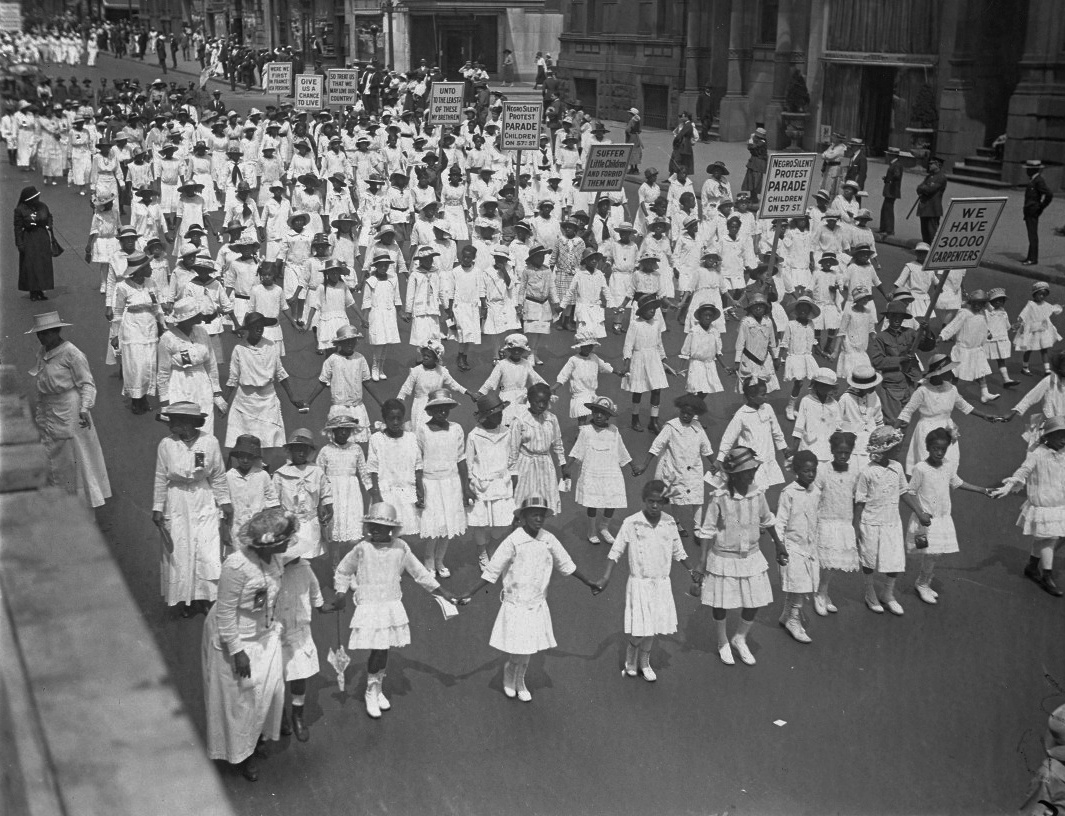
On Saturday, July 28, 1917, thousands assembled to move along Fifth Avenue in New York. The march passed through a prominent public space where spectators could see large groups of people advancing in orderly lines. Contemporary reporting and historic photographs show participants holding placards and banners while people lined the route. It was a remarkable demonstration for its scale and the visibility of Black men, women and children acting together in the heart of a major American city.
Sources differ slightly about how they characterize the starting and ending points, the precise count of marchers and the role of individual organizers. The broadly documented facts—the date, Fifth Avenue, the silent method and the focus on racist violence—are secure. Historical interpretation should avoid building a grand claim on a single unverified headcount or reconstructing the exact route from modern memory alone. The Library of Congress has collected contemporary newspaper reports that can be compared with the surviving images.
Why women and children wore white
The march’s carefully organized appearance made a strong visual impression. Women and children wore white, while many men wore dark suits. The contrast is visible in surviving photographs and newsreel footage. It helped distinguish different parts of the procession and reinforced the protesters’ solemnity. Children walking in the front portions of the march reminded spectators that racial violence endangered entire families rather than only adult political activists.
The dress also demonstrates how early civil-rights organizers thought about public imagery. White clothing provided a coherent appearance and emphasized discipline, but it should not be reduced to one universal symbolic meaning assigned by every participant. Some marchers may have understood it through mourning, moral claims or shared belonging. What historians can establish from photographs and accounts is the collective presentation, the arrangement of participants and the use of public visibility to convey the protest’s aims.
The meaning of silence and banners
Silence was the defining feature, but the demonstration was not wordless. Placards carried direct appeals and accusations, identifying racial violence and asking why a country claiming democratic ideals could permit it. The signs meant spectators could read the protesters’ demands even without speeches. This combination of solemn movement and visible text gave the march a distinctive form of political communication. It challenged the expectation that a large demonstration must be loud to make a point.
Silence also allowed participants to present a disciplined public response to horrific violence. The method was not an admission that the conditions were acceptable; it made mourning and condemnation central to the scene. Organizers could use a tactic that required thousands of participants to cooperate without creating a chaotic procession. Later movements used a wide variety of methods, including sit-ins, boycotts and mass speeches, but the 1917 march is an important early example of carefully staged mass protest.
James Weldon Johnson and Black leadership
James Weldon Johnson, a writer and an important NAACP figure, was among the people associated with the organizing and public interpretation of the parade. His contemporary accounts later helped preserve the meaning of the event. W. E. B. Du Bois and other Black intellectuals likewise used journalism and organizational networks to address racist violence. The event was not the work of one individual: local activists, churches, NAACP staff and ordinary participants made the procession possible.
Recognizing this collective effort matters because accounts that credit only a famous leader can obscure the hundreds of organizational decisions behind a demonstration. Someone had to reach families and church congregations, communicate the plan, organize the procession and coordinate banners. Women who marched and organized, children who participated and people who brought neighbors to the streets were integral to the event’s scale and visibility.
How newspapers and photographs recorded the march
Contemporary newspapers reported on the demonstration, sometimes using racial language that is outdated or offensive today. Historians can quote or describe original titles when necessary while explaining that these terms belong to the source’s era rather than the writer’s own vocabulary. The Library of Congress Chronicling America guides provide articles published around July 28 and 29, 1917. These reports can be compared with NAACP records to examine differences in emphasis or estimates of attendance.
The historic photograph accompanying this article appeared in The Crisis in September 1917 and shows organized rows of women and children in light clothing along Fifth Avenue. It is genuine documentation of the march, not a generic photo of a later civil-rights demonstration. Careful captions protect readers from the confusion that often occurs when historical imagery is reused without dates or places. The existence of still photographs and moving film makes this event unusually tangible more than a century later.
What the march demanded from government
The parade’s participants protested lynching and racial terror and demanded that governments protect Black Americans against violence. These demands drew on the Fourteenth Amendment’s promise of equal protection and broader claims about citizenship and democracy. Federal officials and state authorities had different legal responsibilities, but the protesters saw a national problem requiring serious public attention. By bringing the issue to Fifth Avenue, they sought to challenge political leaders and the wider public to act.
The march did not immediately end lynching, racial segregation or state failures to prosecute white violence. Treating it as an instant victory would distort the difficulties activists faced. Its significance was the articulation of demands on a major public stage and the demonstration of an organizational capacity that could be used in later campaigns. In historical writing, an event can be influential without immediately achieving all its goals.
The longer civil-rights history of public marches
The Silent Protest Parade anticipated later large-scale demonstrations by showing that African Americans could use disciplined collective action to demand public accountability. It did not invent Black political protest: abolitionist mobilization, Reconstruction-era activism, women’s associations and earlier campaigns long predated 1917. Nor was it identical to the marches of the 1950s and 1960s. Its particular context involved the East St. Louis killings and the racial climate of the First World War.
The later March on Washington in 1963 brought a different coalition, set of demands and national circumstances. Comparing the two helps illustrate continuity without erasing change. Both relied on visible assembly and claims to full citizenship, yet differed in their scale, setting, communication methods and immediate political objectives. The history of civil-rights protest is best understood as a collection of related movements rather than a single unbroken blueprint.
Legacy of July 28, 1917
The Silent Parade has become a landmark in the history of the NAACP and public protest against racist violence. It showed the ability of thousands of Black Americans, including children, to make a disciplined claim to equal protection at a moment when deadly attacks had shocked their communities. The organizers chose a tactic that used the city’s most conspicuous spaces, carefully arranged clothing and unmistakable banners to carry the message.
The violence that prompted the protest did not disappear. The Red Summer of 1919 would show how widespread racial attacks remained. That later history makes the 1917 demonstration more significant, not less: it reveals the persistence of a public movement that challenged terror even when immediate protection was elusive. The parade’s legacy is one of civic courage, organized dissent and a demand that citizenship be defended in practice.
Timeline
- 1909: NAACP founding call
- July 1–2, 1917: Deadly white mob attacks in East St. Louis
- July 28, 1917: NAACP Silent Protest Parade on Fifth Avenue
- September 1917: The Crisis publishes photographs of the march
- 1919: Red Summer demonstrates ongoing nationwide racial violence
- 1963: March on Washington uses mass public protest for new civil-rights demands
Frequently asked questions
When was the Silent Protest Parade?
July 28, 1917.
Where did the Silent Parade take place?
Along Fifth Avenue in New York City.
How many people marched?
Contemporary accounts generally describe roughly 8,000–10,000 participants; exact totals vary.
Why was the march silent?
Organizers deliberately used silence and signs to express mourning, condemnation and disciplined protest against racist violence.
What prompted it?
The deadly anti-Black attacks at East St. Louis, Illinois, and the wider pattern of racist violence.
Who organized the march?
The NAACP worked with community leaders, churches and many Black participants to coordinate it.
Sources and further reading
Relevant primary records and historical institutions support the dates and interpretations presented here.