
Battle of Chancellorsville (1863): Lee, Hooker and Stonewall Jackson
How Jackson’s hidden flank march produced Lee’s tactical triumph and a devastating Confederate loss.
The Battle of Chancellorsville, fought in Virginia from late April to May 6, 1863, ended in a Confederate victory. Robert E. Lee divided his smaller army and sent Stonewall Jackson on a flank march that devastated the Union XI Corps on May 2. Union commander Joseph Hooker eventually retreated. Jackson was accidentally wounded by Confederate soldiers and died on May 10, making the victory costly for Lee.
Explore Hooker’s plan, Jackson’s movement around the XI Corps, the battles around the Chancellorsville crossroads and the loss of Stonewall Jackson.
On this page — 23 topics
What happened at Chancellorsville?
The Battle of Chancellorsville was fought from April 30 to May 6, 1863, near Fredericksburg, Virginia. Union General Joseph Hooker tried to outflank Robert E. Lee’s smaller Confederate army. Lee divided his force and sent Thomas J. ‘Stonewall’ Jackson on a daring march around the Union right, leading to a devastating attack on May 2.
The Confederates won, forcing Hooker to retreat across the Rappahannock. However, Jackson was accidentally wounded by Confederate soldiers after his flank attack and died on May 10. The victory increased Lee’s confidence but cost him one of his most capable commanders shortly before the Gettysburg campaign.
Why is Chancellorsville called Lee’s masterpiece?
Lee faced a numerically superior Union army yet chose to divide his force in the presence of the enemy. Rather than surrender initiative, he exploited information about Union movements and used the wooded battlefield to conceal Jackson’s flanking march. The resulting Confederate attack rolled up part of Hooker’s line.
The decision was risky because dividing a smaller army could have allowed Union forces to defeat the separated parts. Later writers often call Chancellorsville Lee’s finest tactical victory, but the praise should not obscure the casualties or Jackson’s death. A tactical success can have serious long-term costs.
Where was the battlefield?
Chancellorsville lay in a region of Virginia known as the Wilderness, west of Fredericksburg. Dense secondary forest, narrow roads, tangled undergrowth and scattered clearings made it difficult for commanders to see movements and coordinate large formations. The Chancellorsville crossroads and nearby Chancellor family house became important landmarks.
The battlefield extended beyond one small village. Union troops approached along several roads, while other fighting took place near Fredericksburg and Salem Church. Modern visitors can explore preserved portions in Fredericksburg and Spotsylvania National Military Park, but road changes and later growth complicate interpretation.
Why was Joseph Hooker commanding the Union?
After the costly defeat at Fredericksburg, Ambrose Burnside was replaced by Joseph Hooker as commander of the Army of the Potomac. Hooker improved some organizational and supply arrangements and sought to restore morale before a renewed campaign against Lee.
His plan combined a turning movement across upper Rappahannock crossings with pressure against Confederate positions near Fredericksburg. In principle, the maneuver could force Lee to respond to threats from more than one direction. Success depended on Hooker exploiting the initiative once his troops had moved into the Confederate rear area.
What was Hooker’s plan?
Hooker intended to move a large portion of his army west of Lee’s main position, crossing rivers and marching toward Chancellorsville, while other Union troops held or threatened Confederate defenses near Fredericksburg. The maneuver was meant to put Lee between converging federal forces.
The opening movements succeeded in gaining an advantageous position, but Hooker then adopted a more defensive posture in the Wilderness. His decision gave Lee an opportunity to concentrate and attack rather than retreat. Historians debate whether cautious leadership, uncertainty or practical conditions most influenced the change.
Who commanded the Confederate army?
Robert E. Lee led the Army of Northern Virginia, with Thomas J. Jackson commanding a major corps. James Longstreet and part of the Confederate army were away from the immediate battlefield during the campaign, reducing the forces Lee could bring against Hooker.
Lee’s response therefore depended on aggressive movement, deception and the ability of subordinates to carry out risky orders. The offensive was not an easy attack by a larger army. It was a gamble made possible by intelligence about the Union position and the willingness of Confederate officers to operate with divided forces.
What happened on May 1?
Hooker’s columns had advanced into the Chancellorsville area, but they encountered Confederate resistance as Lee moved to meet them. After some fighting and conflicting reports, Hooker ordered his forward units to fall back toward defensive positions nearer the crossroads.
This withdrawal ceded ground and initiative at a moment when the Union army had achieved much of its flanking movement. Lee perceived that Hooker might remain on the defensive rather than exploit his numerical strength. The next day’s Confederate plan grew from that assessment of the Union commander’s intentions.
How did Jackson find the Union right flank?
Confederate scouts and staff officers investigated the Union lines and identified a vulnerable right flank held largely by the XI Corps under Oliver O. Howard. Parts of the position were poorly oriented to resist an attack from the west. Reports of Confederate movements did not produce a fully effective response.
Jackson and Lee planned a wide march through wooded country to approach the flank without being detected. The operation required disciplined marching and confidence that a smaller holding force could occupy Union attention while the main striking column moved.
What was Jackson’s flank march?
On May 2 Jackson led roughly 28,000 men on a lengthy march around the Union right, using roads concealed by the Wilderness. Some Union soldiers saw parts of the movement and interpreted it as a Confederate retreat. The division of Lee’s force was extreme: a comparatively small group remained in front of Hooker while Jackson moved toward the rear and flank.
Such a maneuver could have ended disastrously if the Union army attacked the weaker Confederate front at the right moment. Instead, the main Union force remained hesitant. By late afternoon Jackson’s troops were in position to strike the exposed XI Corps.
What happened when Jackson attacked?
Jackson launched his assault late on May 2, hitting Union units whose defenses were not adequately prepared for an attack from that direction. Many federal soldiers fell back in confusion as Confederate formations advanced through camps and roads. Some units resisted and bought time for reinforcements, but the flank was heavily disrupted.
The Confederate attack was one of the war’s most successful large-scale turning movements, although it did not destroy the entire Union army. Darkness and the complexity of the ground made coordination increasingly difficult. The next stage of the battle required Lee’s forces to reconnect their separated formations.
How did Stonewall Jackson get wounded?
After the fighting on May 2, Jackson and members of his staff rode forward to reconnoiter in the darkness. Confederate soldiers mistakenly identified the riders as enemy cavalry and opened fire. Jackson was hit several times, losing the use of his left arm and sustaining severe injuries.
He was evacuated and underwent amputation, but later developed pneumonia and died on May 10. His death was a major blow to Confederate command. The episode is a tragic example of how darkness, confusion and friendly fire could undermine even a successful operation.
Who took over Jackson’s command?
After Jackson was wounded, other Confederate officers took charge of his corps, including J. E. B. Stuart during the critical fighting that followed. The army needed to continue pressing the Union despite the loss of its most prominent subordinate commander.
The transition exposed the importance of command structures able to function when a leader was injured. Confederate units still advanced and fought effectively, but Jackson’s absence created uncertainty about future campaigns. Later debates about Gettysburg often speculate on what he might have accomplished, though such counterfactual claims cannot be proven.
What happened on May 3?
The fighting on May 3 included intense attacks and counterattacks around the Chancellorsville crossroads and nearby wooded areas. Lee’s separated forces moved toward reconnection while Union troops struggled to coordinate a defense. Artillery and infantry fire caused severe losses on both sides.
The battle was not decided solely by Jackson’s late-afternoon attack on May 2. The next day’s clashes were among the costliest portions of the entire engagement. Union units resisted strongly but eventually withdrew from key positions, allowing the Confederates to gain ground near Chancellorsville.
What happened at Salem Church?
Union troops under John Sedgwick attacked Confederate positions around Fredericksburg and advanced westward, threatening Lee’s rear. Fighting developed near Salem Church on May 3–4, where Confederate forces checked Sedgwick’s movement.
The operations were closely connected to the main battle. Had Union forces successfully joined or coordinated pressure, Lee might have faced more serious danger from divided threats. Instead, delays and Confederate concentration prevented Sedgwick from creating a decisive advantage. Chancellorsville is therefore a campaign involving several simultaneous fronts rather than one forest ambush.
Why did Hooker retreat?
After days of fighting and the failure to create a successful combined offensive, Hooker decided to withdraw his army across the Rappahannock. Union forces still had considerable manpower, but their commander lacked confidence in the position and the ability to resume the attack.
The retreat handed the Confederates victory. Historians disagree over the relative influence of Hooker’s personal decisions, poor subordinates, battlefield injuries, communication problems and Lee’s aggressive tactics. No single explanation fully describes the complex sequence of decisions across the campaign.
What were the casualties?
Chancellorsville produced more than 30,000 combined Union and Confederate casualties when killed, wounded and missing or captured are included, though exact totals vary across sources. Confederate losses were particularly serious relative to their smaller army, and Jackson’s death had consequences beyond the immediate figures.
Casualty totals should be separated from deaths alone. The battle’s reputation for daring can overshadow the human cost to soldiers who were wounded or killed in wooded ground where medical care and evacuation were difficult. Both armies continued campaigning after suffering these losses.
Why was Chancellorsville important?
The Confederate victory increased confidence in Lee and helped encourage a new invasion of Northern territory. It also demonstrated the danger of a Union army failing to exploit a numerical and positional advantage. Lee’s decision to divide his force succeeded because Hooker’s army did not take full advantage of the risk.
However, the victory cost Jackson and many experienced soldiers. When Lee marched north toward Pennsylvania later in 1863, his army had lost a major commander and undergone reorganization. The result thus combined tactical brilliance with long-term strategic uncertainty.
Was Chancellorsville Lee’s last major victory?
Lee achieved further successes in some later engagements, so the phrase ‘last victory’ requires qualification. Chancellorsville was among his most celebrated offensive successes before the disastrous Confederate defeat at Gettysburg in July 1863.
It is better to explain the operational result and subsequent campaign than to turn the war into a simple rise-and-fall narrative about one general. The Civil War was decided by armies, supply systems, national resources and politics as well as individual command decisions.
Chancellorsville timeline
The chronology distinguishes Hooker’s initial advance from Jackson’s flank attack, the later fighting and withdrawal.
| Date | Event |
|---|---|
| Apr 27–30, 1863 | Union crossings and approach to Chancellorsville. |
| May 1 | Hooker withdraws toward a defensive position. |
| May 2 | Jackson’s flank march and attack; Jackson wounded. |
| May 3 | Intense fighting around Chancellorsville and Salem Church. |
| May 4–6 | Union withdrawal and campaign ends. |
| May 10 | Jackson dies. |
Frequently asked questions about Chancellorsville
When was it fought? Late April to early May 1863, with major fighting May 1–3.
Who won? The Confederacy under Robert E. Lee.
Who led the Union? Joseph Hooker.
What was Jackson’s maneuver? A flank march around the Union XI Corps on May 2.
How was Jackson wounded? By friendly Confederate fire.
When did Jackson die? May 10, 1863.
Which sources explain Chancellorsville?
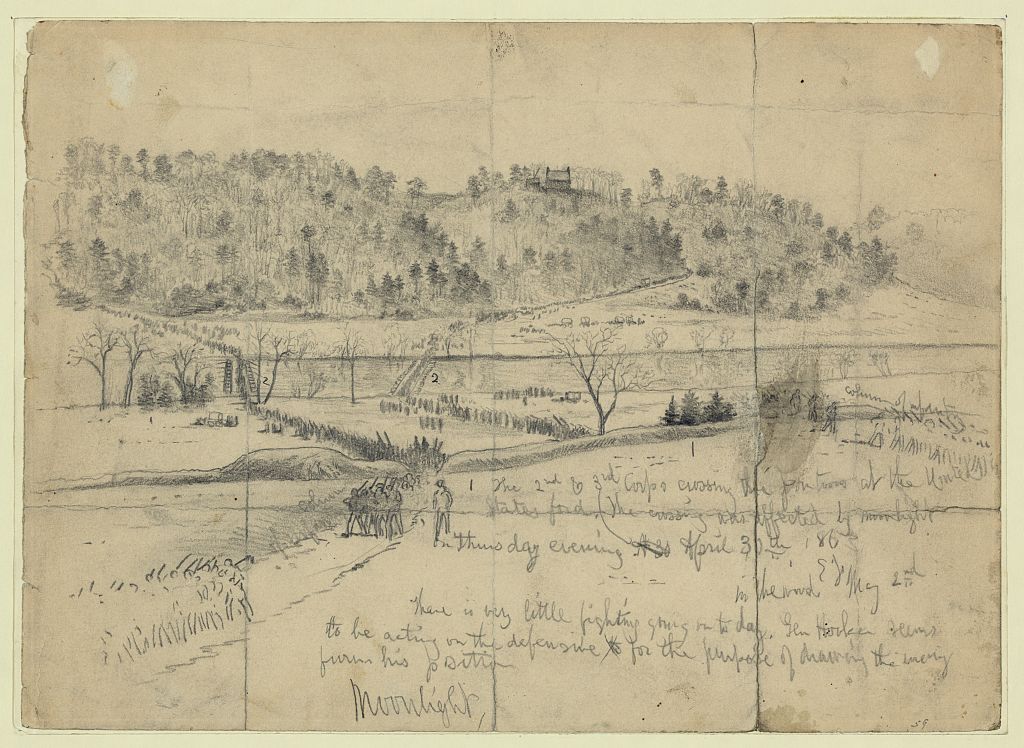
Fredericksburg and Spotsylvania National Military Park preserves the campaign landscape and research. The NPS battle database provides the dates and broad military result, while the U.S. Army chronology places the campaign before Gettysburg. The 1863 drawing by Edwin Forbes shows an artist’s contemporary interpretation of fighting.
Compare narrative sources with detailed maps to understand Jackson’s march and the Union flank. Later claims about what Jackson might have achieved had he survived are speculative and should not substitute for documentation of what actually occurred.

