Gettysburg Address (1863): Meaning, Context and Five Versions
How a brief cemetery dedication speech redefined the war’s meaning for American democracy.
Abraham Lincoln delivered the Gettysburg Address on November 19, 1863, at the dedication of a national cemetery for Union soldiers killed at Gettysburg. In a speech of roughly two minutes, he traced the nation’s founding ideals to 1776 and connected the Civil War to equality, freedom and the survival of democratic government. Five manuscript versions survive, with minor differences in wording.
Explore its historical context, key phrases, drafts, public reception and later use in American civic life.
On this page — 25 topics
What was the Gettysburg Address?
The Gettysburg Address was a brief speech delivered by President Abraham Lincoln at the dedication of the Soldiers’ National Cemetery in Gettysburg, Pennsylvania, on November 19, 1863. It followed the costly Union victory at Gettysburg in July. Lincoln honored those who had died while connecting the Civil War to the nation’s founding principles and the future of democratic government.
Its importance comes partly from its brevity and partly from its argument: the United States was confronting whether a nation committed to liberty and equality could survive a devastating internal conflict. The speech became one of the most widely studied statements in American history.
When and where did Lincoln speak?
Lincoln spoke on Thursday, November 19, 1863, during a ceremony near the Gettysburg battlefield in Pennsylvania. The event dedicated a cemetery for Union soldiers killed in the three-day battle that had ended on July 3. The cemetery was being created to provide a dignified resting place for men whose bodies had often been buried hurriedly in temporary graves.
The address occurred more than four months after the fighting, not while the battle was underway. The location was part of a landscape undergoing enormous physical and emotional changes as residents and officials recovered the dead and prepared the national burial ground.
Why was the cemetery being dedicated?
The Battle of Gettysburg generated tens of thousands of casualties and left an immense burden of burial, medical care and property damage on the town. Pennsylvania officials and local leaders worked to create an organized cemetery for Union soldiers instead of leaving many in scattered battlefield graves.
The dedication ceremony served practical, political and moral purposes. It acknowledged the dead, expressed public gratitude and gave surviving citizens an occasion to consider what their sacrifice meant. The ceremony itself was not a celebration of an easy military triumph; it came amid a war that continued to claim lives daily.
Who invited Lincoln?
David Wills, a Gettysburg attorney involved in organizing the soldiers’ cemetery, invited Lincoln to make brief appropriate remarks. The principal oration was assigned to Edward Everett, one of the nation’s best-known public speakers. The difference in assignments helps explain the contrast between the long formal address and Lincoln’s short remarks.
Lincoln was president during a continuing civil war and faced political opposition, military uncertainty and the immense challenge of emancipation. The invitation offered an opportunity to connect the Union cause with enduring national ideas. His words were addressed to mourners but also to a wider American public receiving reports of the ceremony.
Who was Edward Everett?
Edward Everett was a celebrated orator, scholar and former politician who delivered the ceremony’s main address. He spoke for approximately two hours, drawing on classical references, battle details and the traditions of nineteenth-century commemorative oratory. Contemporary audiences were familiar with much longer formal speeches than many modern listeners expect.
Lincoln’s much shorter address followed Everett’s oration. It would be misleading to claim that Everett was simply a foolish speaker whose long address no one appreciated. His role was respected, and he later praised Lincoln’s ability to express the occasion’s central idea concisely. Comparing the two speeches shows different rhetorical approaches to the same event.
How many words did Lincoln use?
The Gettysburg Address is often said to contain 272 words, but the precise total depends on which historical manuscript version is counted and how some words or punctuation are interpreted. Several text versions survive, with small differences in wording, capitalization and phrasing.
For students, the important point is that the speech was extremely short compared with Everett’s formal oration. Its structure was deliberate rather than careless. Lincoln moved quickly from the founding of the nation through the war’s challenge to a renewed promise of democratic government, making the speech memorable without attempting to summarize the entire battle.
What does ‘four score and seven years ago’ mean?
The opening phrase means 87 years earlier. Lincoln was speaking in 1863, so the calculation points to 1776 and the Declaration of Independence. He deliberately selected the year of the declaration rather than 1787, the year of the Constitutional Convention.
This choice located the moral foundation of the United States in the claim that people are created equal. It also reframed the Civil War as a contest over the fulfillment of the nation’s founding ideals. Lincoln did not mean that the Constitution was irrelevant; rather, he stressed the declaration’s promise at a moment when slavery and secession challenged the country’s future.
Why did Lincoln refer to equality?
The Declaration of Independence had proclaimed a principle of human equality, yet slavery continued in the United States for decades afterward. Lincoln drew attention to this contradiction in 1863, the same year his Emancipation Proclamation took effect in territories under rebellion. The speech’s equality language connected military sacrifice with a larger moral and political purpose.
Lincoln’s own views on race developed over his career and cannot be reduced to the ideals of one address. Moreover, the speech did not immediately provide voting rights or equal treatment to formerly enslaved people. It articulated a national aspiration that later Americans would invoke during struggles over citizenship, civil rights and democracy.
What was the ‘new birth of freedom’?
Lincoln described the war as an opportunity for the United States to experience a renewed commitment to freedom. The phrase is frequently interpreted in light of emancipation and the transformation of the Union’s war aims. Preserving the United States was still fundamental, but national restoration would have to address slavery more directly.
It would be inaccurate to claim that the Gettysburg Address by itself abolished slavery. The actual legal steps included military action, the Emancipation Proclamation and the ratification of the Thirteenth Amendment in 1865. The speech matters because it expressed a moral direction for the conflict while those political and legal developments were unfolding.
What does government by the people mean?
The speech’s ending defended the possibility of representative self-government. Lincoln argued that the outcome of the war would test whether a nation based on popular political authority could endure rather than fragment through armed rebellion. The phrase became a widely quoted statement of democratic ideals.
Its historical meaning should be considered alongside the limits of democracy in 1863. Women were excluded from most formal voting, enslaved people faced bondage and many citizens of color lacked equal political rights. Lincoln offered an aspiration about political legitimacy, not a complete description of how fairly the United States already governed.
Did Lincoln expect the address to be remembered?
Popular folklore claims Lincoln thought the speech was a failure, but surviving correspondence and contemporary reporting do not support a simple story of universal disappointment. Some newspapers praised its words, while partisan critics attacked its interpretation of national origins and military sacrifice.
The speech’s later status grew as Americans repeatedly quoted, printed and taught it. Its modern reputation was not a single instantaneous vote by every listener on the cemetery grounds. Reactions depended on political affiliation, interpretations of emancipation and the expectations people brought to a public memorial ceremony.
How many versions of the speech survive?
Five handwritten copies associated with Lincoln survive, conventionally named after people who received them: Nicolay, Hay, Everett, Bancroft and Bliss. The texts contain small differences, and historians examine their relationship to the words spoken in Gettysburg. The Bliss copy became especially influential as a standard printed text.
These variations are not evidence that the speech was fabricated decades later. They show how Lincoln wrote and supplied copies for different purposes. The Library of Congress exhibition presents manuscript history and helps distinguish drafts, later fair copies and newspaper transcripts.
Was the speech written on an envelope?
A persistent story says Lincoln wrote the entire speech on the back of an envelope during the train journey to Gettysburg. The surviving manuscript evidence contradicts this simplified legend. Lincoln had prepared the speech before the ceremony and worked on its wording in connection with his trip, but the famous envelope scene should not be treated as established fact.
The story appeals because it portrays a great speech as spontaneous inspiration. The historical record instead suggests deliberate composition and revision. The exact sequence of drafts remains a subject of scholarly analysis, but Lincoln did not simply invent all the words moments before walking to the speaker’s platform.
What was the Nicolay copy?
The Nicolay manuscript is often discussed as an early version of the speech, associated with Lincoln’s private secretary John G. Nicolay. It differs in some details from later copies and is important to efforts to reconstruct the address’s drafting history. The physical document and its revisions provide evidence about Lincoln’s writing process.
A manuscript can reveal authorial choices but does not necessarily prove exactly what every listener heard on November 19. Contemporary newspaper transcriptions also vary. Historical scholarship considers several witnesses rather than assuming one version resolves every question about delivery.
What was the Bliss copy?
The Bliss copy was prepared by Lincoln after the ceremony for a charitable publication project. It is the only surviving copy that he signed, and it has become the source for many standard reproductions of the address. Its punctuation and wording differ in some respects from earlier manuscripts.
Students who compare historical copies should record which version they are quoting. This matters when counting words or debating small textual differences. The variations do not change the address’s central themes of national endurance, equality and self-government, but they reveal the process by which a public speech became a fixed civic text.
Did photographers capture Lincoln speaking?
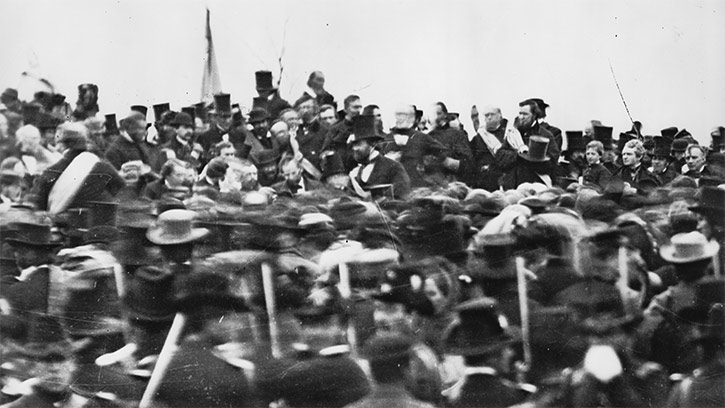
Photographs survive from the Gettysburg cemetery dedication, and Lincoln has been identified in the crowd in certain images, but there is no verified detailed photograph capturing him at the precise instant of delivering the address. Nineteenth-century camera exposure times were too long for modern action photography.
The featured image for this article shows the ceremony setting rather than a close-up of the speech itself. Readers should distinguish a photograph made at the event from a painting created afterward. Each medium can be useful, but only the former provides direct visual evidence for the gathering’s appearance.
How did the press respond?
Newspapers printed versions of Lincoln’s remarks and assessed them through the political divisions of the Civil War. Union-supporting editors often praised the speech’s clarity and patriotic themes, while some opponents objected to its interpretation of equality or the war’s aims. Reactions were neither perfectly unanimous nor permanently fixed.
The press preserved important early versions of the words, yet reporters could miss phrases or change punctuation. A nineteenth-century transcript is valuable evidence but should be compared with manuscripts and other accounts. It is a mistake to rely on one sensationally negative editorial as proof that audiences generally hated the address.
Why was Gettysburg a turning point?
In July 1863, Union forces under George G. Meade defeated Robert E. Lee’s Confederate invasion of Pennsylvania. The victory ended an important offensive campaign but cost tens of thousands of casualties. The soldiers’ cemetery commemorated part of that human sacrifice.
Lincoln’s November speech turned attention from tactical events to the larger meaning of the war. He did not give a detailed analysis of Pickett’s Charge or the positions on Little Round Top. Instead he asked what responsibility the living held after so many soldiers had died. The distinction between a battle guide and an address guide prevents overlapping search intent.
How did the address influence civil rights?
Later advocates for abolition, equal citizenship, voting rights and constitutional democracy repeatedly cited the Gettysburg Address. Its assertion of equality provided language for criticizing discrimination, even though the United States did not fulfill that ideal immediately. The speech became part of debates about what the country’s founding commitment required in each generation.
Historical influence does not mean everyone interpreted Lincoln’s words in the same way. Different political movements invoked the address for competing purposes. A careful account distinguishes Lincoln’s 1863 circumstances from how later activists and officials applied his language to their own struggles.
How is the Gettysburg Address commemorated?
The Gettysburg cemetery, memorials, museums and school curricula preserve the speech as a central moment in national memory. Lincoln’s words appear on monuments and in public ceremonies, and the address is widely used to introduce students to the relationship between the Declaration of Independence and the Civil War.
Commemoration can emphasize inspiring language without conveying the enormous loss of life behind the ceremony. Visiting the cemetery or reading soldier letters helps restore the setting in which Lincoln spoke: a country at war, communities mourning and a government struggling to define the meaning of freedom.
Gettysburg Address timeline
Separate the July battle from the November dedication and later manuscript history.
| Date | Event |
|---|---|
| July 1–3, 1863 | Battle of Gettysburg. |
| Summer–autumn 1863 | National cemetery organized. |
| Nov 19, 1863 | Edward Everett and Lincoln speak at the dedication. |
| 1864 | Lincoln supplies additional handwritten copies. |
| Later decades | Speech becomes a central civic text. |
Frequently asked questions
When was the Gettysburg Address? November 19, 1863.
How long was it? Around two minutes; its exact word count depends on the manuscript version.
Who gave the main oration? Edward Everett.
What does four score and seven mean? Eighty-seven years, pointing to 1776.
How many Lincoln manuscript copies survive? Five.
Did it end slavery? No, it articulated a commitment to freedom while emancipation progressed through other measures.
Where can the text and manuscripts be studied?
The Library of Congress exhibition compares major manuscript versions and the speech’s contemporary reception. The exhibition objects include historical photographs and manuscripts, while Gettysburg National Military Park explains the cemetery dedication. For deeper research, the Abraham Lincoln Papers provide a larger documentary setting for the president’s work.
Compare copies before quoting a specific phrase or claiming an exact word count. A public speech changes as it circulates in newspapers, private copies and memorial inscriptions; that history is part of understanding why the address became so influential.