Scottsboro Boys Trials (1931): False Accusations, Supreme Court Cases and Legacy
How nine Black youths were falsely accused in Alabama, why early death sentences were overturned, and what Powell and Norris established about due process.
Quick answer
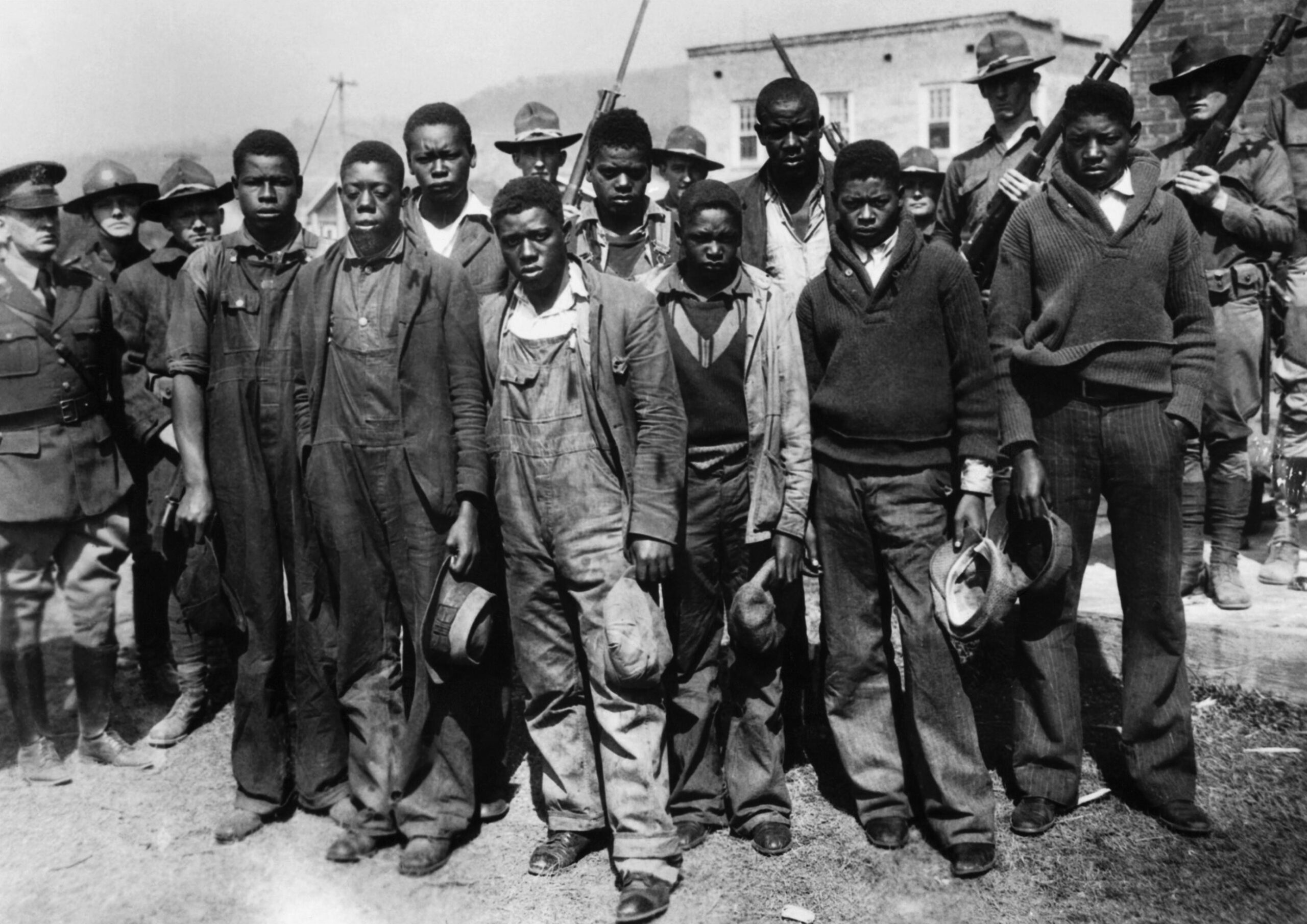
On March 25, 1931, nine young African American men were arrested near Scottsboro, Alabama, after two white women accused them of rape aboard a freight train. Eight received death sentences in hurried trials; the youngest defendant’s first trial ended without a verdict. The U.S. Supreme Court reversed convictions in Powell v. Alabama (1932) because of the denial of effective legal assistance, and Norris v. Alabama (1935) addressed racial exclusion from juries. Retrials, imprisonment and struggles for exoneration continued for decades.
Key facts
On this page
- The freight-train confrontation on March 25, 1931
- The danger of lynching and the initial arrests
- The rushed Alabama trials of April 1931
- The absence of meaningful legal representation
- Powell v. Alabama in 1932
- Retrials and the recantation of Ruby Bates
- Norris v. Alabama and jury discrimination
- The role of civil-rights groups and political campaigns
- The differing outcomes for the nine defendants
- The final posthumous pardons in 2013
- Why the Scottsboro case still matters
- Timeline
- FAQs
- Sources
The freight-train confrontation on March 25, 1931
Nine African American youths were riding a Southern Railroad freight train through northern Alabama at a time when many young people traveled in search of work. A confrontation developed among passengers, and authorities stopped the train near Scottsboro. Two white women, Victoria Price and Ruby Bates, subsequently accused the Black youths of rape. The accusations brought the men under immediate threat in an atmosphere of Jim Crow segregation and the possibility of mob violence.
The men were Haywood Patterson, Clarence Norris, Charlie Weems, Andy Wright, Roy Wright, Ozie Powell, Olen Montgomery, Willie Roberson and Eugene Williams. Their ages and circumstances varied, and they did not form an organized group before the train incident. Using the familiar name Scottsboro Boys does not mean their lives and legal experiences were interchangeable. The original allegations were false, but the state’s treatment of them as established fact led to consequences lasting decades.
The danger of lynching and the initial arrests
The arrests occurred in a society where racial accusation could place a Black defendant’s life in immediate danger. Officials guarded the defendants amid threats from white crowds, and the National Guard was deployed to help prevent mob violence. The presence of guards did not mean the legal process was fair. Criminal procedures, appointed counsel and jury selection remained shaped by racial inequality and the urgency with which officials pursued convictions.
Public excitement and racist assumptions affected the courtroom environment. Some newspapers presented the defendants as guilty before evidence had been carefully examined. Historians have relied on court records and later testimony to reconstruct the sequence and distinguish rumor from established events. The Red Summer of 1919 and Tulsa massacre of 1921 provide broader context for the real threats Black communities and defendants faced.
The rushed Alabama trials of April 1931
Trials began in early April before all-white juries. Defense representation was inadequate, and counsel lacked the time and opportunity to investigate serious accusations. Within days eight of the nine defendants were convicted and sentenced to death. The case of Roy Wright, the youngest defendant, ended without a final jury verdict because jurors disagreed over punishment. It would therefore be inaccurate to state that all nine received death sentences in the first trials.
The speed and severity of the verdicts shocked observers. The prosecution’s case relied heavily on the women’s allegations, and substantial evidence contradicted the charges. Judges and officials proceeded in a climate where racial prejudice made an impartial trial exceptionally difficult. The historical issue was not only whether the men committed the alleged offense, but whether a system could protect fundamental legal rights when popular feeling demanded convictions.
The absence of meaningful legal representation
Although lawyers appeared during the original proceedings, the defense was not prepared in a way capable of providing meaningful assistance in a capital case. Lawyers had little time to investigate witnesses, gather evidence or formulate arguments. Courts sometimes treated the formal appointment of counsel as though that alone satisfied the obligation to provide a fair trial. The Scottsboro record exposed the inadequacy of such an approach where defendants faced death.
The defendants’ poverty, youth, isolation and the racial hostility surrounding the trials made legal assistance especially important. A meaningful defense required opportunities to question the accusations and contest evidence, not merely an attorney standing in a courtroom. Later Supreme Court review focused on those circumstances. The case became a major milestone because it clarified that due process could require effective appointment of counsel in a state capital prosecution.
Powell v. Alabama in 1932
In November 1932 the U.S. Supreme Court decided Powell v. Alabama and reversed the convictions before it. The Court held that the failure to give the defendants reasonable time and meaningful assistance of counsel violated the Due Process Clause of the Fourteenth Amendment under the circumstances of the capital proceedings. The decision did not acquit all the accused or declare that no subsequent prosecution could occur; it required legal proceedings that satisfied constitutional standards.
The decision is often summarized as establishing the right to a lawyer. That captures its broad influence but needs precision. Powell concerned indigent defendants in a highly particular capital case, and later decisions extended and clarified the right to counsel for other state criminal proceedings. Gideon v. Wainwright in 1963 became another landmark. Describing Powell as if it immediately resolved every problem of public defense across the country oversimplifies the subsequent legal history.
Retrials and the recantation of Ruby Bates
After Powell, Alabama continued prosecuting several of the men. Ruby Bates recanted her earlier accusation and testified that the claimed rape had not happened. Her recantation became central evidence challenging the prosecution, but cases still proceeded, with multiple convictions and appeals. Judge James E. Horton set aside one of the guilty verdicts after expressing grave doubts about the evidence. The state then reassigned proceedings, and further trials followed.
These developments demonstrate why a Supreme Court reversal did not immediately restore liberty. The prosecution could retry charges, while the defendants still faced hostile settings, continued detention and lengthy legal campaigns. Different defendants experienced different outcomes, and later summaries often blur them together. A historically reliable account follows the specific procedural stages rather than announcing that all nine were freed by the Court in 1932.
Norris v. Alabama and jury discrimination
In 1935 the U.S. Supreme Court decided Norris v. Alabama, finding that the systematic exclusion of Black people from jury service violated equal protection under the Fourteenth Amendment. Although Black citizens were technically eligible for jury duty, evidence showed that qualified Black residents had been excluded from jury rolls. The ruling examined the practical operation of jury selection rather than accepting neutral-sounding descriptions of a system that consistently excluded an entire racial group.
Powell and Norris addressed different constitutional failures. Powell concerned meaningful counsel in a capital case; Norris concerned discriminatory selection of jurors. Neither decision meant that all racial discrimination in criminal courts disappeared immediately. Their importance lies in defining legal protections that defendants could invoke and that officials were obliged to respect. The broader history of political equality after Reconstruction shows how formal rights often coexisted with substantial exclusion.
The role of civil-rights groups and political campaigns
The case attracted support from different organizations, including the International Labor Defense, associated with the Communist movement, and the NAACP. The groups did not agree on every tactic, and conflict over representation became part of the wider story. Public campaigns raised money, circulated petitions and drew attention to the treatment of the defendants. Writers and activists used the case to expose the dangers of racially biased criminal justice in the Depression-era South.
The international attention does not mean organizers were always united. Some focused primarily on the fate of the individuals, others saw the trials as evidence of a wider system of class and racial oppression, and lawyers had to make immediate legal choices. Their competing strategies created tensions alongside a shared concern about injustice. The case helped civil-rights movements demonstrate how local proceedings could be challenged through national organizing and constitutional litigation.
The differing outcomes for the nine defendants
By 1937 the state dismissed charges against five of the defendants, while others remained imprisoned or faced continued sentences. Some men were paroled in the 1940s, and others escaped or died after years of legal uncertainty. No single release date applies to all nine. The National Archives and PBS provide detailed chronologies showing the differing experiences of the accused. Grouping those men under a memorable name must not erase what happened to each person.
Clarence Norris survived into the late twentieth century and was pardoned by Alabama Governor George Wallace in October 1976. That pardon came decades after his original death sentence, showing how long the case’s consequences lasted. Other defendants had already died, complicating the possibility of personal vindication. The story of individual lives thus continues well beyond the famous Supreme Court opinions of the 1930s.
The final posthumous pardons in 2013
In 2013 Alabama adopted legislation permitting posthumous pardons in the case. On November 21, 2013, the Alabama Board of Pardons and Paroles granted pardons to Haywood Patterson, Charlie Weems and Andy Wright, the three remaining defendants whose convictions required such action. The Alabama parole board’s own annual report records the names and the date. It is misleading to claim that a court suddenly issued one blanket acquittal of all nine defendants in 2013.
The posthumous pardons represented a formal acknowledgment of injustice but could not restore years lost in prison or remove the harm experienced by families. They also arrived after a long period of scholarship and community remembrance. The case remained important because the injustice was documented through court records, later research and the testimony of people who had lived through its consequences.
Why the Scottsboro case still matters
The Scottsboro prosecutions are a defining example of false accusation, inadequate counsel and racial exclusion from juries. The original verdicts were imposed rapidly under a threat of mob violence, and the men endured years of retrials and punishment despite evidence undermining the charges. Supreme Court intervention established important principles, but enforcement and reform were uneven. The distance between a constitutional judgment and a fair outcome for a defendant is part of the historical lesson.
The case belongs alongside the NAACP’s early campaigns and other struggles for equal protection, but it deserves separate treatment because its procedural details shaped constitutional law. Reading Powell and Norris alongside original records shows that a right has practical meaning only when institutions implement it. The nine defendants’ experiences reveal the human cost when that duty fails.
Timeline
- March 25, 1931: Nine youths arrested
- April 1931: First hurried trials and eight death sentences
- November 1932: Powell v. Alabama overturns convictions
- 1933–1934: Retrials and recantation testimony
- April 1935: Norris v. Alabama addresses jury exclusion
- 1937: Charges dismissed against five defendants
- 1976: Clarence Norris receives pardon
- November 2013: Three posthumous pardons granted
Frequently asked questions
When were the Scottsboro Boys arrested?
March 25, 1931, after a freight-train incident in northern Alabama.
How many were accused?
Nine African American teenagers and young men.
Did all nine receive the death penalty?
No. Eight were sentenced to death in the early trials; the youngest defendant’s case did not yield a final verdict.
What was Powell v. Alabama?
A 1932 Supreme Court decision overturning convictions because the defendants were denied meaningful legal assistance in a capital case.
What was Norris v. Alabama?
A 1935 Supreme Court decision finding systematic racial exclusion from juries unconstitutional.
Did Ruby Bates recant?
Yes. She recanted her rape allegation and testified in defense of the accused.
When were the last posthumous pardons issued?
November 21, 2013, for Patterson, Weems and Andy Wright.