Fifteenth Amendment (1870): Voting Rights, Text and Limitations
What the amendment prohibited, who it protected and why enforcement remained contested.
The Fifteenth Amendment, ratified February 3, 1870, prohibits the United States and states from denying voting rights because of race, color or previous condition of servitude. It did not grant universal adult suffrage or immediately prevent intimidation and discriminatory election rules.
This article explains the original wording, Reconstruction politics, enforcement laws and the longer voting-rights history.
On this page — 20 topics
What is the Fifteenth Amendment?
The Fifteenth Amendment is part of the United States Constitution and prohibits federal or state governments from denying or abridging the right to vote on account of race, color or previous condition of servitude. Ratified on February 3, 1870, it was the third Reconstruction Amendment, following the abolition of slavery in 1865 and the citizenship and equal-protection provisions ratified in 1868. It represented a major constitutional change after the Civil War, when many Black men had previously been excluded from formal political participation. But the amendment did not abolish every voting restriction or provide the vote to women. Its actual effect depended on federal enforcement, state election rules and the ability of citizens to vote without violence or intimidation.
When was it ratified?
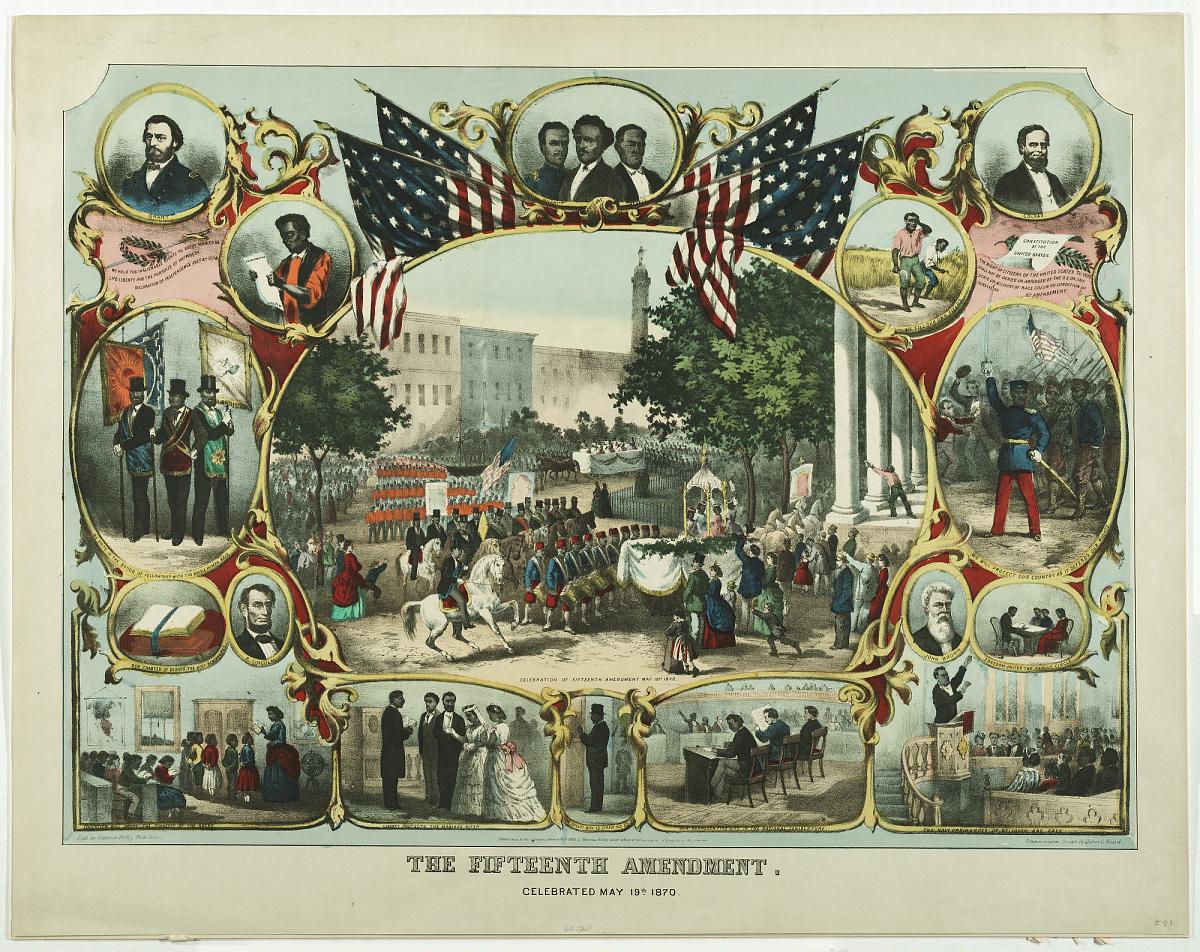
Congress proposed the Fifteenth Amendment in February 1869, and the required number of states ratified it on February 3, 1870. The secretary of state formally announced its ratification later that month. Popular depictions often emphasize celebrations held in 1870, including commemorative prints showing Black civic participation. These images capture the enormous public significance of the amendment but should not be mistaken for a legal document. The precise date matters because the right to vote had already been extended to Black men under some Reconstruction state constitutions before the amendment became national law. The amendment gave the principle a constitutional foundation applicable beyond the particular Southern political arrangements of the late 1860s.
What does the text actually say?
The first section bars denial or abridgment of voting rights by the United States or any state because of race, color or a previous condition of servitude. The second gives Congress power to enforce that prohibition through appropriate legislation. This is a narrower guarantee than a statement that every adult citizen may vote under all circumstances. The wording left room for states to establish qualifications that were not explicitly based on race, subject to other constitutional limitations. Later officials exploited that distinction to impose discriminatory restrictions. The National Archives’ original text is the best starting point, because casual summaries can blur the difference between the amendment’s precise prohibition and its broader democratic importance.
Why was it necessary after the Fourteenth Amendment?
The Fourteenth Amendment granted national citizenship and protected due process and equal protection, but it did not simply guarantee the vote to every citizen. Section 2 addressed the relationship between male voting rights and representation without establishing universal male suffrage. Congressional Republicans continued debating whether racial restrictions on the franchise should be prohibited nationally. The Fifteenth Amendment answered that question through a specific rule focused on race, color and previous servitude. Its adoption was related to the expansion of Black political participation under the Reconstruction Acts, but went beyond the ten states that were subject to military district legislation. The amendments are linked but their legal subjects should not be treated as identical.
Did the amendment give women the right to vote?
No. The Fifteenth Amendment did not prohibit voting discrimination based on sex. Some women who had campaigned for abolition and equal rights hoped the Constitution would protect a broader franchise, and the amendment contributed to serious disagreements within the women’s suffrage movement. Black women continued organizing and asserting political influence even without equal ballot access. Nationwide constitutional protection against denial of voting rights because of sex did not arrive until the Nineteenth Amendment was ratified in 1920. Treating the Fifteenth Amendment as a universal adult suffrage provision erases this limitation. It also overlooks that women and men faced different legal, social and economic barriers during Reconstruction.
Which men benefited immediately?
The amendment was especially important to African American men whose voting rights had been restricted before or after the Civil War. In several Southern states Black men were already voting under Reconstruction constitutions, while elsewhere the amendment offered a national rule against explicit race-based exclusion. Black communities organized political meetings, voter education and electoral campaigns, and the ability to vote changed local and state politics. However, eligibility on paper did not mean everyone could register or cast a ballot safely. Residency rules, threats and unequal administration could still obstruct participation. African American political action was essential: the amendment did not create a passive electorate, but strengthened efforts already underway in churches, civic organizations and political associations.
How did the amendment affect Southern politics?
Reconstruction brought major changes to state legislatures, constitutional conventions and congressional representation. Black voters helped elect local officers, lawmakers and members of Congress, often through Republican coalitions that also included white Unionists and migrants from the North. These governments developed public schools and other reforms but faced intense opposition from former Confederates and white supremacist organizations. The Fifteenth Amendment gave national constitutional status to one critical political right within this struggle. Its effect differed from state to state, because political organizations, population patterns, election administration and the presence of federal troops varied. A meaningful history must examine these local differences rather than assuming that the South changed uniformly on one ratification date.
Who opposed Black voting rights?
Many former Confederate political leaders and white supremacist groups opposed Black suffrage because it threatened their hold on state and local power. Opposition ranged from constitutional arguments about state authority to organized intimidation, assault and murder. Black political leaders, teachers, veterans and voters could become targets. The threat was not limited to election day; employers and landlords sometimes used economic pressure to influence political behavior. These realities made the amendment’s enforcement clause crucial. Simply permitting a citizen’s name on a voter roll could not prevent a hostile crowd from blocking the polling place. Federal officials had to decide when and how to intervene in local elections and criminal violence.
What were the Enforcement Acts?
Congress passed enforcement legislation in 1870 and 1871 to protect the rights associated with the Reconstruction Amendments. The laws authorized federal action against certain forms of voter intimidation and conspiracy, including conduct associated with the Ku Klux Klan. Under President Ulysses S. Grant, federal prosecutions temporarily disrupted organized white supremacist violence in some districts. But enforcement was uneven and political support later weakened. The National Archives’ voting-rights history describes how the acts were intended to make constitutional guarantees effective. They illustrate why the Fifteenth Amendment contained a separate enforcement provision: a right could be threatened by private violence as well as by the language of an official state statute.
What role did President Ulysses S. Grant play?
Ulysses S. Grant was president when the Fifteenth Amendment was ratified. His administration supported enforcement against organizations using terror and intimidation to suppress Black voters. Federal authorities prosecuted some perpetrators under the Enforcement Acts, demonstrating that national power could protect political rights in circumstances where local officials refused to act. Grant’s position was not consistently backed by every federal or state official, and later policy choices faced competing demands. Nevertheless, his administration’s actions show that Reconstruction was not only a matter of constitutional language. Enforcement depended on political leadership, prosecutors, troops and courts, all of which could become constrained as public attitudes and congressional priorities shifted.
Why did poll taxes and literacy tests become important later?
During the decades after Reconstruction, Southern governments developed voting restrictions such as poll taxes, literacy tests and registration procedures that disproportionately excluded African Americans. Although such laws were often drafted without explicitly referring to race, discriminatory design and enforcement undermined the Fifteenth Amendment’s purpose. Violence and economic coercion reinforced these legal barriers. The existence of the amendment did not automatically invalidate every practice in ordinary political life; enforcement required litigation, legislation and federal action. Understanding the distinction between explicit racial discrimination and supposedly neutral rules applied unequally explains why the struggle over voting rights continued into the twentieth century. It also connects Reconstruction to later civil-rights campaigns without suggesting nothing changed between 1870 and 1965.
Did the Supreme Court affect enforcement?
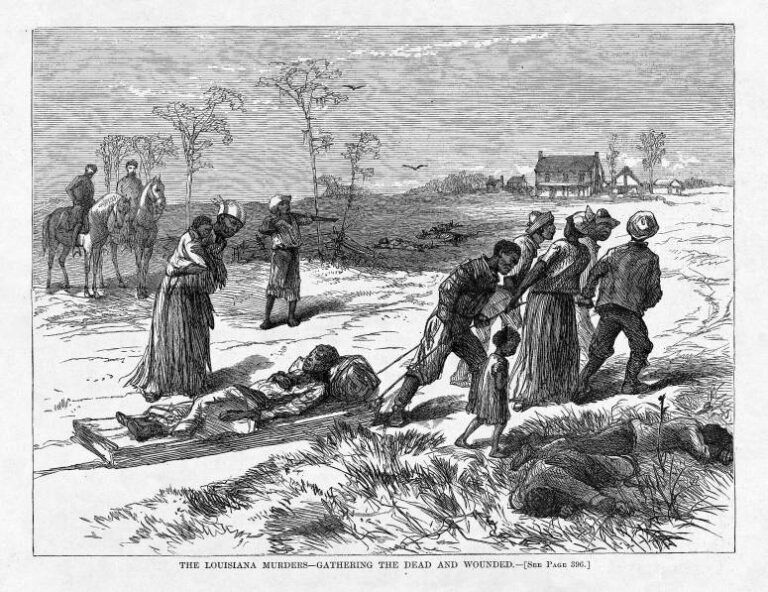
Judicial decisions following Reconstruction narrowed or complicated some federal approaches to protecting civil rights and punishing private violence. For instance, the 1876 decision in United States v. Cruikshank concerned prosecutions following the Colfax Massacre and raised important questions about federal power and individual rights. The case did not erase the Fifteenth Amendment from the Constitution, but the interpretation of federal authority affected the ability to address certain abuses. Different legal provisions were involved in different cases, so it is misleading to attribute every later voting restriction to one Supreme Court ruling. The amendment’s meaning developed through repeated conflicts among state legislation, federal law, courts and political movements.
What happened to Black voting after 1877?
The conventional end of Reconstruction in 1877 coincided with a reduction in federal military involvement and the consolidation of white Democratic political power in remaining contested Southern states. Black men continued voting and holding office in some places, but increasing violence and restrictive rules weakened that participation over subsequent decades. Disfranchisement was a process, not one nationwide election in which every Black citizen suddenly lost the ballot. Its timing varied by state. The amendment remained part of the Constitution while political realities increasingly contradicted its promise. This distinction is important for explaining the later emergence of organized voter-registration campaigns, federal litigation and new civil-rights legislation.
How is it connected to the Voting Rights Act of 1965?
The Voting Rights Act of 1965 was enacted nearly a century after the Fifteenth Amendment to challenge persistent racial discrimination in voting. It provided mechanisms for enforcing the constitutional guarantee, including restrictions on certain practices and federal oversight in jurisdictions covered by the original law. The history from Reconstruction to Selma shows a recurring pattern: formal rights were undermined by discriminatory rules and violence, prompting demands for stronger national protection. The 1965 Voting Rights Act guide explains the later statute and its implementation. The Fifteenth Amendment is the constitutional foundation in this longer history, but it should not be mistaken for the detailed administrative framework Congress adopted in 1965.
How did people celebrate ratification in 1870?
Black communities and supporters organized meetings, parades and public commemorations after ratification. Historical prints from 1870 depict the amendment as a turning point in national citizenship and political participation. The artwork accompanying this article, held by the Smithsonian’s National Museum of American History, shows a large commemorative scene and smaller depictions of civic life. Such images reveal hopes and political messages, but they are artistic compositions, not neutral photographs of every event. The celebrations mattered because they publicly asserted the place of African Americans in the nation. They also serve as evidence of optimism that later generations would compare with the uneven and often violent experience of enforcement.
What are common misconceptions?
One misconception is that the amendment guaranteed every adult American the vote. It did not include a prohibition on sex discrimination, and other rules concerning age and eligibility remained. Another is that ratification immediately ended racially discriminatory voting practices; intimidation and restrictive laws continued. A third is that Black voters simply received rights without organizing to claim them. Community activism, political alliances and risks taken by individual voters were essential. Finally, the amendment should not be confused with the Fourteenth Amendment’s citizenship and equal-protection clauses. Clear distinctions among the three Reconstruction Amendments help explain both the advances of the era and the later fights to secure their promises.
Why does the Fifteenth Amendment still matter historically?
The amendment marked a constitutional rejection of explicitly race-based exclusion from voting in the United States and provided Congress with authority to enforce that prohibition. Its impact was shaped by Black political organization, federal legislation, local elections and violent resistance. The difference between its promise and uneven application became a central theme of American democratic history. Studying it alongside the Thirteenth and Fourteenth Amendments reveals how emancipation, citizenship and political participation were legally distinct questions. The amendment also reminds readers that constitutional change can outlast the governments that produced it, supplying a foundation for later campaigns even when its protections are ignored or narrowed for long periods.
Fifteenth Amendment timeline
| Date | Event |
|---|---|
| February 1869 | Congress proposes the Fifteenth Amendment. |
| February 3, 1870 | The required states ratify the amendment. |
| February 1870 | Formal proclamation of ratification. |
| 1870–1871 | Congress enacts enforcement laws to protect voting rights. |
| Late 1800s | Disfranchisement systems undermine Black voting in much of the South. |
| 1965 | Voting Rights Act strengthens federal protection against racial discrimination. |