Tulsa Race Massacre of 1921: Greenwood, Causes, Deaths and Aftermath
How white mobs destroyed Tulsa’s Greenwood district in 1921, why the death toll remains uncertain and how residents fought to rebuild.
Quick answer
On May 31 and June 1, 1921, white mobs attacked the predominantly Black Greenwood district of Tulsa, Oklahoma. Homes, businesses and institutions were burned and residents were killed, injured or displaced. The violence followed the arrest of Dick Rowland, a young Black man, after an alleged incident with a white elevator operator, and threats of lynching. The exact death toll remains uncertain; historical estimates run as high as 300. Greenwood residents began rebuilding despite enormous losses and inadequate official accountability.
Key facts
On this page
- What happened in Tulsa in 1921?
- Greenwood before the attack: Black Wall Street
- The allegations involving Dick Rowland and Sarah Page
- Crowds at the courthouse on May 31
- The attack on Greenwood on June 1
- The death toll and the problem of incomplete records
- Detention and the role of public authorities
- The immediate humanitarian and economic losses
- Rebuilding despite obstacles
- Why the massacre was minimized for decades
- The 2025 Department of Justice historical review
- Tulsa in the wider history of racial violence
- Timeline
- Frequently asked questions
- Sources
What happened in Tulsa in 1921?
The Tulsa Race Massacre was an assault on Greenwood, a prosperous and culturally important Black neighborhood in Oklahoma. During the night of May 31 and the following day, large groups of white attackers entered the district, set fires, looted property and killed residents. Much of the built environment of the community was destroyed. Survivors were left without homes and businesses, and many were confined in detention facilities after the violence. These events occurred in a city whose economic growth had benefited some residents while racial segregation severely limited equal opportunity.
Calling it a ‘race riot,’ as many contemporary reports did, can hide the unequal roles of those who carried out the destruction and the Black residents who were attacked. Historians increasingly use ‘massacre’ because the evidence shows a concerted assault on a targeted community. This does not mean every detail of individual incidents is known. The main chronology, the destruction of Greenwood and the widespread suffering of its residents are well established through archival records, survivor testimony, photographs and later official investigations.
Greenwood before the attack: Black Wall Street
Greenwood developed as a center of Black commerce and community life in segregated Tulsa. The district included shops, hotels, restaurants, churches, professional offices, theaters and homes. Business owners, workers and families built economic networks within a city where discriminatory practices restricted access to many white-owned institutions and neighborhoods. The phrase Black Wall Street became associated with the area’s concentration of successful enterprises. It remains a powerful description but should not suggest that every resident was wealthy.
The community contained different income groups and occupations. Its businesses depended on customers, suppliers, skilled labor and the wider Tulsa economy. Many families had invested savings and years of work in homes and establishments that could not easily be replaced. Schools and churches also provided vital support. The history of Greenwood matters because the massacre did not merely damage buildings: it destroyed accumulated resources, institutions and a sense of safety that residents had worked to establish.
The allegations involving Dick Rowland and Sarah Page
On May 30, 1921, an encounter involving Dick Rowland, a Black young man, and Sarah Page, a white elevator operator, became the focus of allegations. Historical accounts differ over what happened inside the elevator, and surviving evidence does not establish a clear assault as later rumor suggested. Rowland was arrested, and public discussion quickly escalated. Sensational newspaper coverage contributed to a climate in which a white mob gathered at the courthouse, with some people demanding that Rowland be handed over.
Rowland’s arrest is the immediate trigger of the crisis, but not a sufficient explanation for the destruction of an entire neighborhood. The larger setting included white supremacist attitudes, segregation, resentment of Black economic success and a history of lynching threats. Those conditions made the rumors especially dangerous. A responsible account does not repeat an unproven allegation as fact or describe the subsequent assault as a spontaneous, unavoidable response to a verified crime.
Crowds at the courthouse on May 31
As white crowds gathered, Black Tulsa residents became concerned that Rowland might be lynched. Some armed Black men, including veterans, went to the courthouse in an effort to defend him and prevent mob violence. A confrontation developed, and gunfire broke out. The sequence of particular shots has been described differently in testimonies, but the broader pattern of escalation is clear. The fighting became the pretext for white attackers to mobilize more widely against Greenwood.
Local officials had responsibilities to protect Rowland in custody and safeguard the public. The presence of armed defenders must be understood within a national history in which Black people had been threatened with lynching and could not always rely on authorities. Concluding that the community caused its own destruction because some residents attempted to protect a threatened prisoner would ignore the subsequent conduct of white attackers. The responsibility for burning and looting Greenwood rests with those who carried out those acts.
The attack on Greenwood on June 1
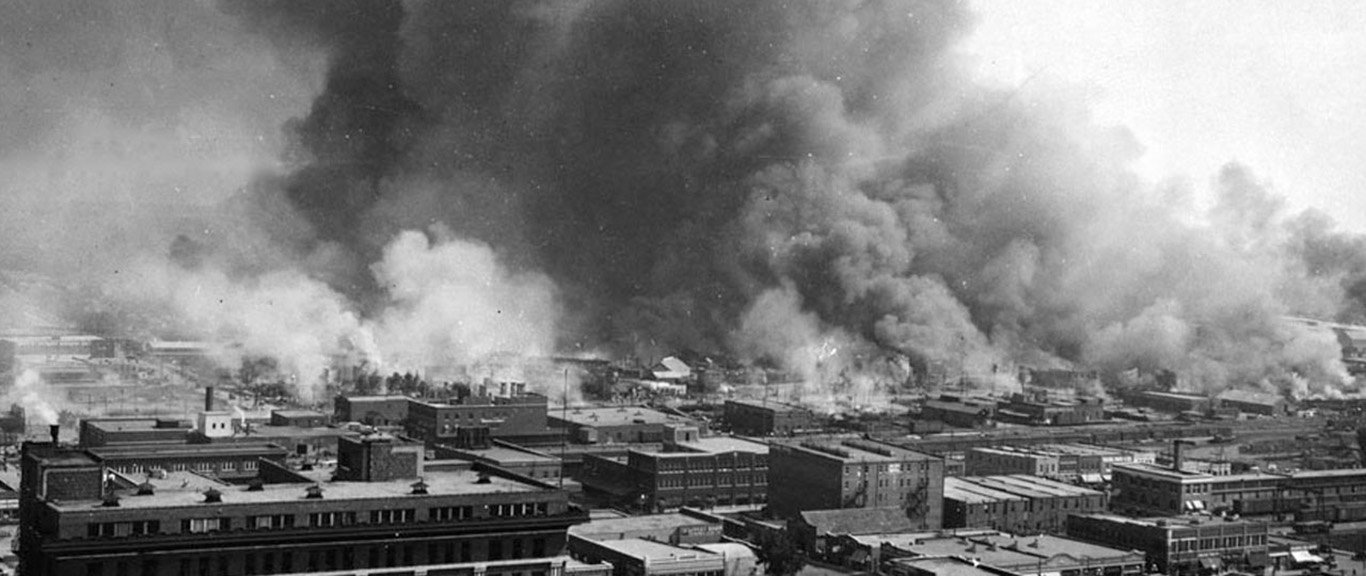
During the early hours of June 1, armed white attackers moved into Greenwood and set buildings on fire. Homes and businesses were looted or destroyed, and people trying to escape faced serious danger. Photographs of the aftermath show large sections of the district reduced to burned walls and rubble. The Federal Reserve Bank of Kansas City preserves an image showing smoke rising over the area during the attack. It is historical documentation, not an artistic rendering of what the violence might have looked like.
Accounts also refer to aircraft in the skies above Tulsa. Researchers have examined testimony about planes used for observation and allegations of objects being dropped, but the specific role of aircraft remains a subject where evidence must be carefully assessed. The confirmed central fact is not dependent on proving every aircraft allegation: armed mobs destroyed extensive parts of Greenwood through violence and fire. Survivors fled, sought shelter or were detained as authorities attempted to restore control.
The death toll and the problem of incomplete records
The exact number of people killed in the massacre has never been established conclusively. Some contemporary official figures were low, while later researchers and witnesses indicated far more deaths. Estimates in reputable historical accounts have reached as high as 300. The Library of Congress and Tulsa Historical Society document the uncertainty and the reasons it persists. Incomplete reporting, the destruction of records and the treatment of Black victims all complicate attempts to reconstruct a precise number.
A careful account therefore avoids presenting one estimate as a fully verified list of deaths. The same caution applies to property-loss calculations, which differ depending on whether they include buildings, business stock, personal possessions, lost income and later economic consequences. These uncertainties do not weaken the established reality of the massacre. They show why renewed research, burial investigations and survivor records remain important for understanding both the immediate harm and its longer consequences.
Detention and the role of public authorities
After the attack, many Black residents were confined in temporary detention centers. National Guard units participated in the mass detention of Greenwood residents, even though they were the community that had been attacked. Survivors could need authorization or sponsorship to leave detention and resume ordinary activities. The Tulsa Historical Society emphasizes how these actions added to the crisis experienced by families whose homes and businesses had been destroyed.
Official conduct has received close scrutiny because authorities were responsible for public safety, including the protection of Greenwood. Later reviews investigated whether local police, officials and other institutions enabled or failed to stop white violence. Distinguishing individual conduct is important, but the broader failures were serious. The Justice Department’s historical review concluded that a large white attack devastated Greenwood and that the record showed major failures of lawful protection. The community suffered both from private violence and from the actions or omissions of institutions that should have defended residents.
The immediate humanitarian and economic losses
Thousands of people faced displacement, hunger and uncertainty when large areas of Greenwood were destroyed. Families lost homes, household possessions, employment sites and stored business inventory. Schools, churches and other community spaces were damaged or destroyed. Relief efforts assisted survivors, but the scale of loss was overwhelming for people who had suddenly been stripped of the resources they depended on. Some had nowhere to return when the fires ended.
The destruction also broke the normal relationships that sustain a neighborhood economy. A shopkeeper needed a building, equipment, customers and suppliers; workers needed employers; property owners needed access to credit and insurance. Rebuilding all those connections took years. Property-loss figures can convey some of the damage, but they cannot measure the experience of losing relatives, homes or a sense of security. Any account of Greenwood’s recovery should begin with the scale of what was taken from its residents.
Rebuilding despite obstacles
Survivors organized to rebuild homes and businesses, drawing on mutual aid, community leadership, religious institutions and personal resilience. Some residents returned to operate enterprises in Greenwood, and parts of the district recovered over time. The rebuilding process demonstrated the continued strength of the community but should not be interpreted as proof that the original loss had been repaired or that survivors had received full compensation.
Residents also encountered barriers, including contested reconstruction regulations and difficulty recovering insurance payments. Legal and political conditions could make it harder to restore buildings or obtain assistance. The Tulsa massacre illustrates a wider economic truth: destruction of assets can have effects across generations when opportunities to recover wealth are unequal. Rebuilding a business years later does not erase income lost in the meantime, nor does it guarantee that children and grandchildren inherit the security they might otherwise have enjoyed.
Why the massacre was minimized for decades
The violence was not entirely unknown after 1921, but the event received limited treatment in many mainstream historical accounts and local public narratives for decades. Survivors preserved memories within families and communities, while later researchers worked to assemble newspaper reports, court records, photographs and oral histories. Public silence and uneven official documentation contributed to the difficulty of reconstructing what had happened. The absence of a prominent schoolbook account is not evidence that the event was insignificant.
Historical scholarship and community activism eventually led to renewed investigation. Oklahoma created a commission that reported in 2001, and other inquiries continued. Recent federal review has gathered and assessed archival materials and survivor histories. Researchers also investigate possible burial sites. These efforts are not a single discovery proving that every question is solved; they form a continuing process of correcting omissions and establishing what the evidence can support.
The 2025 Department of Justice historical review
The U.S. Department of Justice released findings from a historical review of the massacre in January 2025. The review described an organized white attack that destroyed Greenwood and examined the roles of public officials and the failure to protect residents. It drew on archival sources, firsthand accounts and earlier investigations. The review acknowledged the atrocity and contributed to public understanding, but it did not create criminal trials of perpetrators who had died long before the report.
This distinction matters when considering accountability. Historical acknowledgment, civil remedies, criminal prosecution and educational work are separate processes with different legal and evidentiary requirements. A finding that violence occurred does not automatically settle every question about compensation or the responsibility of a particular individual. The Justice Department’s report is significant because it provides a government-supported analysis of the available record, not because it eliminates all continuing debate.
Tulsa in the wider history of racial violence
The massacre was not an isolated episode outside the rest of American history. The Red Summer of 1919 had brought deadly anti-Black attacks to multiple communities, and the Great Migration reflected the pressures of segregation, violence and the search for opportunity. Greenwood’s history also illustrates Black commercial achievement under restrictive conditions. These contexts are relevant, but neither makes the specific attack in Tulsa inevitable.
The Tulsa Race Massacre remains important for understanding civil rights, economic loss, historical memory and the meaning of protection under law. Residents created a vibrant district and then suffered targeted destruction. Some rebuilt, while the consequences continued long after 1921. An accurate account honors those experiences through specific dates, careful sources and honest uncertainty about unresolved details rather than sensational numbers or unsupported stories.
Timeline
- May 30, 1921 — Disputed encounter involving Dick Rowland and Sarah Page
- May 31 — Rowland arrested; courthouse crowds and confrontation
- June 1 — White attack devastates Greenwood
- June 1921 — Survivors seek relief and begin rebuilding
- 2001 — Oklahoma commission publishes historical report
- January 2025 — U.S. Justice Department releases historical review
Frequently asked questions
When did the Tulsa Race Massacre happen?
May 31 to June 1, 1921, in Tulsa, Oklahoma.
What was Black Wall Street?
A nickname for the Greenwood district, a center of Black-owned businesses and community institutions.
What triggered the violence?
The arrest of Dick Rowland following a disputed elevator encounter and a white mob’s lynching threats, within a wider context of racism and hostility to Greenwood.
How many people were killed?
The exact total remains uncertain. Historical estimates reach as high as 300 deaths, and some records are incomplete.
Who attacked Greenwood?
White mobs conducted the attacks, while government authorities failed to provide adequate protection and participated in detentions.
Did Greenwood recover?
Residents rebuilt parts of the community, but that did not reverse all the economic, personal and generational losses.
Why was it not widely taught for decades?
Survivor accounts endured, but limited official treatment, incomplete records and public silence contributed to historical neglect.