Andersonville Prison (1864–1865): Conditions, Death Toll and Camp Sumter
How overcrowding, poor sanitation and war policy produced one of the most lethal Civil War prisons.
Andersonville Prison, or Camp Sumter, was a Confederate prison in Georgia that held approximately 45,000 Union soldiers in 1864–1865. Nearly 13,000 died from disease, malnutrition, overcrowding and exposure. The prison’s terrible conditions resulted from inadequate facilities, resources, administration and the wider breakdown of prisoner exchange.
This evidence-based article explains the prison’s growth, daily life, prisoner identities and the later work of identifying the dead.
On this page — 23 topics
What was Andersonville Prison?
Andersonville Prison, officially Camp Sumter, was a Confederate military prison in southwest Georgia during the American Civil War. It operated from February 1864 into 1865 and held captured Union soldiers in an open-air stockade. The site became notorious because overcrowding, inadequate food, poor sanitation, disease and exposure produced an exceptionally high death toll. The National Park Service estimates that approximately 45,000 Union prisoners passed through the camp and nearly 13,000 died. Those figures should be understood as estimates supported by burial and prison records, not as proof that everyone entered or died at the same moment.
Why was Camp Sumter built in Georgia?
Confederate authorities needed additional space to confine Union prisoners as fighting approached Richmond, where many captured soldiers had previously been held. Georgia appeared safer from Union armies, and officials hoped that supplies would be available in the region. The prison was constructed near Andersonville, a small railroad community in Sumter County. It was named for the county, not for the fort where the war began. The decision reflected the Confederacy’s deteriorating military and logistical circumstances. A remote location may have made custody easier, but it did not guarantee the food, shelter or medical infrastructure needed to keep thousands of men alive.
When did the first prisoners arrive?
The first Union prisoners reached Camp Sumter in February 1864. At that point the stockade was a recently built installation designed to hold a far smaller population than it eventually confined. Prisoners arrived by rail and were moved into an enclosure of rough timber walls. They had to make shelter from blankets, scraps of canvas and materials that could be obtained or traded. The arrivals did not end after the camp became crowded; large numbers continued to be transferred during the spring and summer. As a result, any description of the prison must explain how conditions changed over time rather than treating one photograph as the whole story.
How large was the original stockade?
According to the National Park Service, the initial enclosure covered about 16.5 acres and was surrounded by a wooden stockade roughly fifteen feet high. In June 1864 the enclosure was expanded to approximately 26.5 acres, an effort to ease overwhelming crowding. The expansion was inadequate because prisoner arrivals continued at a high rate. The land was uneven, a stream crossed the site and substantial areas were unsuitable for healthy living. The measured dimensions help illustrate the shortage of space, but area alone does not capture the hardships of men without adequate tents, sanitation or nutritious food.
How overcrowded did Andersonville become?
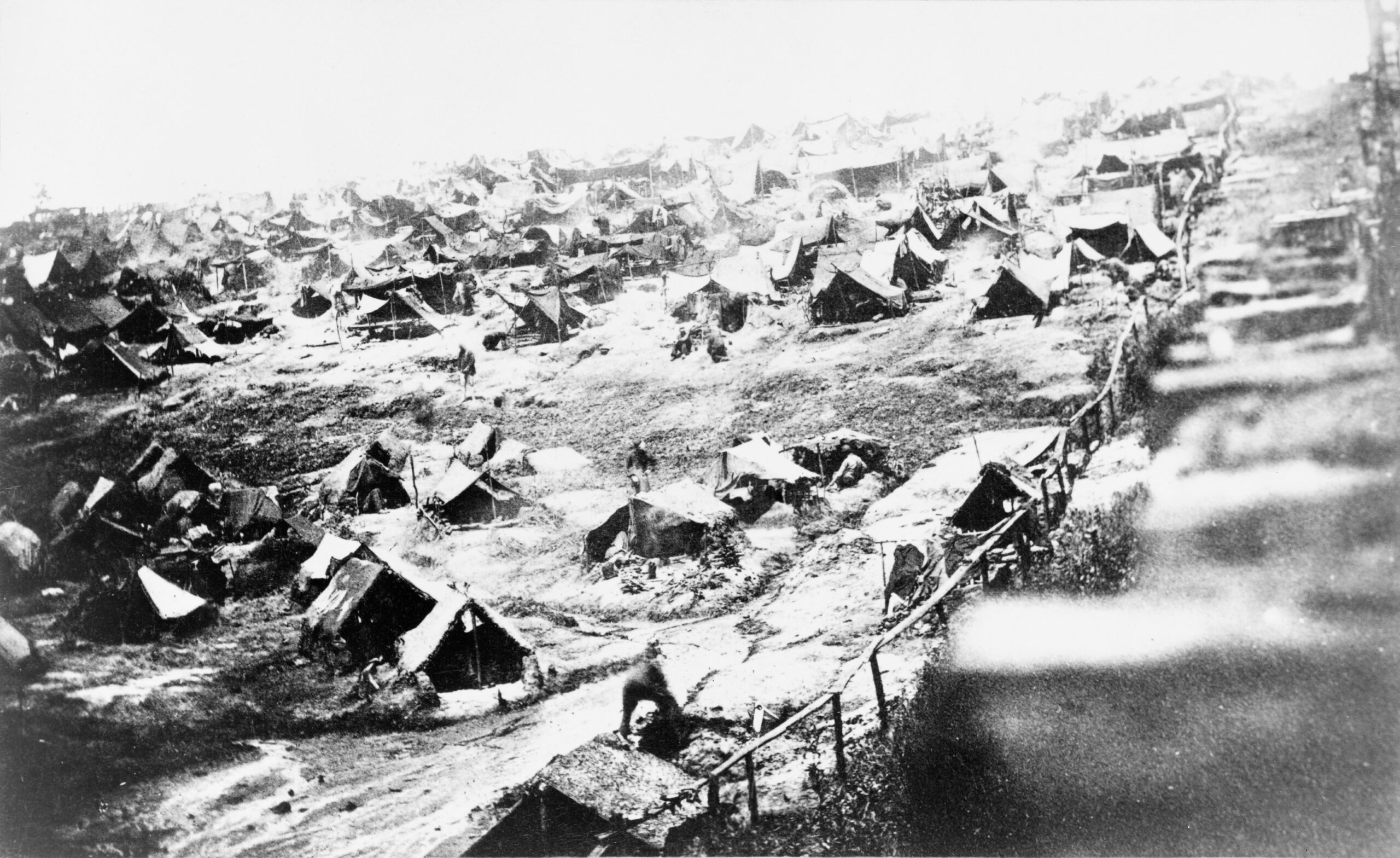
The National Park Service reports that the population exceeded 26,000 by June 1864 and reached approximately 32,000 men at one time later in the summer. These figures were many times the number originally anticipated when the camp was built. Crowding meant that prisoners lived very close together, improvised shelters provided limited protection and contaminated ground was used repeatedly. Movement, cooking, waste disposal and access to the stream became difficult. Disease spread readily in an environment where sick men could not be isolated or treated effectively. The camp was not simply uncomfortable; its overcrowding became a major cause of mortality.
What was the deadline inside the prison?
The prison maintained an internal boundary often called the “deadline,” marked by a rail or low barrier inside the main stockade wall. Prisoners who approached or crossed it risked being shot by Confederate guards. The boundary created an additional zone of danger within an already overcrowded enclosure. Its precise location and appearance can be studied using period plans and historical interpretation. The term should not be confused with a modern deadline for completing a task. At Andersonville it referred to a restricted space enforced with lethal force, and surviving prisoners recalled the anxiety associated with moving near it.
Why was water so dangerous?
A stream crossed the prison grounds and became contaminated by human waste, washing and the concentration of thousands of men. Prisoners needed water for drinking and other essential purposes, yet reliable clean supplies were limited. Poor sanitation contributed to diarrhea, dysentery and other diseases. Without sufficient soap, clothing or proper medical facilities, illness spread and worsened. The famous Providence Spring became important in prisoner memory because it supplied fresher water during a period of extreme hardship. The spring’s appearance and later memorial were interpreted religiously by survivors, but its historical significance also rests on the practical importance of safer drinking water.
What food did prisoners receive?
Food rations at Camp Sumter were often inadequate in quantity, quality or preparation. Prisoners might receive cornmeal and limited other provisions, but shortages, poor storage and the absence of healthy cooking arrangements made malnutrition a severe problem. Some Confederate officials argued that shortages across the South restricted what could be provided, yet the conditions at Andersonville were exceptionally deadly and reflected failures of policy, administration and humane care. We should avoid claiming that every prisoner always received the same ration. Surviving diaries and reports document changing supplies and the desperate attempts of prisoners to trade or supplement what they were given.
Which diseases killed prisoners?
Dysentery, diarrhea, scurvy and other illnesses were widespread, and their effects were intensified by starvation and exposure. Infected wounds, parasites and illnesses associated with contaminated water added to the toll. Medical staff were overwhelmed and lacked adequate supplies, shelter and effective treatments. Prisoners who might have survived with food, clean water and sanitary living conditions instead deteriorated rapidly. The causes of death cannot be reduced to a single disease or one particular official decision. The humanitarian disaster emerged from overlapping failures that continued as the camp’s population increased throughout 1864.
How many men died at Andersonville?
The National Park Service gives a figure of about 45,000 Union soldiers held and nearly 13,000 deaths during the prison’s roughly fourteen months of operation. Another NPS summary specifies 12,920 deaths. Different source totals should be presented with their dates and definitions rather than combined into a false exact figure. The prison cemetery provides extensive evidence for the loss of life because many burials were recorded and later identified. The death rate was appalling even in the context of a war marked by widespread prisoner suffering. These men died far from home, often without their families knowing the immediate circumstances.
What was life like in the makeshift shelters?
Prisoners improvised shelters sometimes called “shebangs” using scraps of cloth, blankets, wood and personal belongings. Such constructions offered limited protection against the Georgia sun, rain and cold. The men lived amid mud, contaminated ground and a shortage of usable materials. Some formed groups to share food or defend their limited possessions. Others were so weakened by illness that they could not maintain shelter or obtain supplies. Photographs from 1864 show the density of tents and rough structures but cannot convey the smell, noise and constant fear described in written testimony. Both visual and written evidence are necessary.
Who were the Andersonville Raiders?
Within the prisoner population, groups known as the Andersonville Raiders robbed and terrorized other captives, taking advantage of desperation and limited internal control. Other prisoners organized to resist them and conducted proceedings that led to the execution of six accused raiders in July 1864. This episode highlights the strain placed on social order by overcrowding, hunger and violence. It must not be used to shift primary responsibility for the camp’s terrible conditions onto the prisoners themselves. The vast majority were victims of confinement and deprivation, and the internal violence occurred within a system created and administered by Confederate authorities.
What happened to Black Union prisoners?
Black Union soldiers faced distinctive risks because Confederate policies often denied them the same treatment as white prisoners and threatened re-enslavement. Some African American prisoners were nevertheless held at Andersonville, and surviving records and testimony reveal their forced labor and conditions. National Park Service research has identified a limited number of named Black captives in the camp’s database. Their experiences form part of the story of how racial ideology shaped prisoner policy. They should not disappear from accounts focused only on the larger white prisoner population, nor should uncertain estimates be presented as complete totals for every Black prisoner held elsewhere.
Why had prisoner exchanges broken down?
The Union and Confederacy had earlier agreed to a prisoner exchange system, but it faltered amid disputes about treatment, military status and the refusal of Confederate officials to recognize Black Union soldiers as equal prisoners of war. Exchanges became irregular, leaving both sides holding increasing numbers of captives. Military and political decisions contributed to the growth of prison populations across the conflict. The breakdown did not make extreme deprivation inevitable, nor does it absolve prison administrators of responsibility. It helps explain why Andersonville expanded so rapidly and why the crisis could not be solved simply by releasing prisoners through routine exchanges.
Who commanded the prison?
Captain Henry Wirz became the most notorious prison officer associated with Andersonville. His authority was limited by larger Confederate systems of supply and command, yet his actions and treatment of prisoners were subjects of serious accusations. After the war he was arrested, tried by a United States military commission and executed in November 1865. The trial generated extensive testimony and controversy about responsibility, evidence and justice. A careful history distinguishes the conduct of individual officials from the broader policy failures that created the camp. It also avoids the unsupported idea that one officer alone controlled every supply problem across the collapsing Confederacy.
What happened when Union troops approached?
As Union military operations moved through Georgia in 1864, Confederate authorities began transferring many captives from Andersonville to other prisons. The number remaining declined, although deprivation and deaths continued. Camp Sumter operated on a reduced scale until the war’s final months and closed in 1865. The prison’s history therefore has a distinct peak crisis in summer 1864 followed by a changing population and administrative collapse. Explaining that chronology prevents readers from assuming conditions, numbers and management remained identical for the full fourteen months. Transfers sometimes moved prisoners into other places of hardship rather than immediately bringing relief.
Who was Dorence Atwater?
Dorence Atwater was a Union prisoner who helped maintain records of the dead and made his own copy of names and burial information. After the war, his records proved vital for identifying graves and notifying families. Atwater worked with Clara Barton and a military expedition in 1865 to mark burial sites. The effort demonstrates the importance of paperwork in recovering identities after mass suffering. Lists of names can appear dry compared with dramatic memoirs, but they allow researchers to trace individual soldiers and often correct or refine family histories. His role was a major contribution to the preservation of Andersonville’s history.
What did Clara Barton do after the war?
Clara Barton, who later founded the American Red Cross, traveled to Andersonville in 1865 as part of efforts to identify Union dead and provide information to their families. Working with Atwater’s records and military personnel, the expedition marked thousands of graves in what became Andersonville National Cemetery. The work was an early expression of the effort to account for missing soldiers after the Civil War. It did not erase the loss or suffering, but it gave many families a documented resting place to remember. Barton’s activity also connects military history with the emergence of organized humanitarian assistance in the United States.
What can visitors see at Andersonville today?
Andersonville National Historic Site preserves the prison grounds and the adjacent national cemetery in Georgia. Visitors can see portions of the stockade reconstructed for interpretation, earthworks, monuments and exhibits. The National Prisoner of War Museum, located at the site, broadens the subject to Americans held captive in later conflicts. Modern interpretation includes suffering, survival and the difficult ethics of imprisonment. A reconstructed section of wall is useful for understanding the scale of the space, but it is not an untouched original structure from 1864. Park resources provide maps and documented histories for separating reconstruction from surviving landscape evidence.
Why does Andersonville matter in Civil War history?
The prison exposes an aspect of the war not captured by battlefield victory maps: thousands of soldiers suffered and died while unable to fight or protect themselves. Andersonville’s history is about state responsibility, the treatment of captives, racial policy, logistical breakdown and the obligation to identify the dead. It also reflects the wider collapse of the Confederacy as the war reached its final stages. The men buried there were not statistics alone. Their records, letters and graves connect national political decisions to individual families. Understanding those links is essential to a complete account of the American Civil War.
Andersonville timeline
| Date | Event |
|---|---|
| February 1864 | First prisoners arrive at Camp Sumter. |
| June 1864 | Stockade expanded as the prisoner population grows. |
| Summer 1864 | Overcrowding and deaths reach catastrophic levels. |
| September 1864 | Many prisoners transferred to other Confederate facilities. |
| May 1865 | Andersonville closes after the Confederate collapse. |
| July–August 1865 | Clara Barton, Dorence Atwater and others work to identify graves. |