Battle of Shiloh (April 6–7, 1862): Grant, Johnston and the Outcome
How a Confederate offensive nearly overwhelmed Grant before the Union recovered on the second day.
The Battle of Shiloh, fought April 6–7, 1862, in Tennessee, began with a Confederate surprise attack against Ulysses S. Grant’s Union army. Confederate commander Albert Sidney Johnston was killed on the first day. Union troops held near Pittsburg Landing, received reinforcements, and counterattacked on April 7. The Confederates withdrew, leaving the Union victorious after more than 23,000 combined casualties.
Explore Shiloh’s two-day chronology, commanders, Hornet’s Nest, Union reinforcements, the casualty toll and strategic impact.
On this page — 24 topics
What was the Battle of Shiloh?
The Battle of Shiloh was fought on April 6–7, 1862, in southwestern Tennessee near Pittsburg Landing on the Tennessee River. Confederate forces under Albert Sidney Johnston launched a surprise attack on Union troops commanded by Ulysses S. Grant. The initial assault pushed Union units back toward the river, but the defenders held key positions and received reinforcements overnight.
On April 7, Grant’s troops counterattacked and forced the Confederates to retreat toward Corinth, Mississippi. Combined casualties exceeded 23,000, shocking Americans who still hoped the war could be relatively limited. Shiloh became a key Union victory in the western theater of the Civil War.
Where was Shiloh fought?
Shiloh is named after a small church in rural Hardin County, Tennessee. The battlefield extended through woods, fields, creek valleys and roads near Pittsburg Landing, an important point where Union forces could receive supplies by river. The Tennessee River shaped the army’s position and the options available to both sides.
The modern Shiloh National Military Park preserves substantial battlefield ground, but visitors should remember that the 1862 landscape included working farms, cabins and primitive roads. The terrain influenced lines of sight, the movement of artillery and the difficulty of coordinating divisions across the front.
Why were Union armies near Pittsburg Landing?
Union forces had gained important victories at Fort Henry and Fort Donelson in February 1862, opening routes into Tennessee. Grant advanced along the Tennessee River while Union leaders expected a further movement toward Confederate railway centers, especially Corinth, Mississippi. General Don Carlos Buell’s Army of the Ohio was approaching to reinforce the operation.
The Confederate army recognized that the combination of Union forces might threaten the region’s vital rail junctions. Johnston decided to attack Grant before Buell’s troops fully joined him. The campaign demonstrates why river transportation and rail connections were central to the western war.
Who was Ulysses S. Grant?
Ulysses S. Grant commanded the Union Army of the Tennessee and had gained recognition after Fort Donelson. His force camped near Pittsburg Landing, with divisions positioned along roads and fields. Grant was not personally at the foremost camps when the Confederate offensive began, but he traveled to the battlefield and directed the defense.
He later faced criticism for the severity of the initial surprise and the casualties. Nevertheless, the army survived the first day and achieved victory on the second. Studying Grant’s conduct requires considering preparation, defensive decisions, reinforcement and the counterattack rather than relying on either heroic myth or personal vilification.
Who commanded the Confederates?
General Albert Sidney Johnston commanded the Confederate Army of the Mississippi, while P. G. T. Beauregard served as a senior subordinate. Other corps commanders included Braxton Bragg, Leonidas Polk, William Hardee and John C. Breckinridge. Their force advanced north from Corinth hoping to strike before the Union armies united.
The National Park Service Confederate command record lists the formations and contemporary estimates of troop strength. The attack required coordinating thousands of men across difficult roads, and the army’s alignment changed repeatedly once fighting began.
Why was the Confederate attack delayed?
Confederate troops marched from Corinth through heavy rain and challenging roads before reaching the Union camps. The movement took longer than commanders anticipated, and the army lost some of the surprise that an earlier arrival might have produced. Despite concerns about the delays, Johnston pressed the attack.
Large-scale offensives depend on transportation as well as courage. Artillery, ammunition wagons and different formations cannot all move at infantry speed over muddy roads. At Shiloh, timing affected the number of Union soldiers in the area, the availability of reinforcements and the Confederate opportunity to concentrate against a dispersed army.
What happened early on April 6?
Confederate troops struck the outer Union camps early in the morning, attacking soldiers who were not uniformly prepared for a major engagement. Union regiments formed hurried defensive lines and attempted to resist across a broad front. Some units were driven back, while others held long enough for officers to organize new positions.
The initial surprise was serious, but it is not accurate to say that the entire Union army simply ran to the river. Many units fought fiercely as the battle shifted through fields and woodland. The first day consisted of numerous local engagements whose combined result was a gradual Union withdrawal toward stronger lines.
Was Grant’s entire army surprised in its tents?
The popular image of Confederate troops finding every Union soldier asleep and unarmed is exaggerated. There were advanced patrols, pickets and reports of enemy activity before the battle. Yet Union commanders failed to anticipate the full scale and timing of Johnston’s offensive, and several divisions were caught in vulnerable positions.
Different units responded differently. Some quickly organized, while others lost camps and equipment. A reliable explanation avoids both extremes: the Union was surprised operationally, but the fighting was neither an effortless Confederate victory nor a single instantaneous collapse.
What was the Hornet’s Nest?
The Hornet’s Nest is the popular name for a Union defensive position along a sunken road and nearby fields, where troops under several commanders resisted sustained Confederate attacks. The name reflects later descriptions of the intense fire rather than a perfectly defined geographical line known to every soldier during the battle.
Prolonged resistance bought time for other Union troops to organize defensive positions, although historians differ about how central the Hornet’s Nest was to the entire day’s outcome. A narrow focus on that location can obscure fighting elsewhere, including the areas around Shiloh Church and the Tennessee River.
What happened to Albert Sidney Johnston?
Johnston was mortally wounded during the afternoon of April 6 while directing operations near the Confederate line. His death removed the army’s senior commander at a critical stage, and Beauregard assumed command. Johnston’s personal courage became important in Confederate remembrance, but his death was also a practical disruption to battlefield leadership.
The exact details of how he was wounded are discussed in military histories, including reports that he suffered a leg wound and lost blood. His death did not immediately halt all Confederate activity, but it complicated command and occurred as the offensive was reaching the limits of its initial momentum.
What was the fight at the Peach Orchard?
Fighting around the Peach Orchard and nearby fields involved intense infantry and artillery clashes as the Union force fell back and Confederate troops tried to break its resistance. Names of orchards and farms help historians map local actions, but they should not imply that a battle extending over miles took place in one small enclosed field.
The Confederate army advanced through successive Union positions, suffering casualties and consuming ammunition. The repeated attacks weakened the cohesion of some Confederate formations, making it harder for officers to carry the assault to a decisive conclusion as evening approached.
Why did the Union army hold near the river?
Grant’s soldiers eventually formed a defensive position near Pittsburg Landing, supported by artillery and the presence of Union gunboats on the Tennessee River. The river could supply and reinforce the army, but also limited opportunities to withdraw safely if Confederate forces captured the landing.
The Union concentrated artillery and remaining infantry to resist the final attacks of April 6. Holding the landing was crucial because it allowed fresh troops to arrive rather than forcing an evacuation. The battle was not decided by riverboats alone, but naval gunfire and the transport network helped the defenders survive.
How did Buell’s army arrive?
Elements of Don Carlos Buell’s Army of the Ohio began arriving and crossing the Tennessee River during the late stages of the first day and overnight. Fresh units strengthened the Union position for the morning counterattack. Other reinforcements included a division under Lew Wallace, whose march had been delayed and later became controversial.
The arrival of additional soldiers changed the balance for April 7. Confusing the number of men at the start of the battle with the number available the next morning can produce misleading descriptions of the armies’ relative strength. The timeline must distinguish early surprise from the reinforced Union offensive.
What happened on April 7?
Union forces attacked across much of the battlefield early on April 7, pressing Confederate formations that had become tired and disorganized after the previous day’s fighting. Grant’s army, supported by Buell’s fresh units, gradually regained ground through difficult woods and fields.
Beauregard’s troops resisted but eventually withdrew toward Corinth. The reversal illustrates that occupying an enemy’s camps after one day is not the same as destroying its army. Confederate commanders had failed to seize the river landing, and their force was less able to withstand a renewed Union offensive after casualties and exhaustion.
Who won Shiloh?
The Union army won the battle because Confederate troops retreated and Grant’s forces held the strategic position around Pittsburg Landing. The cost was enormous: the Union victory did not resemble the easy success that some Americans imagined when the fighting began.
The Confederate attack had damaged the Union army severely and killed important officers, but it failed to prevent northern reinforcements from arriving. The Union’s subsequent advance helped strengthen federal control over western Tennessee and put pressure on Corinth, a major Confederate railroad junction.
How many casualties were there?
The combined losses at Shiloh were approximately 23,746 killed, wounded and missing or captured, using a commonly cited historical total. These were casualties, not 23,746 deaths. Thousands of soldiers survived wounds or were captured, while others died later from infections and disease.
The Shiloh National Military Park records the battle as one of the most costly engagements of the early war. Always compare the casualty categories used by different publications. The scale was particularly shocking because the conflict had only recently begun and combat losses of this size were unfamiliar to many Americans.
How did soldiers experience the aftermath?
The battlefield was crowded with wounded men needing water, shelter and medical assistance. Surgeons and volunteers worked under conditions of inadequate supplies and unfamiliar demands. Heavy rain during the night and the large number of casualties created serious suffering.
The human consequences did not end when the armies left. Men who survived wounds faced infection or disability, while families waited for often incomplete casualty lists. The battle influenced arguments about medicine, ambulance arrangements and battlefield aid even though improvements came slowly and unevenly during the war.
Why was Shiloh important to the West?
The Union victory kept the Tennessee River corridor open to federal operations and contributed to the pressure on Corinth, Mississippi. Confederate commanders had failed to defeat Grant before Buell’s army joined him, leaving the strategic initiative uncertain but increasingly favorable to the Union.
The battle also showed that western campaigns could involve armies and casualties comparable to those in Virginia. The war was not being decided only near Washington and Richmond. Control of waterways, rail junctions and agricultural regions helped determine the long-term capacity of both sides.
Was Shiloh a turning point?
Shiloh did not end the Confederate war effort or guarantee Union victory, but it demonstrated the determination and cost of the conflict. It preserved a major Union position at a time when Confederate leaders hoped to recover their initiative in Tennessee. The battle also helped make Grant a central figure in western operations.
Describing one battle as a turning point should identify the specific change it produced: Shiloh kept Union forces advancing, but the western struggle continued through Corinth, Vicksburg, Chattanooga and Atlanta. A longer military chronology is needed to understand how those campaigns interacted.
Battle of Shiloh timeline
The two-day sequence explains why the result changed so dramatically after Union reinforcements arrived.
| Date | Event |
|---|---|
| Feb 1862 | Union victories at Fort Henry and Fort Donelson. |
| Early Apr 1862 | Confederates approach from Corinth. |
| Apr 6 morning | Confederate surprise attack on Union camps. |
| Apr 6 afternoon | Hornet’s Nest fighting; Johnston killed. |
| Apr 6 night | Buell’s units arrive and cross river. |
| Apr 7 | Union counterattack and Confederate withdrawal. |
Frequently asked questions about Shiloh
When was the battle? April 6–7, 1862.
Where did it take place? Near Pittsburg Landing in Tennessee.
Who led the Union? Ulysses S. Grant, reinforced by Don Carlos Buell.
Who led the Confederates? Albert Sidney Johnston and then P. G. T. Beauregard.
Who won? The Union.
How many casualties? More than 23,000 combined.
Where can readers research Shiloh?
The Shiloh National Military Park history documents the two-day battle and its severe losses. Its Confederate order-of-battle plaque provides formation and casualty information, while the U.S. Army Civil War timeline places Shiloh in the western campaigns.
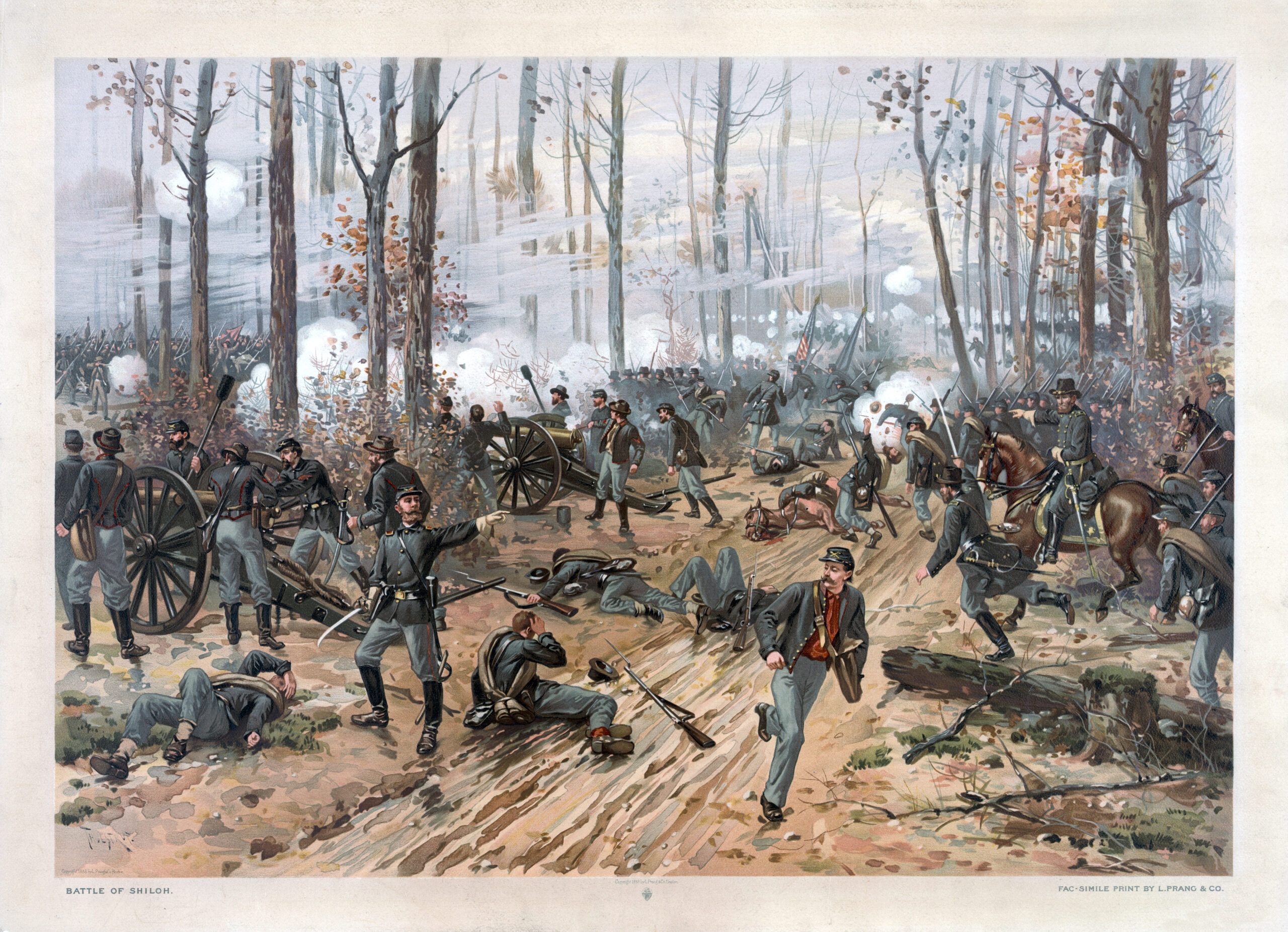
Compare battlefield maps with accounts from soldiers who fought in separate sectors. The Hornet’s Nest was only one part of the fighting. Later artwork, including the featured painting, is an interpretation created after the event, not a photograph made during combat.