Smoot–Hawley Tariff Act of 1930: Higher Duties, Retaliation and Trade
How the 1930 tariff increased protection for U.S. goods, prompted criticism and retaliation, and contributed to trade tensions during the Depression.
Quick answer
President Herbert Hoover signed the Tariff Act of 1930, widely called the Smoot–Hawley Tariff, on June 17, 1930. It raised U.S. duties on thousands of imported goods and strengthened protectionism during the early Great Depression. More than 1,000 economists petitioned against the proposal. Several countries retaliated or adjusted trade policies, while world commerce subsequently contracted. Historians regard Smoot–Hawley as damaging to trade, but the collapse in world trade cannot be attributed to the tariff alone.
Key facts
On this page
- Why Congress reconsidered tariffs after 1928
- Reed Smoot, Willis Hawley and congressional bargaining
- The crash happened before the act was signed
- What the Tariff Act of 1930 actually changed
- Why more than 1,000 economists objected
- The June 17, 1930 enactment
- Retaliation by trading partners
- Did Smoot–Hawley cause the Great Depression?
- How tariffs affected different Americans
- The shift toward reciprocal trade agreements in 1934
- Smoot–Hawley’s historical significance
- Timeline
- FAQs
- Sources
Why Congress reconsidered tariffs after 1928
American farmers had endured years of weak prices during the 1920s. Republicans promised tariff relief for agriculture and hoped that raising duties on competing imports would strengthen farm incomes. President Herbert Hoover called Congress into a special session early in his administration to address that problem. Yet the proposed tariff schedule soon expanded beyond agricultural goods into many industrial products as lawmakers sought protection for other sectors. The resulting bill became far larger and more controversial than a narrow farm measure.
The United States already maintained protective duties under the Fordney–McCumber Tariff of 1922. Smoot–Hawley was not the first American protectionist law, and the choice facing Congress was not free trade versus tariffs for the first time. It was how broadly duties should be increased and what costs that policy might impose on consumers, exporters and relations with other countries. The wider debate took place while the economy was becoming more unstable.
Reed Smoot, Willis Hawley and congressional bargaining
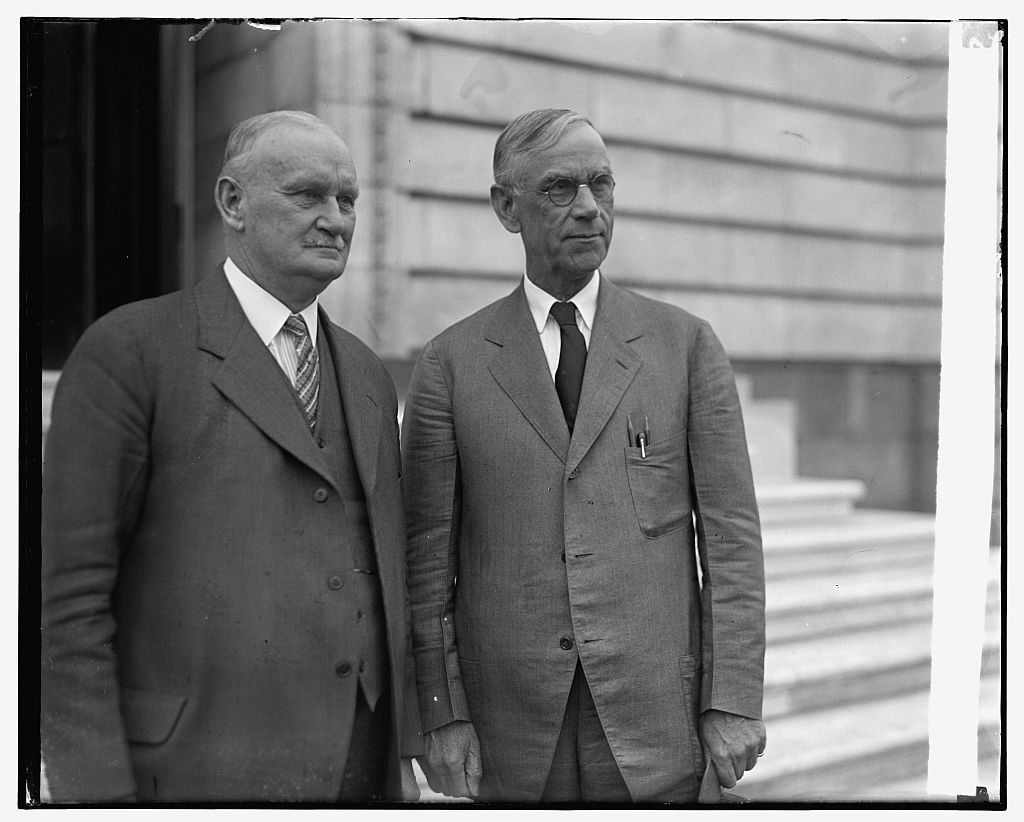
Senator Reed Smoot of Utah and Representative Willis C. Hawley of Oregon lent their names to the bill as leaders of the relevant congressional committees. Their photograph, taken in April 1929, appears with this article. It records the lawmakers shortly before the bill’s major debates but is not a photograph of the June 1930 signature ceremony. Historians can use such portraits to identify political figures without misrepresenting the event captured.
Tariff legislation involved negotiations over hundreds of product classifications. Individual industries and lawmakers pressed for higher duties on goods they regarded as threatening domestic production. Compromises in one category could encourage requests for protection in another, a process sometimes called tariff logrolling. The resulting schedule was not the mechanical application of one percentage to everything entering the country. A tariff must be analyzed through its rates, categories, exemptions and the actual pattern of imports.
The crash happened before the act was signed
The New York stock market crashed in October 1929 while the Smoot–Hawley bill was still under consideration. The tariff became law on June 17, 1930, nearly eight months later. This chronology makes it impossible for the enacted law to have been the sole cause of the earlier market crash. Expectations about the bill may have influenced contemporary debate, but that is different from saying a statute not yet enacted directly caused the crash itself.
Once the Depression began, the administration and Congress faced growing economic strain. Some supporters believed stronger import barriers would protect jobs and prices, whereas critics predicted higher costs and damage to U.S. exports. Their disagreement became sharper as industrial production weakened and international credit conditions deteriorated. Understanding when each event occurred prevents a simplistic sequence in which the tariff both caused the initial crash and was a response to it.
What the Tariff Act of 1930 actually changed
The act adjusted thousands of duties on imported goods, including agricultural and manufactured products. Higher duties could make competing foreign goods more expensive in the American market and thereby support some domestic producers. They could also increase costs for consumers and businesses relying on imported inputs. Actual effects differed by product, exchange rate, availability of substitutes and the ability of sellers to change prices. The law did not impose the same new percentage on every import.
Trade statistics distinguish an average duty on dutiable imports from an average calculated across all imports, including those admitted free of duty. A frequently quoted headline rate can therefore be misleading unless its denominator and date are stated. Prices also fell during the Depression, affecting the measured ad valorem equivalent of specific duties. The U.S. International Trade Commission’s historical tables are useful for comparing regimes without assuming that a single percentage describes the experience of every importer.
Why more than 1,000 economists objected
A large group of economists signed a petition urging Hoover to reject a general increase in tariffs. The U.S. Senate’s own historical account describes a petition supported by approximately a thousand economists, and congressional records preserve an appeal associated with 1,028 signatories. The economists warned that higher duties would raise costs for many Americans, impede trade and damage relations with foreign governments. Their petition demonstrated that opposition came not only from foreign suppliers but also from American academic specialists.
The petition did not carry legal authority to veto the legislation. Congress could choose its own tariff policy, and the president could sign or reject the bill. Hoover nevertheless faced unusual public criticism from economists. The debate remains historically interesting because it shows how expert advice, electoral promises and competing industry pressure can point toward different choices. The fact that economists objected does not make every later outcome mechanically attributable to the law, but it demonstrates that major risks were publicly identified in advance.
The June 17, 1930 enactment
After prolonged debate, the Senate passed the tariff on June 13, 1930, and Hoover signed the completed law four days later, on June 17. The U.S. Senate’s historical account explicitly records these milestones. Contemporary observers knew the law was controversial, and Hoover had reservations about the breadth of the changes. But the enactment stands as a clear decision by the administration and congressional majority to pursue higher protection during a period of economic crisis.
The president’s signature also shows the limits of campaign labels. Hoover had called for farm tariff relief, but the final statute reached far beyond agriculture. A single political objective had become a broad economic program affecting numerous industries. This is why the debate over Smoot–Hawley often illustrates the difficulties of product-by-product tariff bargaining. The final law reflected compromises and demands accumulated during the legislative process.
Retaliation by trading partners
Countries trading with the United States considered their own economic interests when American duties rose. Canada took retaliatory measures, and other governments adopted or maintained restrictions that affected international trade. Retaliation could take the form of higher tariffs on U.S. goods, changes to commercial agreements or efforts to shift purchases toward other suppliers. The precise policies varied; it would be inaccurate to claim every country immediately imposed an identical retaliatory tariff.
The concern for U.S. exporters was that protecting sales in the domestic market might reduce sales abroad. Agricultural exporters were especially vulnerable because they relied on foreign buyers at a time when commodity markets were weak. Other countries were also dealing with banking problems, falling prices and unemployment, making protectionist responses politically attractive. The resulting tension added obstacles to trade when recovery required functioning international markets.
Did Smoot–Hawley cause the Great Depression?
No single tariff explains the Great Depression. Its causes and severity involved financial crises, banking failures, monetary contraction, collapsing prices, debt problems and declining demand. Smoot–Hawley worsened commercial relations and damaged trade opportunities, but historians and economists disagree about the size of its contribution to total economic output loss. The fact that world trade shrank dramatically during the early 1930s does not mean every dollar of that decline was due to tariff rates.
A careful causal argument recognizes timing and interaction. The Depression began before the act took effect, but protectionism could intensify trade disruption and make recovery harder. Foreign retaliation and falling commerce could reinforce economic weakness already underway. Our Great Depression overview explains the larger crisis. Smoot–Hawley deserves separate coverage because it illuminates one important policy choice within that crisis, not because it offers a one-factor explanation.
How tariffs affected different Americans
Some domestic firms stood to gain from reduced competition, particularly where imported alternatives became more expensive. Other manufacturers relied on foreign materials or export customers and could be harmed by higher costs or retaliatory barriers. Consumers could face higher prices for certain products, while farmers might struggle to sell grain or cotton overseas. Regional effects therefore differed according to local industries, trade relationships and the availability of substitutes.
This complexity is why economists study more than the statutory tariff schedule. Import volumes, foreign demand, currency changes, production and employment all matter. A drop in imports can result from higher tariffs but also from a general collapse in domestic purchasing power. Similarly, a fall in exports may reflect foreign retaliation, yet also the inability of overseas consumers to buy U.S. goods. The historical analysis needs multiple sources rather than treating a correlation as proof of one universal mechanism.
The shift toward reciprocal trade agreements in 1934
Congress enacted the Reciprocal Trade Agreements Act in 1934 under Franklin Roosevelt. It authorized the president to negotiate reciprocal reductions in tariffs with other countries within statutory limits. The act reflected a turn toward lowering trade barriers through negotiated arrangements rather than relying solely on periodic congressional increases in duties. It did not instantly abolish every duty in the 1930 tariff schedule, and some protective measures remained in place.
The policy change matters because it created an institutional route for future trade agreements. The United States continued balancing domestic producers’ interests against the benefits and costs of international commerce, but the mechanism of adjustment changed. Historians often contrast the Smoot–Hawley approach with the reciprocal trade-agreement model to explain the evolution of American commercial policy. The Underwood Tariff of 1913 and the 1922 tariff provide earlier context for that shift.
Smoot–Hawley’s historical significance
The Smoot–Hawley Tariff remains prominent because it was enacted in a deepening economic crisis despite substantial warnings about its likely trade effects. Congress expanded protection across many categories, and foreign governments responded within an already fragile world economy. The law did not create the 1929 crash or single-handedly cause the global Depression. It did contribute to a protectionist environment that made international trade more difficult.
Understanding the tariff requires distinguishing dates, economic mechanisms and statistical measures. June 17, 1930 is the enactment date; the economists’ petition preceded it; and the 1934 trade-policy change came later. An accurate history acknowledges both the law’s harmful trade consequences and the wider collapse of credit and demand. That measured account is more useful than a simplified warning that all recessions have one cause or that a single rate governed every imported product.
Timeline
- 1922: Fordney–McCumber protective tariff
- 1929: Hoover requests farm tariff relief
- October 1929: Stock market crash
- Spring 1930: Economists petition against higher duties
- June 13, 1930: Senate approves tariff
- June 17, 1930: Hoover signs Tariff Act
- 1934: Reciprocal Trade Agreements Act
Frequently asked questions
When was Smoot–Hawley signed?
June 17, 1930, by President Herbert Hoover.
Who were Smoot and Hawley?
Reed Smoot was a U.S. senator and Willis C. Hawley was a House representative who led key congressional tariff work.
Did it raise tariffs?
Yes, it raised many duties, though rates differed by product and import category.
How many economists protested?
About 1,000 signed a petition opposing the proposal; the contemporary petition recorded 1,028 names.
Did it cause the 1929 stock market crash?
No. The crash occurred in October 1929, before the law was signed in June 1930.
Did other countries retaliate?
Yes, some trading partners, including Canada, increased barriers or took other trade measures.
What changed in 1934?
The Reciprocal Trade Agreements Act gave the president authority to negotiate specified reciprocal reductions.