Second Battle of Corinth (1862): Van Dorn, Rosecrans and the Railroads
The Second Battle of Corinth, fought October 3–4, 1862, was a Union victory in northern Mississippi. Confederate General Earl Van Dorn attacked William S. Rosecrans’s defenses
The Second Battle of Corinth, fought October 3–4, 1862, was a Union victory in northern Mississippi. Confederate General Earl Van Dorn attacked William S. Rosecrans’s defenses around the important rail junction. Confederate troops briefly penetrated parts of the town, but Union counterattacks forced their retreat, and federal forces retained Corinth.
Explore the military chronology, historical participants, consequences and evidence behind the event.
On this page — 23 topics
What happened at the Second Battle of Corinth?
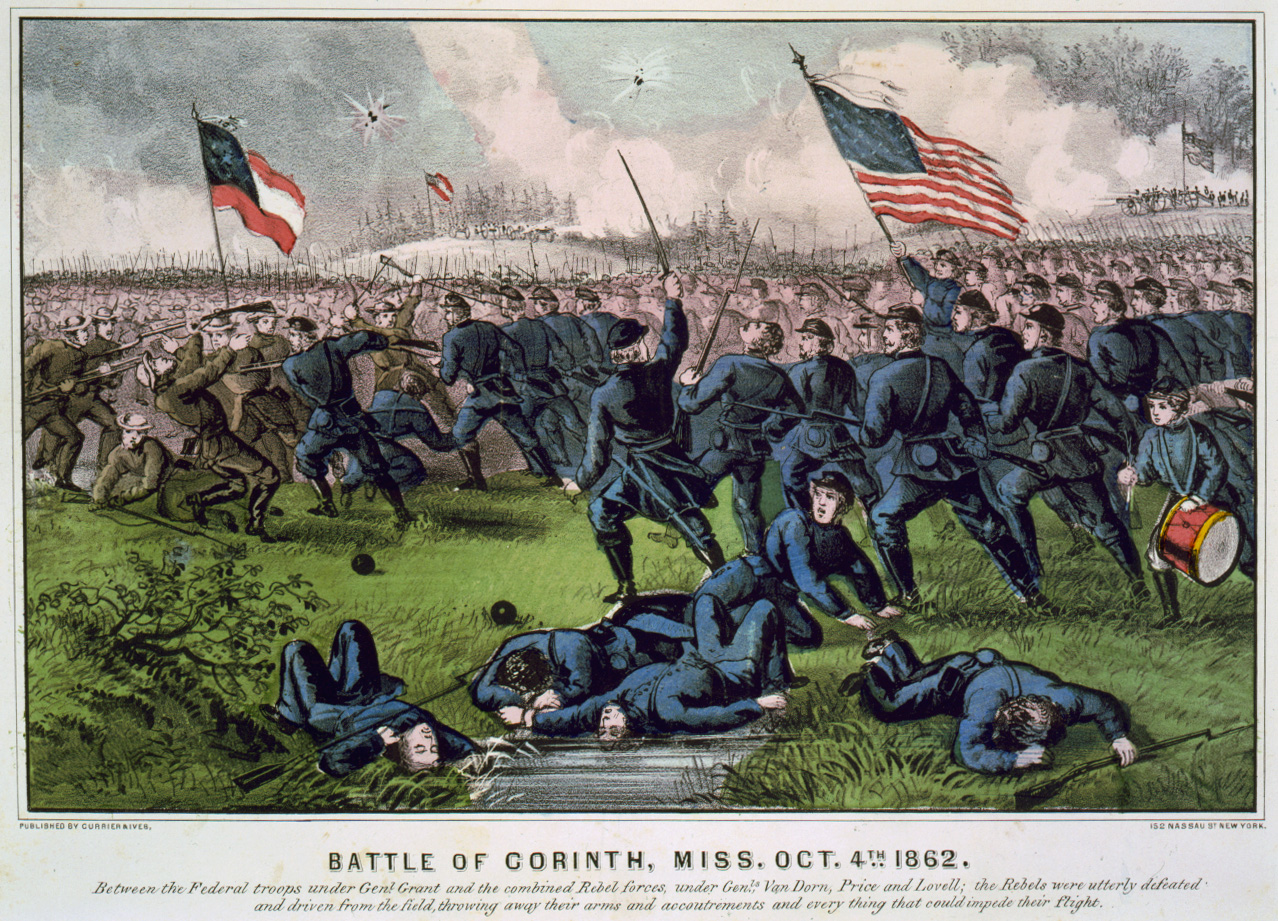
The Second Battle of Corinth was fought on October 3 and 4, 1862, near the Mississippi town of Corinth. A Confederate army commanded by Earl Van Dorn attacked Union positions defended by William S. Rosecrans. The first day’s fighting forced the Union back toward an inner line, but on October 4 the defenders repulsed repeated assaults and counterattacked. Confederate troops withdrew, leaving Corinth in Union hands. The battle mattered because the town stood at an important railroad junction, and its loss would have threatened federal transportation and operations in northern Mississippi. It should not be confused with the earlier spring siege.
Why was Corinth a railroad junction?
Corinth stood where two major railroads crossed: the Mobile and Ohio Railroad and the Memphis and Charleston Railroad. Railroads moved food, ammunition, men, horses and other supplies over distances that would have required slow wagon trains by road. Possession of the junction therefore shaped operations across western Tennessee, northern Mississippi and surrounding regions. Confederate commanders hoped to regain it, while the Union wanted to preserve its communication network after previous victories. The town’s strategic significance came from its transportation infrastructure, not from its population alone. Maps of the intersecting lines explain why armies fought over this otherwise modest community.
What happened during the spring Siege of Corinth?
Earlier in 1862, following the bloody Battle of Shiloh, Union forces under Henry W. Halleck advanced cautiously toward Confederate positions around Corinth. Confederate commander P. G. T. Beauregard eventually withdrew in late May, and the Union occupied the town. The slow advance became known as the Siege of Corinth, though it involved maneuver and entrenchment rather than a classic long bombardment of a walled city. The October 3–4 battle was a separate Confederate attempt to recapture the position. Distinguishing the two events prevents confusion over dates, commanders and casualty totals.
Who was Earl Van Dorn?
Earl Van Dorn commanded Confederate troops operating in the western theater after earlier campaigns in Arkansas and Mississippi. In October 1862 he united forces with those of Sterling Price, creating an army capable of challenging Rosecrans near Corinth. Van Dorn hoped a bold offensive could regain the railroad junction and improve the Confederacy’s strategic position. The attack required troops to march hard in hot weather and assault strong defensive works. Its failure caused heavy casualties and damaged Van Dorn’s standing. His responsibilities should be considered separately from Price’s, because the two men commanded distinct formations within the combined Confederate effort.
Who was William Rosecrans?
William S. Rosecrans commanded the Union force at Corinth and used defensive lines constructed after the spring occupation. Rosecrans had a reputation for energy and aggressive battlefield leadership but also faced criticism for the way he pursued his defeated opponents. The October battle gave him a major success and strengthened his standing among federal commanders. Later in 1862 he assumed command of the Army of the Cumberland in Tennessee, where he fought at Stones River and subsequently at Chickamauga. Corinth is an important early episode for understanding his military career.
How did Confederate forces approach Corinth?
Van Dorn’s army moved toward Corinth after linking with Price’s troops in northern Mississippi. The advance required marches through difficult country and left soldiers exhausted before they reached the defenses. Confederate leaders aimed to strike a divided Union force before reinforcements could intervene. Rosecrans placed troops in an outer line while preserving the option to withdraw toward stronger positions closer to the town. The Confederate approach created opportunities for an initial breakthrough but also complicated the timing and cohesion needed for a second day’s assault. Successful marching to the battlefield did not guarantee effective coordination once fighting began.
What happened on October 3?
On October 3 Confederate troops attacked the Union outer positions and drove federal defenders back in several sectors. The heat, smoke and confused terrain made coordinated movements difficult. Union soldiers withdrew toward the fortified inner perimeter near Corinth, while Confederate forces pressed forward but grew exhausted. Fighting continued into the evening and created an impression that the attackers might succeed if they renewed their effort the following day. However, the retreat had drawn them closer to strong Union batteries and protected positions. The first day’s Confederate progress was real, but it did not amount to capture of the town or defeat of Rosecrans’s army.
What was Battery Robinett?
Battery Robinett was one of the key Union defensive works near Corinth. It consisted of a fortified position with artillery and infantry support defending an important approach to the town. On October 4 Confederate soldiers mounted a determined assault against the battery, reaching parts of the position in close fighting. Union defenders eventually repulsed them. The fighting at Battery Robinett became one of the most memorable moments of the battle because of its intensity and the heavy losses among attackers. Historical photographs taken afterward show dead Confederate soldiers near the defenses, grim evidence of the cost of frontal attacks.
Who was Colonel William P. Rogers?
Colonel William P. Rogers led a Confederate brigade that attacked Battery Robinett during the October 4 fighting. He was killed near the works, and his death became a central feature of accounts describing the assault. Reports praised his personal courage while also revealing the extreme danger of sending infantry into prepared artillery positions. His story should not obscure the actions of thousands of other soldiers on both sides who fought across Corinth’s defensive line. The attempt to capture Robinett was a tactical episode within a broader Confederate offensive, not a standalone duel between one officer and a single Union gun.
What happened on October 4?
Confederate units renewed attacks early on October 4 and briefly penetrated parts of the Union line, including positions near the town. Federal artillery, infantry resistance and counterattacks eventually stopped the assault. The attack against Battery Robinett failed, and Union forces restored control over contested ground. By afternoon the Confederates had begun to withdraw. The second day’s fighting reversed much of the progress achieved on October 3. Rosecrans’s army retained its railroad position, while Van Dorn’s force suffered heavy casualties. The battle demonstrates how a strong inner defensive line can prevent an initial breakthrough from becoming a decisive victory.
Why were the Union defenses effective?
After occupying Corinth in the spring, federal forces had improved the town’s fortifications with batteries, infantry works and connecting lines. These prepared positions enabled Union troops to fall back from exposed outer ground and continue fighting without losing control of the railroad junction. Guns could fire into attacking formations while infantry supported the batteries at critical points. Confederate troops had already marched and fought for long periods, reducing their ability to renew coordinated attacks. Defensive engineering did not make Union soldiers invulnerable; several positions were contested fiercely. It did, however, give Rosecrans valuable options when the first day’s line became untenable.
How many casualties were there?
The National Park Service’s Corinth II battle record gives an estimate of 7,150 casualties: about 2,350 Union and 4,800 Confederate casualties. These figures combine military categories such as killed, wounded, missing and captured; they are not the number of battlefield deaths alone. Different sources may use varying returns or include adjacent engagements. The Confederate losses were particularly serious because Van Dorn needed his army to remain effective in future campaigns. Families on both sides suffered, and wounded men overwhelmed local medical facilities. The toll reflects the cost of attacking prepared defenses in a campaign that lasted only two days.
Did Confederate troops enter Corinth?
Yes. During the October 4 fighting, Confederate troops penetrated portions of the Union defensive line and reached areas associated with the town. But those temporary gains did not produce lasting Confederate control of the railroad junction. Federal counterattacks and defensive fire forced the attackers back. It would be inaccurate to say that Van Dorn simply failed to reach the Union defenses at all, just as it would be inaccurate to call the action a successful recapture of Corinth. The battle’s narrative includes serious Confederate advances followed by a Union recovery. Recognizing both phases helps explain why the engagement was so costly.
What happened during the Confederate retreat?
After the attack failed, Van Dorn’s army withdrew from Corinth and attempted to reach safer ground. Union troops followed, but the pursuit was delayed and not fully coordinated. At the Battle of Hatchie’s Bridge on October 5, another federal force struck parts of the retreating Confederate army and inflicted additional losses. Despite this pressure, Van Dorn escaped with the remainder of his command. The retreat demonstrates the limits of Union exploitation after victory: preserving Corinth was important, but destroying the Confederate field force would have been an even larger strategic achievement. The failed pursuit became part of later criticism of Rosecrans.
How was the battle connected to Iuka?
The September 1862 Battle of Iuka, Mississippi, preceded the Corinth fighting. Sterling Price’s Confederate force had engaged Union troops in the area before joining Van Dorn. The combined force then marched on Corinth, hoping to defeat Rosecrans and regain a key transportation junction. The sequence is sometimes called the Iuka–Corinth Campaign. Readers should distinguish the dates and locations rather than treating both engagements as one battle. Both were part of Confederate efforts to improve their position in Mississippi and Tennessee while Union armies pursued wider western objectives, including control of the Mississippi River.
Why did the Confederates want to attack Tennessee?
Regaining Corinth could have improved Confederate access to rail communications and opened possibilities for operations toward Tennessee. During autumn 1862 Confederate forces were attempting advances in several regions, including Bragg’s campaign in Kentucky and Lee’s invasion of Maryland. The Corinth offensive formed part of that larger effort to regain initiative against the Union. However, it was not conducted as a single perfectly synchronized national plan. Confederate armies faced different conditions and command priorities. The failure at Corinth helped prevent a recovery of the strategic ground lost earlier in the year.
What was the military result?
The Union won the Second Battle of Corinth. Rosecrans’s forces maintained control of the town and the valuable railroad junction after repelling Van Dorn’s October 4 assaults. The Confederate army escaped destruction but lost thousands of men and was unable to resume the offensive immediately. The victory supported Union positions in northern Mississippi and contributed to federal success in the western theater during a difficult year. It did not end Confederate resistance in Mississippi, and further major operations, including the Vicksburg Campaign, would be required. A complete Civil War timeline should show Corinth’s role without exaggerating it into a war-ending victory.
What happened to the town of Corinth?
The fighting damaged land, structures, roads and facilities around Corinth. Soldiers used public and private buildings, and the dead and wounded required burial and care. Civilian residents faced disruption from armies occupying a town valued primarily for its railroads. The Union continued to use Corinth as a logistical and defensive point afterward. Its local history also intersects with emancipation: large numbers of formerly enslaved people entered Union-controlled areas and sought safety and opportunities in federal camps. A complete account should include these experiences alongside descriptions of Battery Robinett and the movements of Confederate brigades.
Why is Battery Robinett remembered today?
Battery Robinett became a symbol of the desperate Confederate assault and stubborn Union defense. Its reconstructed position and historical interpretation help visitors visualize the strength of the fortification and the very short distances at which men fought. The site also connects to one of the Civil War’s disturbing photographic records: images of the dead after the battle. Such evidence should be interpreted with care rather than used as spectacle. The events at the battery are important, but they represent one sector of the struggle. The broader battle depended on actions around multiple works and the town’s railroad approaches.
Where can visitors learn about Corinth?
The Corinth Civil War Interpretive Center, part of Shiloh National Military Park, explains the town’s railroad importance, the 1862 siege, the October battle and the experiences of African Americans in wartime Mississippi. The National Park Service center offers exhibitions and maps. The NPS Corinth II battle record describes the commanders and outcomes. Visitors should distinguish preserved original features from reconstructed earthworks and understand that the railroad junction influenced both the spring and autumn operations.
Timeline
| Date | Event |
|---|---|
| May 1862 | Confederates evacuate Corinth during the earlier campaign. |
| September | Price fights at Iuka, then joins Van Dorn. |
| October 3 | Confederate attacks push Union soldiers toward Corinth’s inner defenses. |
| October 4 | Attacks at Battery Robinett and near town are repulsed. |
| October 5 | Confederates retreat under pressure near Hatchie’s Bridge. |