Panama Canal Construction (1904–1914): Workers, Locks and Opening
How American engineers and an international workforce built the Panama Canal—and at what human cost.
The United States built the modern Panama Canal between 1904 and 1914 after an earlier French project failed. Engineers used locks, a dam and the Culebra Cut to create a navigable route across the isthmus. Tens of thousands of workers, including many from the Caribbean, faced landslides, disease and racial segregation. The canal officially opened to commercial traffic on August 15, 1914, with the transit of SS Ancon.
Follow the canal from the French failure and 1903 treaty to the lock design, construction, opening, and political consequences.
On this page — 24 topics
When was the Panama Canal built?
The Panama Canal’s modern American construction phase ran from 1904 until 1914, following a largely unsuccessful French project begun in the 1880s. The United States acquired French canal assets and took charge of the construction zone in 1904. Workers excavated an enormous waterway, built a dam and locks, and developed hospitals, railway facilities and supporting infrastructure. The official opening to commercial traffic was August 15, 1914. These dates do not mean all engineering began in 1904 or that no vessel moved through part of the waterway earlier. The canal’s history includes French excavation, American trial transits and later expansion, each of which needs a separate chronological place.
Why was a canal across Panama so valuable?
A waterway through Central America would allow ships to travel between the Atlantic and Pacific without going around Cape Horn at the southern end of South America. For merchants this promised shorter routes, savings in fuel and quicker movement of goods. For the United States it also offered strategic advantages, enabling naval vessels to move more rapidly between oceans. The Spanish–American War of 1898 had drawn attention to the difficulty of shifting ships between American Pacific and Caribbean theaters. The canal responded to longstanding commercial plans, however, not a new idea invented in 1898. Engineers and governments had examined routes across the isthmus for decades.
Why did France fail to complete the project?
A French company associated with Ferdinand de Lesseps began construction in the 1880s after his success with the Suez Canal. The effort initially pursued a sea-level canal, an undertaking made exceptionally difficult by Panama’s terrain, rainfall and the flood-prone Chagres River. Disease, financial mismanagement, expensive excavation and landslides added to the crisis. The company failed, leaving equipment and partially completed workings. The deaths suffered by French-era workers were severe, though exact totals differ among sources. An account focused only on American success can erase the earlier sacrifices and engineering lessons that shaped later choices. The abandoned French work nevertheless became part of the assets the United States acquired.
What happened between Panama and Colombia in 1903?
Before 1903 Panama formed part of Colombia, whose government was negotiating with the United States over canal rights. The Colombian Senate rejected a proposed treaty. Panama’s independence movement then declared separation in November 1903, and U.S. naval and diplomatic actions helped prevent Colombia from reasserting authority at the critical moment. The United States quickly recognized the new Republic of Panama and negotiated favorable canal-zone terms. The sequence has remained controversial in Panamanian history because the new state’s sovereignty developed alongside substantial American intervention. It should not be described as a transfer of territory from a freely consenting Colombian government directly to the United States.
What was the Hay–Bunau-Varilla Treaty?
The Hay–Bunau-Varilla Treaty was negotiated between the United States and Panama shortly after Panamanian independence. Signed in November 1903, it granted the United States extensive rights over a canal zone for construction, operation and defense. The arrangement provided for a payment of ten million dollars and later annual payments under the treaty. Philippe Bunau-Varilla, a French engineer and promoter associated with the canal interests, represented Panama in the negotiation, a fact that remains politically significant because he was not a Panamanian elected leader. The treaty’s broad provisions created decades of disputes about control and sovereignty. It established a legal and diplomatic framework distinct from the engineering challenges of building the waterway.
How much did the United States pay for the French assets?
The United States agreed to pay approximately forty million dollars for the rights and physical assets of the French canal enterprise. This amount was separate from the ten-million-dollar payment arranged with Panama under the treaty. The French property included equipment, records and the partially excavated route, although many assets needed repair or replacement. Distinguishing the two payments prevents the common mistake of describing the entire American project as a ten-million-dollar purchase. Actual construction, sanitation, administration and transportation expenses added far more. Historical sources calculate total costs using different accounting periods and categories, so a single dollar figure should identify whether it includes the French purchase, land payments and later work.
Why did engineers choose locks instead of sea level?
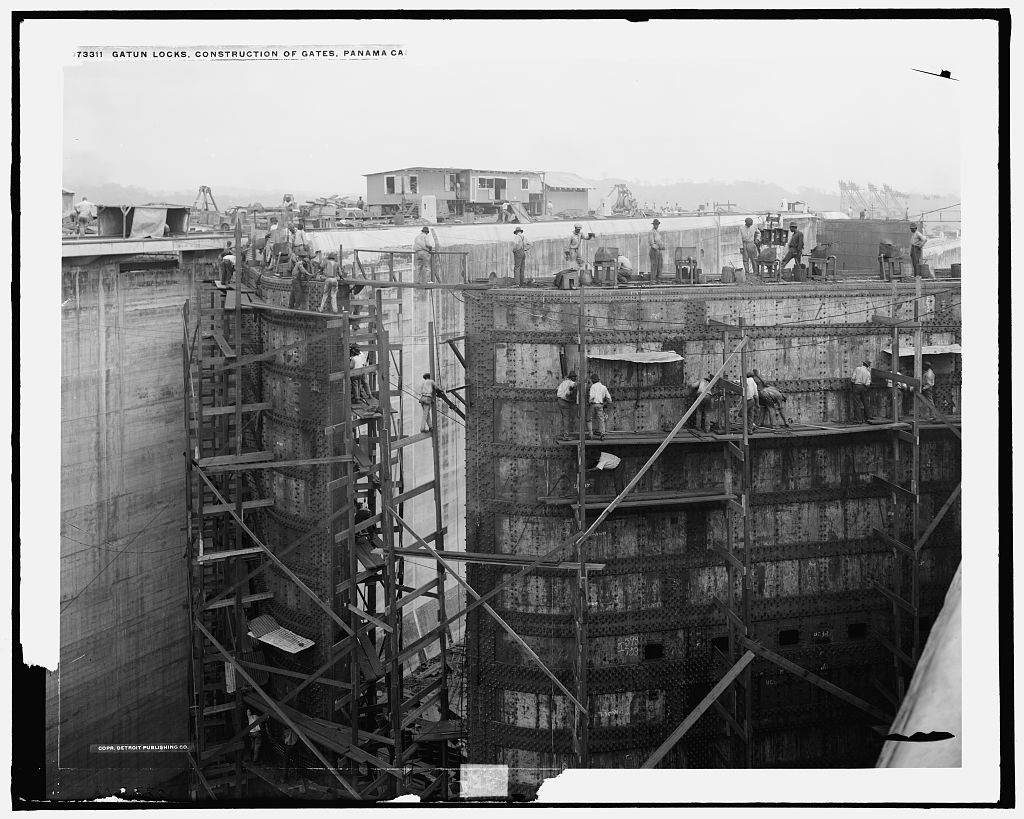
The United States ultimately chose a lock canal using a large artificial lake instead of attempting to excavate a continuous sea-level channel. Raising ships to the level of Gatun Lake reduced the volume of digging and allowed the Chagres River system to become part of the waterway. Locks lifted ships from one ocean to the inland water level and lowered them on the other side. The decision reflected both technical feasibility and an assessment of cost, geological risk and time. A sea-level plan would have required far greater excavation through difficult terrain and additional means of controlling floods. The lock design became the defining engineering feature of the canal that opened in 1914.
How do the Panama Canal locks work?
A vessel enters a chamber where gates close behind it, then water flows in or out to raise or lower the ship toward the next level. The original locks use gravity-driven water movement rather than pumps lifting the entire vessel. On the Atlantic side Gatun Locks raise ships toward Gatun Lake. On the Pacific side Pedro Miguel and Miraflores Locks lower them toward sea level, with the process reversed for ships traveling the other direction. Tugs and other assisting equipment have changed over time, but the underlying principle is to control water level in successive chambers. The system depends on reliable gates, ample freshwater supplies and careful vessel handling.
What is Gatun Lake?
Gatun Lake is the large artificial reservoir created by damming the Chagres River. It formed a central part of the canal route and allowed ships to travel across much of the isthmus at an elevated level rather than in an excavated trench at sea level. The lake also supplies the freshwater needed to operate the original lock chambers. Its creation flooded land and altered communities and ecosystems, consequences often minimized in engineering celebrations. Canal operators later faced environmental and water-supply challenges because the navigation system depends on rainfall and watershed management. Understanding the lake explains why the canal is a complex landscape and hydraulic system, not simply a channel carved between two open seas.
What was the Culebra Cut?
The Culebra Cut, also known historically as the Gaillard Cut, was a difficult excavation through the continental divide near the center of the canal. Workers removed enormous quantities of earth and rock, and unstable slopes repeatedly slid into sections that had already been cleared. The excavation became one of the most famous engineering struggles of the entire project. Steam shovels and railway systems helped transport spoil material, but machines could not remove the geological danger. The cut’s final shape required continued maintenance and landslide management even after ships began using the canal. Its history illustrates why major infrastructure projects must account for geology as well as design drawings and budgets.
How were steam shovels and railroads used?
Large steam shovels loaded excavated material into railway cars, which carried spoil away from the worksite. Engineers built and repeatedly adjusted tracks as the cutting face moved and the ground changed. Coordinating equipment, repair crews, explosive work and transport required sophisticated scheduling. Railway methods were especially valuable in the Culebra Cut, where moving earth efficiently was central to progress. Machines increased output but did not replace the thousands of workers responsible for operating, maintaining and supplying them. Period photographs emphasize the dramatic shovels and cranes, while less visible labor included track crews, cooks, cleaners and medical staff. The canal was an industrial system maintained by people, not a feat performed by machinery alone.
Who was John F. Stevens?
John Frank Stevens became chief engineer of the American canal project in 1905 and helped organize transport, housing and sanitation infrastructure while advocating the lock-canal approach. His railroad experience was valuable because moving excavation material was a major logistical problem. Stevens emphasized that the canal could not be built efficiently without reliable support systems for workers and equipment. He left the project in 1907, before final completion, and was succeeded by George Washington Goethals. The engineering leadership should not be reduced to one individual. Different stages depended on planners, sanitary experts, laborers and supervisors, and the eventual success drew on methods that developed under several administrations.
Who was George Washington Goethals?
George Washington Goethals, a U.S. Army engineer, took charge of canal construction in 1907 and directed the project through its completion. He oversaw excavation, lock construction, administrative coordination and the management of an immense workforce. Goethals became publicly associated with the achievement when the waterway opened in 1914. However, the project had been underway for years before he arrived, and major designs and sanitation improvements had already been developed. Recognizing his role while crediting predecessors and workers avoids the heroic narrative in which one man single-handedly solves every technical problem. The Panama Canal Authority’s official history documents the involvement of multiple engineers and construction phases.
How did William Gorgas control disease?
Colonel William C. Gorgas led sanitary measures against yellow fever and malaria, diseases that had devastated earlier workers in Panama. Improved understanding of mosquito transmission made systematic control possible. Teams drained standing water, screened buildings, treated mosquito breeding sites and improved public-health infrastructure. These measures sharply reduced yellow fever and helped lower the burden of malaria, though workers continued to suffer disease and other dangers. The effort was not a single medical discovery made in Panama; it relied on earlier research and extensive labor by sanitation crews. It illustrates how scientific knowledge can shape the success of large engineering projects when public-health systems are organized and sustained.
Who worked on the canal?
Tens of thousands of laborers from Panama, the Caribbean, the United States and other regions built the canal. Many Black workers arrived from British Caribbean islands, including Barbados, and performed demanding excavation, track, maintenance and service work. Some workers were recruited from Europe, while American engineers and supervisors generally occupied better-paid positions. The workforce was diverse, and conditions differed considerably by job and the racial categories applied by administrators. A history focused only on American officials misses the people whose physical labor made the project possible. Their experiences of migration, family life, housing and discrimination are central to understanding both construction and the social history of the Canal Zone.
What was the gold roll and silver roll system?
The American Canal Zone administration divided employees into employment categories known as the gold roll and silver roll. The system became closely associated with racial and nationality segregation, differences in wages and access to housing and services. White American employees were disproportionately represented in the more privileged categories, while many Black West Indian workers received less favorable terms. The structure was not simply a technical distinction between payment coins: it shaped status, working conditions and opportunities. Historians examine payrolls, housing records and worker testimony to reconstruct its effects. The canal’s achievement must therefore be considered alongside unequal treatment of people whose labor contributed directly to its construction.
How many workers died?
The American construction period caused thousands of deaths from accidents and disease. Smithsonian historical interpretation estimates that more than 5,600 lives were lost during U.S.-directed construction, while earlier French efforts suffered a much larger, less certain death toll. Totals vary by period, nationality and record completeness. It would be misleading to combine all deaths into one precisely established figure without distinguishing the French and American phases. Major excavation sites, railway operations and tropical disease posed continuing threats despite sanitary improvements. A responsible history remembers workers as people with families and communities rather than treating the casualty figure as simply the cost of building a technological landmark.
When did the Panama Canal officially open?
The official opening to commercial service occurred on August 15, 1914, with SS Ancon making a celebrated transit. Ships had used parts or all of the route in earlier testing and engineering passages, so the date should not be mistaken for the first time a powered vessel physically traveled through the canal system. The Panama Canal Authority distinguishes such early transits from the official opening. The event occurred just as World War I began in Europe, limiting some plans for elaborate international celebrations. The waterway immediately altered the practical possibilities of global shipping and naval movement, but its traffic and operation continued evolving as technology, commerce and political circumstances changed.
How did the canal change world trade?
The completed canal shortened important Atlantic–Pacific routes and made many journeys faster than voyages around South America’s southern coast. It became a major artery for commercial shipping and gave the United States an important strategic position. Yet the benefits were not distributed equally, and the Canal Zone’s unequal governance affected Panama for decades. The canal required continued dredging, maintenance, freshwater management and improvements as ships grew larger. Its value was therefore not captured by the 1914 opening ceremony alone. Later expansion and political changes illustrate how an engineering achievement becomes part of a continuing system of international trade, state power and environmental management.
When did Panama regain control of the canal?
The 1977 Torrijos–Carter treaties created a framework for transferring control and revising the relationship between Panama and the United States. The Panama Canal was handed over to Panamanian administration on December 31, 1999. This later history matters because the original 1903 treaty had granted extensive U.S. rights that Panamanians continued challenging for much of the century. It is therefore inaccurate to describe the canal as having been built under an uncomplicated agreement reflecting equal power between two governments. The eventual handover marked a major change in sovereignty and administration. Panama has since operated and expanded the waterway through its own canal authority.
What are the most useful primary sources?
The Panama Canal Authority’s construction history documents the opening and early test passages. The Library of Congress preserves photographs, maps and newspapers from the project, while the Smithsonian interprets the engineering and labor history, including West Indian workers. The U.S. Army Corps of Engineers provides technical historical accounts of the locks and excavation. Comparing these materials helps separate celebrated engineering milestones from overlooked experiences of Panamanian and Caribbean workers. It also clarifies why 1903 diplomacy, 1904 construction, 1914 opening and 1999 transfer are four different historical events.
Panama Canal timeline
| Date | Event |
|---|---|
| 1880s | French excavation begins and later fails. |
| November 1903 | Panama separates from Colombia; treaty negotiations proceed. |
| May 1904 | United States takes over French canal property and work. |
| 1905–1907 | Stevens strengthens support systems and lock-plan approach. |
| 1907–1914 | Goethals directs final construction. |
| 1913–1914 | Locks and waterways undergo testing. |
| August 15, 1914 | SS Ancon makes official inaugural commercial transit. |
| 1977 | Torrijos–Carter treaties signed. |
| December 31, 1999 | Control transferred to Panama. |
Historical sources
- Panama Canal Authority — End of Construction
- Panama Canal Authority — Workforce Records
- Library of Congress — Panama Canal Historical Guide
- Smithsonian — The Conquerors and Labor of Canal
- U.S. Army Corps — 1914 Canal Opening
- Library of Congress — Gatun Locks Construction Photograph
- Office of the Historian — Building the Panama Canal