The Eiffel Tower Was Supposed to Be Dismantled After 20 Years
Today the Eiffel Tower is almost impossible to separate from the image of Paris. Yet the monument was not originally guaranteed a permanent place on the skyline.
The fact
The Eiffel Tower was built for the 1889 Exposition Universelle and was originally expected to be dismantled after a 20-year concession.
The official Eiffel Tower history notes that Gustave Eiffel deliberately promoted scientific uses for the structure because practical value could help secure its future.
A temporary giant
The agreement behind the tower allowed Eiffel to operate it for twenty years beginning at the end of 1889. After that period, the City of Paris could have chosen to remove it.
That possibility was not trivial. The tower had powerful critics from the beginning. Some artists and writers saw the iron structure as an industrial intrusion on the classical appearance of Paris.
Gustave Eiffel’s strategy
Eiffel understood that beauty and tourist popularity might not be enough. He promoted the tower as a platform for scientific research.
Experiments and observations connected to meteorology, astronomy, physics and aerodynamics were conducted there. Its exceptional height made it useful in ways that ordinary buildings could not match.
Radio helped save the tower
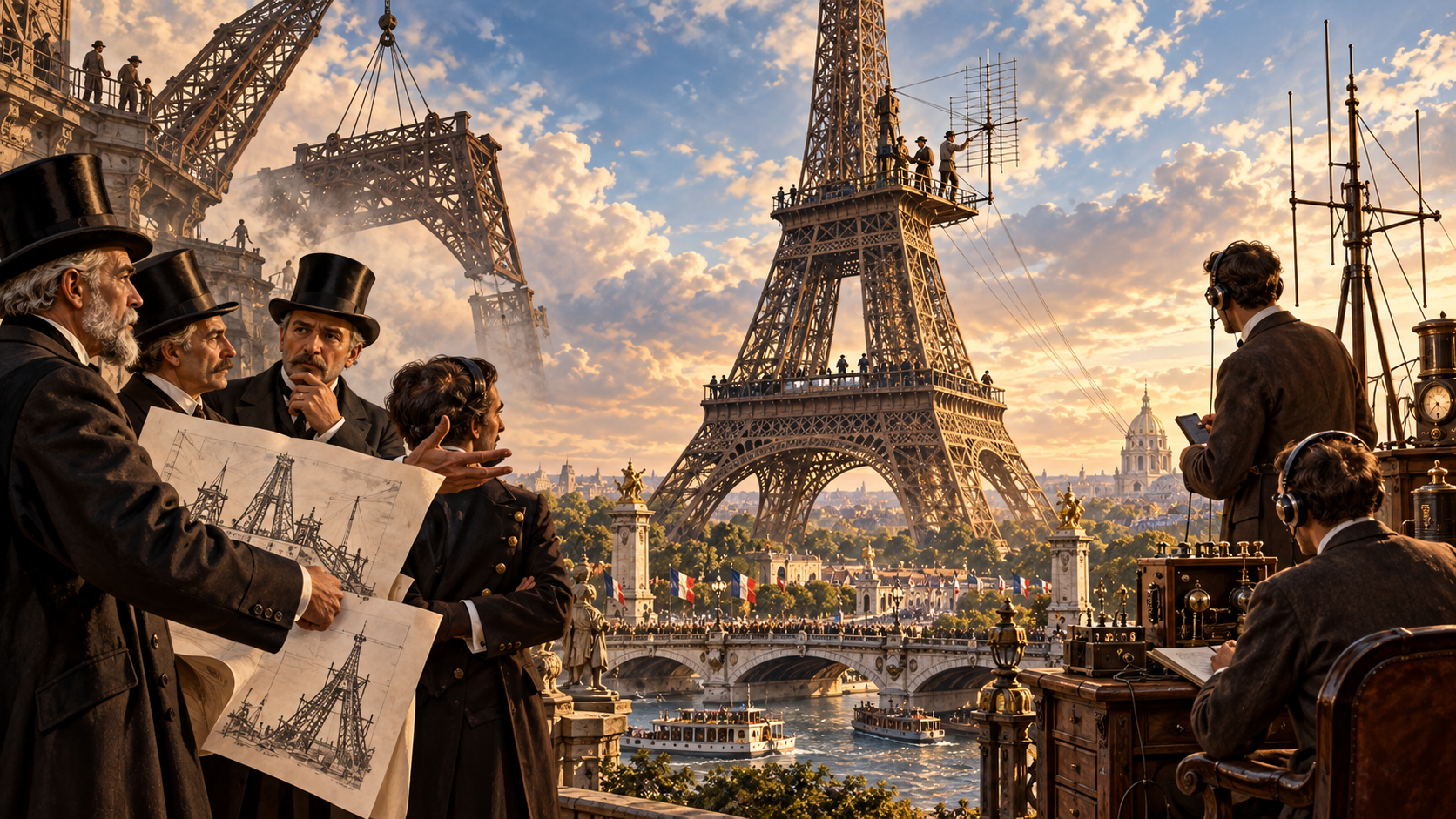
The most important practical use became wireless communication. In 1898, experiments demonstrated wireless telegraphy between the tower and the Panthéon. During the following years, radio transmission became increasingly important.
The tower’s value as a high communications platform gave authorities a compelling reason to keep it standing when the original concession approached its end.
From controversial structure to national symbol
The Eiffel Tower eventually became one of the most recognizable monuments on Earth. Its survival shows how the meaning of a building can change dramatically over time.
What began as a temporary world’s-fair structure became useful infrastructure, a scientific laboratory, a communications platform and finally a permanent cultural symbol.
A different Paris was possible
Had the original plan been followed strictly, visitors in the 20th century might have known the Eiffel Tower only through photographs and drawings. Instead, new technology made an apparently temporary building too useful to remove.
One of the world’s most famous landmarks survived in part because radio waves needed somewhere high to go.