Theodore Roosevelt’s Square Deal: Three Cs, Trust-Busting and Reform
What Roosevelt meant by a fair deal, and how his reform priorities changed American government.
The Square Deal was President Theodore Roosevelt’s promise of fair treatment for workers, businesses, and the public. Historians often summarize the program as three Cs—control of corporations, consumer protection, and conservation. Important examples include federal intervention in the 1902 coal strike, antitrust litigation, food-safety laws and expanded protection of public lands.
A historically grounded guide to the three Cs, trust regulation, public safety and natural-resource conservation.
On this page — 22 topics
What was Theodore Roosevelt’s Square Deal?
The Square Deal described Theodore Roosevelt’s view that the federal government should protect the public interest when powerful businesses, workers and consumers came into conflict. It was a political principle rather than one statute with a numbered set of clauses. Roosevelt argued that government should enforce law fairly without assuming that every large corporation was dishonest or every union demand was justified. During his presidency from 1901 to 1909, the administration pursued antitrust cases, investigated industry, encouraged regulation of consumer products and expanded conservation. Those activities did not arise from a perfectly unified blueprint, but they developed a recognizable approach to national reform during the Progressive Era.
What were the three Cs?
The Square Deal is commonly taught as the three Cs: control of corporations, consumer protection and conservation of natural resources. This is a useful modern historical summary, not a phrase that Roosevelt presented as a formal three-part law enacted at one moment. Corporate oversight included enforcement of antitrust statutes and transportation regulation. Consumer protection included restrictions on adulterated foods and drugs. Conservation encompassed forests, wildlife and nationally significant landscapes. The categories overlap: rail regulation influenced consumers, and conservation involved decisions about the economic use of public lands. The Theodore Roosevelt Center specifically notes that historians later condensed a larger agenda into this memorable formula.
When did Roosevelt become president?
Roosevelt assumed the presidency on September 14, 1901, after William McKinley died from wounds sustained in an assassination attempt. The transition brought a younger and unusually energetic public figure into the White House. He had already served in state government, the Navy Department and as governor of New York before becoming vice president. The McKinley assassination chronology explains the circumstances of the succession. Roosevelt was elected to a full presidential term in 1904 and left office in 1909. During those years his administration operated within existing constitutional institutions, but he used speeches and public pressure extensively to shape how citizens understood presidential responsibilities.
Why did the Square Deal emerge?
Industrial growth had created enormous corporations and nationwide markets, while many workers faced hazardous employment, insecure wages and limited bargaining power. Railroads, mining concerns and food manufacturers could affect people across state lines. State regulation alone often proved inconsistent, and the Sherman Antitrust Act of 1890 had not immediately solved concerns about concentrated power. Roosevelt believed government could reduce the risk of violent conflict by investigating abuses and mediating disputes. His approach also reflected a Progressive movement with many leaders and viewpoints, not a reform campaign created exclusively by one president. Journalists, scientists, unions and local organizations pushed for action in their respective fields.
What did a square deal mean for labor?
Roosevelt sought to present the presidency as a defender of public welfare rather than a tool automatically available to either mine owners or striking employees. That did not mean he accepted every labor demand or supported modern union rights. Workers wanted reliable wages, reasonable hours and safety protections, while employers argued that costs and management authority were essential for continued operation. Roosevelt’s famous intervention in the 1902 anthracite coal dispute sought to prevent a winter fuel shortage through talks and an independent commission. The episode gave the phrase Square Deal a concrete political meaning: powerful parties should be asked to justify their positions before a wider public.
How did the 1902 anthracite strike affect the program?
The Pennsylvania anthracite strike began in May 1902 and lasted for months, threatening heating supplies across the northeastern United States. Roosevelt met mine operators and union representatives in October and supported a commission to examine their competing claims. The miners returned to work later that month, while the commission recommended wage and hour improvements in 1903 without requiring formal union recognition. Our Anthracite Coal Strike history details the sequence. The case was important because an American president sought an active mediating role in a major private industrial dispute. It was not a sweeping new law that resolved all future strikes or guaranteed equal outcomes for both sides.
Did Roosevelt want to break up every trust?
No. Roosevelt drew a political distinction between corporations that served the economy without violating law and combinations that unlawfully restrained competition or abused their power. He considered large enterprises a feature of modern industrial life and favored oversight when appropriate. Antitrust cases nevertheless challenged powerful financiers and business leaders, making his administration famous for trust-busting. The distinction matters because popularity of the term sometimes creates the mistaken picture of a president attempting to dissolve every successful company. Federal lawyers had to prove violations under existing statutes, and courts determined the legal outcome. Roosevelt’s efforts helped make enforcement more visible and credible, but they did not abolish corporate concentration.
What was the Northern Securities case?
The Northern Securities Company was a holding company designed to place major competing northern railroads under common control. The Justice Department challenged its arrangement under the Sherman Antitrust Act, and the Supreme Court upheld the federal position in March 1904. The judgment became one of the clearest early successes of Roosevelt’s corporate-control policy. It showed that government might contest powerful corporate combinations despite the wealth and influence of their owners. The Northern Securities case guide examines the merger, financiers and decision. The ruling concerned a specific arrangement and did not establish that every stock-holding company violated antitrust law.
What was the Bureau of Corporations?
Congress created the Bureau of Corporations in the Department of Commerce and Labor in 1903. The bureau investigated companies engaged in interstate commerce and gathered information about business practices, helping government assess claims of abuse rather than relying entirely on newspaper accusations. Its creation reflected Roosevelt’s belief that transparency and supervision could improve relations among business and the public. The bureau’s reports and investigations contributed to later regulatory development. It was not the same agency as the Federal Trade Commission, which Congress established in 1914, and it did not have every power later regulators would possess. Distinguishing the two prevents anachronistic accounts of Progressive Era administration.
How did railroad regulation change in 1906?
The Hepburn Act of 1906 strengthened the Interstate Commerce Commission by extending its authority over rates and certain transportation practices. This built on the Interstate Commerce Act of 1887, which had created the ICC but left significant enforcement weaknesses. Roosevelt supported stronger public oversight of railways because freight prices affected farmers, consumers and manufacturers across the country. Rate regulation was not identical to antitrust enforcement: one imposed standards on carrier behavior, while the other challenged unlawful market restraints. Both methods formed part of the broader effort to address economic power. Neither could guarantee that every commercial complaint would be resolved or that railway disputes would disappear.
How did the Pure Food and Drugs Act protect consumers?
Roosevelt signed the Pure Food and Drugs Act on June 30, 1906, establishing federal restrictions against adulterated and misbranded products moving in interstate commerce. Harvey Washington Wiley and many other scientists and reformers had campaigned for legislation long before its passage. Public reaction to Upton Sinclair’s novel The Jungle helped increase political urgency. The Pure Food and Drugs Act guide separates the law’s original requirements from later FDA powers. The statute did not instantly require modern testing of all medicines or comprehensive nutrition labels. Its historical importance was the principle that national commerce in food and drugs needed enforceable protections against unsafe and deceptive practices.
What was Roosevelt’s approach to meat inspection?
Concerns about meatpacking hygiene led to federal investigations and the Meat Inspection Act of 1906. The law was separate from the Pure Food and Drugs Act, although both belonged to the same period of reform. Roosevelt and Congress responded to evidence of unsanitary conditions and public concern about products sold across state lines. Government inspection sought to protect consumers and improve confidence in the industry. The legislative outcome also reflected lobbying and negotiations about who should pay for inspection and what standards were practicable. Treating both 1906 statutes as one law would obscure their different provisions. They illustrate how consumer protection became an increasingly visible responsibility of federal authorities.
Why was conservation part of the Square Deal?
Roosevelt regarded forests, water supplies, wildlife and scenic landscapes as national assets requiring long-term stewardship. He believed that unrestricted exploitation could waste resources needed by future generations. Conservation did not always mean leaving land untouched: Roosevelt and many advisers supported regulated timber use, irrigation and scientific management alongside protection of particular landscapes. This approach created tensions with ranchers, miners, farmers and Indigenous nations whose interests and rights were affected by federal designations. Roosevelt’s policy expanded national forests and other protected places. Its enduring significance lies in making resource management a central issue of federal public policy, although debates over who controlled land and for what purpose continued.
What happened when Roosevelt met John Muir?
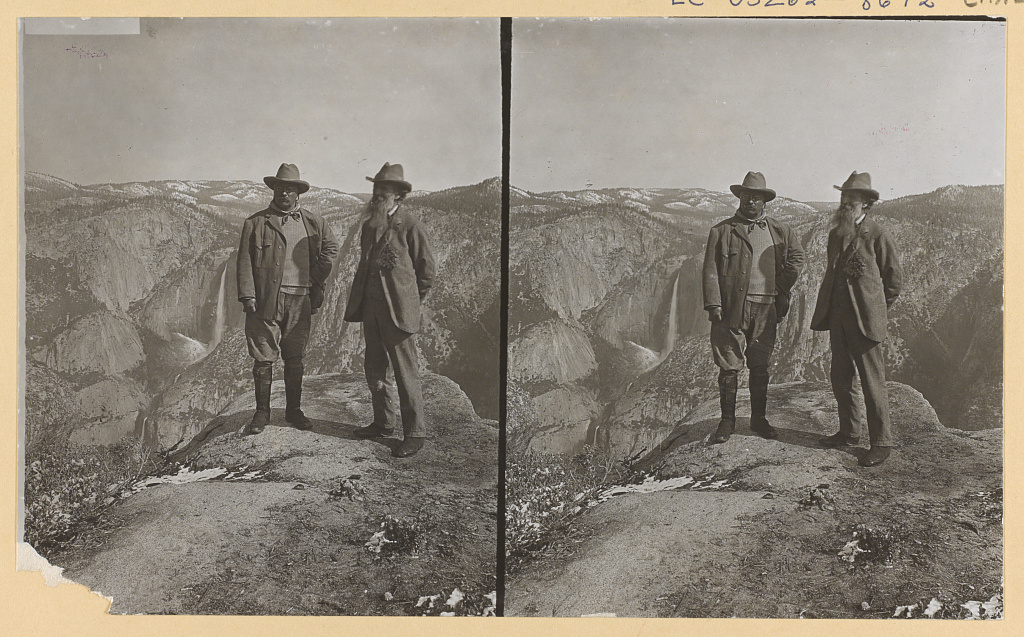
In 1903 Roosevelt visited Yosemite and spent time with naturalist John Muir, who advocated preservation of wilderness. Their conversations and the landscapes they visited helped strengthen public attention to the value of national parks. The historical photograph accompanying this article shows them at Glacier Point in Yosemite Valley. It illustrates an important encounter but should not be treated as the moment every later conservation law was conceived. Roosevelt already held strong views about resource management, and a network of conservationists, scientists and officials influenced his decisions. Muir’s preservationist philosophy also differed in some respects from the utilitarian approach favored by federal foresters. Both strands shaped the era’s conservation debate.
What did the Antiquities Act of 1906 authorize?
The Antiquities Act, signed June 8, 1906, empowered presidents to proclaim national monuments on federally owned or controlled land to protect certain historic, prehistoric or scientific objects. Roosevelt established Devils Tower as the first such monument that September and used the statute repeatedly to protect culturally and environmentally important places. The law addressed longstanding concerns about destruction and theft of archaeological resources. Its reach was significant but not unlimited: it did not provide a general authority to take any privately owned land without legal process. The act became an enduring conservation tool used by presidents of different parties well after Roosevelt left office.
What were Roosevelt’s limitations?
The Square Deal did not end poverty, industrial injury, racial discrimination or unequal bargaining power. Many factories remained dangerous, as the Triangle Shirtwaist Factory fire of 1911 would later illustrate. Roosevelt’s civil-rights record was mixed, and policies toward Indigenous peoples and overseas territories operated within systems of unequal power. Some reformers criticized his business policies as too moderate, while opponents argued that presidential intervention threatened property rights. The Three Cs should therefore be treated as a way to organize the administration’s principal domestic actions, not proof that each group in American society received equal benefits. The movement for reform continued under later presidents and state governments.
Did the Square Deal continue under Taft?
William Howard Taft succeeded Roosevelt as president in 1909 and continued antitrust litigation, with some cases going further than actions initiated under Roosevelt. But differences over tariff policy, conservation administration and political strategy contributed to a widening split between the two men. In 1912 Roosevelt challenged Taft and eventually ran as the Progressive Party’s candidate. Their disagreements helped divide Republican votes and contributed to Woodrow Wilson’s electoral victory. The Election of 1912 guide details that contest. Progressive Era policies did not stop in 1909, but neither did Roosevelt’s agenda pass unchanged to the new administration. Taft’s record needs independent assessment rather than treatment as simple opposition to all reform.
How was the Square Deal different from New Freedom?
Woodrow Wilson’s New Freedom campaign in 1912 placed greater rhetorical emphasis on restoring competition through changes in tariff, banking and antitrust policy. Roosevelt’s later New Nationalism favored stronger federal oversight of large corporate enterprises. Both spoke the language of reform, but their proposed relationships between government and big business were not identical. The Square Deal predates these 1912 programs and belongs primarily to Roosevelt’s 1901–1909 presidency. Historians sometimes combine all Progressive Era slogans into one list, obscuring who proposed them and when. Comparing them reveals genuine policy disagreements inside a reform movement that opposed certain industrial abuses but lacked one shared economic blueprint.
What is the Square Deal’s lasting significance?
Roosevelt helped popularize the expectation that presidents should use national authority to defend public welfare when private economic decisions have broad consequences. The administration’s antitrust cases, regulatory legislation, labor mediation and conservation measures set precedents without creating the modern administrative state all at once. Federal agencies, courts and Congress remained essential in implementing or limiting changes. The Square Deal is significant because it connected diverse concerns—corporate power, consumer health and natural resources—under a public-interest philosophy. Studying its achievements alongside unresolved inequalities gives a more accurate account than either celebrating Roosevelt as the sole creator of reform or dismissing all his efforts as empty rhetoric.
Square Deal timeline
| Year | Event |
|---|---|
| September 1901 | Roosevelt assumes presidency following McKinley’s death. |
| 1902 | Coal strike intervention makes fair treatment theme nationally visible. |
| 1903 | Bureau of Corporations created; Roosevelt meets John Muir. |
| March 1904 | Supreme Court upholds Northern Securities antitrust case. |
| 1904 | Roosevelt wins election to a full presidential term. |
| June 1906 | Hepburn Act, Pure Food and Drugs Act and Antiquities Act enacted. |
| 1906–1909 | Roosevelt uses Antiquities Act and expands conservation protections. |
| 1909 | Taft succeeds Roosevelt. |
| 1912 | Roosevelt and Taft divide over Progressive policies. |
Research sources
- Theodore Roosevelt Center — Square Deal
- Miller Center — Roosevelt Domestic Affairs
- National Park Service — Theodore Roosevelt and the National Park System
- National Archives — Square Deal Political Cartoon
- NPS — Anthracite Coal Strike History
- FDA — 1906 Food and Drugs Act History
- Library of Congress — Roosevelt and John Muir Photograph