Siege of Port Hudson (1863): Black Union Troops and the Mississippi River
Union forces under Nathaniel P. Banks besieged Confederate Port Hudson, Louisiana, from May to July 1863. Failed frontal assaults were followed by a 48-day siege. Black Union
Union forces under Nathaniel P. Banks besieged Confederate Port Hudson, Louisiana, from May to July 1863. Failed frontal assaults were followed by a 48-day siege. Black Union regiments participated prominently, and Confederate commander Franklin Gardner surrendered on July 9 after learning that Vicksburg had fallen. The Union could then navigate the entire length of the Mississippi River.
Explore the military chronology, historical participants, consequences and evidence behind the event.
On this page — 23 topics
Where was Port Hudson?
Port Hudson was a small river community on high bluffs above the Mississippi River north of Baton Rouge, Louisiana. Its position allowed Confederate batteries to command a difficult bend in the waterway, making the passage of Union vessels dangerous. Earthworks extended inland to protect the guns from attack by land. This combination of river cliffs and wooded ravines shaped the 1863 siege. Port Hudson was strategically important because it stood near the southern end of a stretch of the Mississippi still controlled by the Confederacy. Capturing it would help reunite federal river navigation from the northern states to the Gulf of Mexico.
Why did the Union want Port Hudson?
President Lincoln and Union military leaders sought control of the Mississippi River to divide Confederate territory and open transport between the upper river and New Orleans. Grant’s forces threatened Vicksburg to the north, while Nathaniel Banks operated against Port Hudson farther south. Both positions had to fall before the river could be used freely by Union shipping. The campaign was therefore part of a coordinated strategic effort, not simply a local dispute over one Louisiana town. The Union also expected that successful river operations would weaken Confederate communications and supply routes across the trans-Mississippi region.
Who commanded the Union army?
Major General Nathaniel P. Banks commanded federal ground forces in the Department of the Gulf. He had a background in politics and experience in several earlier Civil War theaters. In Louisiana he faced the difficult task of advancing against strong Confederate earthworks with an army containing troops of varied training and experience. Banks initially attempted to take the defenses by direct assault, but the failures forced him into a prolonged siege. His performance has been debated, especially because his ambitious attacks caused heavy losses. Yet the eventual surrender achieved the strategic objective of opening the lower Mississippi.
Who defended Port Hudson?
Confederate Major General Franklin Gardner commanded the garrison, supported by officers and enlisted men defending a series of batteries and earthworks. Their position benefited from steep ravines, dense vegetation and high ground that made Union movement difficult. Gardner’s soldiers faced severe shortages as the siege continued. They had no easy way to bring in adequate supplies once federal forces closed the land approaches. The Confederate defense was determined and prolonged, but it could not ultimately compensate for the loss of Vicksburg and the isolation of its river position. Gardner surrendered when continued resistance no longer offered practical benefit.
What happened before the formal siege?
Union naval forces had already tried to challenge Port Hudson’s river batteries earlier in 1863. In March, Farragut attempted to pass the position with warships, but the Confederate guns made the operation extremely costly and limited its success. Ground operations intensified in May as Banks moved into position around the fortifications and Union forces secured surrounding roads. The fighting at Plains Store helped close a Confederate escape route. By late May the garrison was increasingly isolated. These preparatory events show that a siege begins through maneuver, control of roads and naval pressure, not only when the first trench is dug.
What happened in the May 27 assault?
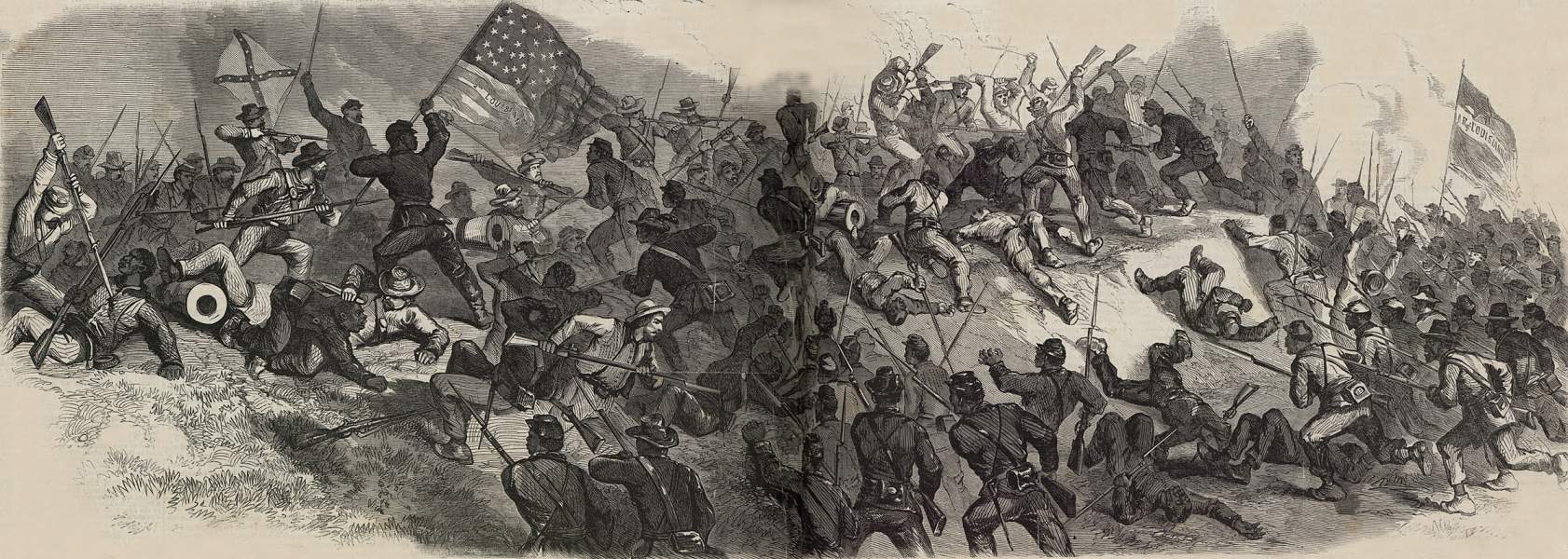
Banks ordered a large assault against the Confederate works on May 27, 1863, hoping to capture Port Hudson quickly and move north to help Grant. Federal soldiers attacked through thick woods and difficult terrain against entrenched defenders. The assaults failed, causing heavy casualties. In one sector African American Union troops fought courageously under fire and received significant public attention. The day showed that Confederate fortifications were too strong for an uncoordinated direct attack. After the defeat, Banks placed increasing emphasis on siege operations intended to weaken the defenders and isolate their garrison.
Why was the Louisiana Native Guard important?
Units of African American soldiers organized as the Louisiana Native Guard took part in the May 27 fighting. Some soldiers had been free Black men before the war, while the wider Union force increasingly included men liberated from slavery. Their participation was important because federal military policy toward Black enlistment was changing rapidly in 1863. Reports of the assault helped challenge racist claims that Black soldiers would not fight effectively. Their courage did not bring immediate equality in pay, treatment or civil rights, but it became part of the broader argument for Black military service and citizenship during and after the war.
Did Black Union troops lead the entire assault?
No. Black units made an important attack in a particular sector, but the broader May 27 operation involved numerous white and Black Union regiments across a long perimeter. Popular accounts sometimes isolate the Louisiana Native Guard and imply that its soldiers alone conducted the failed attack. An accurate description recognizes both their specific contribution and the scale of the overall offensive. Some contemporary newspapers also depicted the action in dramatic engravings that reflect the period’s public presentation rather than an exact battlefield photograph. The article’s accompanying image should be read as a historical illustration, not visual proof of every detail.
How did the siege last 48 days?
After the initial assaults, Union forces established positions around Port Hudson and gradually tightened their control of the roads and surrounding ground. The siege is commonly described as lasting 48 days, from late May until the surrender on July 9. Banks’s men dug trenches, placed artillery and attempted to reduce Confederate defenses. The defenders responded with fire, repairs and local countermeasures while their supplies diminished. The length of the siege reflects the strength of the initial Confederate position and the difficulty of attacking through steep ravines. The process also imposed severe health and supply challenges on the besieging Union soldiers.
What happened during the June 14 attack?
Banks renewed his attempt to capture Port Hudson by direct assault on June 14, 1863. Once again Union troops faced prepared Confederate defenses, difficult approaches and concentrated fire. The attacks failed with serious losses. This setback confirmed that even after weeks of pressure, the fortifications remained dangerous to storm. Banks continued siege operations rather than immediately ordering more large frontal attacks. The June 14 engagement should not be confused with the earlier May 27 assault; the two attacks occurred under different conditions and inflicted separate casualties. Distinguishing dates is important for tracking units and evaluating command decisions.
Why was the geography difficult for attackers?
Ravines, thick woods, steep slopes and broken ground surrounded the Confederate defenses. These features made it hard for Union troops to maintain lines, move artillery and see what was happening nearby. Confederate defenders used their higher ground and prepared firing positions effectively. The same landscape could make siege works difficult, because trenches and guns had to be placed where they would not be dominated by enemy fire. Modern maps can make the distance between positions seem modest, but nineteenth-century infantry operating in Louisiana heat and vegetation faced substantial obstacles even over short distances. Terrain was a major reason why quick victory proved elusive.
What did Union artillery accomplish?
Federal artillery and naval gunfire gradually increased the pressure on Confederate batteries and infantry positions. Guns could damage works, force soldiers into shelter and disrupt movement, but earthworks absorbed punishment more effectively than exposed stone walls. Artillery was therefore one instrument of siege warfare rather than an automatic method of reducing the position. Engineers and infantry also had to protect supply routes, dig approaches and prevent Confederate troops from escaping or receiving reinforcements. The combination of fires and encirclement became more powerful as the Confederate food supply dwindled. Bombardment alone did not explain the eventual surrender.
How were prisoners and wounded treated?
Both armies suffered heavily from battle wounds, disease, heat and inadequate sanitation. Wounded soldiers had to be moved through difficult ravines and carried to field hospitals, where medical resources were strained. The besiegers could eventually replenish some supplies, while the Confederate garrison endured growing isolation. Prisoners taken in smaller actions also became part of the logistical and humanitarian burden. Individual experiences differed by rank, unit and access to treatment, and they cannot all be reconstructed from casualty totals. The siege is a reminder that a military operation extending across weeks can be more destructive to health than a single day’s battle.
What was the relationship with Vicksburg?
Port Hudson and Vicksburg were the two major Confederate positions whose defenses prevented complete Union control of the Mississippi River. Grant besieged Vicksburg to the north while Banks applied pressure to Port Hudson in Louisiana. The Vicksburg garrison surrendered July 4, 1863. News of this event made the Port Hudson position strategically untenable. Gardner recognized that holding out would no longer prevent Union navigation on the river indefinitely. His surrender on July 9 completed the military sequence that Union leaders had hoped to achieve through parallel campaigns.
When did Port Hudson surrender?
Franklin Gardner surrendered Port Hudson on July 9, 1863, after hearing that Vicksburg had fallen five days earlier. The capitulation ended weeks of siege operations and removed the last major Confederate obstruction to Union navigation on the Mississippi. Its terms involved the surrender of the remaining garrison and military property. The July 9 date is distinct from Vicksburg’s July 4 surrender. Describing both victories together is useful strategically, but readers should not merge the two garrisons or imagine that the same commanders personally negotiated both agreements. Grant and Banks were operating in different locations with related objectives.
How many casualties were recorded?
The National Park Service’s Port Hudson battle record estimates 17,500 total casualties, divided between approximately 10,000 Union and 7,500 Confederate casualties. The categories are broad and include large numbers of captured Confederates at surrender. These numbers should not be understood as 17,500 people killed in combat. Other historical studies distinguish battle deaths, wounded men, disease deaths and prisoners with different accounting methods. Siege figures are especially complicated because losses accumulated over weeks. A precise explanation should identify which categories are being compared before estimating the human cost of May and June assaults.
Did Port Hudson end the Civil War in Louisiana?
No. The surrender was a major Union victory, but fighting and political conflict continued in Louisiana and across the Gulf region. Confederate forces still operated in other parts of the state, especially along routes leading toward Texas and the Red River. Union occupation and emancipation changed civilian life, but legal and social struggles remained unresolved. Banks later led the unsuccessful Red River Campaign in 1864. Port Hudson did, however, transform strategic control of the main Mississippi channel, reducing Confederate ability to shift goods and forces across the river.
How did the siege affect enslaved people?
Union military advances in Louisiana changed the possibilities for enslaved people seeking freedom and work outside Confederate control. Black enlistment brought previously marginalized men into federal military service, though prejudice and unequal treatment remained. The participation of Louisiana Native Guard soldiers gave the siege an importance extending beyond military geography. Their service challenged assumptions about race, citizenship and the right to bear arms in defense of the United States. Yet the fall of Port Hudson did not by itself secure lasting equal rights. Those questions continued through the end of the war and the Reconstruction era.
Why is Port Hudson less familiar than Vicksburg?
Vicksburg became strongly associated with Grant’s rise to national prominence, while Port Hudson’s commanders and battles have attracted less popular attention. Yet Port Hudson was essential to the Union objective of restoring Mississippi River navigation. The two positions functioned as strategic complements, one farther north and the other below the Red River connection. The history also includes important early combat service by Black Union soldiers and an unusually long siege. Understanding both garrisons prevents a simplified version in which Vicksburg alone opened the entire waterway. Port Hudson’s July 9 surrender finished that task.
What is preserved at Port Hudson today?
Port Hudson State Historic Site in Louisiana protects important remains of the Confederate works and the surrounding battlefield terrain. Visitors can explore trails, earthworks and interpretive features that show how ravines and the river bluffs shaped the operation. Some parts of the historical landscape have changed, so period maps remain important. The National Park Service teaching guide offers maps and primary-oriented research prompts. Reading about the siege alongside the Vicksburg campaign provides a clearer view of the Union’s 1863 strategy on the Mississippi.
Timeline
| Date | Event |
|---|---|
| March 1863 | Farragut challenges Port Hudson river batteries. |
| May 21 | Union troops gain ground at Plains Store. |
| May 27 | First major Union assault fails; Black Union soldiers participate. |
| June 14 | Renewed Union assaults fail. |
| July 4 | Vicksburg surrenders. |
| July 9 | Port Hudson surrenders, opening the Mississippi River. |