Open Door Policy (1899–1900): John Hay, China and the Boxer Rebellion
Why John Hay proposed equal trade access in China and what the 1899 and 1900 notes actually meant.
The Open Door Policy was an American diplomatic initiative announced through notes sent by Secretary of State John Hay in 1899 and 1900. It called for equal commercial opportunity in China despite the spheres of influence claimed by foreign powers. A second statement emphasized China’s territorial and administrative integrity during the Boxer Rebellion. The policy aimed to protect U.S. trade rather than guarantee Chinese self-government, and foreign governments did not sign a single enforceable agreement.
This guide examines the first and second Open Door Notes, imperial competition, the Boxer Rebellion and their long-term diplomatic effects.
On this page — 24 topics
What was the Open Door Policy?
The Open Door Policy was an effort by the United States to secure equal commercial access to China’s markets at a time when foreign powers were competing for privileges and territorial influence. Secretary of State John Hay circulated diplomatic notes in 1899 asking governments with spheres of influence to respect existing treaty rights and treat foreign trade fairly. A second note in 1900 emphasized preservation of China’s territorial and administrative integrity during the Boxer Rebellion. The policy did not create an actual open border or unrestricted immigration. It also did not give China full control over foreign demands; it was framed largely around the interests and competition of outside powers.
Why did the United States care about trade in China?
American merchants and policymakers viewed China’s large population and economic potential as an opportunity for future trade. By the late nineteenth century, European powers and Japan were establishing spheres of influence, leasing ports and obtaining railway and mining concessions. Washington feared that an exclusive arrangement might shut out American firms even without a formal partition of the country. The U.S. had recently acquired the Philippines, increasing its involvement in Pacific affairs and strengthening commercial arguments for continued access to East Asia. These objectives combined diplomacy, strategic interest and economic expectation. They were not the same as a program designed primarily to advance Chinese citizens’ political rights.
What were spheres of influence?
A sphere of influence was a region where one foreign power claimed a privileged political, commercial or strategic position, often secured through pressure on the Qing government. Concessions could include port leases, railroad construction rights, mining privileges or preferential treatment for a country’s businesses. China was not formally divided into complete colonies everywhere, but these arrangements weakened its independence. The Open Door Notes sought to prevent exclusive trade rules within such spheres. Describing them as fixed territories already annexed to foreign states would be inaccurate. Their boundaries, legal terms and practical control varied, contributing to uncertainty about how other merchants could operate.
Which foreign powers were involved?
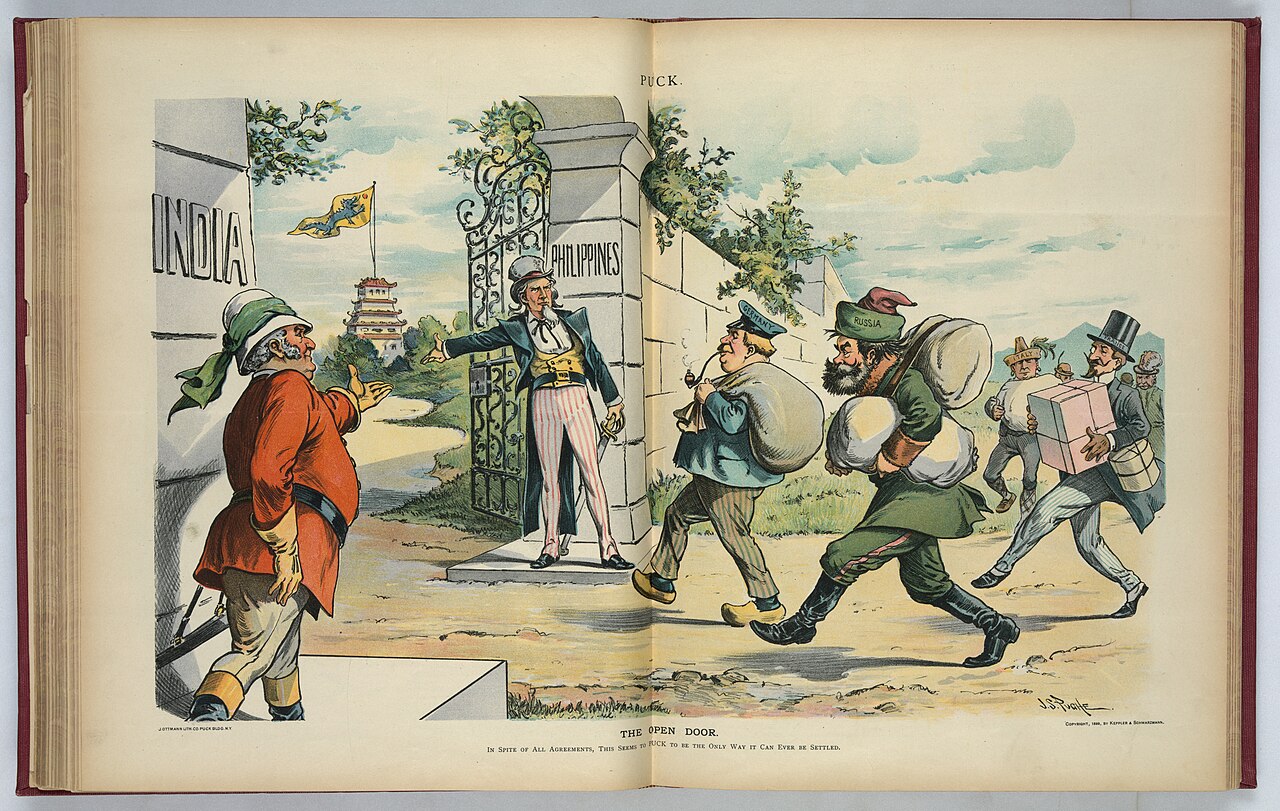
Britain, Russia, Germany, France and Japan were major participants in the diplomatic competition over China. Italy was also included in Hay’s approach to powers interested in the region. Their political and economic goals were not identical. Russia sought influence in Manchuria, Germany had secured a lease at Kiaochow, Britain held important commercial positions and naval access, and Japan had emerged as a major regional power after its war with China. The United States wanted access without establishing the same kind of formally designated territorial sphere. Differences among the foreign powers made a uniform agreement hard to obtain and contributed to their cautious diplomatic replies.
What happened after the Sino-Japanese War?
China’s defeat in the First Sino-Japanese War of 1894–1895 exposed the Qing Empire to greater foreign pressure. The Treaty of Shimonoseki, subsequent intervention by European powers and additional concessions contributed to an atmosphere in which major states sought advantages over the weakened government. Investment in railways, mines and commercial ports became intertwined with military force and diplomatic leverage. By 1899 Americans feared that spheres of influence might evolve into exclusive imperial markets. The Open Door initiative responded to that risk. It did not begin the entire problem of unequal treaties or foreign intervention, which had roots in earlier nineteenth-century conflicts and agreements.
Who was John Hay?
John Hay served as U.S. secretary of state under Presidents William McKinley and Theodore Roosevelt. Earlier in his career he had worked as a secretary to Abraham Lincoln, later serving as a diplomat and political figure. Hay became closely associated with the Open Door Notes, which aimed to state a coherent American position without requiring the United States to seize a Chinese territory of its own. Other advisers and diplomats helped shape the wording. The initiative emerged from practical commercial concerns as well as arguments about China’s territorial integrity. It was an American policy articulated by a particular administration, not an international law automatically binding every power.
What did the first Open Door Note say?
In September 1899 Hay instructed American diplomats to seek assurances from powers claiming spheres of influence in China. The notes proposed that existing treaty ports and vested interests be respected, that Chinese treaty tariffs continue to apply without discriminatory manipulation, and that transportation and harbor charges not unfairly favor one nationality. The purpose was equal opportunity for commerce inside spheres established by competing states. It was not a demand to eliminate every sphere immediately or return all leases to China. Reading the September 6, 1899 text clarifies these specific commercial requests better than the phrase open door alone.
When was the first note issued?
Hay’s first note was dated September 6, 1899, and sent through diplomatic channels to the governments concerned. Different official publications record later exchanges as replies arrived during 1899 and early 1900. That is why the initiative is often described as the 1899–1900 Open Door Notes. It is not a treaty signed at a conference on one day. American diplomats asked states to promise particular commercial conduct, and the replies differed in wording and commitment. A chronological guide should distinguish the initial September circular from Hay’s later July 1900 statement. The two communications addressed overlapping but not identical concerns.
Did the foreign powers accept the policy?
Replies were qualified and inconsistent. Several governments indicated support in principle but attached conditions or avoided an unconditional commitment, particularly when they wanted assurances that other powers would act similarly. Hay nonetheless announced in March 1900 that the exchange of correspondence justified treating the principles as accepted. Historians debate how much substantive agreement this represented. The United States did not obtain a formal, enforceable multilateral treaty with detailed penalties for violations. The gap between diplomatic declarations and actual conduct remained important throughout subsequent decades. It would therefore be misleading to say that all foreign powers signed a binding Open Door treaty in 1899.
What did equal commercial opportunity mean?
The principle meant that merchants from different countries should not face discriminatory tariffs, port dues or railroad charges merely because they operated inside a particular power’s sphere. In theory a business from the United States could trade under comparable rules to one from Britain, Germany or Japan. Yet equal treatment among foreign merchants did not necessarily mean equal treatment for Chinese merchants or a reduction of foreign economic privilege. The policy prioritized competition between outsiders and sought to prevent exclusive monopolies over regional markets. Its language of fairness should therefore be evaluated in the context of unequal treaties and China’s limited freedom to negotiate its own economic relationships.
Why was China not an equal partner in the notes?
The Open Door Notes were chiefly addressed by the United States to foreign powers rather than negotiated as an equal agreement with China’s government. China was the territory in which the states wanted access and privileges, but it had limited influence over the conditions imposed by stronger outside governments. Preserving Chinese integrity could align with some Chinese interests, yet the American approach did not fundamentally abandon unequal treaty arrangements. That contradiction is central to modern interpretations of the policy. An account that celebrates the United States as a neutral defender of China without acknowledging its trade ambitions and imperial position in the Philippines would present only part of the history.
What was the Boxer Rebellion?
The Boxer Rebellion was an anti-foreign and anti-Christian uprising in China that intensified around 1899–1900. Members of the movement commonly called the Boxers attacked missionaries, Chinese Christians and other perceived symbols of foreign influence. The crisis expanded as Qing officials and factions differed in their responses, and armed foreigners became involved. In 1900 international legations in Beijing came under siege, prompting an expedition by several foreign powers. The violence produced substantial deaths among Chinese civilians and foreigners. The episode was rooted in domestic grievances and foreign encroachment; it should not be reduced to a simple Chinese rejection of modern technology or trade.
How was the Boxer Rebellion related to the Open Door?
The Boxer crisis threatened to destabilize the foreign privileges and administrative arrangements that Hay’s first notes sought to protect. Washington worried that rival powers might use intervention as a reason to occupy additional Chinese territory or divide the country. Hay therefore issued another Open Door circular in July 1900 emphasizing China’s territorial and administrative integrity. This second statement was more directly concerned with the preservation of the Chinese state, even while the United States participated in military intervention. The timing illustrates how a commercial initiative became entangled with military conflict and diplomacy. The new language did not eliminate colonial practices or prevent all later violations of Chinese sovereignty.
What did the second Open Door Note propose?
Hay’s July 1900 note stated an American desire to maintain equal commercial opportunities and preserve China’s territorial and administrative integrity. This combined the earlier opposition to exclusive trade barriers with a broader warning against the partition of China into separate colonial territories. It was issued during the Boxer Rebellion, when foreign forces were considering how to respond to attacks on legations and nationals. The phrase integrity carried diplomatic meaning but was not accompanied by guarantees that China could independently determine all foreign trade and security arrangements. The second note should not be quoted as the first September 1899 communication, because it reflected an expanded crisis and a changed political emphasis.
What role did U.S. troops play in 1900?
The United States joined an international military expedition in response to the siege and danger facing foreign legations and civilians in China. American troops served alongside forces from Japan, Russia, Britain, Germany, France and other powers during the campaign toward Beijing. Intervention helped relieve the legation siege, but it also involved fighting and abuses against Chinese civilians. Military participation illustrates the tension between American claims to support Chinese territorial integrity and the use of foreign force on Chinese soil. The Open Door Policy was diplomatic, not a pledge of nonintervention. Its supporters considered military action compatible with protecting existing privileges and restoring international access.
What was the Boxer Protocol of 1901?
The Boxer Protocol was an agreement imposed on Qing China in September 1901 after the defeat of the uprising. It required substantial indemnities and other measures favoring the foreign powers, including arrangements affecting diplomatic security. It was not the original Open Door Note, nor did it create the policy in 1899. The indemnity burden and foreign military privileges reflected China’s continued weak bargaining position. Later American decisions about parts of its indemnity receipts had implications for educational exchange, but that subsequent history should be kept distinct. The protocol demonstrates why formal declarations respecting China’s integrity did not amount to genuine equality in international relations.
How did the policy relate to American expansion in the Pacific?
The United States had annexed Hawaii and acquired the Philippines following the Spanish–American War, creating new commercial and military interests across the Pacific. The Open Door Notes were issued amid this expansion and reflected concern over the economic future of East Asia. American advocates argued that equal access could protect commerce without direct annexation of Chinese territories. Yet Washington governed Filipinos who had sought independence, and the Philippine–American War revealed the coercive side of its overseas policy. An accurate interpretation therefore links the Open Door initiative to the broader rise of the United States as an imperial and commercial power, not solely to an abstract ideal of free trade.
What is the relationship with the Chinese Exclusion Act?
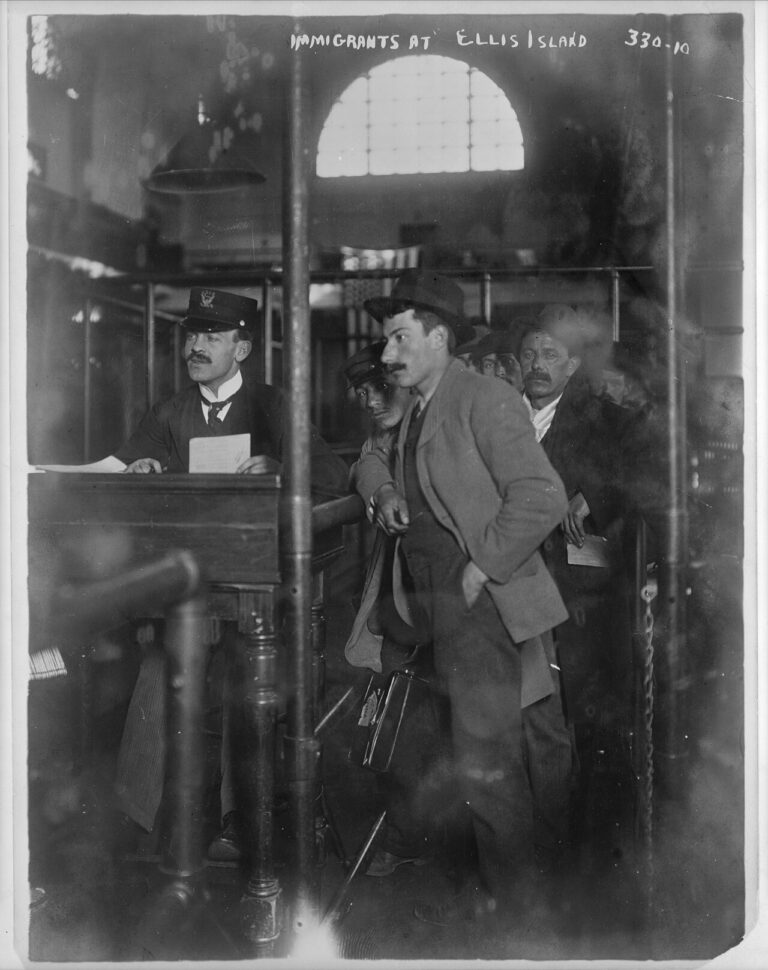
The United States promoted American access to Chinese markets while restricting Chinese labor immigration through the Chinese Exclusion Act and subsequent legislation. This difference between seeking economic opportunity abroad and limiting migration at home demonstrates the unequal assumptions embedded in foreign and domestic policies. The Open Door did not offer Chinese workers unrestricted access to the United States or repeal the exclusion system. The two policies were enacted for different immediate reasons, but studying them together reveals how late-nineteenth-century Americans could favor trade with China while denying Chinese individuals equal mobility and naturalization rights. The contrast is important for assessing whose economic freedom officials sought to protect.
Did the Open Door Policy prevent the partition of China?
China was not formally divided among the major powers in 1900 in the way parts of Africa had been partitioned, but it retained numerous foreign concessions and continued facing military and economic pressure. The Open Door Policy was one influence among several diplomatic and strategic factors, and it is impossible to prove that Hay’s notes alone prevented partition. The powers had differing reasons for preserving or weakening Chinese administration, while Chinese resistance and political developments also mattered. Later events, including Japanese expansion in Manchuria during the twentieth century, demonstrated the limits of American diplomatic statements. The policy was significant but lacked mechanisms capable of ensuring that every foreign actor would comply.
Why does the Open Door Policy matter in US history?
The Open Door Notes established a recurring theme of American diplomacy: support for equal commercial access without accepting exclusive domination of a foreign market by a rival. They helped define U.S. relations with China and later debates over the Pacific balance of power. Their practical results were limited by qualified foreign responses, weak enforcement and the contradictions of imperial intervention. The policy is best understood as an American diplomatic position rather than a universally accepted treaty or a direct guarantee of Chinese sovereignty. Reading the original notes makes it possible to distinguish what Hay requested, what governments promised and what actually happened in the decades that followed.
Where can readers verify the original notes?
The U.S. State Department’s Office of the Historian explains the context of both Open Door statements and the Boxer crisis. The original September 6, 1899 note is available through the University of Southern California’s China collection, and the Library of Congress publishes diplomatic documents from 1899–1900. Historical political cartoons reveal how American audiences interpreted the competition for Chinese markets, but they should be read as advocacy or satire rather than literal records of negotiations. Comparing the notes, replies and Chinese history provides a sounder account than repeating the simplified claim that China agreed to open all of its doors to American merchants.
Open Door Policy timeline
| Date | Development |
|---|---|
| 1894–1895 | China defeated in First Sino-Japanese War. |
| Late 1890s | Foreign spheres of influence and concessions expand. |
| September 6, 1899 | Hay sends first Open Door diplomatic note. |
| March 1900 | Hay treats conditional replies as acceptance of principles. |
| Spring–summer 1900 | Boxer Rebellion and siege of Beijing legations escalate. |
| July 1900 | Second Open Door circular emphasizes China’s territorial integrity. |
| September 1901 | Boxer Protocol imposes indemnities and foreign privileges. |
| 20th century | Open Door remains an important but contested US diplomatic principle. |