Espionage Act of 1917: Wartime Speech, Sedition Act and Supreme Court Cases
What the 1917 law prohibited, how the 1918 Sedition Act expanded it and why wartime prosecutions shaped free-speech doctrine.
Quick answer
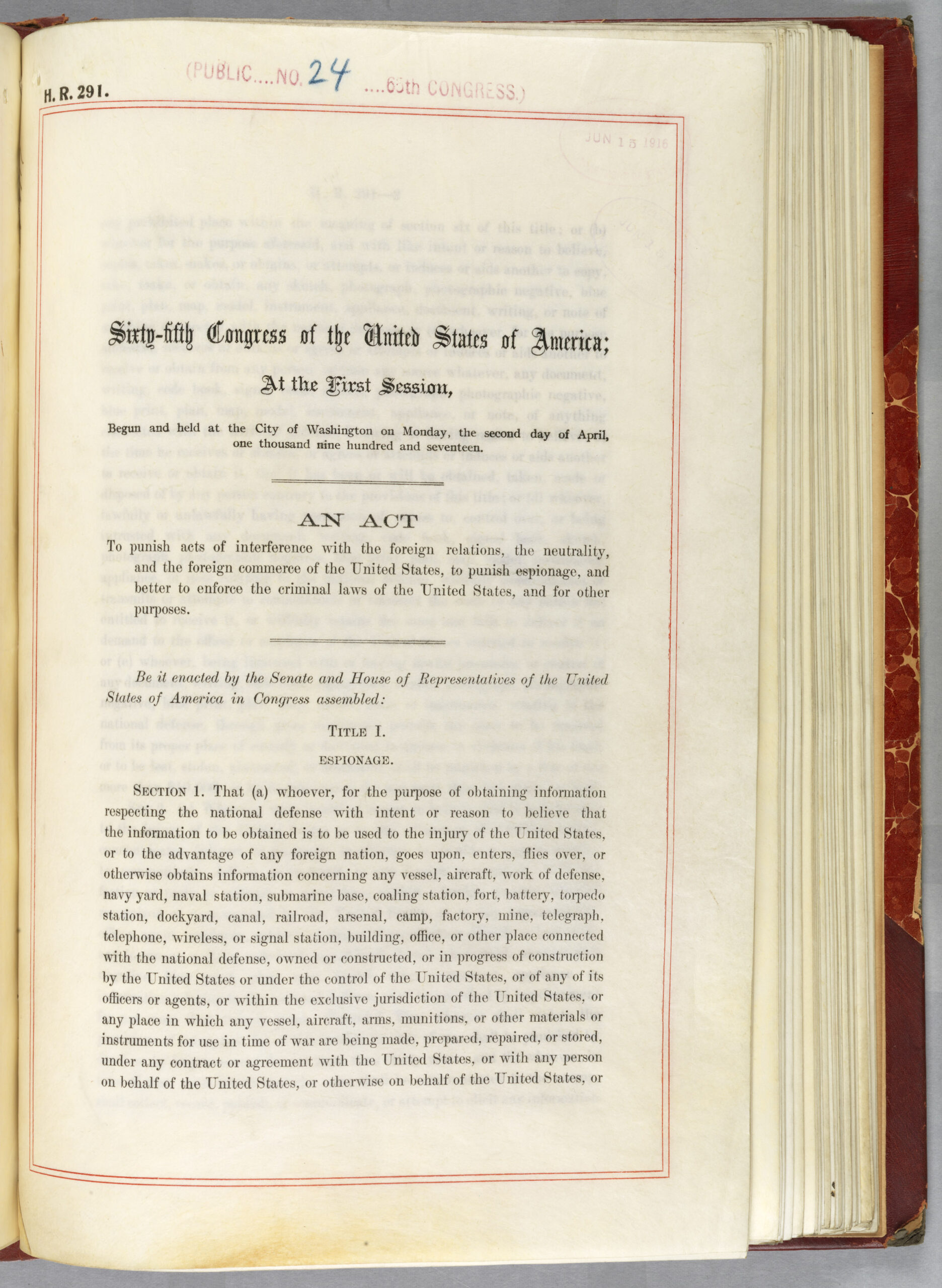
President Woodrow Wilson signed the Espionage Act on June 15, 1917, after U.S. entry into World War I. The act criminalized specified national-defense espionage and interference with the war effort, including intentional obstruction of recruitment or enlistment. The Sedition Act of May 16, 1918 expanded restrictions on certain forms of wartime expression. Cases such as Schenck v. United States (1919) tested the First Amendment limits of those laws. The 1918 Sedition Act provisions were repealed in 1921, but the 1917 Espionage Act was not repealed wholesale.
Key facts
On this page
- Why Congress enacted the Espionage Act
- The law signed June 15, 1917
- The national-defense information offenses
- Interfering with recruitment and enlistment
- What Congress did not enact in the original bill
- How the Sedition Act of 1918 changed the law
- Schenck v. United States and the 1919 ruling
- Eugene V. Debs and wartime dissent
- The Abrams case and disagreements among justices
- The law’s effects on publishers and political organizations
- What happened after the First World War
- Why the Espionage Act remains a historical turning point
- Timeline
- FAQ
- Sources
Why Congress enacted the Espionage Act
The United States entered the First World War in April 1917, and the federal government rapidly expanded its military and industrial mobilization. Officials worried about foreign intelligence, the transmission of defense information, sabotage and interference with recruiting soldiers. Congress therefore considered legal measures to protect military operations and the government’s ability to wage war. In this setting the term ‘espionage’ referred to obtaining or communicating defense-related information in dangerous circumstances, but the bill’s scope extended into other activities connected with the war effort.
The legislation provoked questions about freedom of expression even while it was being debated. Americans differed sharply on whether the country should enter the war and on whether compulsory military service was justified. Those conflicts did not disappear when the United States joined the fighting. Civil libertarians warned that measures aimed at espionage could also reach dissenting political speech. Supporters argued that some forms of interference were too dangerous during war to be protected by ordinary rules. The enacted law and its administration reflected this tension between security and constitutional rights.
The law signed June 15, 1917
President Woodrow Wilson signed the Espionage Act on June 15, 1917. Its original text appears in volume 40 of the United States Statutes at Large, beginning on page 217. The enrolled document is preserved by the National Archives. Historians should distinguish its provisions from later amendments rather than treat every wartime restriction on speech as though it was written into the law on the same day. The original statute contained several titles dealing with different subjects, including national-defense secrets, military interference and the mails.
The law emerged shortly after the Selective Service Act of May 1917, which created the wartime draft registration system. The two statutes did different things. Selective Service organized potential military manpower and the process of calling men into service; the Espionage Act identified criminal activities that Congress sought to prevent while the nation was at war. Their overlap became important in cases involving opposition to recruitment, but the acts were not simply two names for the same policy.
The national-defense information offenses
The statute prohibited specified conduct involving information related to national defense when a person acted with the intent or reason to believe that it could be used to injure the United States or benefit a foreign nation. It addressed matters such as sensitive documents, plans and information concerning military installations, ships, facilities and equipment. The exact elements of an offense mattered: not every public discussion of a war or military topic amounted to espionage under the statutory text.
The law also dealt with possession, retention and transmission of restricted material in circumstances defined by its provisions. Over subsequent decades, legal interpretations and amendments altered how related offenses were prosecuted. Reading the 1917 text therefore is not a substitute for interpreting current statutes or legal advice. For the history of World War I, the key point is that Congress created criminal provisions against specified harmful handling of national-defense information in addition to its rules concerning the war effort.
Interfering with recruitment and enlistment
Some provisions were directed at activities that Congress believed could impede military success. These included making certain false statements with the required intent, causing or attempting to cause insubordination in the armed forces, and willfully obstructing recruitment or enlistment. This part of the act became particularly contentious because antiwar speakers and activists could be accused of conduct that the authorities considered interference. The difference between unpopular opinion and intentional obstruction was central to later legal disputes.
The wartime setting intensified those conflicts. Americans were being asked to register for the draft, military units were preparing for overseas service, and public debate about the war remained heated. Prosecutors examined speeches, pamphlets and organizing activities in light of the act’s prohibitions. Those cases were controversial not just because of their subject matter, but because they raised a constitutional question: when may the government punish speech on the theory that it threatens a lawful military program?
What Congress did not enact in the original bill
The administration sought additional authority over press censorship, and Congress debated proposals to control publication of material considered useful to the enemy. Lawmakers rejected a proposed broad executive press-censorship provision. This distinction is important because summaries sometimes state that the original 1917 act simply authorized presidential censorship of every newspaper article about the war. That was not the enacted structure, even though postal restrictions and prosecutions significantly affected the circulation of antiwar material.
The measure nonetheless gave officials substantial tools, including provisions involving the postal system and the treatment of prohibited material. The Post Office’s role could affect publishers whose newspapers and pamphlets depended on the mails. A rejected formal censorship provision did not mean that every dissenting publication was free of government interference. To understand the law’s practical reach, it is necessary to examine both what Congress excluded from the final bill and how other powers were enforced.
How the Sedition Act of 1918 changed the law
On May 16, 1918, Congress enacted amendments commonly called the Sedition Act. These amendments expanded the criminal restrictions on wartime expression and addressed certain disloyal or abusive language about the U.S. government, Constitution, flag and military. The wording was controversial because it reached expressions of political hostility as well as activities directly connected with spying or military operations. The change occurred after the original 1917 enactment, so the two legislative dates must not be merged.
Descriptions that attribute all of the Sedition Act’s speech language to June 15, 1917, blur an important development. The later amendment took place after months of American participation in the war, during a period of heightened demands for conformity and suspicion of dissent. Civil libertarians challenged the broad restrictions, while advocates argued that hostile speech could threaten national unity. The 1918 amendments were repealed in 1921, but that repeal did not abolish the earlier Espionage Act in its entirety.
Schenck v. United States and the 1919 ruling
In Schenck v. United States, decided in March 1919, the Supreme Court considered convictions arising from the circulation of material aimed at men subject to the draft. The defendants argued that their First Amendment rights protected their activities. The Court upheld the convictions, and Justice Oliver Wendell Holmes Jr.’s opinion used the ‘clear and present danger’ formulation to discuss when speech in particular circumstances could be punished. The decision became an important early precedent in American free-speech law.
That doctrinal language must be placed in its historical setting. The First Amendment’s interpretation developed significantly in the decades after 1919, and the Schenck decision should not be presented as an exhaustive statement of the modern legal test for punishing political advocacy. The more accurate historical conclusion is that the Court in 1919 gave the government broad latitude to enforce certain wartime restrictions against conduct it understood as obstruction. Later First Amendment cases reassessed the protection available to political expression.
Eugene V. Debs and wartime dissent
Socialist leader Eugene V. Debs publicly criticized the war and compulsory service. After a speech in Canton, Ohio, in June 1918, he was prosecuted under the Espionage Act. He was convicted and sentenced to imprisonment, and the Supreme Court upheld the judgment in Debs v. United States in 1919. His case demonstrates how enforcement reached beyond people accused of supplying secret information to a foreign power. The prosecution focused on the relationship between his political speech and alleged interference with military recruitment and discipline.
Debs’s conviction remained a subject of intense political controversy. Supporters of the prosecution argued that the law targeted conduct that could obstruct military mobilization. Critics viewed the case as an example of government punishing antiwar political views. Both perspectives can be described through the historical record without pretending the dispute was resolved for all later generations by one judicial opinion. The case helps reveal why the legislation matters to histories of labor politics, socialism and constitutional rights.
The Abrams case and disagreements among justices
Another major case was Abrams v. United States, decided in November 1919. It concerned leaflets protesting American intervention in Russia and involved convictions under provisions amended in 1918. The Supreme Court upheld those convictions by a majority. Justice Holmes, joined by Justice Louis Brandeis, dissented and argued for stronger protection of speech in the circumstances. That disagreement became influential in later discussions of freedom of expression.
The Abrams decision is often cited alongside Schenck, but the cases involved different facts and legal provisions. Reading them in chronological order shows that the justices were not uniformly agreed about the boundary between political expression and punishable interference. The evolution of Holmes’s views is an important part of First Amendment history, but it should not be simplified into a claim that the Constitution’s modern speech doctrine was settled by the end of 1919. Later jurisprudence continued to change.
The law’s effects on publishers and political organizations
Political groups opposed to the war faced investigation, prosecution and restrictions involving distribution of their publications. Some newspapers and pamphlets depended on access to postal services, making administrative decisions about mailing privileges particularly consequential. Socialist, pacifist and other organizations were affected, although individual prosecutions depended on specific allegations and legal circumstances. It would be inaccurate to describe everyone who criticized the war as automatically convicted, or every antiwar publication as permanently banned.
The enforcement record also shows the relationship between federal legal power and the pressures of wartime public opinion. Suspicion toward immigrants, political radicals and opponents of conscription shaped the climate in which cases arose. Courts and juries still had to apply legal standards, but social attitudes could influence which activities drew official attention. Historians seeking to assess the law need both statutory documents and accounts of those investigated or prosecuted, not simply an abstract debate over security and liberty.
What happened after the First World War
The armistice of November 1918 ended major fighting on the Western Front, but legal proceedings and debates over wartime dissent continued. The Supreme Court decided important Espionage Act cases in 1919, demonstrating that the constitutional consequences extended beyond the battlefield. In 1921 Congress repealed the 1918 Sedition Act amendments. That change removed particular speech restrictions but did not repeal the entire 1917 statute or eliminate laws protecting national-defense information.
The Espionage Act continued to have a legal history long after the First World War, as Congress amended relevant provisions and courts interpreted them in new circumstances. Modern cases cannot be assessed simply by applying the 1917 wartime language without considering later legislation and judicial decisions. This article is concerned with the historical origin and early controversies of the act, not with assessing an individual modern prosecution. The distinction prevents a historical guide from being mistaken for advice about today’s law.
Why the Espionage Act remains a historical turning point
The 1917 law illustrates how war can transform the relationship between government power and civil liberties. National-defense concerns encouraged new criminal restrictions, while political disagreement over the draft and war produced controversial prosecutions. The ensuing Supreme Court cases became part of the long development of First Amendment doctrine. That history is more complicated than a single conclusion that the government either had no legitimate security interests or could prohibit every form of opposition.
By separating the original 1917 act from the 1918 Sedition amendments and the judicial decisions of 1919, readers can identify how the legal framework developed. The Selective Service Act explains the military obligation at the heart of many controversies, while the World War I timeline places these events alongside the wider conflict. In combination, the sources show the institutional and human stakes of wartime lawmaking.
Timeline
- April 6, 1917: United States enters World War I
- May 18, 1917: Selective Service Act signed
- June 15, 1917: Espionage Act enacted
- May 16, 1918: Sedition Act amendments enacted
- March 1919: Schenck and Debs decisions
- November 1919: Abrams decision
- 1921: Sedition Act amendments repealed
Frequently asked questions
When was the Espionage Act passed?
June 15, 1917, during World War I.
Did the 1917 act prohibit all criticism of the government?
No. It created specific offenses involving national defense and wartime interference. Broader speech restrictions were added by the 1918 Sedition Act amendments.
What did the Sedition Act of 1918 change?
It broadened the restrictions to cover specified forms of disloyal or abusive wartime expression.
What happened in Schenck v. United States?
In 1919 the Supreme Court upheld convictions involving anti-draft material and used the clear-and-present-danger formulation.
Did Congress repeal the Espionage Act in 1921?
No. Congress repealed the 1918 Sedition Act amendments, not the 1917 statute as a whole.
Who was Eugene Debs?
A socialist political leader convicted for speech associated with wartime opposition; the Supreme Court upheld his conviction in 1919.
Does the 1919 test describe current free speech law?
Not by itself. First Amendment doctrine developed substantially through later decisions.
Sources and further reading
Contemporary legal documents, National Archives material and Supreme Court decisions support this historical account.