Ellis Island Immigration (1892–1954): Inspection, Records and Myths
How millions of immigrants were inspected, which records survive and what the popular stories get wrong.
Ellis Island opened as a federal immigration station on January 1, 1892, and closed in 1954. It processed more than 12 million immigrants during its history. People were examined for medical and legal admissibility, and most were permitted to enter. The famous brick Registry Room belongs to a replacement building opened in 1900.
Explore inspection procedures, passenger records, family myths and the changing immigration laws that shaped the experience.
On this page — 25 topics
What was Ellis Island?
Ellis Island was the principal federal immigration inspection station in New York Harbor for much of the period from 1892 to 1954. More than twelve million people passed through its immigration facilities, making the site one of the best-known places in American migration history. The island was not the destination of every immigrant to the United States, and many travelers entered through other ports or land crossings. Its main purpose was to examine arriving passengers and determine whether they could legally enter the country. Today the preserved immigration building is a museum and a place where families explore ship manifests, photographs and the experiences of people crossing the Atlantic.
When did Ellis Island open and close?
The first federal immigration station opened on January 1, 1892. It operated in an initial wooden building until a fire destroyed that structure in June 1897, after which the immigration service used temporary facilities while a replacement was constructed. The familiar red-brick main building opened on December 17, 1900. Ellis Island’s role changed as new immigration laws restricted arrivals and detention became a larger part of its work. The station closed on November 12, 1954. Photographs taken inside the building after 1900 should not be captioned as though they show the original 1892 structure. The site evolved substantially throughout its sixty-two-year operational history.
Why did the federal government create the station?
During the nineteenth century, individual states had carried much of the responsibility for processing immigrants at major ports. Growing migration and new federal immigration legislation made a national system more important. The Immigration Act of 1891 expanded federal authority over admission and exclusion, and the government selected Ellis Island to serve the New York port. The station allowed inspectors to examine large numbers of travelers in one place and enforce federal restrictions. Its creation reflected both the country’s demand for immigrant labor and political movements seeking tighter control over borders. Federal processing was not the same as an unconditional welcome; the system was designed to admit some people and exclude others.
Where is Ellis Island located?
Ellis Island lies in Upper New York Bay near the Statue of Liberty, between New York and New Jersey waters. Its location allowed ferries and immigration vessels to transfer passengers arriving on ocean liners. The island’s area was enlarged significantly with landfill during federal construction and later development. Today it is part of the Statue of Liberty National Monument system administered by the National Park Service. The physical layout is important because different buildings served inspection, medical, detention, laundry and other functions. Researchers should not assume that the modern museum’s route recreates every path an immigrant might have followed in the nineteenth or early twentieth century.
Who was Annie Moore?
Annie Moore, a teenage immigrant from Ireland, is traditionally recognized as the first person processed at the new Ellis Island station on January 1, 1892. She arrived with her younger brothers and became a symbolic figure in the history of the island. The commemoration highlights an individual experience, but it is not representative of all immigrants who arrived afterward. Migrants came from many places, traveled under different economic conditions and faced changing regulations. Historical researchers also corrected older popular assumptions about Annie Moore’s later life through genealogical work. Her story demonstrates both the appeal of a memorable first arrival and the importance of checking personal details against surviving records.
How did immigrants reach the island?
Most travelers associated with Ellis Island came by ship across the Atlantic, landing in New York Harbor. Steamship companies carried large numbers of passengers in steerage or third-class accommodation, as well as smaller numbers traveling in first and second class. Ships supplied passenger lists to immigration authorities. After arrival, passengers who required inspection on Ellis Island were transferred to the station, often by ferry or barge. The process depended on the period and the passenger’s class and circumstances. It was not true that every traveler automatically walked directly from a ship’s gangway into the same large inspection hall. Transportation arrangements could change as laws and facilities evolved.
Did first-class passengers go through Ellis Island?
Many first- and second-class passengers were inspected aboard ship or at the dock rather than being routinely sent through Ellis Island’s full facilities. Officials could still require further examination if a problem arose. Steerage and third-class travelers were more likely to undergo processing at the island. This distinction reflected class-based assumptions about who might become a public charge or face other exclusion grounds. It should not be read as proof that every wealthy passenger was exempt from law or that every steerage passenger was detained for days. Different inspection routes show how social class shaped immigrant treatment within a formally national federal system.
What happened in the Registry Room?
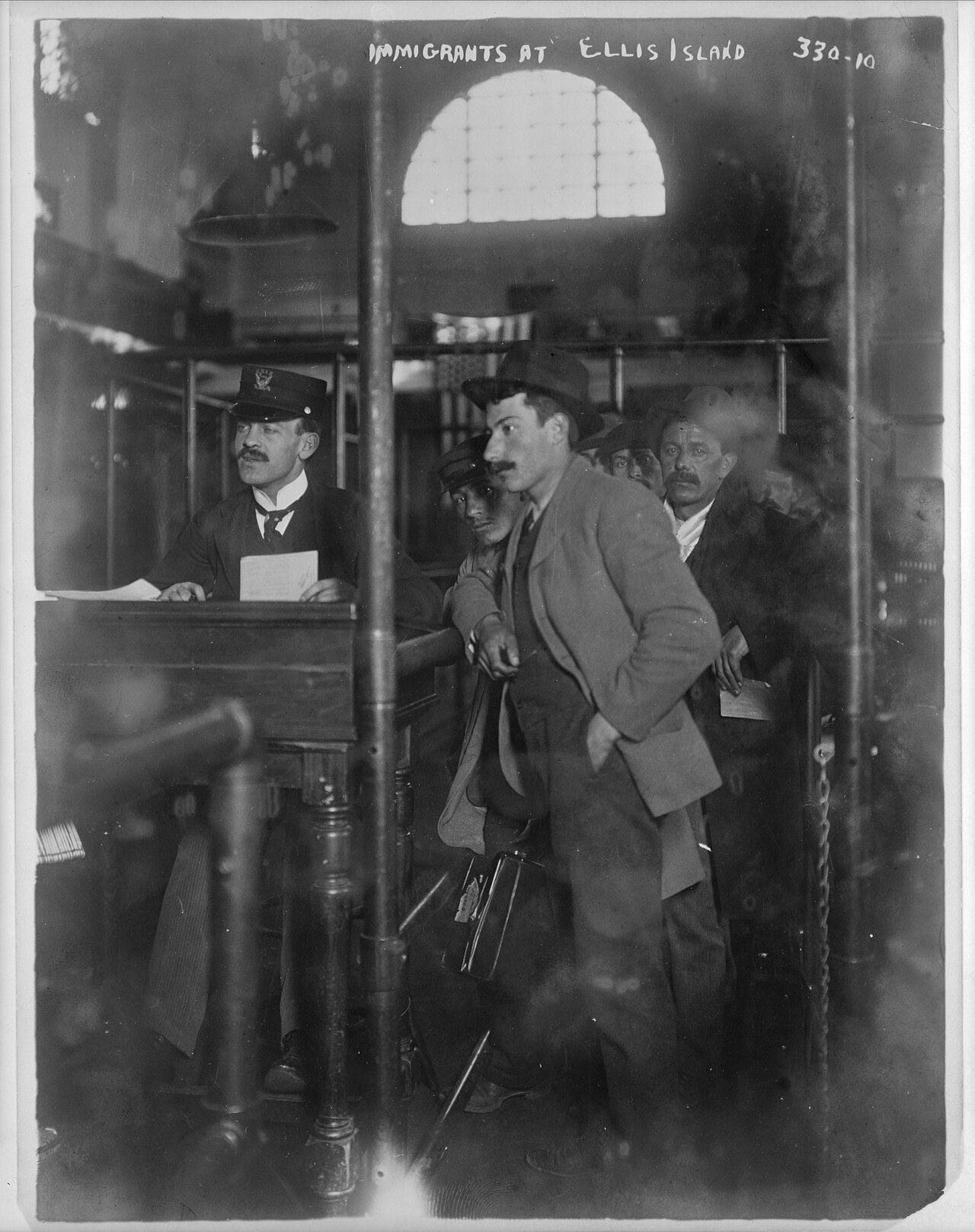
The Registry Room, often called the Great Hall, was the main space where arriving immigrants underwent preliminary examinations and waited to meet inspectors. Staff checked names against ship manifests, examined documents and asked questions relevant to admission. The room’s large windows, high ceiling and lines of people became iconic in historical photography. The familiar hall belongs to the building opened in 1900 rather than the original wooden station. For many newcomers, inspection was relatively brief; others faced additional medical checks or questioning. The atmosphere combined hope, uncertainty and administrative pressure because a family’s ability to remain together could depend on the outcome.
What questions were immigrants asked?
Inspectors could ask about a passenger’s name, age, origin, occupation, destination, intended contacts, financial resources and ability to support themselves. The answers were compared with the information recorded by steamship companies on passenger manifests. The exact questions changed as immigration laws and administrative rules evolved. Interpreters assisted people who did not speak English, though communication difficulties could still occur. For genealogists, these questions explain why passenger lists may contain useful information about relatives, hometowns and occupations. The records were produced for enforcement rather than family history, so inconsistencies and errors should be expected and evaluated in context.
How did the medical examination work?
Immigrants could undergo a visual medical screening known for its line inspection, during which physicians looked for signs of contagious disease, disability or conditions that could affect admissibility under the laws of the time. Doctors sometimes used chalk marks on clothing to identify people for closer examination. Those requiring more attention might be sent to medical rooms or hospital facilities. Not every person received the same examination, and medical grounds for exclusion changed over time. The process reflected the medical understanding and prejudices of its period. A chalk mark did not always mean a passenger would be deported, and readers should distinguish screening for further examination from a final immigration decision.
What was the eye examination for?
Inspectors paid particular attention to trachoma, a contagious eye disease that could lead to blindness, and used eye examinations during inspection. Medical procedures could feel invasive, especially to people already exhausted by an Atlantic crossing. Public-health policies were important, but they also operated within an immigration system that viewed newcomers with suspicion and sometimes relied on discriminatory assumptions. Not every person with a medical concern was automatically rejected, and treatment facilities or appeals could affect outcomes. Historical photographs show doctors examining eyelids, but one image should not be treated as evidence of every passenger’s experience. Procedures differed by decade and by an individual’s medical history.
How long did inspection take?
For many arriving passengers whose documents and health raised no major concerns, examination could be completed in a matter of hours. The Statue of Liberty–Ellis Island Foundation describes typical processing times of approximately three to five hours during the peak era. Some people remained much longer for hearings, medical care, detention or arrangements with relatives. The popular claim that all immigrants spent days or weeks on Ellis Island is incorrect. Equally, a short average processing time does not describe the fear experienced by someone separated from family or awaiting a decision. Conditions changed with passenger volume, laws, staffing and the availability of space.
Were most immigrants allowed to enter?
Most people examined at Ellis Island were admitted, with a relatively small proportion excluded or deported. This broad pattern helps correct the idea that the station routinely turned back half its passengers. However, being admitted was not identical with enjoying equal treatment in American society, and the rules excluded categories of people based on health, perceived economic dependence or other statutory criteria. Immigration law also changed substantially, especially during the early twentieth century. The exact exclusion rate differs by year and how cases are counted. For that reason, researchers should avoid quoting one percentage as if it applied without change to the entire 1892–1954 period.
What happened at a Board of Special Inquiry?
Some immigrants were referred for a more detailed hearing when inspectors questioned whether admission requirements had been met. A Board of Special Inquiry considered evidence such as financial support, family contacts, medical findings and answers to official questions. Hearings could lead to admission or exclusion, and some decisions could be appealed. The procedure was more consequential than the routine inspection and could separate family members during a stressful arrival. The board’s record reflects laws that discriminated against various categories of people at different times. Researchers should interpret a case file as a record of a government decision, not an objective measure of an immigrant’s character or potential contribution.
Did officials change immigrants’ names at Ellis Island?
The familiar story that clerks routinely assigned new surnames to immigrants is largely a myth. Passenger lists were usually created by steamship companies before ships arrived, and inspectors generally compared travelers’ answers with those existing manifests. Name variations could arise from transliteration, unfamiliar handwriting, recordkeeping mistakes or later choices by immigrants seeking easier pronunciation or different identities. A surname might appear in several forms across records without any formal renaming ceremony at Ellis Island. Researchers should look for spelling variations, names in the original language and changes made after arrival. The National Park Service’s explanation addresses this persistent misconception directly.
What happened in the 1897 fire?
A major fire destroyed the first Ellis Island immigration station in June 1897. The loss forced officials to use temporary processing facilities while planning a more durable replacement. The fire also destroyed a significant quantity of administrative material, though its effect on surviving passenger and immigration records depends on which records were stored where. It is misleading to claim that every New York immigrant record before 1897 vanished. Many ship manifests and other records survived in separate collections. The 1900 main building was constructed with greater fire resistance and became the structure familiar in many later photographs. The episode explains why architectural history and genealogical research both require care about dates.
What changed when the 1900 building opened?
The new main immigration building opened on December 17, 1900, and was designed to handle large passenger flows in a more permanent federal complex. Its architectural features, including the spacious Registry Room, became visual symbols of American immigration. The station also developed medical, detention and service buildings to manage specialized needs. The new facility did not remove the possibility of exclusion or provide equal treatment to every newcomer. It enlarged the government’s capacity to inspect people efficiently while enforcing increasingly complicated federal laws. Photographs from 1907 show the second building during a period of very high immigration, not conditions in the original opening year.
Why was 1907 a peak year?
The Ellis Island chronology published by the National Park Service records approximately 1.2 million people examined in 1907, an especially busy year. Migration reflected industrial demand for workers, transatlantic shipping networks and the hopes of families seeking new opportunities. Large numbers arrived from southern and eastern Europe during the period, among people from many other regions. Economic conditions and political restrictions affected annual totals, so arrivals varied considerably from year to year. The large 1907 number cannot be used as the station’s annual average across all sixty-two years. Peak traffic is important because it explains why the inspection hall and surrounding facilities became so densely occupied.
How did immigration restrictions affect Ellis Island?
Federal immigration laws increasingly restricted who could enter the country. The 1917 Immigration Act introduced a literacy requirement and other exclusions, while the national-origin quota system of the 1920s sharply reduced many categories of new arrivals. As fewer immigrants were admitted, Ellis Island’s role shifted toward detention and immigration enforcement rather than routine processing of masses of steerage passengers. The changing laws reflected wider political debates about nationality, race, labor and cultural belonging. Our Chinese Exclusion Act guide examines an earlier system of federal immigration discrimination that developed before the island opened. Ellis Island was one part of that broader national legal history.
How do family historians search Ellis Island records?
Passenger manifests, arrival indexes and federal immigration case files can provide a person’s age, origin, last residence, destination and names of relatives. The Statue of Liberty–Ellis Island Foundation offers a searchable passenger database, while the National Archives maintains important federal arrival records. Researchers should begin with an approximate date, vessel or name, then test alternative spellings and compare family information. A list associated with the Port of New York is not always a record of a person physically processed in the Ellis Island building. Arrivals before 1892 or travelers admitted through other procedures also appear in wider shipping documentation. Historical passenger lists often preserve the steamship company’s original spelling.
What is the difference between Castle Garden and Ellis Island?
Castle Garden was the New York state immigrant depot operating before the federal Ellis Island station opened in 1892. The earlier facility processed large numbers of immigrants from 1855 until 1890, with interim arrangements used before Ellis Island was ready. Confusing these locations can lead family researchers to search the wrong period or assume that a relative who arrived in 1880 passed through Ellis Island. New York Harbor had a long migration history before the island became the principal gateway. The distinction also explains why records cover the Port of New York across different institutions and legal systems. Physical arrival points and the existence of a passenger manifest are separate questions.
What is Ellis Island’s legacy?
Ellis Island became a major symbol of immigration and family origins because millions of people passed through federal examinations there. The site also represents the growth of national bureaucracy, public-health inspection, detention and laws that excluded certain immigrants. Stories of hope and opportunity should be considered alongside those of fear and forced return. The immigration station closed in 1954 and later became a museum, allowing descendants to explore records and the preserved buildings. Its significance extends beyond one national group or language. Understanding Ellis Island means examining the people who arrived, the rules they faced and the changing ideas about who belonged in the United States.
Ellis Island timeline
| Date | Event |
|---|---|
| 1855–1890 | Castle Garden processes immigrants in New York. |
| 1891 | Federal law expands national immigration inspection. |
| January 1, 1892 | First Ellis Island station opens; Annie Moore becomes famous first arrival. |
| June 1897 | Fire destroys first station. |
| December 17, 1900 | New main immigration building opens. |
| 1907 | More than 1.2 million examined in peak year. |
| 1920s | Quota laws reduce immigration and change station’s function. |
| November 12, 1954 | Immigration station closes. |