
American Civil War (1861–1865): Causes, Timeline, Battles and End
A chronological guide to why the United States fractured and how war and emancipation reshaped the country.
The American Civil War was fought from 1861 to 1865 between the United States (Union) and eleven seceding Southern states forming the Confederacy. Slavery was the central cause of secession. Fighting began at Fort Sumter in April 1861. After enormous losses, the Union won, preserved the country and destroyed the Confederacy’s military power. Emancipation and the Thirteenth Amendment ended legal slavery, but the struggle for equal rights continued during Reconstruction.
This guide brings together the conflict’s political causes, principal military campaigns, human consequences, emancipation and postwar settlement, with detailed supporting articles for individual events.
On this page — 30 topics
What was the American Civil War?
The American Civil War was fought from April 1861 to 1865 between the United States, commonly called the Union, and eleven Southern states that attempted to leave the country and establish the Confederate States of America. The war followed decades of political conflict over slavery, especially whether enslavers could extend the institution into western territories. Secession and the attack on Fort Sumter turned that unresolved dispute into military conflict.
The fighting encompassed campaigns across the eastern and western United States, naval blockades, river operations, guerrilla violence, and enormous civilian mobilization. The Union ultimately defeated Confederate armies and preserved the United States. The conflict also brought legal emancipation to millions of enslaved people and accelerated the adoption of the Thirteenth Amendment, but it did not immediately create racial equality.
What caused the Civil War?
Slavery was the central cause of secession and the war. Southern political leaders feared that a Republican administration opposing slavery’s expansion would undermine the institution on which much of their society, wealth, and political power rested. Secession declarations and contemporary speeches make that connection explicit. Debates over state power, constitutional interpretation, economic development, and federal authority took place within this conflict over slavery.
The National Park Service causes overview identifies slavery as the foremost issue. It is misleading to treat ‘states’ rights’ as a complete alternative explanation without asking what right secessionists principally wanted protected. The documents frequently defended slaveholding and the ability to carry enslaved people into new territories. Different individual soldiers had different reasons to enlist, but those personal motives must be distinguished from government decisions to secede.
What happened in the 1860 presidential election?
Abraham Lincoln won the presidency in November 1860 as the Republican nominee. He opposed the extension of slavery into federal territories, while the election occurred amid fractures between Northern and Southern Democrats and a fourth-party Constitutional Union candidacy. Lincoln won the Electoral College without carrying most slaveholding states.
The electoral result convinced many secessionists that their interests were endangered by a national government increasingly influenced by voters outside the slave states. The reaction was not uniform: some Southern unionists resisted separation, and border states debated their choices. Read the specific Election of 1860 guide alongside the secession documents rather than assuming one election alone caused four years of fighting.
Why did Southern states secede?
South Carolina adopted a secession ordinance on December 20, 1860. Mississippi, Florida, Alabama, Georgia, Louisiana, and Texas followed before Lincoln’s inauguration; four more states joined after fighting started. Secessionist conventions claimed that states could withdraw from the federal Union and establish a separate government.
Their declarations repeatedly explained the need to preserve slavery and the existing racial order. Not every Southern resident supported secession, and enslaved people were denied a political vote over their own fate. The secession chronology helps distinguish the first seven states from Virginia, Arkansas, Tennessee, and North Carolina, which left only after the opening of war.
What were the Union and Confederacy?
The Union was the continuing United States government, led by President Lincoln. The Confederacy was a separate government claimed by states that had seceded, with Jefferson Davis serving as its president. The United States rejected the claim that unilateral secession was lawful and did not recognize the Confederacy as an independent country.
The two governments mobilized soldiers, taxation systems, railroads, factories, agriculture, and public opinion. Their resources were unequal: the Union had a much larger population, greater industrial capacity, and a strong navy, while Confederate commanders often benefited from shorter defensive lines and experienced officers. Numerical advantages did not make Union victory automatic. Both sides faced problems of recruitment, morale, supply, and political dissent.
Where did the fighting begin?
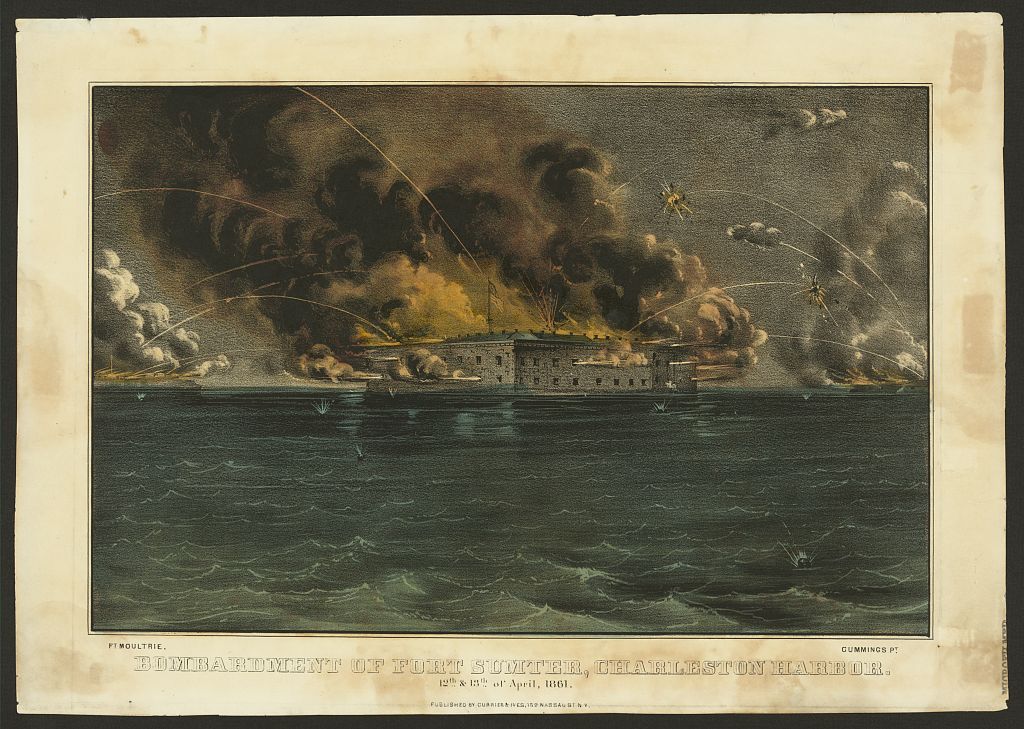
Confederate artillery opened fire on the federally held Fort Sumter in Charleston Harbor, South Carolina, on April 12, 1861. Union Major Robert Anderson commanded the garrison and surrendered after a bombardment lasting into the following day. No soldier was killed during the initial bombardment, although a later flag salute caused deaths after the capitulation.
Lincoln then called for volunteers to suppress the rebellion, and additional states seceded. The episode converted a struggle over federal property and political authority into open war. The detailed Fort Sumter article explains why the fort had become such a dangerous test of sovereignty.
What did each side hope to achieve?
The Union’s original declared objective was to preserve the United States and suppress rebellion. Over time, emancipation became both a military policy and an increasingly explicit national war aim. Confederate leaders sought independence so their government could preserve a slaveholding society beyond federal interference. Their strategy often involved defending territory, exhausting Northern political will, and seeking foreign recognition or a negotiated settlement.
The distinction between military goals and individual motives matters. Some Northern soldiers were abolitionists, while others enlisted primarily to preserve the Union. Confederate soldiers likewise expressed varied personal motives, but the government they defended was established to protect slavery. Historical interpretation must take both personal experiences and the stated political project seriously.
What was the first major land battle?
The First Battle of Bull Run, also called First Manassas, took place near Manassas, Virginia, on July 21, 1861. Union troops under Irvin McDowell attempted to defeat Confederate forces before a long war developed. Instead, Confederate troops held and counterattacked, causing a disorderly Union retreat toward Washington.
The Confederate victory shattered the expectation that the rebellion could be ended through one short campaign. Both sides expanded recruiting, training, and military organization. The First Bull Run guide describes the Stone Bridge, Henry House Hill, ‘Stonewall’ Jackson, and the distinction between the 1861 battle and Second Manassas in 1862.
What was the Anaconda Plan?
Union leaders developed a strategy to blockade Confederate ports and control major rivers, especially the Mississippi. The plan is popularly associated with General Winfield Scott and the metaphor of an anaconda constricting an opponent. It relied on economic pressure and territorial division as well as direct battlefield victories.
Blockades reduced the Confederacy’s ability to export cotton and import weapons, although trade did not cease completely. Union control of rivers allowed armies and supplies to move deeper into the South. The eventual capture of Vicksburg in July 1863 was central to gaining control of the Mississippi. A strategy should be judged by its implementation across years, not merely a cartoon portraying its intended effect.
Why did the war last four years?
The Confederacy could not easily defeat the larger Union, but preserving a defensive army and prolonging resistance offered hope that Northern voters might eventually demand peace. Terrain, transportation difficulties, experienced field commanders, and the scale of the territory complicated Union campaigns. The Union also faced early failures and repeated changes in high command.
Both societies endured extraordinarily high casualties, economic pressures, shortages, and political conflict. Campaigns occurred in different theaters, so a success in Tennessee did not automatically end fighting in Virginia. The war’s duration reflected the interaction of military strength, geography, political endurance, and the changing purpose of Union policy.
Which battles were the most important?
Major engagements included Bull Run in 1861; Shiloh and Antietam in 1862; Chancellorsville, Gettysburg, and Vicksburg in 1863; and the Atlanta and Overland campaigns in 1864. The fighting at Appomattox in April 1865 helped bring the main Confederate army in Virginia to surrender.
No single battle explains the entire war. Antietam influenced emancipation policy and foreign diplomacy. Gettysburg checked Lee’s invasion of Pennsylvania, while Vicksburg made the Mississippi a Union-controlled artery. Atlanta contributed to Northern confidence before the 1864 election. Each event needs to be placed within its own theater and larger strategic sequence.
Why was Antietam important?
On September 17, 1862, Union and Confederate armies fought near Sharpsburg, Maryland, during Robert E. Lee’s first major invasion of Northern territory. The battle produced around 23,000 combined casualties and became the bloodiest single day in American military history. Neither army achieved a straightforward annihilating victory, but Lee withdrew to Virginia.
Lincoln used the resulting strategic opportunity to announce a preliminary Emancipation Proclamation on September 22. The connection between military events and emancipation is fundamental. The conflict could no longer be framed only as restoration of the Union, although emancipation had been central to African American efforts and abolitionist demands long before this battle.
How did the Emancipation Proclamation change the war?
Lincoln issued the final Emancipation Proclamation on January 1, 1863. It declared enslaved people free in areas then in rebellion, subject to the order’s geographical and legal limitations. It did not instantly free everyone held in slavery throughout the United States. The existing Emancipation Proclamation guide examines where the measure applied.
The order undermined the Confederacy’s labor system, authorized the growing participation of Black troops in the United States armed forces, and strengthened the Union’s association with emancipation abroad. Enslaved people had already been seeking freedom through flight and resistance; the proclamation built on a rapidly changing wartime reality rather than creating the struggle for liberty from nothing.
Who fought in the Union armies?
Union soldiers included men of many immigrant backgrounds, free Black Americans, and formerly enslaved people recruited after federal policy shifted. Black regiments such as the 54th Massachusetts challenged racist assumptions through military service while facing discrimination in pay, assignments, and treatment when captured.
Women also worked as nurses, spies, laundresses, aid organizers, and in numerous civilian roles that sustained military operations. Native American soldiers and communities participated under different circumstances on both sides. An accurate history of the armies includes these groups as agents with their own interests rather than treating military history only as a sequence of white commanding generals.
What was life like for Civil War soldiers?
Soldiers spent much more time marching, drilling, building defenses, cooking, foraging, waiting, and dealing with illness than engaged in spectacular battlefield assaults. Camps could spread disease rapidly, particularly when sanitation was poor. Dysentery, typhoid fever, measles, and other illnesses killed large numbers of men.
Soldiers wrote letters and diaries describing boredom, fear, comradeship, homesickness, and disagreements about their commanders and war aims. Clothing and equipment varied, while supply systems changed through the conflict. Photographs from the National Archives Civil War collection document camp life and aftermaths rather than action itself because nineteenth-century exposure times made combat photography impractical.
How did civilians experience the war?
Combat disrupted farms, ports, railways, and towns. Families lost wage earners, faced hunger or displacement, and supplied armies through taxation, purchases, or requisitions. In areas under changing military control, residents could be accused of supporting either side. Women often maintained farms and businesses while men were absent and joined organized relief work for soldiers.
Enslaved people made crucial decisions about when to flee, which army to approach, and how to protect families during advancing campaigns. Some faced forced labor and violence from Confederate authorities. Civilian experiences differed by region, race, wealth, gender, and proximity to military operations, making them essential to the war’s history rather than a secondary social topic.
What happened at Gettysburg?
The Battle of Gettysburg took place July 1–3, 1863, during Robert E. Lee’s invasion of Pennsylvania. Union troops under George G. Meade resisted Confederate attacks on a series of defensive positions. The defeat of Pickett’s Charge on July 3 contributed to Lee’s decision to withdraw to Virginia.
Gettysburg was one of the war’s most costly battles and a crucial failure of Confederate offensive strategy in the East. The site later became the setting for Lincoln’s Gettysburg Address. Read the existing Gettysburg battle guide for a detailed analysis rather than conflating the July battle with the November speech.
Why did Vicksburg matter?
Vicksburg, Mississippi, stood above a critical stretch of the Mississippi River. After campaigns and a siege, Union General Ulysses S. Grant forced the Confederate garrison to surrender on July 4, 1863. The victory, combined with other successes on the river, allowed the Union to control its great north-south transportation route and separated the Confederate states east and west of the river.
The simultaneous Union successes at Gettysburg and Vicksburg were important but did not guarantee that the war would end immediately. Confederate armies continued fighting for nearly two more years, and the Union faced costly campaigns before final victory. Geography, supplies, and endurance remained decisive.
What did the Gettysburg Address say about the war?
On November 19, 1863, Lincoln delivered a brief speech at the dedication of a national cemetery at Gettysburg. He connected the Union’s survival to the founding ideals of equality and republican self-government, presenting the enormous sacrifice of soldiers as a challenge to complete an unfinished national task.
The speech did not itself free enslaved people or enact constitutional change. Its significance lies in how it interpreted what the war could mean. The address is also frequently misquoted or presented in one ‘definitive’ wording despite several surviving manuscript versions. Studying the words, context, and publication history separately offers a more precise interpretation.
How did the Union win in 1864?
Grant took overall command of United States armies in 1864 and maintained pressure on Confederate forces across multiple theaters. His Virginia operations inflicted severe casualties but kept the Army of Northern Virginia engaged. Meanwhile, William T. Sherman’s army captured Atlanta in September and advanced toward Savannah later that year.
These developments damaged Confederate resources and strengthened Northern confidence that victory was possible, especially during the 1864 presidential election. The Union could replace troops and supplies more readily than the Confederacy, but success still required commanders to exploit railways, ports, and the pressure of coordinated campaigns. The conflict remained costly for soldiers and civilians.
What was Sherman’s March to the Sea?
After capturing Atlanta, Sherman marched toward Savannah between November and December 1864, destroying selected military infrastructure and resources that Confederate forces could use. His troops moved across Georgia while the campaign aimed to weaken the Confederate capacity and willingness to continue fighting.
The march devastated parts of the region and shaped later memory of the war. Civilians, including enslaved people who sought protection from Union forces, experienced the operation differently. The March to the Sea guide distinguishes military orders from what individual soldiers did and from later exaggerations on both sides.
How did the war end?
In spring 1865, Confederate defenses around Petersburg and Richmond broke under sustained Union pressure. Robert E. Lee retreated west, hoping to find supplies or unite with other forces, but Union troops blocked his movement. On April 9, 1865, Lee surrendered the Army of Northern Virginia to Grant at Appomattox Court House.
Other Confederate armies did not all surrender that day. Joseph E. Johnston surrendered a major army later in April, and fighting and formal capitulations continued elsewhere. The end of the war was a process rather than a single instantaneous national ceremony. Lincoln’s assassination in mid-April further complicated the transition to peace.
What happened after Lincoln was assassinated?
President Lincoln was shot by John Wilkes Booth at Ford’s Theatre on April 14, 1865, and died the next morning. Vice President Andrew Johnson succeeded him. The assassination occurred only days after Appomattox, leaving the victorious United States without the president most closely associated with its wartime leadership.
It also altered the political context of postwar reconstruction and the struggle over civil and political rights. It would be simplistic to say that one man’s death alone determined Reconstruction’s outcome, but leadership choices clearly mattered. The Lincoln assassination article covers the event and the subsequent investigation.
How many people died in the Civil War?
A traditional estimate of Civil War military deaths is about 620,000, while more recent demographic research has suggested totals nearer 750,000. The exact number remains uncertain because recordkeeping was inconsistent and deaths from disease, wounds, and other causes were not all documented systematically. Civilian suffering is even harder to quantify.
It is important to distinguish military deaths from battlefield casualties, which include wounded and missing people. Many deaths occurred away from combat through disease. Historians use muster rolls, census data, medical records, and demographic methods to estimate the scale of the disaster, which was immense relative to the United States population of the time.
What happened during Reconstruction?
After the war, federal and state officials confronted questions about rebuilding former Confederate governments, protecting freedom, and defining citizenship. The Thirteenth Amendment abolished slavery with an exception for punishment after conviction of a crime. Later amendments established birthright citizenship and equal protection guarantees and prohibited denying voting rights on account of race, though enforcement was contested.
Freedpeople established schools, churches, families, businesses, and political organizations while facing intense violence and resistance from white supremacists. The Reconstruction overview explains the distinct stages of this struggle. The Union’s military victory did not settle the fight over political equality.
American Civil War timeline: 1860–1865
The chronology helps separate political causes, military turning points, emancipation policy, and surrender. Read the date of a battle alongside the campaigns that preceded and followed it rather than assuming every famous encounter was decisive on its own.
| Date | Event |
|---|---|
| Nov–Dec 1860 | Lincoln elected; South Carolina secedes. |
| April 12, 1861 | Fort Sumter attacked. |
| July 21, 1861 | First Bull Run. |
| April 6–7, 1862 | Shiloh. |
| September 17, 1862 | Antietam. |
| January 1, 1863 | Emancipation Proclamation takes effect. |
| July 1–4, 1863 | Gettysburg and Vicksburg. |
| September 1864 | Atlanta captured. |
| April 9, 1865 | Lee surrenders at Appomattox. |
| April 14–15, 1865 | Lincoln assassinated and dies. |
Frequently asked questions about the Civil War
When did the Civil War begin? Confederate forces fired on Fort Sumter on April 12, 1861.
What was the main cause? Slavery, especially disputes over its protection and expansion.
Who was president of the Union? Abraham Lincoln.
Who was president of the Confederacy? Jefferson Davis.
Which side won? The Union defeated the Confederacy.
When did it end? Major Confederate forces surrendered during spring 1865, including Lee’s army on April 9.
Did slavery end automatically at Appomattox? No; emancipation unfolded through wartime policies, military advances, self-liberation, and the Thirteenth Amendment.
What should students read next?
For the causes, read the National Park Service synthesis together with secession documents and the Dred Scott decision. For military chronology use the U.S. Army Center of Military History and the Gettysburg National Military Park timeline. For emancipation examine the National Archives document rather than relying on a compressed textbook sentence.
These sources answer different questions. Government declarations reveal political aims; orders and reports describe intentions and decisions; photographs document people and places but rarely the instant of combat; and modern scholarship assesses why events occurred. Comparing evidence rather than repeating one myth is the best approach to the Civil War’s complexity.




