Battle of Antietam (1862): The Bloodiest Day and Emancipation
Why a one-day battle shaped emancipation, diplomacy and the direction of the war.
The Battle of Antietam was fought September 17, 1862, near Sharpsburg, Maryland, between George B. McClellan’s Union army and Robert E. Lee’s Confederate forces. Roughly 23,000 soldiers were killed, wounded or missing in the bloodiest single day of American military history. Lee withdrew to Virginia, and the strategic result gave Abraham Lincoln an opening to announce the preliminary Emancipation Proclamation.
Follow the Cornfield, Dunker Church, Bloody Lane and Burnside Bridge, then examine casualty estimates, Lee’s withdrawal and the preliminary Emancipation Proclamation.
On this page — 24 topics
What happened at the Battle of Antietam?
The Battle of Antietam occurred on September 17, 1862, near Sharpsburg, Maryland. Union troops under George B. McClellan attacked Robert E. Lee’s Confederate Army of Northern Virginia after Lee entered Maryland. Severe fighting broke out around the Cornfield and Dunker Church, along the Sunken Road and later near the lower bridge over Antietam Creek.
The battle produced roughly 23,000 combined killed, wounded and missing or captured casualties in one day, making it the bloodiest single day in American military history. Neither army was destroyed, but Lee withdrew to Virginia, giving Lincoln a strategic opportunity to announce preliminary emancipation.
Why did Lee invade Maryland?
Lee had achieved significant Confederate successes in Virginia during 1862 and believed a movement north could shift the war’s initiative. Invading Maryland offered possible supplies, recruits, political influence and an opportunity to threaten Union communications. He also hoped a victory on Northern soil might encourage foreign recognition of the Confederacy or strengthen peace sentiment.
Maryland was a slaveholding border state that remained in the Union; its citizens held different loyalties. Lee could not assume widespread support simply because the state permitted slavery. The invasion faced difficulties from exhausted troops, supply needs and the risk of confronting a larger federal army away from Confederate territory.
Who commanded the armies?
Major General George B. McClellan commanded the Union Army of the Potomac. General Robert E. Lee commanded the Confederate Army of Northern Virginia, assisted by senior officers including Thomas J. ‘Stonewall’ Jackson and James Longstreet. Both armies had experienced earlier operations, but their officers and soldiers were exhausted by an extended summer campaign.
McClellan held numerical advantages during much of the operation, but his decisions were affected by uncertainty over Confederate numbers. Lee had divided portions of his army and needed to reunite them before battle. The resulting confrontation reflected not just leadership personalities but the movement of large formations over Maryland roads and hills.
What was Lee’s Special Order 191?
Confederate Special Order 191 described the movements of Lee’s divided army during the Maryland campaign. A copy was discovered by Union soldiers and passed to McClellan, providing valuable information about Confederate dispositions. The discovery created an opportunity to strike separated Confederate columns before they could regroup.
McClellan did not exploit the intelligence as quickly or completely as later critics believed possible. Historical accounts debate the effects of delay, incomplete knowledge and logistical obstacles. The document nevertheless illustrates the value of intelligence in nineteenth-century campaigns and the danger of detailed operational orders falling into enemy hands.
What happened at South Mountain?
On September 14, 1862, Union and Confederate forces fought for passes through South Mountain, west of Frederick, Maryland. McClellan’s army pushed through after heavy fighting, challenging Lee’s attempts to protect his divided forces. The engagements preceded Antietam and affected where the main Confederate army could assemble.
The South Mountain battles are essential background, not simply a minor footnote. They bought time for some Confederate movements while also allowing the Union to press forward. Reading the campaign as one continuous series of decisions explains how the armies ended up facing each other near Sharpsburg.
Where is Antietam Creek?
Antietam Creek flows through western Maryland and passes near Sharpsburg. Its crossings shaped Union movement on the battlefield, especially the stone bridge later associated with General Ambrose Burnside. The larger battlefield included agricultural land, ridges, wooded areas and roads that affected how troops deployed.
The creek did not separate both armies neatly throughout the entire battle. Major fighting occurred on different parts of Lee’s defensive line, including areas where water was not the main obstacle. Geographic understanding helps correct oversimplified maps in which every attack is shown as a direct assault across the creek.
How did the morning battle begin?
The first major Union attacks began near the Cornfield and Dunker Church north of Sharpsburg. Troops under Joseph Hooker advanced against Confederate positions, leading to repeated attacks and counterattacks. The Cornfield changed hands amid enormous casualties as artillery and infantry fire cut through formations at close range.
No one column gained a permanent breakthrough immediately. Confederate reinforcements moved into threatened areas, while Union divisions attempted renewed assaults. The fighting’s intensity demonstrates why the battlefield became synonymous with sacrifice: soldiers fought for individual fields and tree lines under fire that could destroy regiments in minutes.
Why was the Cornfield so deadly?
The field’s tall vegetation, fences and surrounding woods limited visibility while offering little reliable protection from artillery and musket fire. Units crossing or defending the open ground could be exposed to concentrated fire, and the front shifted repeatedly as new formations entered.
Popular accounts sometimes portray one straight charge, but there were multiple attacks, counterattacks and withdrawals involving different brigades. The changing lines created confusion for officers who could see only a small section of the battlefield. The Cornfield is best understood as an area of sustained, repeated fighting rather than one brief dramatic moment.
What was the Dunker Church?
Dunker Church was a small meetinghouse used by the German Baptist Brethren, a religious community associated with nonresistance. Its white building stood near major fighting on the northern battlefield and became a prominent landmark for soldiers and later photographers.
The irony of heavy combat around a pacifist meetinghouse has made the church central to Antietam’s public memory. Photographs made after the battle show the building and surrounding ground. Its location helps modern visitors reconstruct troop movements, but a later photograph should not be confused with an image taken while armies were exchanging fire.
What happened at the Sunken Road?
The Sunken Road was a worn farm lane that Confederate soldiers used as an improvised defensive position in the battlefield’s center. Union divisions attacked repeatedly, suffering severe losses while inflicting damage on the defenders. The road became known as Bloody Lane because of the concentration of casualties.
Eventually Union forces broke part of the Confederate position, but they did not turn the breach into complete destruction of Lee’s army. Command friction, exhaustion and the need to regroup limited exploitation. The fighting demonstrates how a seemingly useful defensive feature could become a trap when attackers gained a flank or sufficient fire superiority.
What was Burnside Bridge?
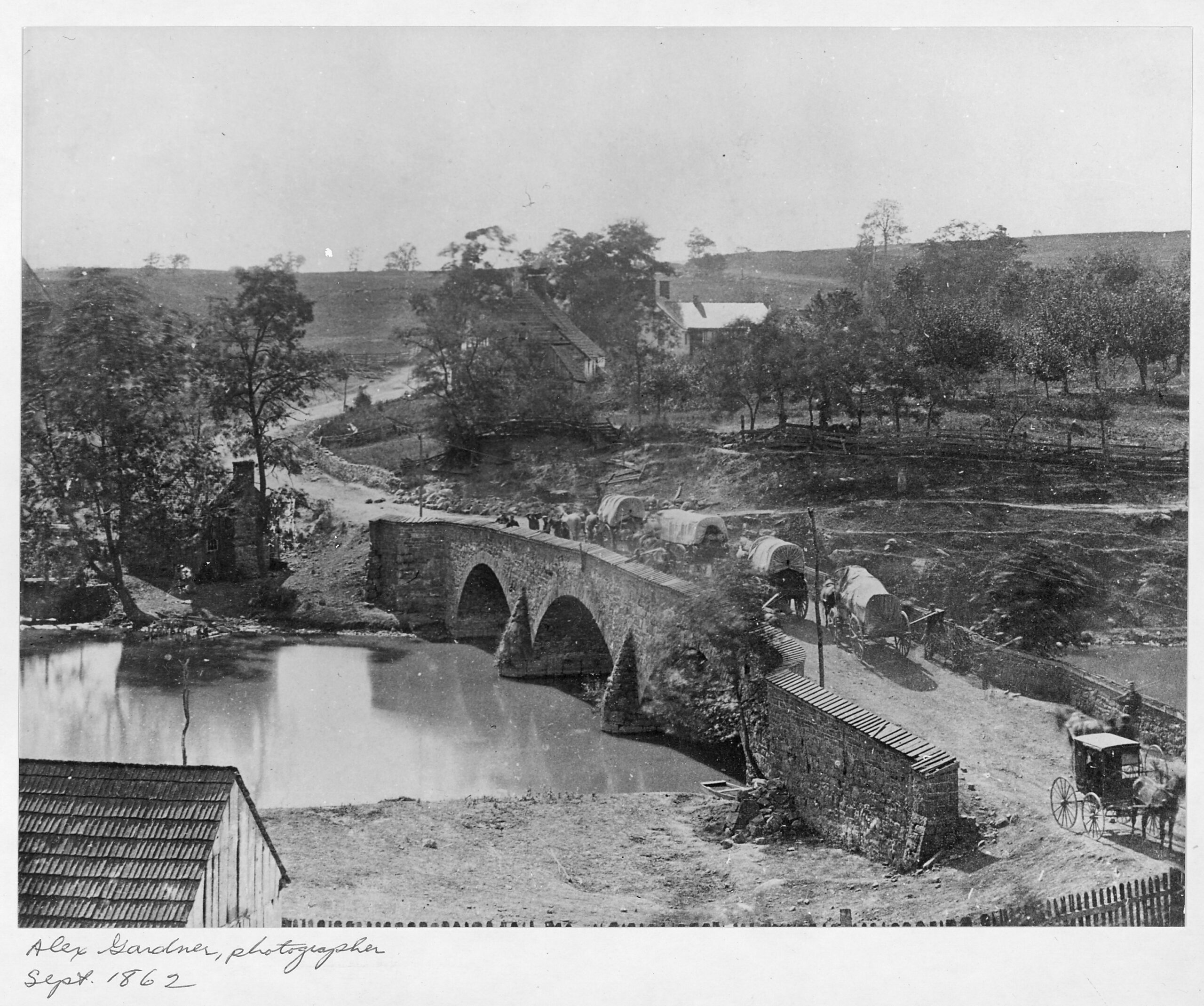
The lower stone bridge over Antietam Creek became associated with Union General Ambrose E. Burnside. His troops attempted to cross a narrow route defended by Confederate soldiers on nearby high ground. Repeated attacks and difficulties at the crossing delayed the larger Union advance on the southern end of the battlefield.
After Union soldiers forced a passage, they advanced westward, threatening Lee’s line. The bridge is now a major historic landmark and appears in contemporary photographs by Alexander Gardner. It helps illustrate how a small crossing can affect the timing of a much larger battle.
What happened when A. P. Hill arrived?
Confederate General A. P. Hill’s division marched from the Harpers Ferry area and reached the battlefield late in the day. His troops counterattacked the Union movement near Burnside’s sector, helping stabilize Lee’s threatened southern flank.
The arrival was important because Lee’s army had endured attacks across its front and had limited reserves available. Hill’s timely intervention did not erase the day’s losses, but it reduced the danger of an immediate Union breakthrough near Sharpsburg. The episode also demonstrates why the movement of troops from other campaign objectives mattered on September 17.
Did McClellan win the battle?
The battle is often described as tactically inconclusive because neither side destroyed the other or gained an overwhelming final position. Strategically, the Union achieved an important result when Lee withdrew from Maryland back into Virginia. McClellan’s army retained the field, but the Confederate army escaped and continued fighting.
Distinguishing tactical and strategic outcomes avoids false certainty. Lincoln had wanted a result strong enough to support a new emancipation policy, and Lee’s retreat supplied that opening. But the failure to pursue aggressively led to criticism of McClellan’s conduct.
How many people died at Antietam?
Approximately 23,000 combined casualties are commonly cited for the single day’s battle, including killed, wounded and missing or captured. The number killed was much smaller than that total, though still horrific. Individual estimates vary by source and classification, especially when wounded soldiers died later.
It is incorrect to say 23,000 people died in one day. The term ‘bloodiest single day’ refers to the combined casualty count. The National Park Service Antietam history explains the significance of the losses in the context of American warfare.
Why was Antietam important for emancipation?
Lincoln had been preparing a policy to declare enslaved people free in territories still in rebellion. He and his advisers wanted a military success before issuing the preliminary proclamation, lest the announcement appear to be a desperate response to defeat. Lee’s retreat after Antietam provided that opportunity.
On September 22, 1862, Lincoln announced the preliminary Emancipation Proclamation, setting the stage for the January 1, 1863 order. The existing Emancipation Proclamation guide examines what the order did and did not accomplish. Antietam was significant because battlefield events changed the political possibilities for abolition.
Did the battle affect foreign diplomacy?
Confederate leaders hoped that successful military operations might persuade Britain or France to recognize their government or mediate an end to the war. Lee’s failure to remain in Maryland weakened the case that the Confederacy could confidently defeat Union forces on Northern soil.
The shift in Union policy toward emancipation also made European recognition of a slaveholding Confederacy more politically difficult. Historians debate the relative importance of public opinion, diplomacy and strategic interests abroad, but Antietam clearly occurred at a moment when foreign reactions mattered.
What did battlefield photographs change?
Photographers associated with Mathew Brady’s enterprise, including Alexander Gardner, made images of Antietam’s aftermath that showed dead soldiers and damaged landscapes. Exhibitions of such photographs confronted Northern audiences with the reality of war in a way that idealized battle prints often did not.
The technology of the period could not capture the split-second motion of combat because long exposure times were required. The photographs are powerful documentary records, but they depict aftermaths, positions and people who could remain still, not the actual gunfire of September 17.
What happened to the wounded?
Thousands of wounded soldiers needed urgent care after the battle. Medical staff used churches, barns, farms and temporary hospitals in the region, often struggling with shortages and infection. Civilians also helped feed and nurse men from the armies, even as farms and homes were damaged.
The consequences extended beyond one day. Many soldiers died of injuries later, and survivors might live with disability, pain or economic insecurity. Studying hospital records and local accounts adds essential human detail to a military timeline that otherwise reduces the suffering to a casualty total.
How does Antietam compare with Gettysburg?
Antietam is described as the bloodiest single day of the Civil War, while Gettysburg, fought over three days in July 1863, produced higher combined casualties across the full engagement. The distinction resolves a common confusion.
Both battles ended Confederate invasions of Northern territory and had major political implications, but their contexts differed. Antietam supported the preliminary emancipation announcement in 1862; Gettysburg influenced the 1863 military balance and later became the site of Lincoln’s famous address. The two should be compared without merging their chronologies.
Antietam campaign timeline
The sequence begins with Lee’s Maryland invasion and ends with the preliminary emancipation announcement.
| Date | Event |
|---|---|
| Early Sep 1862 | Lee advances into Maryland. |
| Sep 13 | Union discovers Special Order 191. |
| Sep 14 | Battle of South Mountain. |
| Sep 17 | Antietam: Cornfield, Sunken Road and Burnside Bridge. |
| Sep 18–19 | Lee withdraws into Virginia. |
| Sep 22 | Preliminary Emancipation Proclamation. |
Frequently asked questions about Antietam
When was Antietam? September 17, 1862.
Where? Near Sharpsburg, Maryland.
Who commanded? George B. McClellan and Robert E. Lee.
Who won? The battle was tactically inconclusive, but Lee withdrew from Maryland.
How many casualties? Roughly 23,000 combined in one day.
Why was it important? It created an opportunity for Lincoln’s preliminary Emancipation Proclamation.
Which sources best explain Antietam?
The National Park Service Antietam collection provides battlefield research and geographical context. The NPS Civil War timeline clarifies the relationship to the emancipation announcement, and the National Archives proclamation provides the original policy text. The Library of Congress photographs document the appearance of the battlefield after fighting.
Compare sources based on what each can establish. A military dispatch records what a commander believed at the time, a photograph documents a view after the event, and a modern analysis can compare multiple conflicting accounts. Those distinctions are especially important when discussing the casualty toll and McClellan’s decisions.