Fort Sumter (April 1861): The First Shots of the Civil War
How a besieged harbor fort became the opening battlefield of the American Civil War.
Fort Sumter in Charleston Harbor was bombarded by Confederate artillery beginning April 12, 1861, after South Carolina had declared secession. Union Major Robert Anderson surrendered on April 13 and evacuated on April 14. No one died from enemy fire during the bombardment, although a flag-salute accident killed two federal soldiers. The attack began the American Civil War and prompted Lincoln’s call for 75,000 volunteers.
Explore the fort’s location, supply crisis, Confederate attack, garrison surrender and how the bombardment changed national politics.
On this page — 23 topics
Why did the Civil War begin at Fort Sumter?
Fort Sumter was a federal military installation in Charleston Harbor, South Carolina, that became a visible test of sovereignty after the state claimed to secede from the United States. Confederate authorities insisted that the United States remove its troops, while the federal government maintained that national installations remained federal property. The dispute escalated after the election of Abraham Lincoln and the formation of the Confederacy.
On April 12, 1861, Confederate artillery began bombarding the fort. Major Robert Anderson’s United States garrison returned fire but could not withstand the siege indefinitely. The confrontation turned the ongoing secession crisis into open warfare and prompted Lincoln to call for volunteers.
Where is Fort Sumter?
Fort Sumter stands on an artificial island near the entrance to Charleston Harbor in South Carolina. The fort was intended to defend a major Atlantic port and was designed as part of the United States’ coastal defense system. It was unfinished when the Civil War began, which affected the available guns, defensive structures and quarters for the garrison.
Its location made the political confrontation difficult to avoid. Federal soldiers inside the harbor could not easily reach supplies or relief by land, while Confederate batteries around Charleston possessed commanding firing positions. The site is preserved as part of Fort Sumter and Fort Moultrie National Historical Park.
Why did South Carolina secede?
South Carolina adopted an ordinance of secession on December 20, 1860, after Lincoln won the presidential election. The state’s declaration of causes emphasized the protection of slavery and grievances over antislavery policies and the enforcement of fugitive-slave laws. Secession leaders rejected the authority of the United States government and claimed that South Carolina could operate as a separate sovereign state.
The dispute about Fort Sumter followed directly from this political decision. Claiming independence required taking control of military installations within the state, but Washington refused to accept that state conventions could unilaterally dissolve the Union. The fort became a physical symbol of that disagreement.
Who was Major Robert Anderson?
Major Robert Anderson commanded the United States garrison in Charleston Harbor. A career officer from Kentucky, he faced the difficult task of maintaining military discipline while political authorities debated the future of the Union. In December 1860, he moved his men from the less defensible Fort Moultrie to Fort Sumter.
The transfer improved his position because Sumter was surrounded by water and could not be approached as easily by ground forces. It also outraged South Carolina’s secessionist government, which regarded the move as defiance. Anderson’s decisions affected the timetable of the crisis but did not by themselves create the political conflict over slavery and sovereignty.
What happened to Fort Moultrie?
Fort Moultrie stood on Sullivan’s Island and had been important during the American Revolution. By late 1860 its position was exposed to potential land attack from nearby areas. Anderson judged that moving his command to Fort Sumter offered stronger defenses and a better chance of avoiding immediate capture.
The movement was completed on December 26, 1860. South Carolina forces subsequently occupied other federal installations in the area. The difference between Moultrie and Sumter explains why two nearby forts appear repeatedly in accounts of the opening crisis. Neither was an ordinary civilian building or a fort created only after secession.
Why was Fort Sumter running out of food?
The United States garrison was small and isolated, and supply deliveries became politically and militarily difficult as Confederate forces controlled the surrounding harbor approaches. Anderson reported diminishing provisions and uncertainty about when federal relief might arrive. The fort’s guns and other equipment were also incomplete because construction had not finished.
Hunger did not make the federal claim of ownership disappear, but it created urgency for Lincoln’s government. A president who simply waited risked seeing the garrison surrender for lack of food, while an armed attempt to reinforce the position could provoke fighting. The supply dilemma was thus both a logistical problem and a national political test.
What was the Star of the West incident?
In January 1861, while James Buchanan was still president, the merchant vessel Star of the West attempted to bring reinforcements and supplies to Fort Sumter. South Carolina batteries fired on it as the ship approached Charleston Harbor, and it turned back without delivering its cargo. No full-scale war began as a result of that exchange.
The incident showed how dangerous relief efforts had become before Lincoln took office. It also demonstrates why the first shot of the Civil War is traditionally dated to the April bombardment rather than every earlier episode in which hostile fire occurred. The larger distinction concerns the outbreak of sustained organized war.
What did Lincoln decide in April 1861?
Lincoln faced advisers who differed about whether the fort could be defended and whether an evacuation might avoid war. He decided to send supplies to the garrison and informed South Carolina authorities that the expedition’s immediate aim was provisioning, not reinforcing with new troops unless resistance occurred.
Confederate officials viewed even the delivery of food as an assertion of federal authority inside territory they claimed. If they allowed Sumter to remain under a United States flag, their sovereignty claim looked incomplete. The decision to open fire was therefore made by the Confederate leadership despite knowing that Lincoln had framed the mission as a supply expedition.
Who commanded Confederate artillery?
Brigadier General P. G. T. Beauregard commanded Confederate forces surrounding Charleston Harbor. He had previously served in the United States Army and, unusually, had been associated with Anderson through earlier military education. Beauregard directed batteries positioned on shore and around the harbor to attack Fort Sumter.
The role of regular military professionals on both sides reveals the institutional fracture caused by secession. Former colleagues found themselves commanding opposing forces. The attack involved planned firing positions and communications among batteries, not simply one angry civilian firing a single unauthorized cannon.
When did the bombardment start?
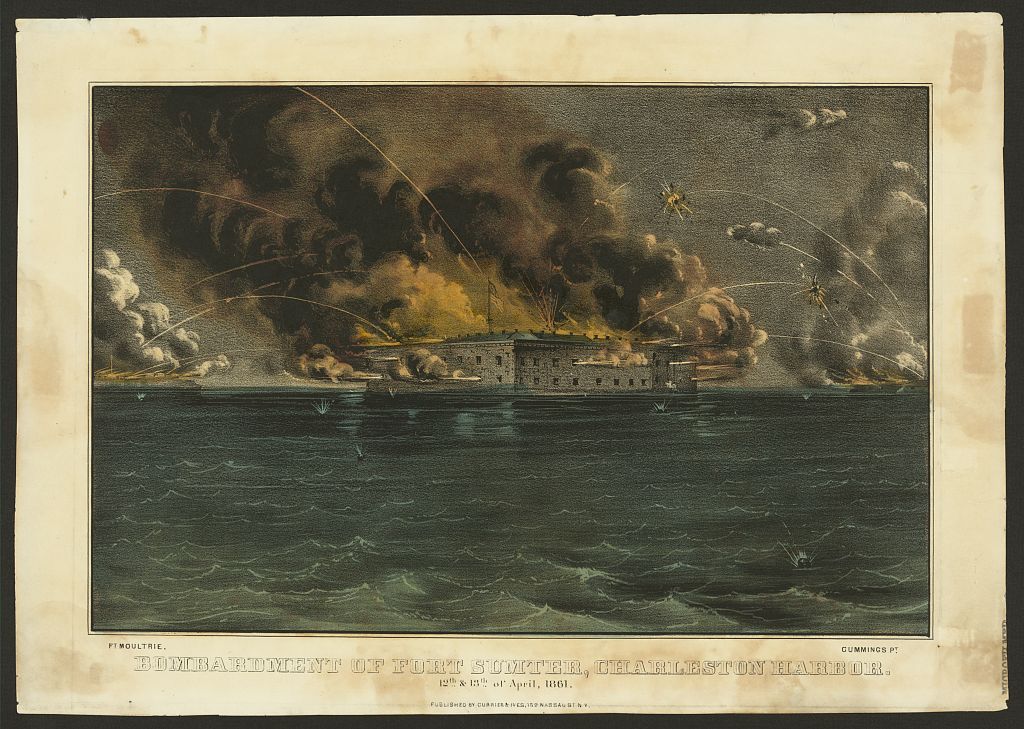
Confederate batteries opened fire in the early hours of April 12, 1861, around 4:30 a.m. The bombardment continued through the day and into April 13. The federal garrison returned fire when able but had limited ammunition and fewer useful guns.
Contemporary accounts record the spectacular flashes over the harbor and the growing damage inside the fort. Smoke and fire complicated defense, while nearby civilians watched the operation from shore. The exact first gun and signal have become subjects of patriotic tradition, but the established fact is that organized Confederate artillery began the bombardment under military command.
How long did Fort Sumter hold out?
The garrison resisted through approximately thirty-four hours of bombardment before Anderson agreed to surrender on April 13. Damage to structures and supplies, difficult firing conditions and the absence of adequate relief made continued resistance untenable. The actual evacuation took place the following day.
It is useful to distinguish the ceasefire or capitulation date from the day the garrison departed. Popular summaries sometimes mix them together. The fort was not defended for weeks after Confederate batteries opened fire, nor did a large federal army attempt a relieving assault during the bombardment.
Were any soldiers killed in the bombardment?
No Union or Confederate soldiers were killed by enemy fire during the initial bombardment, although the fort suffered extensive damage. Tragically, the subsequent ceremony intended to salute the United States flag produced an accident when a cannon discharged prematurely, killing two federal soldiers and wounding others.
This is why claims that the opening battle was entirely without deaths need qualification. It is accurate to say there were no battle deaths from hostile fire during the bombardment, but not that everyone survived the events surrounding the surrender. The distinction is important for historical accuracy and for remembering the individuals who died.
Why did Anderson surrender?
Anderson’s garrison faced dwindling supplies, fires, damaged buildings and increasing danger from Confederate artillery. An honorable capitulation preserved the remaining soldiers and allowed them to leave rather than continue a defense with little military prospect. The surrender did not represent voluntary acceptance of Confederate independence by the United States government.
The soldiers departed with military honors, carrying the national flag. Anderson would later remain a figure associated with the defense of federal authority. The physical fort fell into Confederate hands, but the political result was a rapid escalation to national war rather than a peaceful resolution of the secession crisis.
How did Lincoln respond to the attack?
On April 15, 1861, Lincoln issued a call for 75,000 militia volunteers to suppress the rebellion. The call was intended to demonstrate federal determination to preserve the Union and recover national authority. For many Americans, the attack on the flag changed the question from a debate about secession to a demand for military action.
The call also affected Southern states that had not yet joined the Confederacy. Virginia and other Upper South states subsequently adopted secession ordinances. Those decisions show why events immediately after Sumter were politically consequential beyond the loss of one harbor installation.
Which additional states joined the Confederacy?
Virginia, Arkansas, Tennessee and North Carolina became the four additional states associated with the Confederacy after the attack and Lincoln’s call for troops. Their local political procedures and timing differed, and Unionist communities remained important in several regions.
In western Virginia, opposition to secession helped produce the eventual creation of West Virginia in 1863. This complexity challenges an overly neat map that paints every Southern resident or county as uniformly supporting the Confederate project. The war’s political divisions ran through states and communities as well as between regions.
How did Fort Sumter influence the war’s strategy?
The attack encouraged a large-scale federal mobilization and accelerated Confederate military organization. Lincoln’s government began taking steps toward blockade of Southern ports, and both sides prepared for land campaigns. Within months, the armies met at First Bull Run, demonstrating that the conflict would not be settled quickly.
Fort Sumter mattered less for the number of combat casualties than for its consequences. It created an unmistakable armed confrontation between competing governments and made continued political compromise much more difficult. The harbor fort thus became one of the war’s most consequential early locations.
What happened to Fort Sumter later?
Confederate troops held the fort for much of the war, while United States naval and land forces attempted to regain control of Charleston Harbor. Later operations damaged the fort substantially, and it became a symbol for both sides. The eventual Union advance through South Carolina forced the Confederates to abandon Charleston in February 1865.
The fort was restored and altered after the war. Modern visitors see surviving historic fabric and interpretive structures influenced by later military use. A photograph of the fort today does not show it exactly as it appeared in April 1861, so period maps, plans and prints remain important for understanding the opening battle.
Which popular Fort Sumter claims are misleading?
One myth is that the fort’s surrender immediately ended the secession crisis peacefully. In reality it sparked large mobilizations and additional secession. Another is that all eleven Confederate states had already left the Union before the first shots; four joined afterward. A third is that hundreds of men died in the bombardment.
Confusing the January Star of the West shots with the April battle can also distort the chronology. Each event was important but belongs in a different stage of escalating conflict. Checking the precise dates and the cause of the deaths during the flag salute corrects most of these misunderstandings.
Fort Sumter timeline
The major dates distinguish Anderson’s transfer, the failed January supply mission, the April firing and the beginning of wider mobilization.
| Date | Event |
|---|---|
| Dec 20, 1860 | South Carolina declares secession. |
| Dec 26, 1860 | Anderson moves to Fort Sumter. |
| Jan 9, 1861 | Star of the West turned back by gunfire. |
| Mar 4, 1861 | Lincoln inaugurated. |
| Apr 12 | Confederate bombardment begins. |
| Apr 13 | Anderson agrees to surrender. |
| Apr 14 | Federal garrison evacuates; flag-salute accident. |
| Apr 15 | Lincoln calls for 75,000 volunteers. |
Frequently asked questions about Fort Sumter
Where was the fort? Charleston Harbor, South Carolina.
When did fighting begin? April 12, 1861.
Who fired first? Confederate batteries surrounding the harbor.
Who commanded the Union garrison? Major Robert Anderson.
Who commanded Confederate forces? P. G. T. Beauregard.
When did the fort surrender? April 13, with evacuation on April 14.
Why is it famous? The bombardment marks the accepted start of the Civil War.
What documents explain the Sumter crisis?
The Library of Congress lithograph and notes place the bombardment within the first wave of secession and the failed resupply effort. The National Park Service fort history explains the setting and the development of the harbor defenses. The U.S. Army chronology confirms the April dates and the larger sequence of early war events.
Compare military reports with newspaper reactions and the political statements made by both governments. A later lithograph can convey what contemporaries imagined the bombardment looked like, but it is not a photograph made during battle. Understanding the source type is essential to responsible historical interpretation.