Siege of Vicksburg (1863): Grant, Pemberton and Mississippi River
How Grant isolated a Confederate army and helped open the Mississippi to Union traffic.
The Siege of Vicksburg lasted from May 23 to July 4, 1863, after Union General Ulysses S. Grant surrounded the Confederate fortress in Mississippi. Failed direct assaults gave way to bombardment, trench warfare and shortages. Confederate General John C. Pemberton surrendered the garrison on July 4. The victory helped the Union control the Mississippi River, completed after Port Hudson surrendered on July 9.
This guide distinguishes the wider spring campaign, the failed May assaults, the formal siege and the surrender on Independence Day.
On this page — 25 topics
Why was Vicksburg important?
Vicksburg was a Confederate fortress overlooking a major bend in the Mississippi River. Cannon on its bluffs threatened Union shipping, while river crossings connected Southern states on either side. The Union wanted to open the Mississippi for military and commercial use and disrupt Confederate transport. Capturing the city would be much more than a symbolic victory: it would help split the Confederacy geographically. Yet the city’s height and fortifications made any straightforward attack dangerous. Grant therefore spent months attempting to reach Vicksburg before successfully surrounding it.
Who commanded the opposing forces?
Union Major General Ulysses S. Grant directed the campaign and coordinated land forces with naval commanders, particularly David D. Porter. Confederate Lieutenant General John C. Pemberton defended Vicksburg and its approaches. Pemberton was responsible both for the troops in the field and a strategically valuable city. He faced competing pressures from political authorities and other commanders, including Joseph E. Johnston. Grant’s opportunity came from separating Confederate formations and forcing Pemberton into strong but ultimately isolated defenses. The outcome depended as much on roads and supplies as on individual leadership.
How did Grant reach the east bank?
Earlier attempts to approach Vicksburg from the north and through Mississippi waterways had failed. In spring 1863, Grant moved troops down the west bank of the Mississippi and crossed below the city with naval assistance. This bold maneuver placed Union soldiers on the east bank south of the Confederate fortress and allowed them to move inland. Such operations required ferrying troops, artillery and supplies across a major river near hostile forces. The crossing succeeded because of coordination with the navy, flexible movement and successful engagement of Confederate troops at Port Gibson.
Why did Grant move toward Jackson?
Rather than attack Vicksburg immediately after crossing, Grant moved inland toward Jackson, Mississippi, a Confederate rail and administrative center. This helped interfere with enemy communications and reduced the chance that Pemberton and Johnston could unite effectively. The operation confused Confederate efforts to concentrate against the Union advance. It also demonstrates that the siege began as a campaign of maneuver. Grant accepted supply risks to keep his army moving, then turned west toward Vicksburg after his opponents’ options had narrowed. Studying Jackson and the railways explains the strategic logic behind the later encirclement.
What happened at Champion Hill?
On May 16, 1863, Grant’s army defeated Pemberton’s troops at Champion Hill, a major battle east of Vicksburg. Confederate units were driven back, leaving their army with fewer options for holding the countryside. On May 17, Union soldiers won again at the Big Black River Bridge, forcing further retreat into the fortifications. These setbacks were crucial: Pemberton did not simply choose to enter a siege with all options intact. His army had lost battles, equipment and freedom of movement. The Confederate garrison’s ability to resist thereafter depended on existing earthworks and limited supplies.
What defenses protected the city?
The Confederate army had constructed an extensive line of earthworks and fortified positions around the landward approaches to Vicksburg. The National Park Service describes more than 170 artillery pieces and strong works commanding principal roads and exposed slopes. Defenders could fire from sheltered positions while attackers struggled up difficult terrain. The city also benefited from the Mississippi bluffs and river batteries. However, defensive strength did not guarantee survival: once Union forces blocked outside assistance, troops and civilians were confined inside a ring that could be bombarded and starved into submission.
Why did the May 19 assault fail?
After the defeats outside the city, Grant hoped Pemberton’s soldiers might be disorganized enough to collapse under direct pressure. He ordered an attack on May 19, 1863, especially near the Stockade Redan. Union troops discovered that the Confederate defenses remained capable of withstanding frontal assaults. Earthworks, trenches, uneven ground and concentrated fire made their advance costly. The failure demonstrated the danger of assuming that previous field defeats had destroyed a garrison’s fighting capacity. Grant faced the choice of repeating the attack, withdrawing or adopting the slower methods of siege warfare.
What happened on May 22?
Grant renewed the assault on May 22 across a broader front, hoping to overwhelm separate defensive positions simultaneously. Union divisions made determined efforts against forts and redans but were repulsed with substantial losses. The attacks showed the strength of the perimeter and the difficulty of coordinating infantry over exposed approaches. After the failure, Grant concluded that additional immediate frontal assaults were unlikely to justify the cost. He turned to sustained encirclement and siege operations, using trenches, artillery and naval power to weaken the defenders while preserving his own army’s capacity to continue the campaign.
When did the formal siege begin?
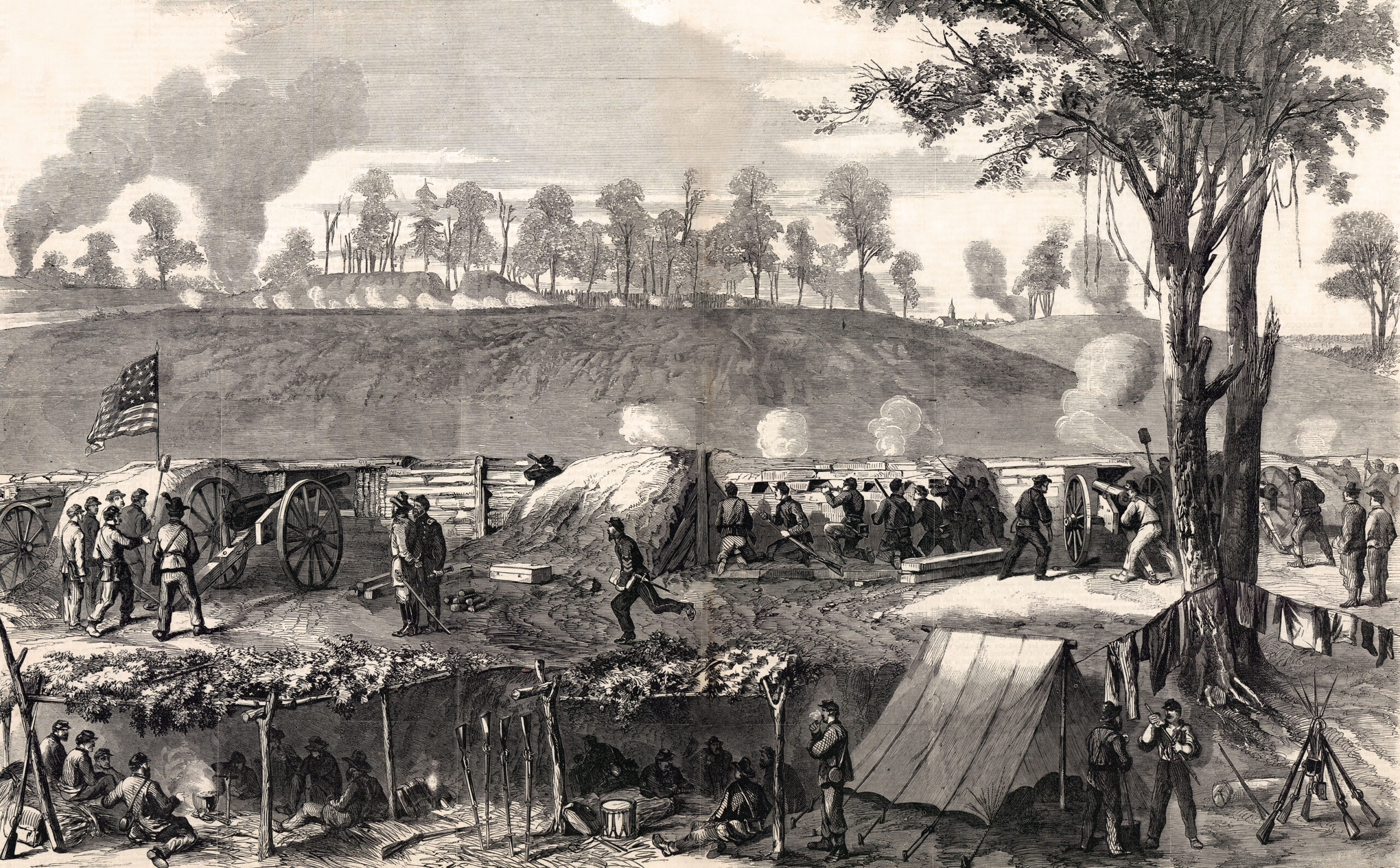
The National Park Service dates the formal siege from May 23 to July 4, 1863, after the failed assaults on May 19 and 22. This distinction matters because the entire Vicksburg campaign lasted much longer than forty-seven days. The siege itself involved surrounding the Confederate positions, cutting supply routes and advancing Union trenches toward the defenses. Gunboats also bombarded the city from the Mississippi. The objective was to make continued resistance impossible, whether through physical damage, shortage of provisions or the final threat of an overwhelming assault.
What did siege trenches accomplish?
Union soldiers dug approach trenches, protected gun positions and made efforts to advance toward selected Confederate works. Trenches reduced exposure to enemy musketry and artillery while allowing pressure to continue day after day. Mining operations threatened particular strongpoints and sometimes produced explosions, yet they did not instantly destroy the entire Confederate perimeter. This type of warfare required engineers, laborers and constant supply of tools and ammunition. Soldiers also had to keep watch, patrol, repair damage and transport casualties. The engineering struggle is a reminder that nineteenth-century battles could be decided by sustained labor rather than one heroic charge.
How did Union gunboats help?
Rear Admiral David D. Porter’s ships helped carry Union troops and materials and attacked Confederate river positions. Naval artillery could bombard the city while army batteries pressured its landward defenses. The combined operation limited the garrison’s ability to communicate or move supplies. Gunboats were also important to the broader Mississippi campaign and to the defense of Union supply bases. Yet the navy could not simply force Vicksburg to surrender independently: high bluffs, shore batteries and the need for an occupying army meant river control and land operations were inseparable parts of Grant’s plan.
What happened to civilians?
Vicksburg was a living city, not an empty military installation. Families endured bombardment, shortages and fear while Confederate soldiers occupied the defensive lines. Residents used caves dug into hillsides to shelter from shells, creating one of the siege’s most distinctive historical memories. These improvised shelters were uncomfortable and sometimes dangerous. Wealthier and poorer civilians faced different resources and choices, while enslaved people were subject to coercion within Confederate society. The human cost continued even when shells were not falling: illness, hunger, uncertainty and the disruption of businesses made ordinary life increasingly difficult.
What did the defenders eat?
Food supplies declined as Union forces prevented deliveries into the city. Defenders increasingly relied on reduced rations and substitutes, and some accounts describe horse or mule meat among desperate provisions. It is misleading to imagine that everyone consumed exactly the same diet at all times; access varied by unit, civilian household and stage of the siege. Hunger affected alertness, morale and physical health, while disease weakened many soldiers. The defenders remained capable of resisting for weeks, but Pemberton could not expect ordinary military efficiency indefinitely without substantial food and medical supplies.
Was Milliken’s Bend part of the campaign?
On June 7, 1863, Confederate troops attacked a Union supply position at Milliken’s Bend north of Vicksburg. The defenders included newly organized United States Colored Troops, many of whom had recently escaped slavery. They fought intensely, supported by Union naval gunfire, and resisted the attack. The battle mattered because it challenged racist predictions about Black soldiers’ ability to fight and helped validate their growing role in Union armies. Milliken’s Bend occurred outside the city rather than inside the siege lines, but it was directly related to Confederate attempts to disrupt Grant’s supply network.
Could Joseph E. Johnston save Vicksburg?
Confederate General Joseph E. Johnston commanded forces elsewhere in Mississippi and considered how to aid the beleaguered garrison. However, earlier Union victories and the destruction or disruption of rail connections complicated efforts to organize relief. Johnston did not break Grant’s lines. Pemberton faced the prospect of continued resistance without sufficient food, ammunition or a realistic escape route. Historians debate the Confederate command decisions, but the underlying problem was operational isolation. A defensive fortress can be formidable in a direct fight yet become vulnerable if no outside force can restore its communications.
Why did Pemberton surrender?
By early July, food shortages, exhaustion and the lack of expected relief made Pemberton’s position increasingly untenable. He met Grant on July 3 to discuss terms, and the city formally surrendered on July 4. Many Confederate soldiers were paroled under the terms rather than moved to distant prison camps. The fall of Vicksburg removed a major army and its equipment from active service. The date was symbolically powerful because it was Independence Day, although later popular claims about how long Vicksburg residents refused to celebrate July Fourth should be investigated rather than repeated without supporting evidence.
How many soldiers were surrendered?
Accounts often estimate that approximately 29,000 to 30,000 Confederate troops surrendered or were paroled, depending on categories and the rolls used. These figures should not be confused with the total killed or wounded during earlier battles in the campaign. Captured artillery and military stores added to the Union success. The scale of the surrender helps explain Vicksburg’s significance: Grant had not merely taken a temporary outpost but eliminated a fortified army from an exceptionally important river position. Yet surviving soldiers still faced uncertain futures and the difficult aftermath of disease, defeat and captivity.
What happened at Port Hudson?
Vicksburg’s surrender was followed by the fall of Port Hudson, Louisiana, on July 9, 1863. With both Confederate strongholds removed, Union forces could operate along the full length of the Mississippi River. This fulfilled one of the major objectives of the larger Union river and blockade strategy. The sequence matters: July 4 was the decisive Vicksburg date, but complete control of the river required the other position to fall. Commercial transport and military communications still needed protection and repair, yet Confederate connections across the river had been profoundly weakened.
Why was Gettysburg happening at the same time?
The Battle of Gettysburg unfolded July 1–3 in Pennsylvania, while Vicksburg’s garrison surrendered on July 4. The two events occurred in different theaters under different commanders, but together they substantially strengthened Union morale and strategic standing. Gettysburg ended Lee’s invasion of Pennsylvania; Vicksburg opened the Mississippi. They did not immediately end the war, and neither should be treated as a perfect substitute for the other. Considering both campaigns together helps explain why July 1863 is often described as a major turning point in the conflict.
What changed for Grant?
Grant’s successful campaign increased his reputation as a commander who could coordinate complex movement, exploit intelligence and change tactics when direct assaults failed. The operation integrated infantry, transport, naval cooperation and siege engineering. Its success helped support his later appointment to command Union armies in 1864. Grant was not successful simply because he possessed more soldiers: he created opportunities through maneuver and kept pressure on disconnected Confederate forces. Vicksburg also revealed the central role of logistics in the western theater, where roads, rivers and railways shaped the range of possible military decisions.
Vicksburg timeline
The campaign can be divided into the river crossing, inland battles, failed assaults and formal siege.
| Date | Event |
|---|---|
| Spring 1863 | Union crosses Mississippi and moves inland. |
| May 16 | Champion Hill. |
| May 17 | Big Black River Bridge. |
| May 19 and 22 | Failed assaults on fortifications. |
| May 23–July 4 | Formal siege of Vicksburg. |
| June 7 | Milliken’s Bend. |
| July 4 | Pemberton surrenders. |
| July 9 | Port Hudson surrenders. |
Frequently asked questions about Vicksburg
When was the siege? May 23 to July 4, 1863.
Who led the Union? Ulysses S. Grant.
Who commanded the defenders? John C. Pemberton.
Who won? The Union.
Why did it matter? It helped open the Mississippi River.
How long did it last? Forty-seven days by the park’s chronology.
Did Port Hudson surrender simultaneously? No, on July 9.
What historical sources are most useful?
The National Park Service siege history carefully distinguishes the May assaults from the siege proper. The battlefield maps and park brochure show the river crossings, Champion Hill and the final defenses. For a wider perspective, compare the campaign chronology with the preserved earthworks at Vicksburg National Military Park. These sources allow readers to connect events in the city with developments outside its walls. Different casualty figures should be checked against the type of troops and time period they count, rather than treated as interchangeable numbers.