
First Battle of Bull Run (1861): First Manassas, Jackson and the Rout
How early Union expectations met the realities of large-scale Civil War fighting.
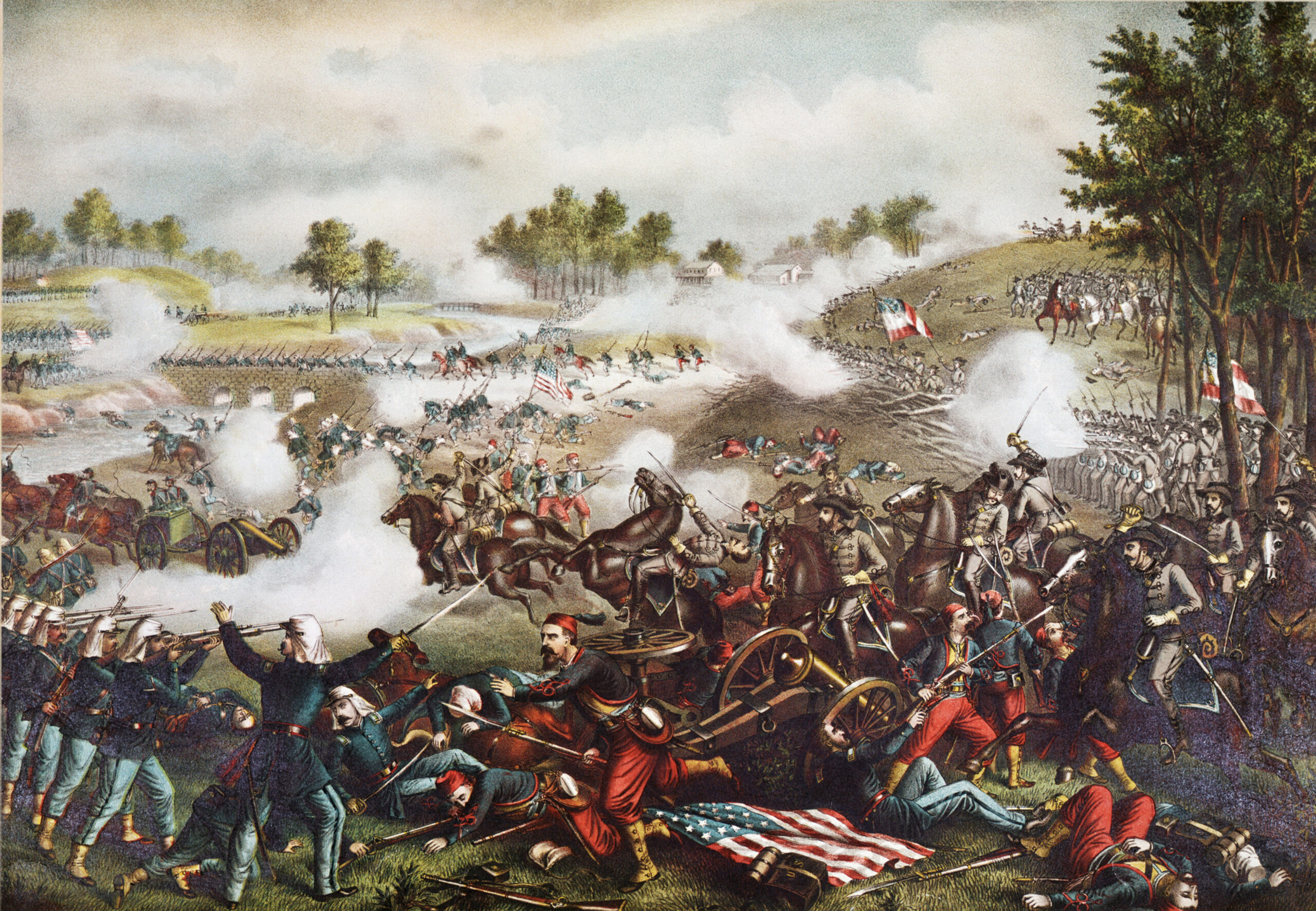
The First Battle of Bull Run, or First Manassas, was fought near Manassas, Virginia, on July 21, 1861. Union General Irvin McDowell attacked Confederate positions but was defeated after fighting on Matthews and Henry House hills. Confederate forces under Beauregard and Joseph E. Johnston rallied, and Thomas ‘Stonewall’ Jackson gained his famous nickname. The defeat ended hopes of a quick Union victory.
Study the plan, river crossings, Confederate reinforcements, Henry House Hill, civilian casualties and the retreat toward Washington.
On this page — 24 topics
What was the First Battle of Bull Run?
The First Battle of Bull Run was fought on July 21, 1861, near Manassas, Virginia, only three months after the firing at Fort Sumter began the American Civil War. A Union army commanded by Irvin McDowell attempted to defeat Confederate forces protecting the routes toward Richmond. Instead, Confederate reinforcements helped stop the advance and drive the Union army from the field.
Also called First Manassas, it was the war’s first major land battle between large armies. Its consequences were disproportionate to the geographical area fought over: both sides realized that the conflict would require more sustained mobilization, better training and far greater sacrifice than many citizens had expected.
Why are there two names for the battle?
Union writers often used the name of a nearby geographical feature, Bull Run, while Confederates frequently used the name of the nearby rail junction and settlement of Manassas. These naming practices were not universal rules, but they explain why two familiar titles describe the same July 21, 1861 engagement.
Historians distinguish it from the Second Battle of Bull Run, or Second Manassas, which occurred in August 1862 on overlapping terrain. The two battles involved different campaigns, commanders and strategic circumstances. When reading a monument or archive record, checking the year is the easiest way to avoid confusion.
Why did Union forces march toward Manassas?
After Lincoln’s call for troops, public and political pressure grew for a federal advance that might suppress the rebellion quickly. Confederate positions in northern Virginia threatened Washington, while Richmond was emerging as the Confederate capital. Irvin McDowell was directed to move against the Confederate army near Manassas Junction.
The Union army included many inexperienced volunteers whose enlistment periods, logistical systems and officers’ routines were still developing. McDowell warned that his force required more preparation. Political leaders nevertheless hoped a decisive early victory would encourage Unionists in Virginia and make further large campaigns unnecessary.
Why was Manassas Junction important?
Manassas Junction linked important railroad routes in northern Virginia. Control of those connections could help move soldiers and supplies over considerable distances. The Confederate army defended approaches to the junction, using the stream called Bull Run and surrounding terrain as part of its position.
Railroads shaped the campaign because Confederate troops under Joseph E. Johnston could travel from the Shenandoah Valley to reinforce P. G. T. Beauregard. The use of the Manassas Gap Railroad is often cited as an early example of rail transport influencing a major American military battle. That advantage required successful coordination and timely movement rather than the railway alone winning the fight.
Who commanded the Union army?
Brigadier General Irvin McDowell led the main Union field army advancing from the Washington area. He faced difficulties organizing and maneuvering a large force of volunteers with limited training. His plan aimed to turn the Confederate left flank while making a diversionary attack against the Stone Bridge.
Subordinates Daniel Tyler, David Hunter and Samuel Heintzelman directed important divisions. Moving them over unfamiliar roads before dawn proved slower and more complicated than expected. McDowell’s problem was not merely choosing a route but aligning timing, troop movements, artillery and support under battle conditions.
Who commanded the Confederates?
Brigadier General P. G. T. Beauregard initially held the defensive line near Bull Run, while Joseph E. Johnston brought reinforcements from the Shenandoah Valley. The two generals worked together to restore Confederate positions as the Union flanking attack developed.
Confederate preparations were not flawless: some troops received orders late, units moved slowly and commanders initially misjudged where the Union attack would fall. But the arrival of reinforcements and the ability to organize a new position on Henry House Hill allowed them to resist after early setbacks.
What happened at Blackburn’s Ford?
On July 18, three days before the main battle, Union troops probed Confederate positions around Blackburn’s Ford and encountered substantial resistance. The action demonstrated that forcing a direct crossing would be difficult and influenced McDowell’s search for a more favorable route around the Confederate left.
Military history often emphasizes the July 21 battle alone, but reconnaissance and earlier skirmishing mattered to the final plan. Intelligence about ford locations was imperfect, and movements required more time than commanders expected. The engagement helped convince McDowell that a broad flanking approach was preferable to a simple frontal assault.
How did the Union attack begin?
Union forces started moving during the night and early morning of July 21. Tyler’s troops approached the Stone Bridge as a diversion, while Hunter’s and Heintzelman’s divisions followed a longer route toward Sudley Ford. Delays caused by narrow roads and the slow passage of units meant the flanking force arrived later than intended.
The Confederate defenders nevertheless faced real danger when Union troops advanced onto Matthews Hill. Early fighting pushed back southern units, creating a moment in which a faster coordinated Union movement might have achieved more. Instead, both sides moved reserves toward Henry House Hill, where the battle would be decided.
What happened on Matthews Hill?
Union troops attacked Confederate brigades on Matthews Hill, forcing a gradual southern retreat toward Henry Hill. The fighting was intense, and both sides struggled to maintain orderly lines as units entered the battle. The Confederate withdrawal created concern among officers attempting to establish a new position.
This phase is essential to understanding why the Confederate victory was not inevitable. The Union plan achieved a degree of tactical success, but its execution was slow, and fresh Confederate formations were arriving. The battle’s momentum changed as retreating troops were reorganized around artillery and infantry on the higher ground.
Who was Stonewall Jackson?
Thomas J. Jackson was a Virginia officer whose brigade became prominent during the defense of Henry House Hill. General Barnard Bee is traditionally credited with the remark comparing Jackson to a stone wall, helping establish his enduring nickname. The exact wording, tone and circumstances remain debated by historians.
Jackson’s soldiers helped stabilize the Confederate position while Union forces attacked. His later reputation as an aggressive commander should not obscure the role of other officers and units at First Manassas. The National Park Service battle narrative explains the brigade’s placement and the formation of the legend.
What happened at the Henry House?
The Henry family farmhouse stood near important fighting on Henry House Hill. Union artillery fired toward the building during efforts to engage Confederate batteries and infantry. Judith Carter Henry, an elderly civilian who remained in the house, was mortally wounded.
Her death illustrates the civilian consequences of battles fought around farms and homes. The house later became a significant landmark in the battlefield’s preservation and interpretation. Popular accounts sometimes focus on famous generals while neglecting civilians who had limited capacity to escape the fighting. Her story provides an important corrective.
Why did the Union artillery struggle?
Union artillery batteries under James Ricketts and Charles Griffin moved into exposed positions on Henry House Hill. Confederate infantry and batteries fired heavily against them. At one critical moment, confusion about the identity of approaching troops contributed to the loss of Union guns.
The battle shows how artillery depended on timely infantry protection and accurate recognition of friendly formations. An apparently advantageous gun position could become dangerous when soldiers advanced or retreated around it. The National Park Service’s Henry Hill account describes the rapid changes in possession and control of the batteries.
Did civilians watch the battle like a picnic?
A popular story claims that fashionable Washington residents gathered for a picnic to watch a short, entertaining battle. Some civilians, journalists and political figures did travel toward the fighting, but the notion of a huge organized picnic crowd is an exaggerated shorthand for the early war’s misplaced expectations.
Treating the scene as comic also risks trivializing the dead and wounded. The real historical issue is that many people did not yet understand the likely scale and duration of the war. News of defeat and retreat made the conflict’s seriousness harder to ignore in the Union capital.
Why did Confederate reinforcements matter?
Johnston’s troops arrived from the Shenandoah Valley by railroad and took part in the Confederate effort to hold and later counterattack. More soldiers reached the battlefield as Union divisions became engaged, changing the relative strength and organization of the opposing lines.
Reinforcements mattered only because commanders succeeded in putting them into useful positions at the appropriate time. Some troops were delayed or confused, while others helped stabilize the fight on Henry Hill. The presence of reinforcements exposed the Union failure to prevent Johnston from joining Beauregard.
How did the Confederate counterattack develop?
As Union units struggled around Henry House Hill, Confederate forces regrouped and eventually pressed forward. Additional brigades entered the battle, while exhausted Union troops could no longer sustain their offensive. The balance of morale and organization shifted, and American federal forces began falling back.
A retreat under pressure can rapidly become disordered when wagons and troops compete for roads. The problem was intensified by fatigue, inexperienced units and difficulty communicating orders. The Confederate victory emerged through a succession of local successes rather than one perfectly synchronized army-wide charge.
Why did the Union retreat become chaotic?
Many Union soldiers began withdrawing toward Centreville and Washington as Confederate counterattacks gathered strength. Narrow roads, civilian vehicles, disabled equipment and frightened troops created traffic jams and disorder. Some units withdrew in relatively good order while others lost cohesion.
The familiar phrase ‘the rout to Washington’ captures the panic but should not imply that every Union regiment abandoned discipline at the same instant. The army suffered a decisive defeat and needed reorganization, yet many soldiers eventually returned to service. The larger lesson was the challenge of coordinating a modern mass army.
How many soldiers fought and were casualties?
The armies together involved many tens of thousands of troops, though not every soldier near the battlefield entered direct combat. Estimates commonly place Union battle losses at around 2,900 and Confederate losses near 2,000, counting killed, wounded and missing or captured personnel.
Casualties are not the same as deaths. Newspaper reports and later summaries sometimes blur the categories, especially in a battle with disordered retreat and incomplete initial returns. Historical comparisons should use the same categories and identify the source of figures rather than combining approximate numbers as though they were a modern audited census.
What did Bull Run change?
The Confederate victory encouraged supporters of secession and shocked many people in the North who expected a short war. Lincoln and military leaders undertook further training, recruitment and reorganization. George B. McClellan soon assumed a prominent command and developed the Army of the Potomac.
The fighting also exposed the difficulty of using inexperienced volunteers and the growing importance of rail transportation, reconnaissance and battle coordination. Its immediate strategic result was a Confederate victory, but it did not force the Union government to abandon the war. Instead both sides prepared for a much longer conflict.
How did it compare with Second Bull Run?
First Bull Run in July 1861 was the early war’s first major land clash. Second Bull Run in late August 1862 was fought during a different campaign, with Robert E. Lee directing Confederate operations against John Pope’s Union army. Although the terrain overlapped, the armies and political circumstances had changed substantially.
Confusing the two battles can distort casualty totals and famous commander stories. Jackson’s nickname originated with the 1861 battle, while the 1862 engagement belonged to the campaigns preceding Antietam. The year and Union commander should be checked whenever a source uses only ‘Manassas’ or ‘Bull Run.’
First Bull Run timeline
The key events show how a Union flanking plan became an American federal defeat within one long July day.
| Date | Development |
|---|---|
| Apr 12, 1861 | Fort Sumter attack begins war. |
| Jul 16 | McDowell advances into Virginia. |
| Jul 18 | Fighting at Blackburn’s Ford. |
| Jul 21 morning | Union attack advances via Sudley Ford. |
| Jul 21 midday | Fighting shifts from Matthews to Henry Hill. |
| Jul 21 afternoon | Confederates hold and counterattack; Union retreats. |
| Aug 1861 | Union reorganizes and expands army. |
Frequently asked questions about First Manassas
When was it fought? July 21, 1861.
Who won? Confederate forces.
Who commanded the Union? Irvin McDowell.
Who were the main Confederate commanders? Beauregard and Joseph E. Johnston.
Why two names? Bull Run was the stream; Manassas was the nearby rail junction.
Where did Jackson earn his nickname? During the defense of Henry House Hill.
Where can readers verify the battle?
The Manassas National Battlefield Park narrative provides a time-based chronology and detail about Matthews Hill, Henry Hill, Jackson and the Union artillery. The U.S. Army chronology confirms the principal dates, while the Library of Congress historical print illustrates how the battle was remembered by contemporaries.
Use the park’s battlefield maps to follow the flanking columns. Distinguish a later artwork showing dramatic action from an eyewitness account. The collision of confusing reports, new volunteers and different commanders makes Bull Run especially useful for learning why battles rarely unfold according to plans.



