Battle of Midway (June 1942): Four Japanese Carriers Lost and the U.S. Navy Victory
How U.S. codebreaking and carrier aviation defeated Japan near Midway in June 1942, sinking four Japanese carriers while losing USS Yorktown.
Quick answer
The Battle of Midway was fought on June 4–7, 1942, around Midway Atoll in the central Pacific. American naval forces under Admirals Chester Nimitz, Frank Jack Fletcher and Raymond Spruance opposed a Japanese operation led by Admiral Isoroku Yamamoto. U.S. intelligence helped anticipate the attack, and carrier-based aircraft sank four Japanese fleet carriers—Akagi, Kaga, Sōryū and Hiryū. The United States lost the carrier USS Yorktown and destroyer USS Hammann. The victory disrupted Japan’s offensive plans but did not end the Pacific War.
Key facts
On this page
- Why Japan targeted Midway Atoll
- How U.S. codebreaking changed the preparations
- The aftermath of the Battle of the Coral Sea
- The opposing carriers and commanders
- The Japanese air strike on Midway on June 4
- American torpedo attacks and severe losses
- The devastating U.S. dive-bomber attack
- The attacks on USS Yorktown
- How Hiryū and the remaining Japanese force were defeated
- The losses and strategic consequences
- The historical legacy of intelligence and carrier warfare
- Timeline
- FAQs
- Sources
Why Japan targeted Midway Atoll
After the attack on Pearl Harbor, Japan expanded its control across the western Pacific and Southeast Asia. Its navy sought to weaken American carrier forces, which had survived the destruction at Pearl Harbor because they were away from the harbor on December 7. Japanese planners hoped an attack on Midway Atoll would draw the U.S. Pacific Fleet into a decisive battle under conditions advantageous to Japan.
Midway was a small but strategically positioned American-held atoll northwest of Hawaii. Its airfields and location made it important to reconnaissance and defense across the central Pacific. Japanese forces planned an elaborate operation involving carriers, an invasion force and supporting warships. The design depended partly on surprise and the assumption that American commanders would react after Japan had already gained the initiative.
How U.S. codebreaking changed the preparations
American cryptanalysts had made progress reading parts of Japanese naval communications and identifying operational patterns. Intelligence officers believed that a target referred to as AF was Midway, and evidence from messages and analysis helped confirm that judgment. The intelligence was not a perfect transcript of every Japanese order, but it allowed Admiral Chester W. Nimitz to position carriers with greater knowledge of the likely enemy approach.
The famous story about Midway transmitting a false message about its freshwater supply captures one aspect of the intelligence effort, but the larger success depended on months of signals analysis and interpretation. The Navy’s historical account emphasizes that codebreaking supported operational decisions without removing uncertainty. American commanders still had to deploy scarce ships and aircraft and take serious risks if the anticipated enemy formation appeared.
The aftermath of the Battle of the Coral Sea
In May 1942 American and Japanese naval forces fought the Battle of the Coral Sea, a carrier engagement in which opposing fleets exchanged air strikes without their main surface ships directly meeting. The United States lost USS Lexington and Yorktown was damaged. Japanese losses and damage prevented important carriers from taking part at Midway, changing the forces available for the June operation.
American repair crews at Pearl Harbor worked rapidly to return Yorktown to service. That recovery strengthened Nimitz’s ability to commit three carriers rather than only Enterprise and Hornet. The Coral Sea battle demonstrated that aircraft carriers were central to naval warfare and could inflict decisive damage across long distances. It also showed how operational readiness could depend on repairs and logistics carried out far from the eventual battlefield.
The opposing carriers and commanders
American carrier forces included USS Enterprise and USS Hornet under Rear Admiral Raymond Spruance and USS Yorktown under Rear Admiral Frank Jack Fletcher, who exercised overall tactical command. Japanese carrier forces under Vice Admiral Chūichi Nagumo included Akagi, Kaga, Sōryū and Hiryū. Admiral Isoroku Yamamoto directed the wider Japanese operation from forces positioned farther from the central carrier engagement.
Each side also relied on reconnaissance aircraft, submarines, surface escorts and land-based support. Counting only the carriers would obscure the logistical and intelligence work that enabled the battle. Midway-based planes attempted attacks despite severe risks, while Japanese pilots had trained extensively for coordinated carrier operations. The outcome cannot be explained simply by a presumed one-to-one comparison of aircraft quality or by portraying one commander as incapable of making tactical decisions.
The Japanese air strike on Midway on June 4
Japanese aircraft struck Midway early on June 4, causing damage but failing to put the American defenses permanently out of action. Marine and Navy aircraft attempted to intercept the raiders, suffering heavy losses. The Japanese commanders considered whether another strike on the island would be necessary, a decision that interacted with changing information about American ships operating nearby.
The timing of aircraft rearming, refueling and landing has become the subject of extensive historical study. Simplified popular accounts sometimes depict all Japanese decks as lined with fueled bombers at one perfectly fixed moment. Modern research presents a more complicated picture involving hangars, aircraft handling and separate strike groups. What matters is that the Japanese force had to manage competing demands while American aircraft were converging.
American torpedo attacks and severe losses
U.S. torpedo squadrons from the carriers attacked Japanese ships under extremely dangerous conditions. Many aircraft were slow, carried unreliable torpedoes and faced defending fighters and anti-aircraft fire. The attacks inflicted little direct damage on the Japanese carriers but cost many American aviators their lives. The fate of Torpedo Squadron Eight from Hornet became especially well known because of the extremely high casualties.
It is inaccurate to reduce those missions solely to a deliberate sacrifice designed to lure fighters away so later dive bombers could strike. Air groups arrived at different times because of reconnaissance and navigation problems, and their coordination was imperfect. Nevertheless the repeated attacks forced Japanese defenders to respond and added pressure during a rapidly changing battle. An accurate account honors the crews without inventing a precise tactical script that every participant understood.
The devastating U.S. dive-bomber attack
Late in the morning of June 4, carrier-based SBD Dauntless dive bombers found Nagumo’s carriers. Aircraft from Enterprise and Yorktown struck with devastating effect, leaving Akagi, Kaga and Sōryū fatally damaged. Fires and explosions spread aboard ships containing fuel, ammunition and aircraft. The speed of the losses transformed the balance of the battle in a matter of minutes.
These strikes were not the end of Japanese resistance. Hiryū remained operational and launched attacks against Yorktown. Nor did all three carriers necessarily sink immediately when bombed; damage-control efforts, evacuations and final sinking occurred over time. The distinction between a carrier being hit, rendered inoperable and finally sunk explains why chronological narratives can differ in wording while agreeing on the ultimate losses.
The attacks on USS Yorktown
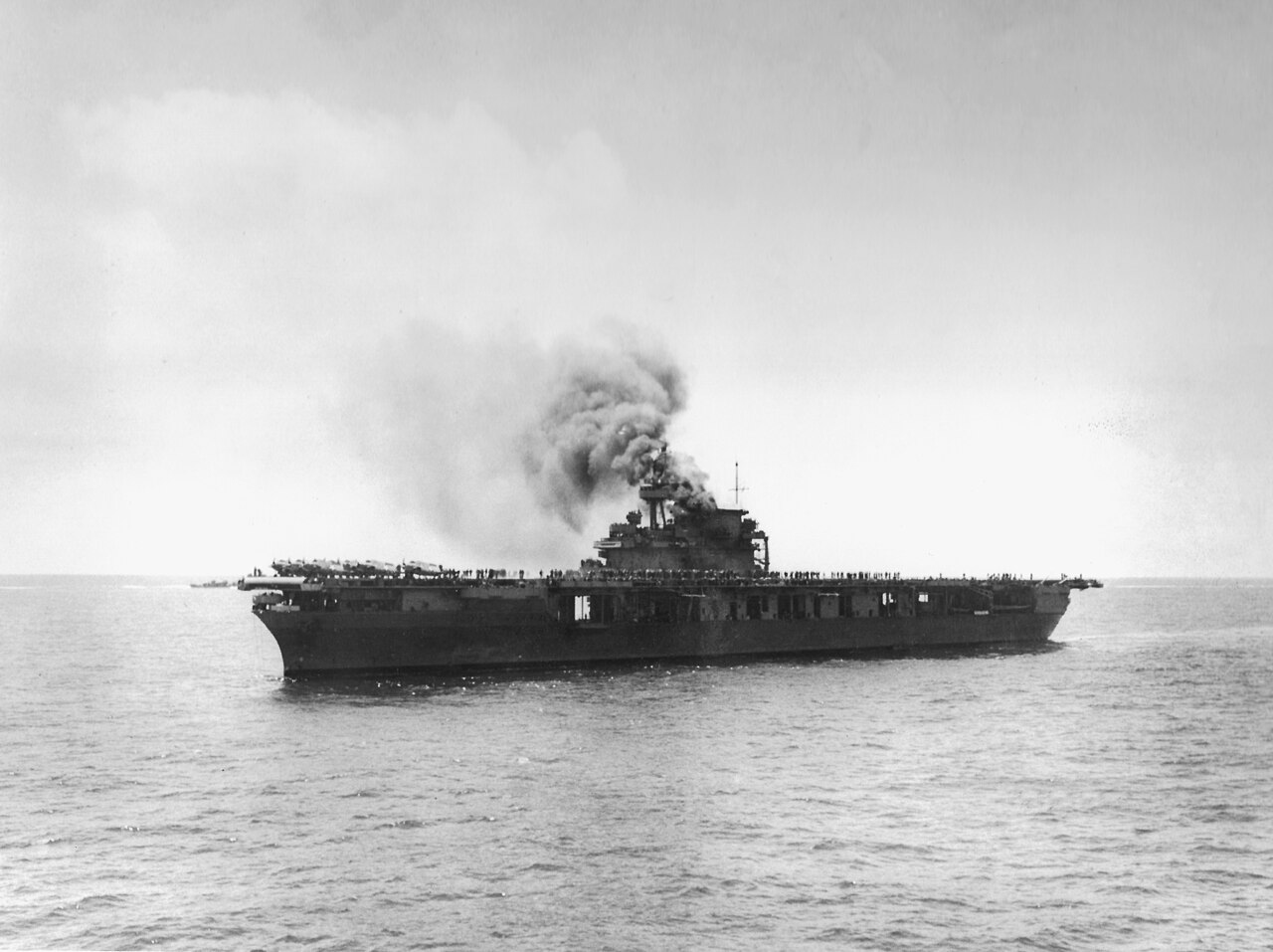
Japanese aircraft from Hiryū found Yorktown and struck it with bombs and torpedoes on June 4. American damage-control crews fought fires, restored power where possible and attempted to save the carrier. The featured Navy photograph records smoke from the Japanese attack and shows the ship before its eventual sinking. Sailors continued trying to preserve a vessel whose loss was not inevitable at the first bomb hit.
After the main June 4 engagements, a salvage operation attempted to recover Yorktown. On June 6 the Japanese submarine I-168 torpedoed the carrier and the destroyer USS Hammann, which was assisting. Hammann sank, and Yorktown finally rolled over and sank on June 7. A popular statement that the carrier simply sank on the morning of June 4 compresses several days of fighting and salvage operations into an inaccurate chronology.
How Hiryū and the remaining Japanese force were defeated
American aircraft located Hiryū later on June 4 and delivered strikes that left the carrier burning and disabled. Its loss brought the Japanese total to four fleet carriers, eliminating much of the strike capability committed to the Midway operation. Admiral Yamamoto eventually abandoned the invasion plan and ordered withdrawal. Fighting continued around other Japanese ships, including a subsequent American attack on the heavy cruiser Mikuma.
The battle included actions on June 3 and continued through June 7, so different official narratives sometimes describe the main carrier fight as June 4 or use a June 4–7 date range. The full campaign chronology includes reconnaissance, fleet movement, carrier air battles and later sinkings. The Navy’s official histories are useful for distinguishing these stages rather than treating Midway as a single air strike.
The losses and strategic consequences
Japan lost Akagi, Kaga, Sōryū and Hiryū along with many trained aviators and experienced sailors. The United States lost Yorktown and Hammann and sustained heavy aircraft losses. The victory disrupted Japan’s plan to seize Midway and engage the American carrier fleet on favorable terms. It also weakened Japan’s ability to support further offensive operations while American shipbuilding and training were expanding.
The battle is often called a turning point in the Pacific War. That label is defensible when tied to the change in strategic momentum, but it should not imply that Japan had lost the war by June 7 or that the United States could immediately advance to Japan. Difficult campaigns, including Guadalcanal, still lay ahead. Japan retained powerful naval and land forces, and a long conflict continued across Asia and the Pacific.
The historical legacy of intelligence and carrier warfare
Midway revealed how intelligence, aviation and ship repair could combine to change the course of a major naval battle. American cryptanalysts helped identify an enemy objective, Nimitz positioned scarce carriers, and aviators delivered attacks that destroyed the Japanese carrier force. Equally important were damage-control workers, mechanics and sailors whose actions are less prominent in popular narratives.
The battle also illustrates the dangers of retrospective certainty. Historians continue to debate Japanese decisions, aircraft timing and the weight of individual factors, but the core record of the carrier losses and American victory is clear. Reading the Navy’s operational accounts alongside the Doolittle Raid shows how the early 1942 Pacific War moved from demonstrations of American striking power to a decisive fleet engagement.
Timeline
- December 1941: Pearl Harbor attack; American carriers survive
- May 7–8, 1942: Battle of Coral Sea
- Late May: U.S. intelligence and repairs prepare Midway defense
- June 3, 1942: Initial reconnaissance and air attacks
- June 4: Major carrier battle; Akagi, Kaga and Sōryū disabled
- June 4 afternoon: Hiryū disabled; Yorktown badly damaged
- June 6: Mikuma struck; I-168 torpedoes Yorktown and Hammann
- June 7: Yorktown sinks
Frequently asked questions
When was the Battle of Midway?
The major fighting occurred June 4–7, 1942, with preliminary actions on June 3.
Where was it fought?
Near Midway Atoll in the central Pacific.
How many Japanese carriers were lost?
Four: Akagi, Kaga, Sōryū and Hiryū.
Which American carrier sank?
USS Yorktown, finally sinking on June 7 after earlier air damage and submarine torpedoes.
Why was codebreaking important?
It helped U.S. commanders anticipate Japan’s objective and position carriers before the attack.
Was Midway the end of the Pacific War?
No. It changed strategic momentum, but fighting continued for more than three years.
Who commanded American carrier forces?
Frank Jack Fletcher and Raymond Spruance, under Pacific Fleet commander Chester W. Nimitz.