Interstate Commerce Act of 1887: Railroad Rates and the ICC Explained
Why Congress intervened in railroad rates and what authority the first ICC actually possessed.
Passed on February 4, 1887, the Interstate Commerce Act required just and reasonable interstate railroad rates, prohibited certain discriminatory practices and created the five-member Interstate Commerce Commission. The original ICC had limited enforcement authority; later laws expanded its powers.
This guide explains the law’s original provisions, constitutional background and subsequent amendments without confusing the ICC of 1887 with later regulators.
On this page — 22 topics
What was the Interstate Commerce Act of 1887?
The Interstate Commerce Act was a federal law enacted on February 4, 1887, to regulate important aspects of railroad transportation between states. It required reasonable and just rates and attempted to prevent unfair discrimination among shippers and passengers. It also created the five-member Interstate Commerce Commission, usually abbreviated ICC, to investigate complaints and oversee compliance. The statute was a landmark in federal economic regulation because the national government established an agency focused on a major private industry. It did not nationalize railroads, set every railroad fare itself or end all abuses immediately. Understanding both its ambitious principles and weak early enforcement is essential.
Why did Congress regulate railroads?
By the 1880s railroads connected farms, factories, ports and cities across the nation. Their growth helped create national markets, but people in towns served by only one carrier could find themselves paying much higher freight rates than larger shippers with competing transportation options. Farmers and small businesses complained about secret rebates, unstable charges and the economic power of railroad corporations. The first transcontinental railroad illustrated how much public land and government support had gone into expanding the network. Federal lawmakers faced growing pressure to make companies that handled interstate commerce answerable to rules beyond those set by individual states.
What problem did small farmers face?
A farmer sending grain from a rural station might depend on a single railway and have little bargaining power. A large industrial shipper, by contrast, might be able to negotiate a discount by promising substantial volumes of business or threatening to use a competing line. These different conditions sometimes produced prices that appeared unrelated to distance or cost. A short journey could be more expensive than a longer one over the same track. Such disputes became politically important because transportation charges affected crop prices, farm income and the prospects of small towns. The law sought to limit unjust discrimination rather than guarantee identical rates for every shipment regardless of circumstances.
How did the Granger movement influence regulation?
The Granger movement began as a rural organization promoting farming interests and community education and became involved in campaigns for fairer railroad and grain-storage practices. Several Midwestern states enacted laws regulating transport rates during the 1870s. In Munn v. Illinois (1877), the Supreme Court upheld certain state regulation of businesses affected with a public interest, though later rulings narrowed how far states could reach across borders. The movement helped turn complaints about railroad pricing into a major public policy issue. State laws provided early models but could not offer one consistent answer for a network that carried goods across state boundaries every day.
Why was Wabash v. Illinois important?
The Supreme Court’s decision in Wabash, St. Louis & Pacific Railway Co. v. Illinois in 1886 limited the ability of a state to regulate railroad traffic extending beyond its borders. The ruling highlighted the constitutional role of Congress in overseeing interstate trade. It did not mean every state railroad rule was immediately invalid, but it exposed a gap in the existing regulatory system. National companies could operate across many jurisdictions while individual states lacked sufficient authority over through shipments. The Interstate Commerce Act followed soon afterward and used Congress’s Commerce Clause powers to establish uniform federal principles for a significant category of transportation.
When was the act signed, and by whom?
President Grover Cleveland signed the Interstate Commerce Act on February 4, 1887, after Congress passed the legislation. The measure reflected years of public disputes over railway power rather than a sudden presidential initiative. Members of Congress debated how to balance competition, reliable transportation and the claims of smaller shippers. Some railroad interests supported a national framework because it could replace inconsistent state requirements, while others opposed interference with pricing. The statute’s title was an Act to Regulate Commerce, and its text is preserved by the National Archives. Dates in historical articles should refer to the 1887 enactment rather than later amendments that expanded the commission’s authority.
What rates were considered just and reasonable?
The statute required charges for covered interstate transport to be just and reasonable. This established a federal principle but did not provide a simple mathematical formula for the correct price of moving one ton of wheat or one passenger. Whether a rate was unlawful could depend on evidence about distance, competition, services and conditions. The commission investigated complaints and developed interpretations through its decisions. The term reasonable gave regulators a basis for examining excessive charges without guaranteeing every shipper the lowest available fare. Railroad managers and customers continued to argue about how the rule should apply in individual cases.
What were railroad rebates?
A rebate was a discount or return of money that could allow one customer to pay less than another for comparable transportation. Secret arrangements were particularly controversial when powerful companies received favorable treatment at the expense of smaller competitors. The act prohibited unjust discrimination and certain devices used to create unequal charges under substantially similar conditions. Not every difference in rates was illegal; the law focused on discriminatory practices rather than universal price uniformity. The distinction matters because carriers transported diverse goods over different routes. Prohibiting hidden preference helped establish the principle that public transportation services should follow published and broadly applicable terms.
What was the long-haul versus short-haul rule?
One of the best-known provisions generally restricted railroads from charging more for a shorter journey than for a longer journey over the same line in the same direction under substantially similar circumstances and conditions. The rule responded to complaints from local communities lacking transportation competition. It contained qualifications and allowed the commission to grant relief in certain circumstances. It should therefore not be summarized as an absolute ban on every fare difference involving distance. The controversy showed how railroads sometimes used competitive pricing at major terminals while imposing heavy charges on intermediate stations. Interpreting the provision required attention to actual routes and commercial conditions.
Did the act prohibit railroad pooling?
The original statute restricted pooling arrangements in which competing railroads divided traffic, earnings or business among themselves. Such agreements could reduce pressure to compete on price or service and had been controversial for years. The goal was to discourage collusion while maintaining a stable transportation network. Yet outright prohibition also created new challenges because aggressive competition could produce rate wars and financial instability. The act represented a political compromise among people who wanted lower prices, those concerned about monopoly and those seeking predictable service. Its provisions did not settle the debate over whether cooperation or competition best served freight shippers and the wider economy.
What was the Interstate Commerce Commission?
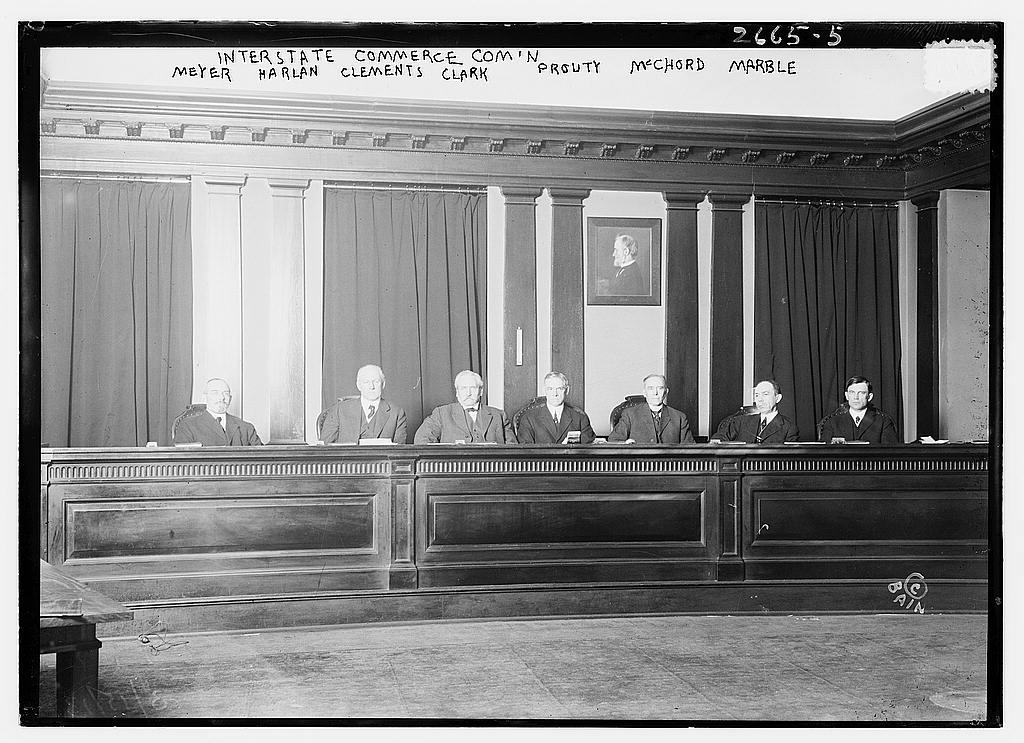
The Interstate Commerce Commission was a five-member federal commission established by the act to investigate transportation practices and hear complaints. It became one of the country’s most important early independent regulatory institutions. Commissioners gathered evidence, interpreted statutory rules and issued reports and decisions. Its existence made regulation more continuous than occasional congressional investigations. However, the first ICC had limited ability to enforce its rulings, and courts frequently reviewed or constrained its interpretations. Calling the commission an immediate all-powerful regulator would exaggerate the 1887 system. Its importance lies partly in the model it created for later permanent federal supervision of industries.
Could the ICC set prices in 1887?
The ICC’s initial authority was weaker than later powers associated with railroad regulation. It could investigate, gather information and judge compliance, but its ability to impose effective rate changes was sharply constrained by the statute and subsequent court decisions. This made enforcement uneven and sometimes slow. Later federal laws expanded its responsibilities, including stronger authority over rates. An article that credits the original commission with comprehensive price-setting power confuses the situation in 1887 with reforms enacted years afterward. The distinction helps explain why many farmers and reformers remained dissatisfied despite winning the principle that interstate railway charges could be regulated federally.
What did the law require railroads to publish?
Carriers were expected to make schedules of rates and charges publicly available and comply with the rules governing their changes. Transparency was intended to make secret favoritism harder to conceal and to give customers a clearer basis for comparing charges. Written schedules also created records that investigators could examine. The requirement did not mean every customer could easily understand a complex tariff book or that companies stopped seeking loopholes. The freight rate for a route depended on classifications, destinations and other technical factors. Nonetheless, publishing information was a meaningful step toward the later regulatory idea that essential services should operate under disclosed terms.
How did companies react?
Railroads varied in their responses. Some preferred federal standards to a patchwork of state regulation, while others resisted restrictions on rates or commercial arrangements. Carriers challenged interpretations before courts, modified pricing systems and lobbied for changes. Large companies could devote resources to legal disputes that smaller shippers could not readily afford. The relationship between corporations and the ICC was therefore complicated rather than a simple struggle between a united industry and a united public. Regulatory systems depend on information and enforcement capacity, and companies often possess detailed operational knowledge that can shape how laws are administered. Those issues became evident early in the commission’s history.
Why was early enforcement difficult?
The act’s language required interpretation, and the commission lacked some powers later considered essential for effective regulation. Courts could overturn or narrow agency decisions, while discriminatory arrangements might be difficult to prove. Railway networks included numerous routes, rate classifications and commercial agreements, making fact-finding laborious. The government also had to balance protection against abuse with a concern that unreasonable restrictions could weaken transportation investment. Reformers expected significant changes, but the first decade exposed institutional limits. That did not make the act irrelevant: it established principles and an agency that later legislators could strengthen rather than creating an entirely new system from scratch.
What changed under the Hepburn Act of 1906?
The Hepburn Act strengthened federal railroad regulation by expanding the ICC’s authority to set maximum rates and by adding other powers involving carrier practices. It reflected dissatisfaction with the weak reach of earlier legislation and broader Progressive Era concerns about corporate influence. The 1906 amendments were significant precisely because the 1887 law had not given the commission equivalent authority. The growing regulatory framework applied to additional transportation practices and industries over time. Readers should distinguish the two dates: 1887 marked the creation of the ICC, while 1906 brought stronger rate-making powers. Both were part of a gradual process rather than one fully formed regulatory system.
How did later federal regulation change?
Congress continued revising interstate transport law during the twentieth century, expanding the ICC’s scope and later reducing parts of economic regulation. Motor carriers and other industries eventually fell within its jurisdiction under separate statutes. By the late twentieth century policymakers increasingly emphasized competition and deregulation in some transport markets. The ICC itself was abolished under the ICC Termination Act of 1995, with many remaining functions transferred to the Surface Transportation Board beginning in 1996. That history does not mean the original law was repealed without consequences. The broader principle of federal oversight of interstate carriers persisted through new institutions and legal arrangements.
How is the law related to monopolies?
Railroads sometimes exercised substantial market power even without owning every line in a region. High construction costs and control over essential routes made competition difficult in isolated places. The Interstate Commerce Act sought to regulate discriminatory practices, while later measures such as the Sherman Antitrust Act of 1890 approached restraints of trade and monopolization through different legal mechanisms. Regulation and antitrust law were related responses to industrial concentration but were not identical. An ICC rate complaint differed from a lawsuit alleging an unlawful trust. Understanding this distinction prevents readers from treating every Gilded Age business reform as though it used the same legal theory or enforcement method.
Why does the Interstate Commerce Act matter today?
The 1887 statute established the federal expectation that important private transport networks could be subject to public rules about fairness and discrimination. It created a permanent commission that collected evidence and influenced national economic policy for more than a century. The act also demonstrated the limits of simply declaring rates reasonable without giving an agency strong enforcement powers. Its history helps explain later debates about regulatory agencies, competition and the relationship between business and government. Studying the original text alongside subsequent amendments shows how institutional authority can evolve. The act is a foundation of modern administrative regulation, not proof that every complaint about powerful corporations had been solved in 1887.
Timeline
| Date | Development |
|---|---|
| 1870s | State Granger laws regulate certain railroad rates. |
| 1886 | Wabash Supreme Court decision limits state authority over interstate routes. |
| February 4, 1887 | Interstate Commerce Act enacted and ICC established. |
| 1906 | Hepburn Act strengthens ICC rate authority. |
| 1995–1996 | ICC abolished; remaining functions assigned to new institutions. |