Bracero Program (1942–1964): Mexican Farmworkers, Contracts and Legacy
How the 1942 U.S.–Mexico Bracero Program recruited seasonal workers, why its contracts were disputed, and what 4.6 million agreements actually means.
Quick answer
The Bracero Program began with a U.S.–Mexico labor agreement on August 4, 1942, to address wartime agricultural and railroad labor shortages. It continued, mainly in agriculture, until 1964. Roughly 4.6 million contracts were issued during its existence, but this figure counts contracts, not 4.6 million distinct people; many workers returned repeatedly. The program promised wages and certain conditions while exposing workers to discrimination, exploitation and disputed deductions. Its economic and social legacy continues to shape the history of Mexican migration and U.S. farm labor.
Key facts
On this page
- Why U.S. farms experienced labor shortages
- The August 4, 1942 U.S.–Mexico agreement
- What the term bracero meant
- How workers were recruited and transported
- What the contracts promised on wages and housing
- The role of railroads and agriculture
- Why 4.6 million does not mean 4.6 million people
- Discrimination, labor rights and unequal bargaining power
- Withheld wages and later compensation disputes
- How the program continued after World War II
- The end of the Bracero Program in 1964
- The Bracero Program’s enduring historical importance
- Timeline
- FAQs
- Sources
Why U.S. farms experienced labor shortages
American participation in World War II changed the supply of workers available for agriculture. Military recruitment, defense factories and urban employment drew many men away from rural jobs. Farmers still had to cultivate and harvest crops, often within short seasonal windows when the loss of workers could leave food uncollected. Agricultural employers sought new labor sources, while government officials worried about maintaining sufficient food production for civilians and armed forces.
The perceived shortage did not mean every existing U.S. farmworker was employed at fair wages or that all employers exhausted opportunities to improve local conditions. Some workers challenged the low pay and harsh circumstances common in agricultural labor. The debate over importing temporary workers therefore involved both genuine wartime disruptions and the preferences of growers seeking reliable, flexible labor. The Bracero Program emerged from those competing pressures.
The August 4, 1942 U.S.–Mexico agreement
Officials of the United States and Mexico reached a bilateral agreement on August 4, 1942, establishing a program for recruiting Mexican workers for temporary employment north of the border. Mexican authorities were concerned that workers might face abuses previously associated with migration to the United States. The governments negotiated formal protections regarding wages, housing, transport and employment conditions, though the details changed over time.
The arrangement was not unilateral American permission for every Mexican citizen to enter and choose any job. It involved recruitment, contracts and administrative oversight by both governments. Workers entered through designated channels and were generally expected to return home after completing terms. The Smithsonian’s Bracero Program exhibition describes both the opportunities and the difficulties created by a labor system dependent on employer and government control.
What the term bracero meant
The Spanish term bracero refers to a laborer working with their arms, an appropriate description of much manual farm work. In the context of the bilateral program, braceros were Mexican workers recruited under contracts for approved employment in the United States. The program was not the same as all Mexican immigration or the experience of every Mexican American laborer already living in the country.
This distinction is important because U.S. communities included citizens of Mexican ancestry, earlier immigrants and workers who migrated outside formal contracts. Their legal situations and economic interests could differ. Some established farmworkers feared that contracted labor would undermine wages or collective bargaining, while others supported relatives or participated in the program. The history of braceros must be connected to wider Mexican American life without treating everyone as belonging to one labor category.
How workers were recruited and transported
Prospective workers generally applied through channels established by the Mexican and U.S. authorities. Applicants could undergo health checks, paperwork and selection before traveling to farms or railroad employers. The journeys involved trains, processing stations and sometimes long separations from home. Individual destinations depended on contract arrangements rather than unrestricted worker choice.
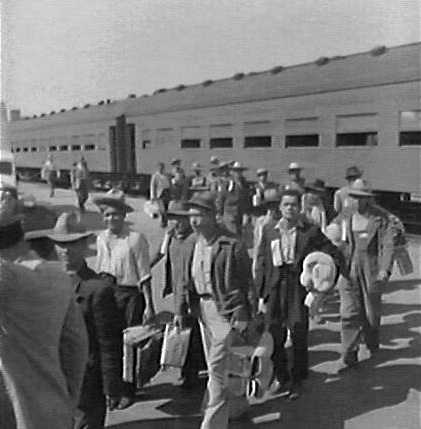
Dorothea Lange’s 1942 photograph accompanying this article shows an early group arriving by train in Los Angeles. It documents actual labor migration at the beginning of the program, not an imagined reconstruction. The bags and clothing in the image also remind us that temporary migration was a personal decision affecting families. Government agreements produced paperwork, but the experience of leaving home, finding work and returning was lived by individuals with different expectations.
What the contracts promised on wages and housing
Agreements contained protections concerning wages, approved employment, housing and transportation, along with obligations on recruiters and employers. Mexican negotiators wanted assurances that workers would not simply be abandoned at the border or subjected to discriminatory treatment. On paper, contracts were intended to make temporary labor migration more orderly than uncontrolled recruitment through private agents.
Actual conditions often fell short. Historians and former braceros have documented inadequate housing, poor sanitation, dangerous work and problems obtaining the wages or benefits promised. Enforcement varied across employers, states and program years. It would be misleading to assume that the presence of a signed contract guaranteed fair treatment, or conversely that every contract job involved identical abuse. Investigating local records and worker testimony reveals wide differences.
The role of railroads and agriculture
The earliest wartime arrangements included labor for railroad maintenance as well as agricultural work. Railroads faced increased wartime traffic and needed workers to maintain tracks and infrastructure, while farms required planting and harvesting labor. The Smithsonian describes the program as addressing shortages in both fields. The relative importance of those sectors shifted after the war as the agricultural labor scheme continued for decades.
Workers’ daily experiences differed by occupation. Railroad laborers might live in mobile or specialized camps while moving along transport routes, whereas farmworkers could be assigned to orchards, vegetable fields or other agricultural operations. Pay systems, supervision and mobility were affected by the specific employer and contract. A detailed article should distinguish the original wartime railroad arrangements from the later program primarily associated with seasonal farms.
Why 4.6 million does not mean 4.6 million people
The figure of approximately 4.6 million is widely reported by the Smithsonian and historical studies. It refers to contracts or admissions during the program’s life, not a census of 4.6 million different individuals. A person could complete a contract, return to Mexico and later receive another agreement. Repeated participation was common, so converting the number directly into unique migrants would substantially misrepresent the program’s scale.
The count also spans 1942 through 1964 rather than only the years of World War II. Many contracts were issued after 1945, when agricultural employers successfully argued for continued access to Mexican seasonal workers. Historical interpretation requires separating the original emergency justification from the peacetime system into which the arrangement evolved. The program’s longevity changed its effect on migration networks and the bargaining position of workers.
Discrimination, labor rights and unequal bargaining power
Mexican contract laborers sometimes faced racial discrimination, segregation and prejudice beyond the hazards of difficult agricultural work. Their legal right to remain in the United States was typically connected to the contractual arrangement, giving employers and administrators considerable leverage. Complaints about wages, conditions or treatment could be difficult to pursue when a worker feared losing employment or being returned to Mexico.
U.S. farm labor rights were also shaped by exclusions from some major New Deal statutes. The 1935 Wagner Act did not provide agricultural workers the same collective-bargaining coverage as many industrial employees, and the 1938 Fair Labor Standards Act initially had major agricultural exclusions. The Bracero Program therefore operated in a sector where legal protections and organizing opportunities were already uneven.
Withheld wages and later compensation disputes
One especially controversial aspect involved deductions from some braceros’ pay, commonly described in discussions of a ten-percent savings withholding. The funds were intended to be returned through arrangements involving Mexican financial institutions, yet many former workers reported that they never received the money. The issue became the subject of later organizing, litigation and compensation debates, particularly among men employed under early program arrangements.
Not every bracero had the same withholding terms, and accounts should distinguish the original wartime program from later contracts. Determining what an individual was owed can require surviving pay records and knowledge of the applicable agreement. The broader historical point is clear: systems that promised protection through administrative controls could fail to deliver accountable payments. Former workers’ campaigns kept these unresolved obligations visible long after the program ended.
How the program continued after World War II
The original justification centered on wartime labor demand, but farms continued to recruit temporary Mexican workers after American soldiers returned home. Employers argued that seasonal harvesting still required dependable workers, while critics believed continuing recruitment made it easier to suppress wages and avoid improving conditions. Congress and bilateral negotiations altered the program’s authority over time, including important legislation in the early 1950s.
The continued program reshaped labor networks between Mexican communities and U.S. agricultural regions. Some families developed repeated patterns of temporary migration, while others settled permanently through different legal channels. It is therefore too simple to say that all braceros became permanent immigrants or that none established enduring ties in the United States. The program affected both movement and the relationships formed through work and remittances.
The end of the Bracero Program in 1964
After years of criticism and political debate, the United States ended the program in 1964. Farmworker advocates raised concerns about low wages, poor living standards and employers’ dependence on inexpensive imported labor. Supporters warned that ending the scheme could create agricultural labor shortages. The decision did not eliminate seasonal farmwork or migration between Mexico and the United States.
Instead, growers, workers and governments adjusted to different legal frameworks and labor markets. The program’s end became part of larger struggles over agricultural unions and immigration policy in the 1960s. The rise of labor activism associated with César Chávez and Dolores Huerta occurred in a related historical context but had its own organizations, chronology and goals. This is why the Bracero Program’s legacy extends well beyond its formal termination date.
The Bracero Program’s enduring historical importance
The Bracero Program was the largest formal temporary contract-labor arrangement in twentieth-century U.S. history. It helped fill certain wartime and postwar labor needs and enabled workers to earn money that supported families in Mexico. Yet the system also concentrated control over mobility and working conditions in employers and government administrators, making abuses difficult to challenge.
Understanding the program requires more than counting contracts. Photographs, letters, oral histories and employment records reveal experiences that cannot be reduced to a single positive or negative verdict. Its lasting significance lies in the tension between economic opportunity, state-managed migration and the protections owed to temporary workers. The program remains central to histories of U.S.–Mexico relations, agricultural labor and immigration policy.
Timeline
- 1941–1942: U.S. wartime labor shortages intensify
- August 4, 1942: U.S.–Mexico bilateral bracero agreement
- 1942–1945: Agricultural and railroad recruitment expands
- After 1945: Program continues despite end of war
- 1950s: Additional statutory arrangements and larger agricultural use
- 1964: Bracero Program ends
- Later decades: Former workers pursue recognition of unpaid deductions
Frequently asked questions
When did the Bracero Program begin?
August 4, 1942, through a bilateral U.S.–Mexico agreement.
When did it end?
1964.
What jobs did braceros do?
Primarily farm labor, with railroad work also important during the wartime phase.
Were there 4.6 million unique workers?
No. The widely cited figure counts contracts; individuals could participate repeatedly.
Did the program promise fair wages and housing?
Contracts contained protections, but enforcement was uneven and abuses were documented.
What does bracero mean?
A manual laborer, especially a worker employed through the U.S.–Mexico contract labor program.
Why was the program controversial?
Labor exploitation, racial discrimination, unequal bargaining power and disputes about withheld pay and domestic farmworker wages.
Sources and further reading
- Smithsonian — Bittersweet Harvest: Bracero Program 1942–1964
- Smithsonian — Bracero Historical Investigation
- National Park Service — Mexican Immigration and Bracero History
- National Archives — Migrant Farm Worker Records
- DPLA — Mexican Labor and World War II
- Oakland Museum of California — Bracero Program Photos