Recession of 1937–1938: Why the Great Depression Returned
How recovery stalled in May 1937, the role of fiscal and monetary tightening, and why unemployment surged again before the war.
Quick answer
The Recession of 1937–1938 was a sharp economic downturn within the longer Great Depression. The National Bureau of Economic Research dates the contraction from May 1937 through June 1938. Federal Reserve History reports that real GDP fell about 10%, industrial production dropped roughly 32%, and unemployment approached 20%. Economists debate the relative importance of tighter fiscal policy, the Federal Reserve’s higher reserve requirements, the Treasury’s gold sterilization program and other financial forces. Recovery resumed in 1938, but full employment was not immediately restored.
Key facts
On this page
- Why the United States was not fully recovered by 1937
- When did the recession begin and end?
- What changed in industrial production and employment
- Why economists examine federal spending
- The Federal Reserve’s reserve-requirement increases
- The Treasury’s gold sterilization policy
- How confidence and private demand weakened
- What happened to Roosevelt’s political reputation?
- The policy response in 1938
- Why historians call it a recession within the Depression
- How the approach of World War II changed the economy
- What the recession of 1937–38 teaches historians
- Timeline
- FAQs
- Sources
Why the United States was not fully recovered by 1937
The Great Depression began in 1929 and caused widespread bank failures, business contraction and mass unemployment. After 1933 the American economy experienced significant recovery in output, employment and confidence. Banking reform and New Deal programs influenced conditions, while monetary changes and rising private activity also mattered. Yet the country had not returned to full employment or escaped the financial damage of the early Depression years.
That unfinished recovery made the economy vulnerable. People with limited savings could not withstand another spell without wages, and businesses were uncertain about demand and credit. Government officials also disagreed over whether extraordinary emergency measures should continue after several years of improvement. The 1937 downturn illustrates that economic indicators can rebound from deep crisis without establishing a self-sustaining expansion.
When did the recession begin and end?
The National Bureau of Economic Research dates the recession from May 1937 to June 1938. It was a contraction within the longer Depression rather than the beginning of a completely separate 1929-style global collapse. Industrial output fell quickly, and the unemployment rate rose sharply again. Although production began recovering in 1938, many Americans remained without work well afterward.
Dating the event accurately matters because the economy did improve during Roosevelt’s first term before suffering a new setback. Calling the entire 1933–1940 period one uninterrupted downward movement ignores that partial recovery. Conversely, describing 1937 as a minor pause conceals its severe impact. The Federal Reserve History project identifies it as one of the twentieth century’s sharpest U.S. downturns.
What changed in industrial production and employment
Manufacturers reduced output as orders weakened and inventories accumulated. Steel, automobiles and other durable goods industries faced particular strain because consumers and businesses could postpone purchases. The Federal Reserve History account reports a drop of approximately 32% in industrial production. Job losses and shorter working schedules followed, reducing household income and further weakening spending.
Unemployment, which had declined substantially during the recovery, rose toward 20%. Estimates differ depending on whether people employed by certain emergency work programs are counted as employed or unemployed. Those methodological distinctions should be acknowledged rather than presenting every quoted unemployment figure as directly interchangeable. Regardless of the measure, the renewed loss of work was deeply serious for families already exhausted by years of economic insecurity.
Why economists examine federal spending
One influential explanation emphasizes changes in fiscal policy. The administration sought to move toward a more balanced federal budget as the recovery continued, and some government spending was reduced. New Social Security payroll taxes began in 1937, while old-age benefits under the original program were not yet providing a matching flow of regular retirement checks. In combination, those developments could reduce the money available for private spending at a vulnerable moment.
Economists differ about the relative size of that effect, especially because other spending and revenue changes occurred simultaneously. It would be too simple to say that one tax automatically caused the recession or that all New Deal spending stopped in 1937. The more careful argument is that reduced fiscal stimulus may have weakened demand alongside other restrictive forces. The downturn became a central example in later debates about when governments should withdraw emergency support.
The Federal Reserve’s reserve-requirement increases
The Federal Reserve increased member banks’ reserve requirements in stages during 1936 and 1937. Policymakers feared that unusually large excess reserves might eventually enable excessive credit expansion or inflation. They believed banks could absorb higher reserve requirements without major disruption because the banking system held substantial reserves after earlier monetary changes.
Some economists argue that the policy caused banks to seek additional reserves and reduce lending or securities holdings, making money and credit conditions tighter. Others question how large the effects were or how much lending responded directly to the changes. The timing is important: the requirements were increased before and during the contraction, and policy was later relaxed. The debate underscores the difficulty of judging how financial institutions respond to rules in a fragile economy.
The Treasury’s gold sterilization policy
The Treasury also altered the treatment of gold inflows. As gold entered the United States, authorities could allow the inflow to expand the monetary base or take offsetting action. Under the gold sterilization policy begun in late 1936, the Treasury prevented some inflows from automatically increasing bank reserves. This policy became an important subject of research into the 1937–38 contraction.
Studies associated with economists including Douglas Irwin argue that sterilization produced a significant monetary contraction, while other explanations emphasize additional policy and demand forces. Understanding the distinction between a Treasury gold operation and a Federal Reserve reserve requirement is useful: both could affect monetary conditions, but they were different tools used by different institutions. The Federal Reserve History discussion treats their interaction rather than attributing the whole downturn to one decision.
How confidence and private demand weakened
Falling production and tighter credit could reinforce one another. A business facing reduced orders might dismiss employees and cancel investments, while those lost wages would further depress demand for goods. Households worried about future employment might postpone purchases. Businesses with uncertain sales prospects could hold cash rather than expand. These responses can make a downturn more severe even without a new wave of bank failures on the scale of 1933.
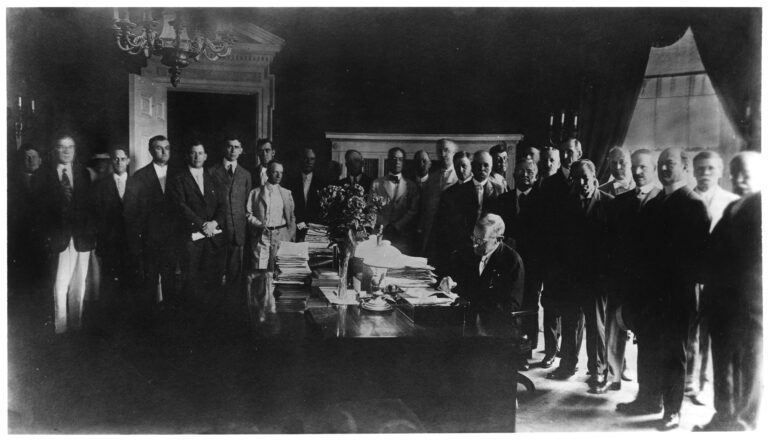
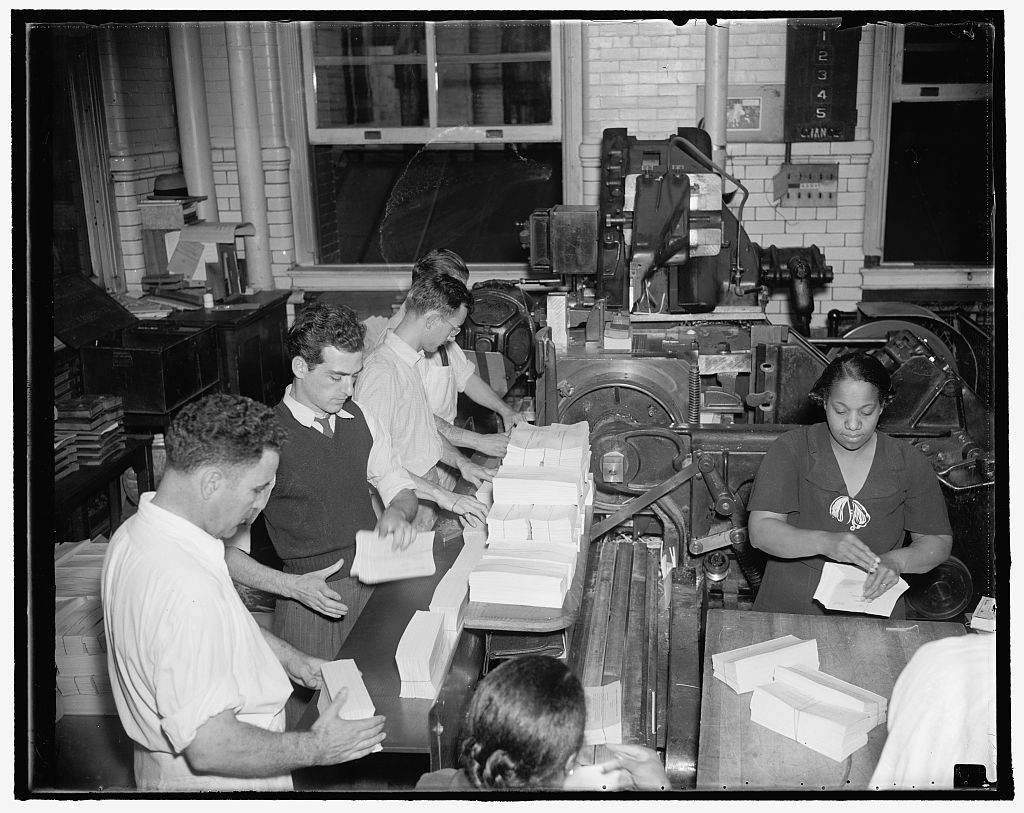
Contemporary press and government records show renewed concern about unemployment and industrial production. The featured photograph documents workers preparing questionnaires for a federal unemployment census in October 1937. It is evidence of official attention to joblessness during the recession, not a photograph of economists announcing its cause. Such images are valuable when paired with production statistics and policy records, rather than used as substitutes for them.
What happened to Roosevelt’s political reputation?
Roosevelt had won a commanding second-term victory in 1936. The renewed recession complicated claims that the New Deal had achieved durable recovery and gave opponents new opportunities to criticize administration policy. The court-packing controversy of 1937 also divided Democrats, creating political strain at the same time as economic conditions worsened.
Critics from different directions disagreed about the lesson. Fiscal conservatives warned that government intervention had distorted business decisions; supporters of stronger public spending argued that withdrawing assistance too soon helped cause the decline. Roosevelt’s administration shifted course in 1938 toward renewed spending and other measures. The political debate shows why economic policy cannot be separated entirely from public confidence and congressional support.
The policy response in 1938
In 1938 Roosevelt proposed new spending and lending measures to support recovery. Federal Reserve policy also became more accommodating, while the Treasury changed aspects of its gold policy. Together with improvements in private demand, these shifts contributed to the economy’s return to expansion. The recovery was not instant, and researchers still debate which measures had the largest effects.
An account that credits one decision with immediately ending the recession would ignore overlapping changes in credit, fiscal policy, inventories and expectations. The National Bureau of Economic Research places the trough in June 1938, but output and employment did not jump overnight to earlier levels. The date identifies when aggregate contraction ended; it is not a date on which every unemployed worker found a job.
Why historians call it a recession within the Depression
The larger Great Depression extended across much of the 1930s, with sustained unemployment, lost wealth and economic restructuring. The 1937–38 episode was a discrete contraction that interrupted the previous recovery. Economic historians use this period to explore whether a weak economy can return to decline when policymakers tighten monetary or fiscal support before employment has fully recovered.
That question became influential in later studies of business cycles and crises. But analogies should remain cautious: institutions, laws, global conditions and the structure of modern economies differ substantially from those of the 1930s. The event provides historical evidence about policy risk rather than a universal mathematical rule. The Great Depression guide places it in the longer economic history.
How the approach of World War II changed the economy
Recovery continued through 1939 and 1940, and defense production expanded as war developed in Europe. Later U.S. wartime mobilization brought much larger demand for labor and industrial output. These changes were distinct from the measures taken to end the 1937–38 contraction, and they occurred on a longer timeline. It is inaccurate to claim that the United States was already at full wartime employment in June 1938.
The experience demonstrates that economic recovery can involve several separate stages: ending an immediate contraction, restoring lost production and finally returning employment toward full capacity. The recession ended before U.S. entry into World War II, but the Depression’s lasting employment problems continued. Keeping those outcomes distinct makes the chronology clearer.
What the recession of 1937–38 teaches historians
The episode offers an unusually sharp example of a new downturn during an incomplete recovery. Policy decisions by the Treasury, Federal Reserve and federal budget authorities occurred against a background of weak private demand and high unemployment. Researchers continue to disagree about how much each contributed, but the interaction of forces matters more than a single-cause story.
The recession also revealed the limits of political success as a measure of economic stability. A president could win a landslide and still face renewed hardship. Its legacy belongs to both the history of monetary policy and the social experience of the Great Depression, when millions of people had to navigate uncertainty long after the financial panic of the early 1930s had ended.
Timeline
- 1933–1936: U.S. economy partially recovers from Depression
- 1936–1937: Reserve requirements increased; gold sterilization begins
- May 1937: Recession begins
- Late 1937: Employment and industrial production decline rapidly
- Spring 1938: Policy shifts and renewed federal spending measures
- June 1938: Recession reaches trough
- 1939–1941: Recovery continues and defense production expands
Frequently asked questions
When was the recession of 1937–38?
May 1937 through June 1938 according to NBER chronology.
Did it happen during the Great Depression?
Yes. It interrupted the recovery that began after 1933.
How severe was it?
Federal Reserve History reports roughly a 10% decline in real GDP, a 32% decline in industrial output and unemployment near 20%.
Did the Fed contribute?
Its increases in reserve requirements are one debated contractionary influence.
What was gold sterilization?
A Treasury policy limiting the effect of gold inflows on money and bank reserves.
Did Social Security cause the recession?
Payroll taxes and broader fiscal restraint may have reduced demand, but researchers debate the relative importance of multiple causes.
Did World War II end it in June 1938?
No. The recession ended well before U.S. wartime mobilization; longer-term recovery continued afterward.