FDR’s Court-Packing Plan of 1937: Why Roosevelt Tried to Expand the Supreme Court
What FDR proposed in February 1937, why it became known as court-packing, how senators resisted and why the plan failed.
Quick answer
On February 5, 1937, President Franklin D. Roosevelt proposed a Judicial Procedures Reform Bill that could add up to six justices to the nine-member U.S. Supreme Court. For each sitting justice aged 70 years and six months who did not retire, the president could appoint an additional justice, up to a total of 15. Roosevelt argued that the courts needed administrative reform; opponents saw a threat to judicial independence after several New Deal laws had been invalidated. Congress did not enact the Supreme Court expansion. The Court’s decisions and personnel changed through normal constitutional processes afterward.
Key facts
On this page
- The New Deal and the Supreme Court before 1937
- Why Roosevelt considered changing the Court’s size
- What the February 5, 1937 plan actually proposed
- The age argument and Chief Justice Hughes
- Why lawmakers from Roosevelt’s own party opposed the plan
- The Senate Judiciary Committee’s damaging report
- The ‘switch in time that saved nine’ question
- Justice Van Devanter’s retirement and normal appointments
- Why the court-packing bill failed in 1937
- What Congress did change instead
- What the dispute means for separation of powers
- Timeline
- FAQs
- Sources
The New Deal and the Supreme Court before 1937
Roosevelt entered the presidency in 1933 during an economic emergency and oversaw legislation intended to stabilize banks, reduce unemployment and reorganize parts of industry and agriculture. Many Americans welcomed the use of federal power, while others believed that the new programs exceeded constitutional limits or interfered with private decisions. Constitutional litigation became a major obstacle to administration policies. The Supreme Court invalidated the National Industrial Recovery Act in 1935 and an important part of the Agricultural Adjustment Act in 1936.
Those rulings produced deep frustration among New Deal supporters, but they did not mean the Court struck down every Roosevelt measure. The Court also upheld certain laws, and different justices had different approaches. Roosevelt won a landslide reelection in 1936 and interpreted the result as strong public support for federal reform. The conflict presented a difficult constitutional question: how far could an elected government go when judges rejected legislation its supporters considered necessary?
Why Roosevelt considered changing the Court’s size
The Constitution creates a Supreme Court but does not specify that it must contain nine justices. Congress has changed its size at different points in American history, with nine becoming the enduring number after the nineteenth century. That legal flexibility offered Roosevelt a route to alter the Court without an amendment, although it raised questions about political norms and institutional independence. The distinction between the legality of congressional power over court size and the wisdom of using that power for ideological purposes was central to debate.
Roosevelt presented his proposal partly as a way to relieve judicial workloads and introduce younger judges. Opponents questioned whether congestion truly explained the Supreme Court’s work and argued that the apparent goal was to appoint justices favorable to the New Deal. A proposal may have multiple stated and unstated motivations, and historians assess both the administration’s public arguments and private political context. The Court’s recent decisions made the proposal appear much more than an ordinary scheduling reform.
What the February 5, 1937 plan actually proposed
The Judicial Procedures Reform Bill would have permitted an additional appointment when a federal judge past seventy years and six months remained in service, subject to specified numerical limits. For the Supreme Court, the effect could have been as many as six additional justices, raising the total from nine to fifteen. The proposal extended beyond the Supreme Court into aspects of the lower federal judiciary. It did not propose abolishing the existing justices or allowing Roosevelt simply to dismiss them.
That mechanism matters because simplified descriptions often say Roosevelt wanted to replace six justices immediately. The bill instead offered additional seats linked to older judges’ decisions not to retire. But opponents argued the practical result could still allow the president to alter the Court’s ideological balance very quickly. The contrast between administrative wording and likely political effects explains why the term ‘court-packing’ became so influential.
The age argument and Chief Justice Hughes
Roosevelt suggested that older federal judges might lack the capacity to keep up with mounting judicial work. Chief Justice Charles Evans Hughes disputed the idea that the Supreme Court was unable to manage its docket, and a letter from him became important evidence used against the proposal. The controversy was therefore partly about the factual basis for reorganizing judicial administration, not simply about whether older justices should retire.
Criticism of the age rationale did not mean every aspect of lower-court workload reform was unnecessary. Some adjustments to judicial procedure were later enacted. But the claim that the Supreme Court’s principal problem was delay proved vulnerable. The political debate increasingly focused on whether an elected president should obtain new appointments because he disliked constitutional rulings. The separation-of-powers question overshadowed the proposal’s ordinary administrative features.
Why lawmakers from Roosevelt’s own party opposed the plan
Democrats held majorities in Congress after the 1936 election, yet support for the president was not unconditional. Several Democratic senators and representatives argued that an attempt to reshape the Supreme Court in response to unfavorable decisions could establish a dangerous precedent. A future president with different goals might use the same power to weaken independent review of legislation. Republicans also criticized the proposal, creating an unusual coalition of opponents.
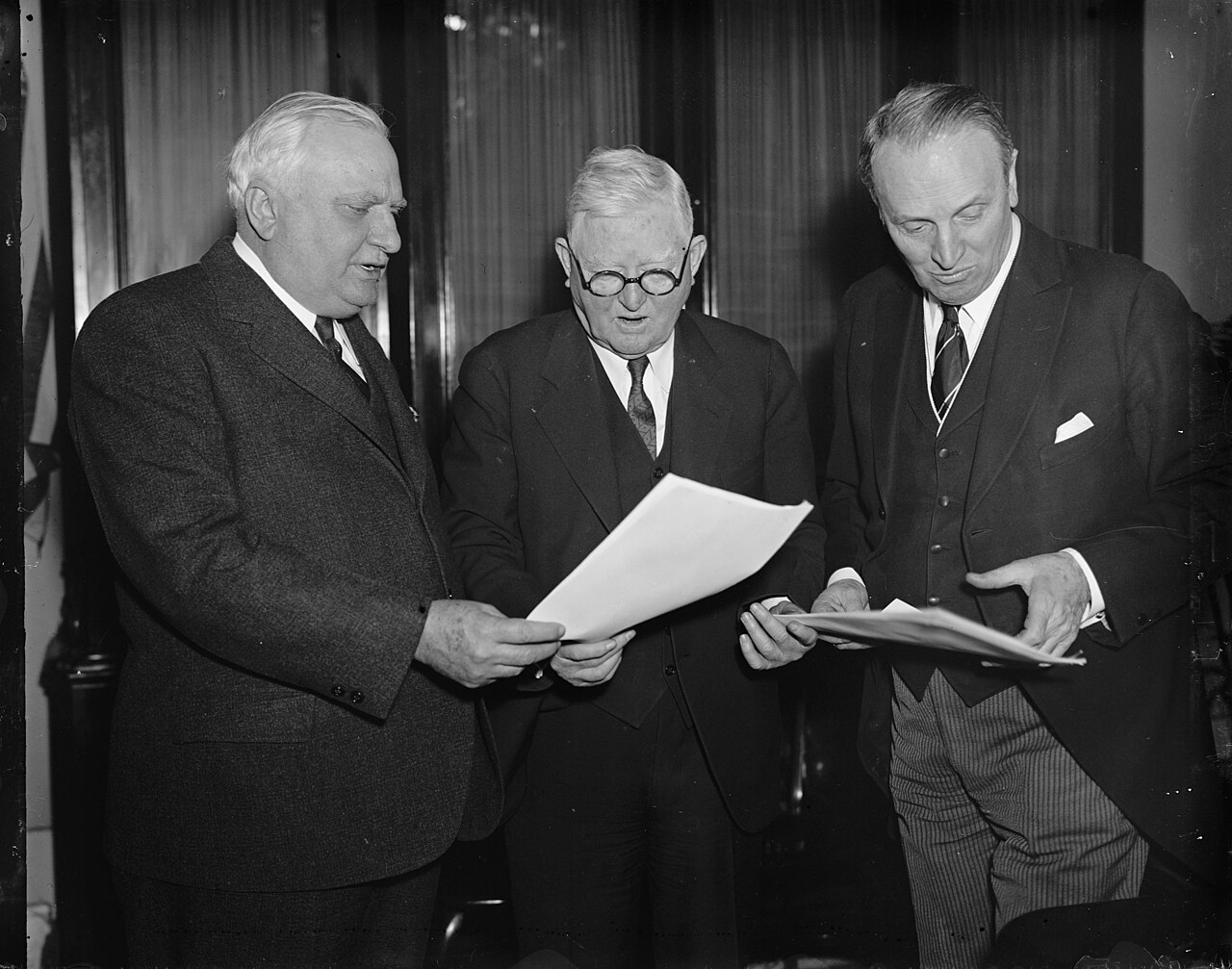
Vice President John Nance Garner was among the important figures involved in the political contest, while senators including Burton Wheeler challenged the plan. The historical photograph accompanying this article shows senior officials examining the legislation. It demonstrates that the dispute reached the highest levels of Congress but does not prove that everyone pictured shared the same position. Legislative records and speeches are needed to determine individuals’ changing views.
The Senate Judiciary Committee’s damaging report
Senate hearings drew extensive testimony from lawyers, judges, constitutional scholars and members of the public. In June 1937 the Senate Judiciary Committee voted to report unfavorably on the proposal, with a majority criticizing the Supreme Court expansion as a threat to constitutional government. The committee’s report did not by itself enact or reject legislation; it provided an institutional judgment that seriously weakened the bill’s chances.
The committee’s opposition illustrated the limits of even a popular president’s influence. Members of Roosevelt’s own party could support parts of the New Deal while refusing this particular method of changing the judiciary. Their position demonstrated that electoral victories did not automatically authorize every institutional reform. Opposition to the court plan was not identical to opposition to economic relief, and that distinction helps explain why some New Deal supporters still resisted the proposal.
The ‘switch in time that saved nine’ question
During spring 1937 the Supreme Court upheld several significant measures, including the National Labor Relations Act in NLRB v. Jones & Laughlin Steel Corp. and state minimum-wage legislation in West Coast Hotel v. Parrish. Commentators later used the expression ‘switch in time that saved nine’ to suggest that judicial changes helped prevent expansion. The timing was striking, and the rulings affected the political debate around the bill.
However, historians and legal scholars dispute whether Justice Owen Roberts changed his vote because of Roosevelt’s proposal. Evidence indicates that decisions and conference votes were more complicated than the famous slogan suggests, and in at least one important case the Court had acted before the plan was publicly announced. A responsible article should report the expression as an interpretation, not as proof of a private bargain or direct political surrender. The Wagner Act article explains one of the laws upheld in 1937.
Justice Van Devanter’s retirement and normal appointments
Justice Willis Van Devanter announced his retirement in May 1937. That provided Roosevelt a vacancy he could fill without changing the Court’s size. Over subsequent years retirements and deaths allowed him to appoint several justices through the ordinary nomination and confirmation process. The personnel and constitutional direction of the Court shifted even though the president’s controversial expansion plan never became law.
This outcome should not be described as Roosevelt obtaining six new seats from Congress by another name. A vacancy created through retirement is different from a new statutory position added for political reasons. The distinction is central to the controversy. It explains how a failed proposal could nevertheless coincide with genuine change in Supreme Court jurisprudence and composition during the remainder of Roosevelt’s presidency.
Why the court-packing bill failed in 1937
Resistance in the Senate remained strong as the summer progressed, and the sudden death of Senate Majority Leader Joseph T. Robinson removed a key supporter of compromise efforts. The Senate eventually rejected the original expansion approach, while more limited judicial administrative reforms were enacted. The central plan to increase the Supreme Court from nine toward fifteen justices did not pass. Histories sometimes blur the failed expansion with later procedural legislation, but they were not the same measure.
The political damage was substantial. Roosevelt had used considerable authority on a proposal that divided his party and allowed critics to accuse him of seeking excessive power. Those divisions contributed to a less unified New Deal coalition in Congress. The episode illustrates that a president’s popularity and party control do not guarantee support when lawmakers see the independence of another branch as being at stake.
What Congress did change instead
Congress adopted narrower judicial reforms in 1937, including adjustments to procedures and the federal government’s ability to participate in certain constitutional cases. These measures dealt with administration and litigation rather than adding six Supreme Court justices. Roosevelt later described their enactment as addressing aspects of his broader reform goals, but the public controversy centered on a particular proposal that did not survive.
It is therefore inaccurate to write that Congress simply passed the court-packing plan in August 1937. A history of the debate needs two separate outcomes: failure of the Supreme Court enlargement and passage of some narrower measures. The difference also shows how compromise legislation can follow the political collapse of a broader proposal. The enacted reforms did not give Roosevelt the same immediate opportunity to appoint additional Supreme Court members.
What the dispute means for separation of powers
The 1937 struggle became a lasting example of how changes to judicial institutions may affect the balance among branches of government. Congress has constitutional authority to determine the Court’s size within the broader constitutional system, but the way that authority is used can influence public confidence in independent adjudication. Supporters of Roosevelt emphasized democratic authority to pursue economic recovery, while critics argued that changing the Court because of its rulings endangered checks and balances.
The case remains relevant to later debates over Supreme Court reform, yet the historical facts deserve independent examination before modern comparisons are drawn. Roosevelt proposed a conditional expansion to as many as fifteen justices; Congress did not approve it; and the Court’s decisions changed for reasons that remain debated. That combination of legal possibility, political resistance and judicial independence gives the episode its enduring importance.
Timeline
- 1935: Supreme Court invalidates major New Deal industrial legislation
- 1936: Agricultural Adjustment Act provisions struck down; Roosevelt wins reelection
- February 5, 1937: Roosevelt announces judicial reform plan
- Spring 1937: Court upholds significant labor and wage measures
- June 1937: Senate Judiciary Committee opposes plan
- July 1937: Original expansion effort collapses in Senate
- August 1937: Narrower judicial reforms signed without Court enlargement
Frequently asked questions
When did FDR propose court-packing?
February 5, 1937.
How many Supreme Court justices were there?
Nine.
How many justices did Roosevelt want?
His proposed mechanism could bring the Supreme Court to as many as 15 members.
Was expanding the Court automatically unconstitutional?
The Constitution does not fix the Court’s size at nine, but opponents argued his proposed use of that authority threatened judicial independence.
Did Congress approve the plan?
No. The central expansion proposal failed.
What was the ‘switch in time’?
A later nickname for the Court’s 1937 decisions upholding laws, but historians dispute the claim that the plan caused a justice to switch his vote.
Did FDR appoint justices later?
Yes. Normal vacancies allowed multiple appointments during his presidency.