Presidential Election of 1920: Harding, Cox, Results and ‘Normalcy’
Why Warren G. Harding defeated James M. Cox after World War I, how women voted in the first post-suffrage national election and what the results meant.
Quick answer
In the presidential election of November 2, 1920, Republican Warren G. Harding defeated Democrat James M. Cox by 404 to 127 electoral votes. Harding won about 60.3% of the popular vote and Cox about 34.1%. Harding campaigned for a ‘return to normalcy’ after World War I, while the League of Nations and Wilson’s record divided voters. It was the first presidential election after ratification of the Nineteenth Amendment, although some women had voted in earlier elections.
Key facts
On this page
- The election after the First World War
- The Republican nomination of Warren G. Harding
- The Democratic ticket: James Cox and Franklin Roosevelt
- Harding’s promise of a ‘return to normalcy’
- The League of Nations debate
- Front-porch campaigning versus national travel
- The Nineteenth Amendment and women voters
- The candidates beyond the two major parties
- Results: 404 electoral votes to 127
- What the result meant for Harding’s presidency
- Why the 1920 election remains significant
- Timeline
- Frequently asked questions
- Sources
The election after the First World War
The presidential contest of 1920 unfolded after years of enormous upheaval. The United States had entered the First World War in 1917, mobilized millions of people and experienced the deadly influenza pandemic. The armistice ended large-scale fighting in November 1918, but Americans still argued about peace settlements, international commitments and the country’s economic future. Strikes, labor conflict, racial violence and political repression contributed to public uncertainty. Those conditions provided the background for Harding’s promise that national life could become more stable and familiar.
President Woodrow Wilson had served two terms and was in poor health after a severe stroke in 1919. His government remained associated with wartime controls and the battle over American participation in the League of Nations. The Democratic Party faced the challenge of defending an administration whose policies were under attack. The Republican Party offered a change in direction. Yet the election cannot be reduced to one issue; voters also considered prices, taxes, labor disputes, public morality and the parties’ competing visions of national government.
The Republican nomination of Warren G. Harding
Harding was a U.S. senator from Ohio and a former newspaper publisher. At the Republican convention in Chicago, several better-known contenders initially attracted substantial support, and the delegates struggled to assemble a majority. Harding eventually emerged as the nominee through successive ballots and party negotiation. Popular accounts sometimes dramatize the result as a secret decision in a smoke-filled room. Party leaders did negotiate, but the actual convention and voting process were more complicated than the familiar anecdote.
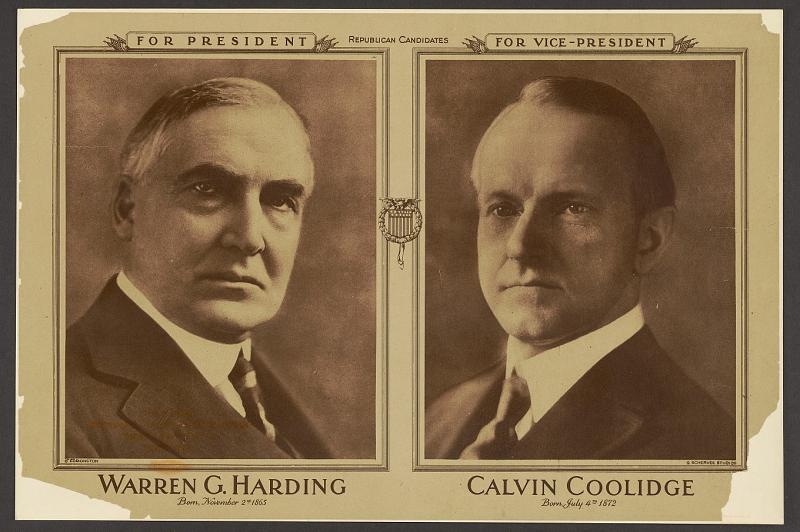
Republicans selected Calvin Coolidge, governor of Massachusetts, as Harding’s running mate. Coolidge had gained national attention during the 1919 Boston police strike, and his reputation for a firm response to disorder appealed to some voters. The Harding–Coolidge ticket joined a candidate promising steadiness with a running mate associated with government authority. Contemporary campaign posters, including the one accompanying this article, emphasized their identities and invited voters to connect the party with a change of leadership.
The Democratic ticket: James Cox and Franklin Roosevelt
Democrats nominated James M. Cox, the governor of Ohio and a newspaper publisher, after a contested convention in San Francisco. Cox had experience in state politics and supported the general idea of American participation in a League of Nations, though he also argued over the conditions of membership. His running mate was Franklin D. Roosevelt, then a younger Democratic politician who had served as assistant secretary of the Navy. Roosevelt’s future presidency was not something voters could know in 1920; he appeared on the ticket in a different political role.
Cox campaigned actively and traveled widely to make his case, contrasting with Harding’s more restrained style. The Democrats faced challenges associated with Wilson’s popularity and the divisions over foreign policy. Cox was not simply Wilson under a different name: his own record and arguments mattered. But the public’s judgment of the outgoing administration inevitably shaped how the Democratic ticket was received. The two main candidates were both Ohio newspapermen, a notable feature of this particular contest.
Harding’s promise of a ‘return to normalcy’
Harding’s use of ‘normalcy’ became one of the most enduring political phrases associated with the election. It suggested that Americans could move away from wartime sacrifice, ideological conflict and repeated national emergencies toward familiar habits and less intrusive government. The appeal was broad enough for different voters to hear their own priorities in it. For some, it meant peace and economic stability; for others, avoiding international commitments or reducing federal activity.
The promise was not a detailed blueprint that automatically determined every policy Harding would pursue. It was campaign rhetoric directed at a nation coping with change. Historians must therefore distinguish what a candidate said from how a later administration governed. The appeal nevertheless helps explain Republican messaging: Harding offered an emotional contrast with wartime mobilization and controversy, not just a list of laws he would pass. His campaign style reinforced that image of calm.
The League of Nations debate
International policy divided politicians and voters. Wilson had supported the League of Nations as part of the postwar settlement, but the Senate refused to approve American entry on the terms presented. Republican critics feared that League obligations could entangle the United States in conflicts without sufficient congressional control. Other Republicans supported some forms of international cooperation, so opposition to Wilson’s proposal did not necessarily mean rejecting every diplomatic institution.
Cox defended participation more strongly, while Harding expressed opposition to the League as Wilson had proposed it. Some voters considered the issue central to America’s future role in the world; others were more concerned about economic and domestic conditions. A fair account avoids presenting the 1920 result as a referendum on the League alone. The large Republican victory reflected overlapping disagreements about the outgoing administration, national politics and the costs of wartime change.
Front-porch campaigning versus national travel
Harding conducted much of his campaign from his home in Marion, Ohio, where delegations, reporters and visitors could hear his speeches. The front-porch approach gave the campaign a controlled and reassuring appearance, drawing on earlier American political traditions. Newspapers carried accounts across the country, and political organizers worked on the candidate’s behalf. It would be incorrect to assume Harding did no campaigning beyond his porch, but the image became a defining feature of his public appeal.
Cox took a more itinerant approach, speaking in many towns and cities and challenging Republican arguments directly. The contrast made for an easily understood story in contemporary coverage. Transportation, newspapers, advertising and other means of communication were increasingly important for national campaigning. The two styles were strategic choices shaped by each candidate’s circumstances and their parties’ judgments about what the public wanted.
The Nineteenth Amendment and women voters
The Nineteenth Amendment was ratified in August 1920, prohibiting the denial or abridgment of voting rights on account of sex. Consequently, the November contest was the first presidential election held after the national constitutional protection took effect. It brought many additional women into the electorate and changed the scale and organization of voting. Political parties sought to appeal to women who could now vote under the new nationwide constitutional rule.
Women had not all been barred from voting before 1920. Several states had already granted women presidential or broader suffrage, and Black women faced discriminatory barriers even after the Nineteenth Amendment. Literacy tests, intimidation and other restrictions continued to deny voting opportunities to many African Americans, particularly in the South. The phrase ‘first election in which women voted’ therefore is inaccurate. The precise point is that it was the first presidential election after ratification of the amendment, whose protections remained unevenly realized.
The candidates beyond the two major parties
The Socialist Party nominated Eugene V. Debs, who was in federal prison after his conviction for wartime anti-draft speech. Debs conducted a symbolic campaign from prison and received hundreds of thousands of votes, approximately 3.4% of the total in commonly cited returns. His participation demonstrates that the political debate extended beyond the Republican and Democratic tickets. The campaign also connected the election with controversies about the Espionage Act and freedom of speech during wartime.
Other minor-party candidates represented differing reform programs and economic views. Their smaller national totals did not give them electoral votes, but the fact that they attracted support shows why the country should not be treated as having only two political opinions. Some voters rejected both major candidates for reasons involving labor, capitalism, prohibition and civil liberties. A complete account can acknowledge those positions without assigning them a decisive role in a contest won by a large Republican margin.
Results: 404 electoral votes to 127
Harding won the Electoral College by 404 votes to Cox’s 127. Popular vote totals in historical compilations vary slightly because returns were tabulated and reported differently, but the Library of Congress gives about 16.15 million votes for Harding and about 9.13 million for Cox. Their shares were approximately 60.3% and 34.1%, respectively. Harding carried thirty-seven states, while Cox carried eleven, mainly in the South.
The scale of the victory was unmistakable even allowing for small differences between published vote totals. The electoral tally reflected a broad national Republican advantage, while Democratic strength remained concentrated in parts of the South. These numbers are useful when paired with the social context: changes in turnout, the newly ratified suffrage amendment and different regional political systems all affected what election returns represented. A large national margin did not mean every eligible citizen could vote freely.
What the result meant for Harding’s presidency
Harding entered office on March 4, 1921, succeeding Wilson. His administration was confronted with a postwar economic downturn and debates over taxes, tariffs, immigration and the relationship between government and business. The change of party control affected policy direction, but every issue faced congressional and institutional constraints. The election was a political mandate in the sense that a large number of voters supported the Republican ticket; it was not advance approval of every later decision.
Harding died in office in August 1923 and Coolidge succeeded him. In later years scandals associated with members of the Harding administration affected public interpretations of the period, most famously the Teapot Dome affair. Those developments belong in separate historical accounts because voters in November 1920 did not yet know the events that would become controversial later. Retrospective judgments should not be projected backward as though the electorate had been choosing with perfect knowledge.
Why the 1920 election remains significant
The election marks a transition from Wilson’s reform and wartime presidency to Republican leadership during the early 1920s. It provides a clear example of how public responses to war, international commitments and domestic instability can influence national politics. It also stands at an important moment in voting history, with the Nineteenth Amendment newly ratified and parties adapting to a changed electorate. Those overlapping developments help explain why it is remembered beyond the unusually large electoral margin.
The contest also links several topics in the site’s U.S. history sequence. The election of 1912 established the Wilson administration, the Nineteenth Amendment changed constitutional voting protections, and the Volstead Act framed another major postwar controversy. Together they show that 1920 was neither a simple return to the past nor the beginning of an entirely new society, but a political turning point amid continuing change.
Timeline
- 1919 — Wilson suffers a major stroke; League of Nations controversy continues
- June 1920 — Republicans nominate Harding and Coolidge
- Summer 1920 — Democrats nominate Cox and Franklin Roosevelt
- August 1920 — Nineteenth Amendment ratified
- November 2, 1920 — Harding wins election
- March 4, 1921 — Harding inaugurated
- August 1923 — Harding dies; Coolidge becomes president
Frequently asked questions
Who won the 1920 presidential election?
Republican Warren G. Harding defeated Democrat James M. Cox.
What was the Electoral College result?
Harding won 404 electoral votes and Cox 127.
What did ‘return to normalcy’ mean?
It was Harding’s campaign appeal for a more stable, familiar national life after wartime upheaval.
Who were the vice-presidential candidates?
Calvin Coolidge ran with Harding and Franklin D. Roosevelt ran with Cox.
Was 1920 the first election in which women voted?
No. Women had voted in some states earlier. It was the first presidential election following ratification of the Nineteenth Amendment.
Did Eugene Debs run while imprisoned?
Yes. The Socialist candidate campaigned from federal prison and received roughly 3.4% of the national popular vote.
When did Harding take office?
March 4, 1921.