Battle of New Market Heights (1864): Black Union Troops and 14 Medals of Honor
Black Union soldiers helped break a Confederate defense north of the James River and challenged racist doubts about their service.
The Battle of New Market Heights took place near Richmond, Virginia, on September 29, 1864. African American regiments of the United States Colored Troops, serving with the Union Army of the James, attacked Confederate entrenchments. They suffered severe losses while overcoming abatis and fire before the Confederate defense was abandoned. Fourteen Black soldiers received the Medal of Honor for bravery at New Market Heights.
A source-based guide to the sequence, commanders, decisions and historical consequences.
On this page — 20 topics
What happened at New Market Heights?
On September 29, 1864, African American soldiers in the Union Army of the James attacked Confederate defensive works at New Market Heights near Richmond. The fortifications were protected by obstacles and fire from defenders who held strong ground. Early attacking formations suffered severe losses and had difficulty reaching the Confederate line.
Later assaults increased the pressure, and Confederate forces withdrew from their position. The Union advance was part of wider operations on the north side of the James River. The battle became especially significant because Black soldiers had demonstrated courage under extreme conditions while serving in an army that still subjected them to discrimination.
Where was the battlefield?
New Market Heights stood northeast of Richmond, near the James River and routes connecting Union forces to the Confederate defenses. The terrain included earthworks and felled trees arranged as obstacles, creating difficult approaches for attacking infantry. The position formed part of a larger fortified system protecting the Confederate capital.
The place should not be confused with the Battle of New Market in the Shenandoah Valley, fought earlier in May 1864. New Market Heights was an engagement near Richmond in September. Distinguishing those names helps prevent mistakes involving commanders, casualty figures and the contributions of African American soldiers.
Why did the Union attack north of the James River?
Union general Benjamin F. Butler’s Army of the James undertook an offensive against Confederate defenses protecting Richmond. The operations aimed to gain ground and force the defenders to respond to threats beyond Petersburg’s main trench lines. Pressure north of the river could divert Confederate troops from other vulnerable positions.
The wider plan included attacks on Fort Harrison and positions near New Market Heights. These engagements were connected by geography and timing but were not identical actions. USCT soldiers played a critical role in the assault against the heights. Understanding the whole operation reveals why the position mattered to commanders on both sides.
What were the United States Colored Troops?
The United States Colored Troops were regiments of Black soldiers organized for Union service during the Civil War. Federal policy expanded Black enlistment after emancipation became an official war measure. These men fought for a country that had long denied Black Americans full equality and political rights.
Most USCT units were commanded by white officers, and Black soldiers initially faced unequal pay and treatment. They also risked special violence if captured by Confederate forces. Their service transformed the Union military effort and made their claim to citizenship and freedom impossible to dismiss as a purely abstract political issue.
Who commanded the attack?
Brigadier General Charles J. Paine commanded the division of Black Union troops involved in the assault, while Butler directed the Army of the James. Several brigades and regiments carried out attacks against Confederate positions. Individual officers and enlisted soldiers made urgent decisions as formations encountered obstacles and heavy fire.
The opposing Confederate forces were smaller than the overall Union force but enjoyed the advantages of entrenched positions. Major Confederate General John Gregg was associated with command of the defenses. Military accounts should identify operational responsibility without reducing the achievement to generals: the assault required enlisted soldiers to advance against severe danger.
What obstacles faced the attacking soldiers?
Confederate troops had constructed defensive works and placed abatis, obstacles made from felled trees with branches directed toward the enemy. Such barriers slowed advancing infantry and made soldiers vulnerable to rifle and artillery fire. Reaching the Confederate parapet required troops to move through or around these obstructions.
The obstacles mattered as much as the height of the earthworks because they disrupted attacking formations before they could reach the defenders. Some soldiers attempted to clear or pass through the tangled branches while under fire. The struggle illustrates why a prepared defensive line could inflict extreme casualties even against determined and numerous attackers.
What happened in the first assault?
Early attacking units encountered concentrated Confederate fire and suffered heavy casualties. Officers fell, formations lost direction and some men became pinned down behind the abatis. The stalled assault did not mean soldiers were unwilling to fight; it reflected the strength of the defenses and the practical difficulty of advancing through the obstacles.
Men continued attempting to find a route forward, and the engagement developed through multiple phases rather than one uninterrupted charge. The National Park Service’s historical interpretation emphasizes courage alongside the tactical challenges. A battle account should separate the initial failure to reach the works from the eventual Union success in forcing the defense to be abandoned.
How did the Union forces secure the position?
Following the first assault, further Union attacks increased pressure against the Confederate line. The defenders eventually withdrew, and federal troops gained the contested ground. The changing situation elsewhere in the Richmond defenses also mattered; Confederate commanders had to balance multiple threats during the larger September operation.
It would be inaccurate to claim that one regiment alone destroyed the entire Confederate army at Richmond. The significance of New Market Heights lies in the achievement of the Black troops within a broader campaign. Their losses and persistence contributed directly to securing an important position while other federal formations attacked additional defenses.
Why did 14 soldiers receive Medals of Honor?
Fourteen African American soldiers were awarded the Medal of Honor for their actions at New Market Heights. The awards recognized acts of exceptional courage such as carrying flags through fire, continuing to advance and helping preserve a regiment’s fighting ability after officers and standard-bearers had fallen.
The number is historically striking. Of the sixteen African Americans awarded the Medal of Honor for Civil War service, fourteen received the distinction for New Market Heights. This does not mean only fourteen men behaved bravely; it reflects a specific system of recognizing certain actions. The NPS maintains biographies of the awardees and their service.
Why were regimental flags so important?
In nineteenth-century combat, flags served as markers of a regiment’s position and identity. Smoke and battlefield noise could make orders difficult to communicate, so soldiers used colors to locate their own formation and rally around leaders. Carrying a flag in a frontal assault was dangerous because the bearer was conspicuous.
Several New Market Heights Medal of Honor citations involve soldiers taking up flags after others had fallen. Such acts helped units maintain cohesion despite casualties. The symbolic value of the flag was closely tied to practical military needs. A standard-bearer’s courage could influence a formation’s ability to advance when more familiar lines of command were disrupted.
How did Confederate soldiers treat captured Black troops?
Black Union soldiers fought knowing they could face greater danger if captured. Confederate policy and practice often denied them the protections commonly claimed by white soldiers, and atrocities occurred during the war. The possibility of enslavement or murder added to the risks of combat.
At New Market Heights, the danger sharpened the importance of Black soldiers demonstrating that they could serve effectively under fire. It is essential not to turn the battle into a simplified morality tale without studying what actually happened on this field. The broader record of unequal treatment explains much about the stakes for USCT troops.
How many casualties occurred?
The assault produced severe casualties, especially among initial attacking formations that became trapped near the abatis. Historical totals vary by the units and phases included, and it is important not to substitute the combined losses from the whole Fort Harrison operation for New Market Heights alone.
The National Park Service offers casualty lists and unit information for researchers. Such records can reveal who was wounded or killed and how losses were distributed, rather than giving only one dramatic number. A casualty was not necessarily a death, and figures should identify the time period and the units that they describe.
What happened at Fort Harrison on the same day?
Other Union troops attacked Fort Harrison and nearby positions in the Richmond defensive system during the same September operation. The attacks forced Confederate commanders to respond to more than one threatened sector. Fort Harrison was captured, creating serious problems for the defenders north of the James.
New Market Heights and Fort Harrison are therefore related but distinct battles within a larger offensive. Connecting them shows why the Confederate defense of the heights did not exist in isolation. The broader pressure affected decisions to hold or abandon positions and shaped how the Union army consolidated its gains.
How did the victory affect perceptions of Black soldiers?
At the beginning of the war, racist assumptions had led some officials to doubt the military value of African American troops. Black soldiers repeatedly disproved these claims through service in battles, garrisons and campaigns. New Market Heights became an especially visible example because of the assault’s difficulty and the honors later awarded.
Military performance did not immediately eliminate discrimination in the army or society. Black veterans continued to face restrictions on citizenship, work and political rights. Their record, however, provided powerful evidence for arguments that men who had fought to preserve the Union deserved equal protection and full civic participation.
What historical sources preserve the story?
National Park Service records include overviews, orders of battle, maps, casualty lists and biographies of Medal of Honor recipients. These materials enable readers to examine details of particular units without relying on a single later commemorative account. Contemporary military reports can be compared with later veterans’ narratives.
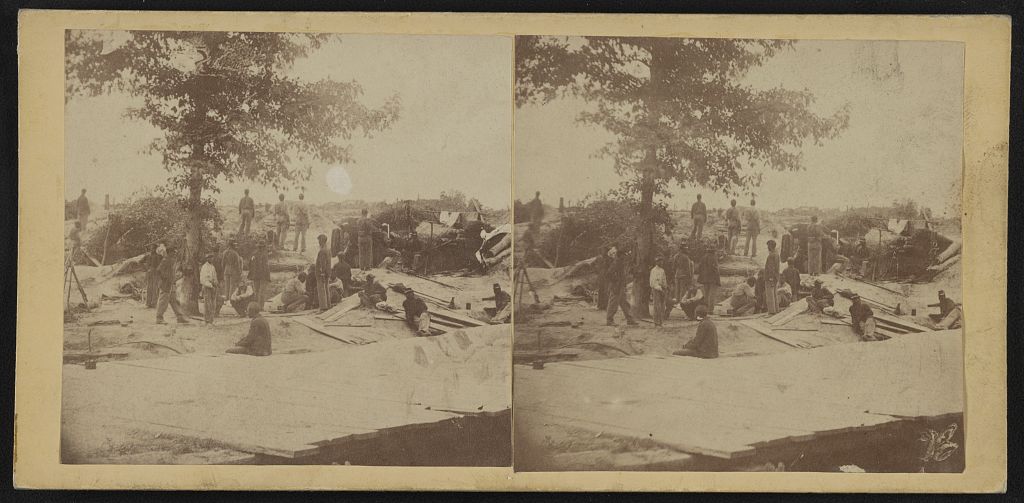
The historical image above shows USCT soldiers during the Petersburg campaign but was not taken during the assault itself. This distinction is deliberate. Few photographs capture Civil War fighting as it happened, and an accurate caption must separate a contextual period photograph from an image documenting a specific minute on the battlefield.
Why is New Market Heights important today?
The battle is important both as a military action and as part of the history of Black Americans’ efforts to secure freedom and citizenship. Its participants were not simply proving themselves to white commanders; they were serving the Union in a war directly connected to the future of slavery.
The fourteen Medal of Honor recipients are a powerful way to begin studying the battle, but the wider story includes hundreds of soldiers who fought, suffered and survived without receiving decorations. New Market Heights demonstrates how military history and the struggle for equal rights are inseparable in the Civil War.
Battle of New Market Heights 1864 timeline
These dates distinguish the main stages of the operation from the consequences that came afterward.
| Date | Event |
|---|---|
| January 1863 | The Emancipation Proclamation encourages Black military enlistment. |
| Summer 1864 | USCT regiments participate in Virginia operations around Petersburg and Richmond. |
| September 28 | Union troops prepare for an offensive north of the James River. |
| September 29, morning | Black troops attack the Confederate works at New Market Heights. |
| September 29 | Confederate troops abandon the contested position; Union advances include Fort Harrison. |
| After the battle | Fourteen USCT soldiers are eventually awarded Medals of Honor. |
Frequently asked questions
When did it happen? September 29, 1864.
Where did it happen? Henrico County, Virginia.
Who were the main commanders? Butler, Paine, Gregg.
What was the outcome? Union victory. The sections above explain the result in context.
How does it fit into the war? Our Civil War overview provides the wider timeline.
Historical sources and further reading
This guide uses National Park Service research, period images and documented chronology; the distinction between contemporary images and later art is maintained.