Volstead Act of 1919: Prohibition Enforcement, Exceptions and Repeal
How the Volstead Act turned the Eighteenth Amendment into national alcohol enforcement—and why the rules proved difficult to sustain.
Quick answer
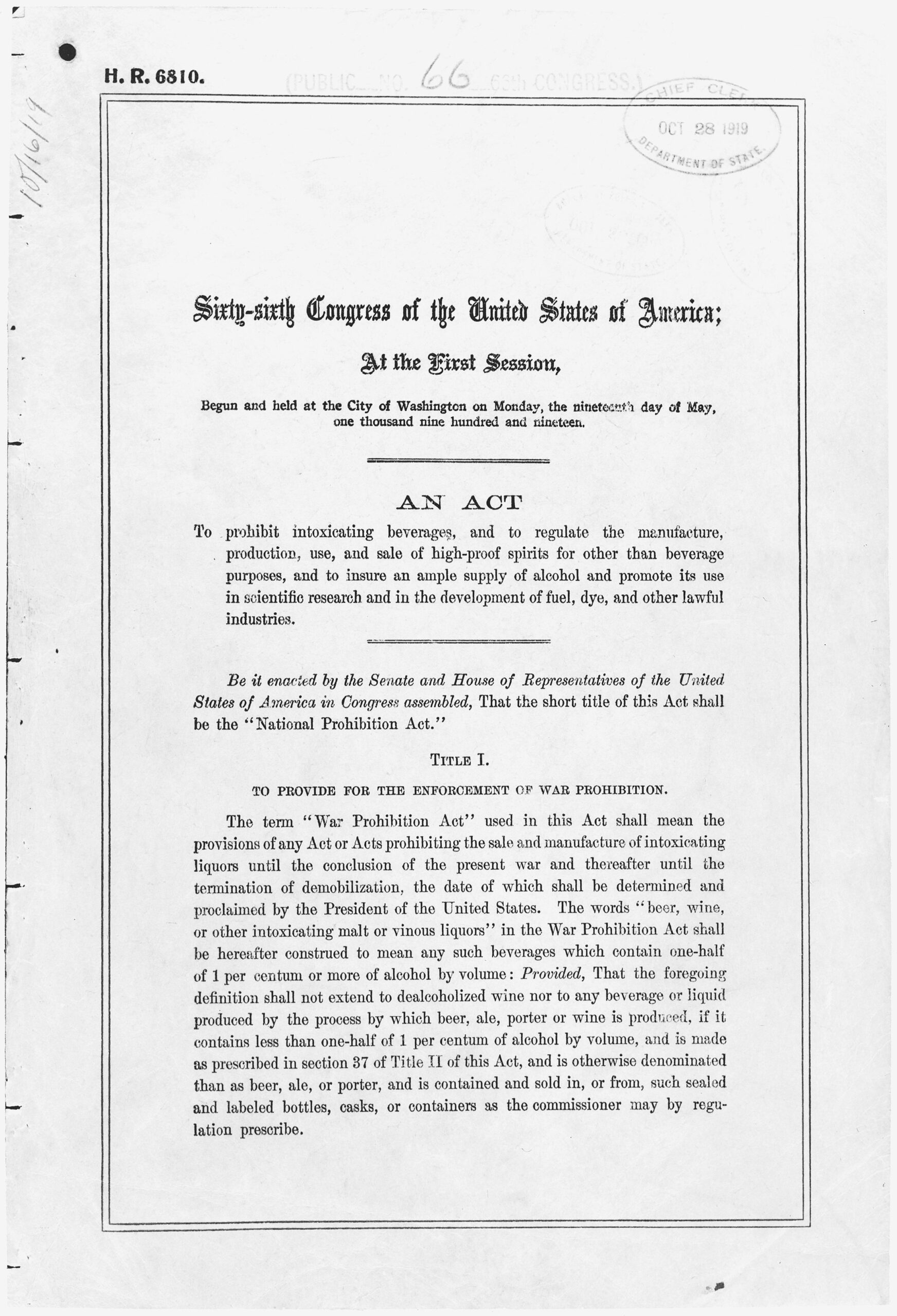
The Volstead Act, formally the National Prohibition Act, became law on October 28, 1919, when Congress overrode President Woodrow Wilson’s veto. It defined intoxicating liquor for enforcement purposes, generally covering beverages containing 0.5% alcohol or more, and established rules for administering the Eighteenth Amendment. Nationwide constitutional Prohibition began January 17, 1920. The Twenty-first Amendment repealed it in December 1933.
Key facts
On this page
- Why an enforcement law was needed after the Eighteenth Amendment
- Temperance, social reform and the wartime background
- Andrew Volstead and the October 1919 vote
- What counted as intoxicating liquor under the law?
- Manufacture, sales and transportation versus drinking
- Medicinal, religious and industrial exceptions
- The Prohibition Bureau and uneven enforcement
- Bootlegging, speakeasies and organized crime
- Did Prohibition reduce alcohol consumption?
- Why the law became politically difficult to sustain
- The Volstead Act’s longer historical significance
- Timeline
- Frequently asked questions
- Sources
Why an enforcement law was needed after the Eighteenth Amendment
The Eighteenth Amendment established a national constitutional prohibition on the manufacture, sale and transportation of intoxicating liquor for beverage purposes. Its text did not spell out every inspection procedure, penalty, license requirement or definition needed to enforce that restriction. Congress and the states were given power to enforce the amendment through appropriate legislation. The Volstead Act supplied an extensive federal statutory framework for doing so. Constitutional authorization and a detailed criminal and administrative code were separate legal steps.
That distinction matters when studying dates. The amendment was ratified in January 1919, the enforcement act passed in October, and nationwide constitutional Prohibition took effect in January 1920. These are not three competing dates for a single event. Each represents a stage of the shift from the temperance movement’s political campaigns to government control of beverage alcohol. The effort also grew out of decades of state and local prohibition laws that preceded the national amendment.
Temperance, social reform and the wartime background
Temperance and prohibition advocates had organized throughout the nineteenth century, including church groups, women’s organizations and political campaigns. They connected alcohol restrictions with concerns about family welfare, working conditions, poverty, domestic violence and political corruption. Opponents challenged those assumptions, defended individual choice and questioned whether restrictions would work in diverse cities and communities. The movement was not uniform; some advocates supported moderation and education, while others sought a complete legal ban on beverage alcohol.
World War I strengthened arguments for restrictions on grain use, industrial efficiency and military discipline. Congress enacted wartime limits before the Eighteenth Amendment took effect. The Volstead Act therefore addressed both wartime prohibition and longer-term constitutional enforcement. President Woodrow Wilson objected particularly to continuing wartime restrictions in the bill, making it misleading to say he simply signed the measure as the central achievement of his administration.
Andrew Volstead and the October 1919 vote
Representative Andrew J. Volstead of Minnesota, chair of the House Judiciary Committee, became closely associated with the legislation. The law was called the Volstead Act, but its official short title was the National Prohibition Act. It included multiple titles addressing wartime prohibition, constitutional Prohibition enforcement and non-beverage alcohol. Its complexity reflected a practical challenge: a single blanket statement that ‘liquor was banned’ could not adequately specify commercial, industrial, medicinal and legal exceptions.
Congress passed the measure despite Wilson’s veto. On October 28, 1919, the Senate voted 65 to 20 to override it, completing enactment. The U.S. Senate’s official history documents the vote and the president’s objection. A prohibition law passed over a presidential veto is not evidence that the executive voluntarily endorsed all its terms. The difference between a bill’s sponsor, congressional majorities and presidential approval is fundamental to understanding how the 1919 law came into force.
What counted as intoxicating liquor under the law?
The Volstead Act defined intoxicating liquor broadly for its enforcement provisions, generally encompassing beverages containing one-half of one percent or more alcohol by volume. This was far lower than the strength of typical beer, wine or spirits. For enforcement purposes, the definition reduced arguments about whether a particular beverage was intoxicating in the everyday sense. The original law also treated several specialized products differently, so citing the threshold without acknowledging statutory exceptions can misrepresent its operation.
The act did not simply prohibit the physical existence of every substance containing alcohol. It set out a system involving permits, control of production, and allowed uses under defined circumstances. A business making alcohol for chemical, manufacturing or scientific purposes faced a different regulatory position from someone selling spirits as beverages. Reading those distinctions helps explain why the government needed an administrative apparatus rather than relying solely on police stopping drinks in public places.
Manufacture, sales and transportation versus drinking
The Eighteenth Amendment specifically targeted manufacture, sale and transportation for beverage purposes, along with importation and exportation under its terms. The constitutional language did not make the private act of drinking liquor itself a nationwide federal offense. The Volstead Act created enforceable rules regarding unlawful production, distribution and possession, subject to defined qualifications. Summaries claiming Prohibition literally outlawed every sip of alcohol obscure the distinctions between consumption, possession and supply.
That did not mean ordinary drinkers could obtain liquor legally whenever they wished. Restrictions on legal production and sale transformed the market. A person possessing liquor could face questions about how and when it had been acquired and whether it met statutory exceptions. Enforcement became a matter of tracing sources, documenting transactions and determining whether a product fell inside the law. The regulatory complexity partly explains why informal distribution networks and illegal markets grew during the 1920s.
Medicinal, religious and industrial exceptions
The National Prohibition Act preserved regulated non-beverage uses of alcohol, including specified medicinal, scientific, manufacturing and sacramental purposes. A physician, pharmacist, religious institution or industrial user did not receive unlimited discretion to disregard the law; permits, records and rules applied. These arrangements acknowledged that alcohol had uses distinct from recreational drinking. They also created administrative difficulties when authorities suspected supposedly lawful supplies were being diverted into illegal markets.
Religion and medical practice posed particular questions because a constitutional ban intended to suppress beverage alcohol had to coexist with established practices and legitimate professional needs. Rules for sacramental wine and medicinal prescriptions became public topics during the era. The existence of exemptions shows why describing the statute as a universal ban on every transfer of alcohol is incorrect. At the same time, exemptions did not make commercial drinking establishments legal merely by relabeling ordinary beverages.
The Prohibition Bureau and uneven enforcement
Federal enforcement required investigators, administrators, record keeping and cooperation with state and local authorities. At first, the Prohibition Unit operated in the Bureau of Internal Revenue within the Treasury Department, a different institutional arrangement from later federal alcohol enforcement agencies. Federal officials often lacked staffing and resources proportional to the scale of the task. The Senate’s official history notes that Congress remained reluctant to provide sufficient funds even as Prohibition became a far-reaching enforcement responsibility.
States and cities differed in willingness to cooperate. Local attitudes toward drinking, the strength of police institutions and political corruption influenced how consistently the restrictions were applied. Laws could be strictly enforced in one area and widely ignored in another. This variation does not mean the measure had no effect: it changed production and consumption patterns and created real penalties. It does mean no single city’s experience can stand for the enforcement of the entire United States during the 1920s.
Bootlegging, speakeasies and organized crime
Illegal supply emerged through smuggling, clandestine production, diverted industrial alcohol and other channels. Speakeasies operated despite restrictions, while distributors sought profits in a market where legal beverage sales had been largely closed. Some criminal organizations expanded through this business, and corruption sometimes undermined enforcement. Popular culture often links the era to high-profile gangsters, but those figures do not explain every Prohibition experience or every local illegal market.
Demand, enforcement intensity and regional economic conditions all affected how illegal trade functioned. A successful raid might reduce a particular distribution network without ending demand. Harsh enforcement could encourage secrecy and bribery, while weak enforcement could weaken respect for the law. Historians therefore distinguish the statute’s goals from its actual social effects. The growth of organized crime is part of the story, but it should not obscure the wider public debate about health, family life, tax revenue, civil liberties and policing.
Did Prohibition reduce alcohol consumption?
Historical assessments are more complicated than a simple yes or no. Available research indicates that consumption declined substantially around the start of national Prohibition, while illegal supply and drinking persisted and adjusted over the decade. The size of the decline is difficult to measure precisely because unrecorded alcohol became a larger part of the market. Data on arrests, hospital cases, recorded production and deaths illuminate different outcomes but cannot be treated as direct measures of every drink consumed.
Some reformers considered declines in drinking evidence of success, while opponents emphasized organized crime, enforcement costs and restrictions on personal liberty. Those arguments changed as economic conditions shifted. It would be mistaken to claim that the law produced only failure from its first day or that its effects were entirely positive because recorded sales fell. Both legal compliance and evasion mattered, and the social history of Prohibition varied by region, class, gender and community.
Why the law became politically difficult to sustain
During the 1920s criticism grew over corruption, violence and the cost of policing illegal liquor. Some Americans supported changing the Volstead Act’s definitions while retaining the constitutional amendment; others advocated outright repeal. The onset of the Great Depression changed the political and fiscal debate, increasing interest in tax revenue and legal employment from a restored alcohol industry. The political coalition that had supported national Prohibition weakened, although temperance and anti-liquor organizations remained active.
Repeal involved another constitutional process rather than a decision by police or one president simply to stop enforcing the law. The Twenty-first Amendment was ratified on December 5, 1933, ending the Eighteenth Amendment’s national constitutional prohibition. Separate federal statutes and state laws continued to govern production and sale. Prohibition’s end should therefore not be confused with an absence of alcohol regulation. States could retain restrictions and developed different systems after repeal.
The Volstead Act’s longer historical significance
The Volstead Act illustrates how difficult it can be to translate a constitutional mandate into a nationwide regulatory program. Congress had to define prohibited conduct, permit exceptions, finance enforcement and coordinate across state governments. The act’s broad rules affected ordinary commerce, professional practice and policing. Its passage over Wilson’s veto also demonstrates that major social legislation can advance despite executive disagreement when Congress has sufficient support.
The episode belongs to the wider history of Progressive Era social reform and its aftermath. The new federal income-tax system changed federal revenue sources in the same decade, while the 1920 presidential election marked a political transition. The Volstead Act did not determine all events of the 1920s, but its legislative design and enforcement difficulties shaped an era and continue to inform historical debates about federal authority.
Timeline
- 1917 — Congress proposes Eighteenth Amendment
- January 16, 1919 — Eighteenth Amendment ratified
- October 28, 1919 — National Prohibition Act enacted over presidential veto
- January 17, 1920 — Nationwide constitutional Prohibition begins
- 1920s — Uneven enforcement and illicit trade
- December 5, 1933 — Twenty-first Amendment ends national Prohibition
Frequently asked questions
When did the Volstead Act become law?
October 28, 1919, when Congress overrode Woodrow Wilson’s veto.
Was the Volstead Act the same as the Eighteenth Amendment?
No. The amendment created national constitutional Prohibition; the Volstead Act supplied the implementing statutory rules.
Did Prohibition begin in 1919?
The Volstead Act passed in 1919, but nationwide constitutional Prohibition took effect January 17, 1920.
Was drinking alcohol itself illegal?
The Constitution did not expressly prohibit the private act of drinking; manufacture, sale, transportation and related statutory offenses were the central restrictions.
What was the alcohol threshold?
The law generally defined intoxicating beverage liquor for enforcement as containing at least 0.5% alcohol by volume.
Were there legal exceptions?
Yes. Carefully regulated medicinal, religious, scientific and industrial uses were among the exceptions.
When did national Prohibition end?
December 5, 1933, when the Twenty-first Amendment was ratified.