Battle of Atlanta (July 22, 1864): McPherson, Hood and the Outcome
Hood attempted to strike Sherman’s army outside Atlanta, but the attack failed and a Union commander was killed.
The Battle of Atlanta occurred on July 22, 1864, east and southeast of Atlanta, Georgia. Confederate general John Bell Hood attempted to defeat part of William T. Sherman’s army with an attack against the Union flank. Union general James B. McPherson was killed during the fighting, but Union forces held important positions and the Confederate offensive failed. Atlanta itself did not fall until September 2.
A source-based guide to the sequence, commanders, decisions and historical consequences.
On this page — 20 topics
What happened at the Battle of Atlanta?
The Battle of Atlanta was a major Confederate attack on Union forces operating east and southeast of the Georgia city on July 22, 1864. General John Bell Hood hoped to strike an exposed flank of Sherman’s army and reverse months of Confederate retreat. The engagement involved complicated marches, sudden attacks and fierce infantry fighting.
The Union held its essential positions, making the battle a failure for Hood. But the attack killed James B. McPherson, an important federal commander, and caused significant casualties. Despite its name, the battle did not result in the immediate capture of Atlanta. Sherman continued the campaign for several more weeks before the Confederate army abandoned the city.
Why was Atlanta strategically important?
Atlanta was a rail and manufacturing center connecting important parts of the Confederacy. Its lines carried supplies for armies and linked the city to other regions. Sherman sought to capture or neutralize these connections, while Confederate leaders recognized that losing the city would harm their military position and public confidence.
The campaign’s political importance was also growing. Northern voters were preparing for a presidential election, and Union losses in Virginia had caused pessimism. A major victory in Georgia could strengthen support for continuing the war. Conversely, a Confederate success against Sherman might change the apparent course of the conflict.
Who was John Bell Hood?
Hood was a Confederate general known for aggressive battlefield leadership. In July 1864, Jefferson Davis replaced Joseph E. Johnston with Hood after a long sequence of defensive withdrawals. The new commander inherited an army facing larger Union forces already close to Atlanta. His appointment was intended to produce a more forceful response.
Hood launched attacks at Peachtree Creek on July 20 and again against Union forces on July 22. Both failed to throw Sherman’s armies away from the city. It would be simplistic to describe Hood as aggressive without considering the desperate strategic situation he inherited, but his attacks did impose heavy costs on Confederate units.
Who commanded the Union forces?
William T. Sherman directed a group of Union armies advancing on Atlanta. James B. McPherson commanded the Army of the Tennessee, the formation attacked heavily on July 22. Other Union forces under George H. Thomas and John M. Schofield operated elsewhere around the city, complicating Confederate attempts to focus on one exposed position.
The Union command depended on multiple leaders responding to rapidly changing threats. McPherson had earned Sherman’s confidence through earlier western campaigns, including operations linked to Vicksburg. His death created an immediate leadership crisis during the battle, but subordinate officers and remaining Union forces continued resisting the Confederate assault.
What was Hood’s plan?
Hood aimed to turn the Union flank by sending Confederate troops on a march intended to strike McPherson’s army from an unexpected direction. Such a maneuver required concealment, coordination and rapid movement into position. If successful, it could force federal troops back and potentially disrupt the entire Union siege of Atlanta.
The plan encountered difficulties as units moved over unfamiliar roads and through obstructed terrain. The attackers did not strike at every intended point with the required surprise and timing. Some Union soldiers were already facing a different direction or had shifted positions. Hood’s plan therefore produced intense local fighting without the comprehensive collapse he sought.
Why did terrain matter?
The battlefield included roads, rail embankments, wooded areas and elevated ground. Units advancing through vegetation could become separated, while those holding a ridge or prepared position had advantages. Bald Hill, also associated with Leggett’s Hill, became an important point because its occupation affected the surrounding Union line.
Terrain limited what commanders could see and how quickly reinforcements could be directed. An army-wide plan might unfold as a series of disconnected struggles. Understanding the location of Union positions and the direction of Confederate assaults is more useful than simply tracing a straight arrow around the city on a modern map.
How was James B. McPherson killed?
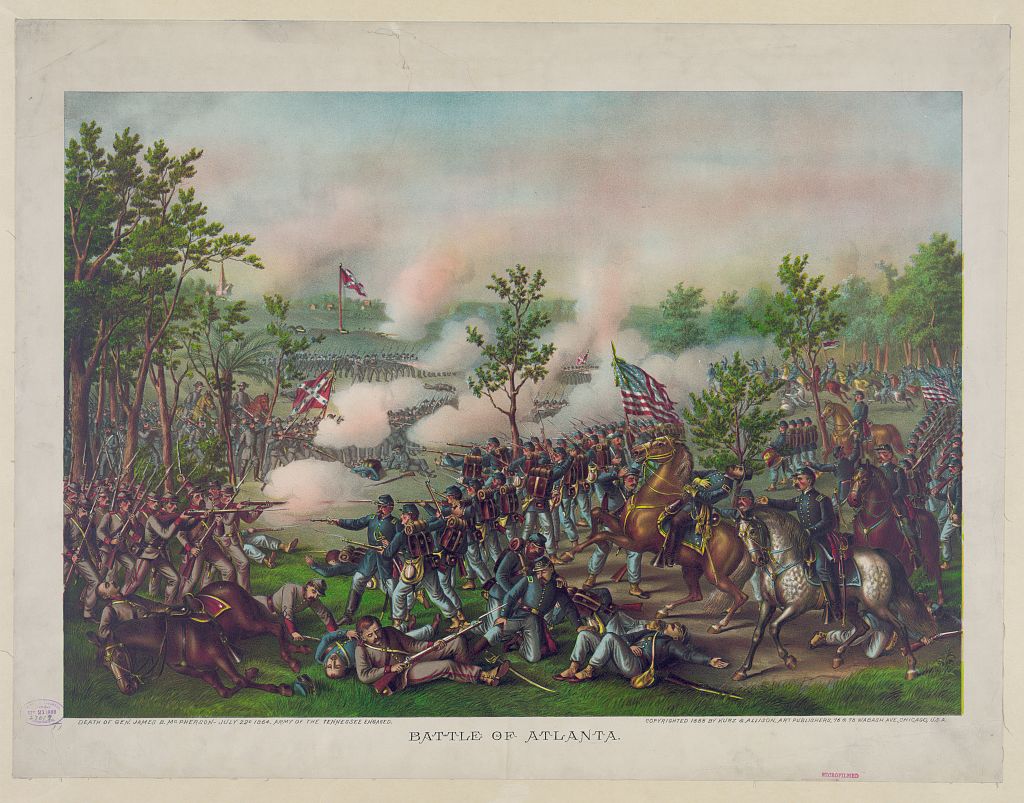
McPherson rode toward a threatened part of the Union line while investigating reports of fighting. He encountered Confederate soldiers in an area where the front was uncertain. He was shot and killed during the engagement, becoming one of the highest-ranking Union generals to die in the Civil War.
His death was a major personal and military loss to Sherman, who respected him deeply. However, the event should not be treated as proof the Union army had been defeated. The battle continued under other commanders, and Union positions ultimately held. Historical paintings that dramatize his death are later interpretations, not photographs of the precise moment.
What happened at Bald Hill?
Fighting around Bald Hill involved assaults on an important rise held by Union forces. The terrain helped Union defenders resist Confederate attacks, and both sides suffered as they contested nearby ground. The struggle was part of the wider attempt to turn McPherson’s flank rather than a separate campaign with an independent objective.
The location became associated with some of the battle’s fiercest combat. Commanders sent troops to support threatened positions, while Confederate units attempted to force defenders from their works. The ultimate inability to take and hold decisive ground contributed to the failure of Hood’s larger operation that afternoon.
Was the railroad contested?
Yes. Railroads and adjacent road corridors were key to Union movements and Confederate plans. Confederate attacks threatened sections of the Union line near the Georgia Railroad and adjacent ground. Control of this area affected how reinforcements could move and where attackers might find a weak point.
However, holding or briefly reaching a stretch of rail line was not equivalent to capturing Atlanta. The city’s eventual abandonment depended on later threats to transport connections farther south, including the operations at Jonesboro. Confusing these episodes can make the July 22 battle appear to have decided the whole campaign immediately.
Did Confederate troops achieve surprise?
The Confederate plan sought to strike from a direction the Union army did not expect. Some federal troops were caught off guard, but the changing positions of Union formations and the delay of Confederate columns reduced the plan’s effectiveness. Rather than a single decisive strike, the battle developed into multiple attacks along a shifting line.
Surprise can create opportunity, but only if troops exploit it rapidly and in coordination. Hood’s forces encountered resistance from units capable of turning and responding to the threat. The engagement therefore became a costly contest that consumed Confederate manpower without removing the broader Union advantage around Atlanta.
How many casualties were there?
The Battle of Atlanta caused thousands of casualties, although published estimates vary by source and by whether nearby operations are included. Confederate losses were particularly damaging because Hood’s army had already fought a long campaign. McPherson’s death was the most prominent Union loss, but many lesser-known soldiers were killed or wounded.
Casualties include wounded, captured and missing personnel as well as deaths. Comparing figures from different publications requires attention to definitions and time periods. Numbers alone also cannot explain the battle’s result: the Confederate attack failed because it did not dislodge Union forces from essential ground or remove the threat to Atlanta.
How did the battle affect ordinary people?
The fighting occurred around a populated transportation center, leaving residents exposed to military danger and disruption. Bombardment, restrictions on travel and shortages affected families even when the main battlefield lay outside their neighborhoods. Property, workshops and railroads were damaged by the extended campaign.
Enslaved people also experienced the approach of Union armies and the weakening of Confederate authority. Some sought freedom in Union-held areas, while others faced forced movement or continued exploitation. Including these experiences makes clear that the battle affected more than soldiers in uniform. Its military outcome changed the prospects of communities living around Atlanta.
Why did Atlanta remain Confederate after July 22?
The July 22 attack failed, but Hood’s army remained organized enough to defend the city. Sherman could not simply occupy Atlanta because Union forces had resisted successfully in one encounter. The city was supported by railroad connections that had to be threatened or cut to make defense impossible.
During August, Sherman shifted operations toward railroads south of the city. The fighting around Jonesboro at the end of the month endangered a vital route and prompted Hood to evacuate. Union troops entered Atlanta on September 2. Keeping these dates separate explains why the Battle of Atlanta is not the same event as the fall of Atlanta.
What effect did the battle have on Hood’s army?
Hood’s attempt to defeat an exposed part of the Union force did not achieve its aim, and the army suffered additional losses. It also failed to reverse the strategic pressure created by Sherman’s months-long advance. Even though the Confederates still defended Atlanta, their ability to replace men and retain mobility continued to decline.
The result shows the risks of seeking a dramatic battlefield success against a larger opponent near a vital city. Hood had reasons to act aggressively, but attacks that did not destroy Union formations could worsen his army’s position. Later Confederate attempts also failed to force Sherman away from the city.
Why does the Battle of Atlanta matter today?
The battle connects military maneuver, industrial logistics and national politics in the Civil War. Its outcome contributed to Sherman’s eventual capture of Atlanta, which strengthened Union morale and Lincoln’s reelection prospects. The death of McPherson gives it a distinct place in the histories of the western armies.
It also highlights the limits of popular battlefield art. The featured 1888 lithograph illustrates how the battle was remembered, but should not be presented as an eyewitness photograph. National Park Service maps and contemporary records offer a more reliable way to examine the actual movements and decisions.
How is the battle different from the Atlanta Campaign?
The Atlanta Campaign lasted from May to early September 1864 and included many engagements across northern Georgia. The Battle of Atlanta was one important fight on July 22 within that larger movement. Other encounters, including Kennesaw Mountain, Peachtree Creek and Jonesboro, shaped the final outcome.
Readers seeking the full sequence should use our Atlanta Campaign timeline, while this page concentrates on the July 22 action. Keeping those search intents separate makes both guides more useful: one explains months of strategy, and the other examines a specific battle, its commanders and its result.
Battle of Atlanta July 22 1864 timeline
These dates distinguish the main stages of the operation; the consequences often continued beyond the moment of battle.
| Date | Event |
|---|---|
| July 17 | Hood replaces Johnston in Confederate command. |
| July 20 | Peachtree Creek offensive is repulsed. |
| July 21 | Fighting builds around the Union eastern flank. |
| July 22, morning | Confederate forces advance to strike McPherson’s army. |
| July 22 | McPherson is killed; fighting around Bald Hill and the rail line. |
| July 22, evening | Confederate attacks fail to break Union positions. |
| September 2 | Atlanta is occupied by Union forces. |
Frequently asked questions
When did it happen? July 22, 1864.
Where did it take place? Atlanta, Georgia.
Who commanded the principal forces? Hood, Sherman, McPherson.
What was the outcome? Union defensive victory. The sections above explain the tactical result and the wider consequences.
How does it fit into the Civil War? For a broader chronology see the American Civil War guide.
Historical sources and further reading
The account uses National Park Service historical interpretation and Library of Congress records. Images are identified as contemporary photographs or later historical representations where applicable.