National Housing Act of 1934: How the FHA Changed Mortgages and Homeownership
What the National Housing Act did in June 1934, how federal mortgage insurance worked and how FHA underwriting entrenched racial exclusion.
Quick answer
President Franklin D. Roosevelt signed the National Housing Act on June 27, 1934. It created the Federal Housing Administration (FHA), which insured eligible mortgages issued by approved private lenders rather than directly lending government cash to every homebuyer. FHA insurance encouraged longer-term, amortizing home loans and supported residential construction and improvements. Its underwriting policies also contributed to racial discrimination and unequal access to housing credit. The FHA should not be confused with the Home Owners’ Loan Corporation (HOLC), created in 1933.
Key facts
On this page
- Housing finance before the 1930s reforms
- The mortgage crisis and the Home Owners’ Loan Corporation
- The National Housing Act signed June 27, 1934
- How FHA mortgage insurance worked
- Longer terms and amortization
- Home improvement and residential construction
- Why private lenders supported and resisted the program
- FHA redlining and discriminatory underwriting
- How FHA policies differed from HOLC security maps
- What the law meant for homeownership
- How the agency changed after 1934
- Why the 1934 National Housing Act matters
- Timeline
- Frequently asked questions
- Sources
Housing finance before the 1930s reforms
Obtaining a mortgage during the early twentieth century often involved shorter repayment periods and larger cash payments than the fully amortizing loans familiar in later decades. Borrowers could face a balloon payment at the end of a relatively short term, forcing them to refinance even when they had been making payments. Such arrangements exposed households to financial risk when credit tightened or property values declined. Conditions differed between localities and lenders, but the mortgage market remained fragmented and difficult for many families to navigate.
The Depression intensified those difficulties. Falling wages and unemployment made monthly payments harder, while falling property prices reduced the value of homes serving as loan collateral. Lenders became cautious, building activity slowed and construction employment collapsed. Reformers argued that stabilizing mortgage finance could support both homeowners and the wider economy. A reliable account should recognize that the system had problems before October 1929, even though the Depression made them far more severe.
The mortgage crisis and the Home Owners’ Loan Corporation
In 1933 Congress created the Home Owners’ Loan Corporation (HOLC) to refinance certain troubled existing mortgages. Its role was to help borrowers avoid foreclosure when they could not meet earlier loan terms. HOLC and the later FHA were therefore distinct agencies with different initial tasks. One sought to refinance some loans already in distress, while the other sought to encourage new, more sustainable private lending through government insurance.
This distinction is vital because many discussions of New Deal housing merge the agencies into a single program. HOLC later produced residential security maps used in historical studies of redlining, while the FHA developed its own underwriting practices. Both were federal institutions and their histories intersect, but assuming that HOLC maps originated every discriminatory FHA decision is too simple. Research shows that exclusionary FHA lending patterns were established independently and in some cases before those maps were prepared.
The National Housing Act signed June 27, 1934
Roosevelt approved the National Housing Act on June 27, 1934, as part of the New Deal response to economic distress. The statute, 48 Stat. 1246, authorized the Federal Housing Administration and programs supporting home improvement and mortgage credit. It sought to revive construction, protect lending institutions and make financing terms more predictable for borrowers. National Archives records identify the FHA’s establishment under the act and document its early correspondence and administrative history.
The law did not simply require the government to purchase every unsold property or make direct loans to all applicants. Its mortgage-insurance mechanism encouraged private lending under defined federal standards. Different provisions covered different types of housing-related credit, and detailed eligibility rules developed through regulations and underwriting manuals. Describing the legislation as a guarantee of universal homeownership would miss the restrictions and the limits of what the law actually enacted.
How FHA mortgage insurance worked
An FHA-insured mortgage was still generally issued by a private financial institution. The FHA evaluated whether a loan and property met its requirements and insured the approved lender against specified losses if the borrower defaulted. That reduced risk for lenders and could make them more willing to offer mortgages with improved terms. Borrowers ultimately remained responsible for their mortgage obligations and typically paid costs associated with obtaining insured financing.
Insurance did not mean a family received a free home, nor that every mortgage holder qualified automatically. Applicants and properties were screened, and loan size, down payments, repayment terms and documentation mattered. The precise requirements changed over time and across programs. For readers researching 1930s family finances, the difference between a federally insured private loan and direct federal ownership or lending is essential.
Longer terms and amortization
One of the most important developments associated with FHA finance was a shift toward longer-term mortgages repaid through regular installments that reduced principal as well as interest. An amortizing loan could avoid the dangerous need to refinance a large balloon balance after only a few years. Federal standards helped encourage a more consistent mortgage product and increased the appeal of financing home purchases through approved lenders.
The 1934 program should not be described as immediately guaranteeing the same thirty-year loan common in later decades. Early FHA single-family programs had shorter maximum terms, often up to twenty years, and terms evolved through legislative changes and market practice. Over subsequent decades thirty-year fixed-rate mortgages became much more common. The historical achievement lies in helping standardize and extend loan structures, not in inventing every modern mortgage feature in one statute.
Home improvement and residential construction
Beyond purchase mortgages, the National Housing Act contained provisions aimed at financing repairs and improvements. The federal government wanted homeowners to maintain properties and builders to find work in a construction industry badly damaged by the Depression. Improving roofs, plumbing, heating and other elements of a house could stimulate demand for materials and skilled labor. The Act’s Title I programs supported qualified lending for modernization rather than concentrating only on new construction.
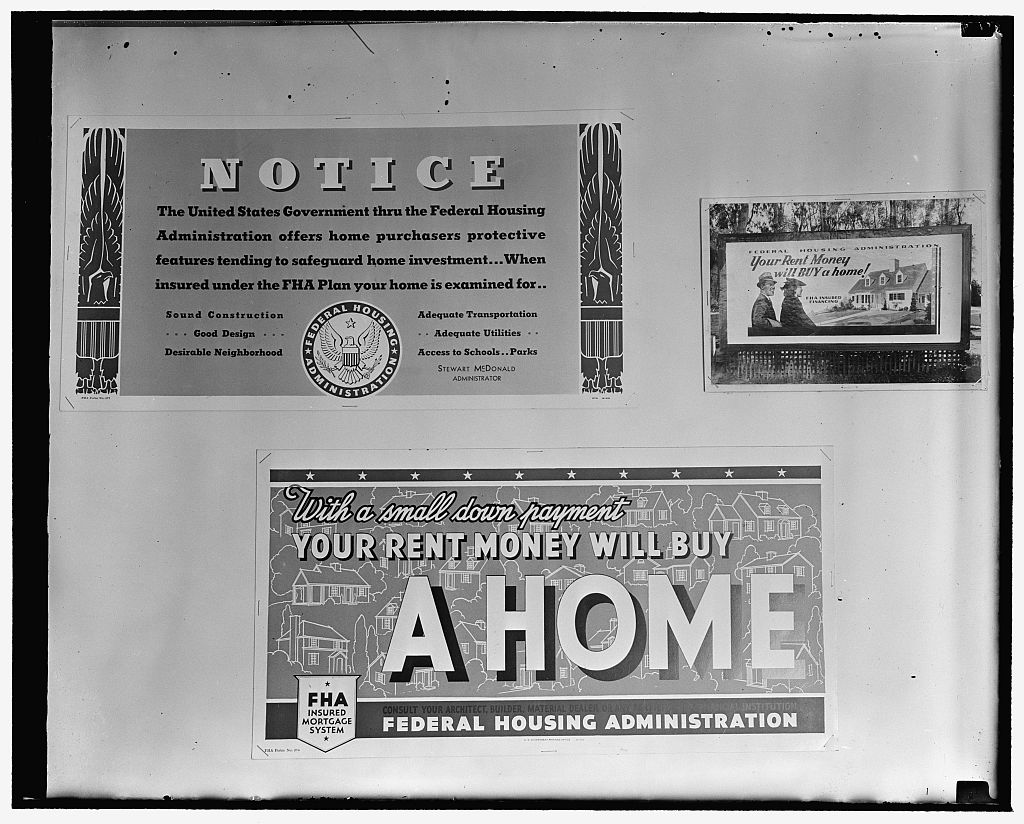
The historical photograph accompanying this article shows FHA promotional posters displayed several years after enactment. These advertisements reflect how the agency encouraged repairs, modernization and housing finance. The photograph is not of the June 1934 signing or of one particular family’s application. Period publicity illustrates federal policy goals, but administrative records are needed to establish which loans were approved and who actually received the benefit.
Why private lenders supported and resisted the program
Some lenders welcomed a system that reduced selected credit risks and offered clearer standards for mortgage investments. Others worried about federal competition, administrative complexity or changes to the established role of savings and loan institutions. The New Deal housing system developed through negotiation among public officials, mortgage lenders, builders and political interest groups. It altered incentives without abolishing private finance.
FHA programs also required judgment about whether a particular property and borrower were economically sound. Standards could encourage safer lending, yet they could also exclude people who lacked steady income or lived in neighborhoods the agency considered risky. The rules therefore had distributional consequences beyond the immediate financial calculations. The expansion of homeownership finance needs to be examined alongside the households left outside the system.
FHA redlining and discriminatory underwriting
The most serious limitation of the historical program was the treatment of race in mortgage risk assessment. FHA officials and underwriting manuals often considered racial composition and neighborhood segregation when evaluating the perceived stability of property values. In practice the agency largely excluded many core urban areas and Black borrowers from federal mortgage insurance. This contributed to unequal access to wealth-building opportunities and helped reinforce patterns of residential segregation.
The discrimination was not a harmless by-product of otherwise neutral arithmetic. Federal Reserve researchers have documented how the FHA developed exclusionary practices from its earliest operations. Later underwriting manuals contained explicitly discriminatory guidance. These historical policies should be identified as discriminatory, not repeated as valid assessments of the character or financial ability of entire communities. A home-finance program can increase lending overall while distributing its benefits unequally.
How FHA policies differed from HOLC security maps
Redlining histories often focus on color-coded residential security maps produced by the Home Owners’ Loan Corporation. Those maps became important visual evidence of how neighborhoods were classified, but newer research cautions against assuming that they were the original source of all FHA racial exclusion. The FHA began drawing its own underwriting conclusions before many HOLC maps were completed, and the agencies financed housing through different methods.
A study discussed by the Federal Reserve Bank of Chicago found that FHA mortgage insurance largely avoided central urban neighborhoods and Black mortgage borrowers, while HOLC refinancing did not follow the same pattern in every place. These findings do not absolve HOLC of discriminatory classifications or deny the harms of later map use; they clarify that the mechanisms differed. The distinction makes the article more accurate than a single story in which one federal map directly controlled every mortgage decision.
What the law meant for homeownership
Federal mortgage insurance helped support the expansion of an American housing finance system in which longer-term private mortgages became standard. It offered approved lenders a framework for reducing risk and helped many households obtain loans that might otherwise have been unavailable. By encouraging repairs, construction and mortgage activity, the program also formed part of broader Depression-era recovery policy.
The benefits were uneven. Households facing employment instability still struggled to qualify, and racial discrimination limited access in Black communities and some other minority neighborhoods. Later suburban development amplified the importance of obtaining mortgage credit, making exclusion particularly consequential across generations. It would be inaccurate to claim that the FHA made every American a homeowner or that federal policy operated separately from local segregation rules and private lenders’ decisions.
How the agency changed after 1934
The FHA survived the Depression and later became important in postwar housing finance, including loans involving returning veterans alongside separate Veterans Administration benefits. Legislative amendments broadened programs, altered underwriting practices and changed the available mortgage terms. The Department of Housing and Urban Development was established in 1965, and the FHA became part of HUD rather than remaining an independent agency.
Fair housing laws and later regulations sought to address discrimination that earlier federal practices had helped institutionalize. The Fair Housing Act of 1968 marked an important federal prohibition on housing discrimination, though inequities persisted. The agency’s history therefore spans both financial innovation and changes to the legal framework governing access. Its founding should be evaluated in that longer context rather than treated as a policy whose effects stopped in the 1930s.
Why the 1934 National Housing Act matters
The National Housing Act created a durable institution and helped reshape the mortgage market from a fragmented system of shorter loans and frequent refinancing toward more standardized, longer-term borrowing. It also provided a mechanism to support private housing credit through federal insurance and helped finance repairs and building. Those developments became important to the structure of American homeownership.
At the same time, discriminatory underwriting excluded many families from benefits that others received. The law’s significance thus includes both innovation and unequal opportunity. Comparing the FHA with the Reconstruction Finance Corporation and the Banking Act of 1933 illustrates several different ways federal institutions tried to restore confidence in lending during the Depression.
Timeline
- Early 1930s: Mortgage foreclosures and housing construction crisis
- 1933: HOLC established to refinance certain troubled mortgages
- June 27, 1934: National Housing Act creates FHA
- 1935–1938: FHA underwriting guidance formalizes program practices
- Late 1930s: Government-insured mortgages grow
- 1965: FHA becomes part of HUD
- 1968: Fair Housing Act prohibits important categories of discrimination
Frequently asked questions
When was the National Housing Act passed?
June 27, 1934.
What federal agency did it create?
The Federal Housing Administration (FHA).
Does the FHA lend directly to homebuyers?
The FHA historically insured qualifying loans from approved private lenders rather than simply distributing home-purchase cash directly.
Was the FHA the same as the HOLC?
No. The HOLC, created in 1933, refinanced existing troubled mortgages, while the FHA supported private lending through insurance.
Did the original 1934 law create modern thirty-year mortgages?
It helped expand longer-term amortized loans, but early FHA programs generally had shorter terms than the later common thirty-year mortgage.
Did FHA policies contribute to redlining?
Yes. Historical FHA underwriting excluded many Black borrowers and neighborhoods, contributing to racial disparities in housing finance.
Sources and further reading
- National Archives — FHA Records and Founding
- HUD — FHA History
- FDR Presidential Library — Housing Legislation
- Federal Reserve History — Redlining
- Federal Reserve Bank of Chicago — Federal Housing Programs and Redlining
- FRASER — FHA Underwriting Manuals
- Federal Reserve Bank of Richmond — History of Long-Term Mortgages