Banking Act of 1933 (Glass–Steagall): FDIC, Bank Separation and Legacy
What Glass–Steagall did in 1933, how it separated major banking activities, why the FDIC was created and which provisions changed in 1999.
Quick answer
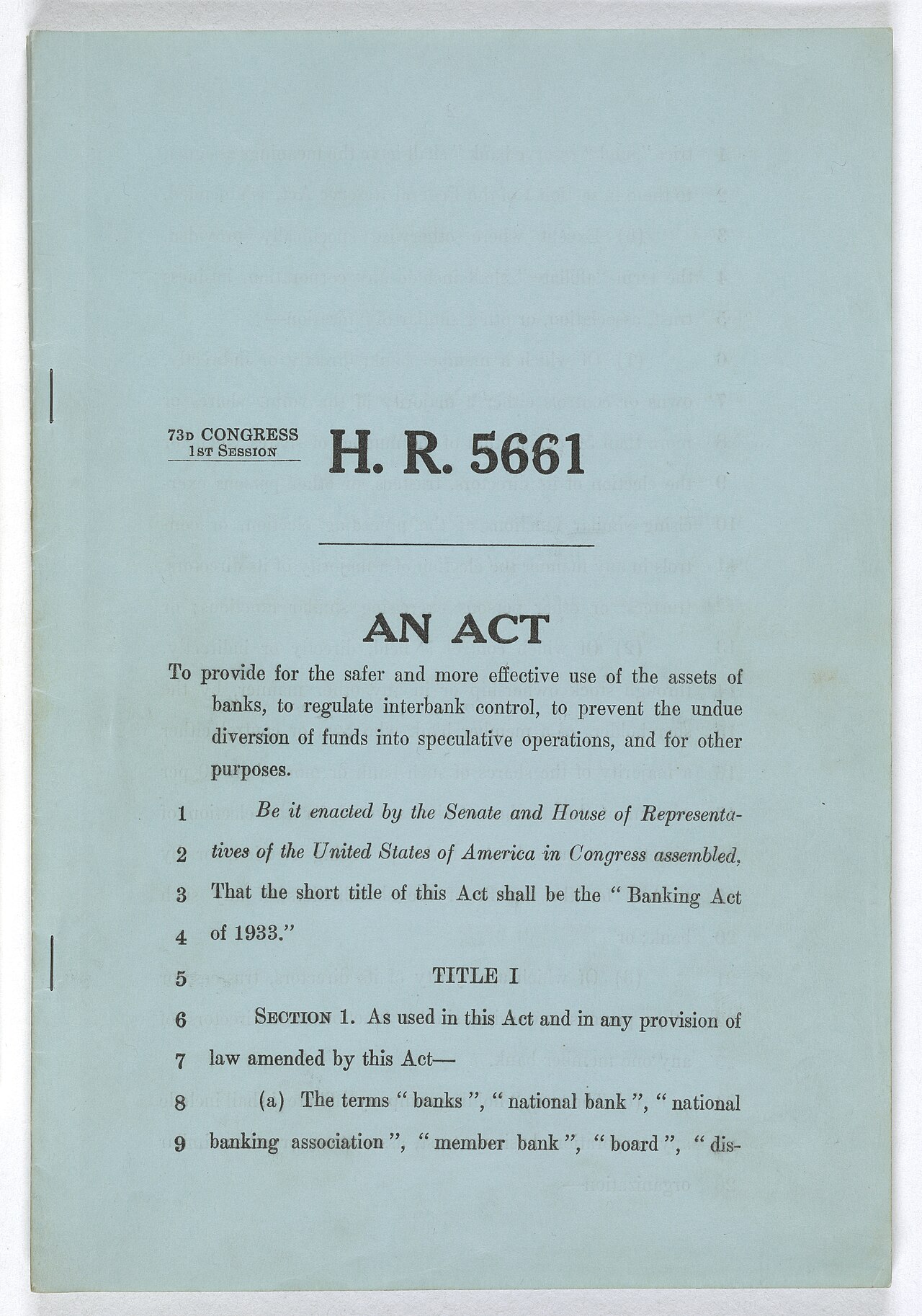
President Franklin D. Roosevelt signed the Banking Act of 1933 on June 16. The legislation, commonly associated with Senator Carter Glass and Representative Henry B. Steagall, restricted affiliations and certain activities linking commercial banks with securities underwriting and dealing. It also established the Federal Deposit Insurance Corporation (FDIC), with initial temporary deposit insurance beginning January 1, 1934. Certain separation provisions were repealed in 1999, but that did not repeal the entire 1933 act or abolish deposit insurance.
Key facts
On this page
- Why banking reform became urgent in 1933
- The bill’s sponsors and its June 16 enactment
- What the separation of banking activities meant
- Why federal deposit insurance was introduced
- When the FDIC began protecting deposits
- The Federal Reserve and the new banking framework
- Why banks’ securities affiliates attracted suspicion
- The relationship to the Securities Acts of 1933 and 1934
- How the rules developed over subsequent decades
- What the 1999 Gramm–Leach–Bliley Act repealed
- Why the 1933 act remains historically significant
- Timeline
- FAQs
- Sources
Why banking reform became urgent in 1933
The United States entered 1933 after several years of banking failures, runs and falling confidence. Thousands of families and businesses had lost access to deposits, and withdrawals placed additional pressure on institutions already weakened by loan defaults and falling asset values. Reformers argued that the crisis exposed serious flaws in the banking system, including the possibility that risky securities business could become entangled with ordinary deposit-taking. Others believed failures were driven more by monetary contraction and a weak economy than by securities affiliation alone.
The Banking Act of 1933 was a response to those concerns, but it came after the emergency banking measures of March. The Emergency Banking Act helped authorities reopen banks during an immediate crisis. The June statute addressed structural questions about which activities banks could undertake and how depositors might be protected from future losses. The difference between crisis stabilization and permanent institutional reform is central to the history.
The bill’s sponsors and its June 16 enactment
Senator Carter Glass of Virginia had played a prominent role in earlier banking legislation, including the creation of the Federal Reserve System. Representative Henry B. Steagall of Alabama chaired the House Banking and Currency Committee and strongly supported federal deposit insurance. Their proposals reflected somewhat different priorities that were combined as Congress worked toward a broad measure. The legislation became law when Roosevelt signed it on June 16, 1933.
The photograph accompanying this article is an official portrait of Steagall from approximately 1933. It identifies a principal lawmaker rather than depicting a particular vote or the bill signing. Congressional negotiations were complex, and the final law cannot be reduced to either sponsor’s personal preference. Understanding its components requires examining both the banking-securities restrictions and the separate arrangements for insuring deposits.
What the separation of banking activities meant
The Glass–Steagall provisions restricted certain combinations of commercial banking and securities business. Commercial banks traditionally took deposits and made loans, while securities firms could underwrite, distribute or deal in stocks and bonds. Congress worried that close relationships between the two fields might allow speculative activities to expose bank depositors to loss or create conflicts of interest. Sections of the 1933 law limited particular securities transactions by banks and affiliations with firms engaged principally in securities activity.
The popular shorthand that the act made ‘banks and Wall Street totally separate’ overstates the law’s precise scope. Exceptions and definitions mattered, and banks continued to engage in activities such as certain government securities transactions. The statute was also applied through interpretation, supervision and later amendments. A historically accurate account should distinguish prohibitions on particular activities and affiliations from a universal rule that no bank could ever hold or transact any security.
Why federal deposit insurance was introduced
A person depositing savings at an ordinary bank faced the risk of loss if the institution collapsed. During the Depression, news of failures encouraged other customers to withdraw, sometimes causing panic that endangered otherwise viable institutions. Advocates of federal deposit insurance argued that protecting qualifying deposits would reduce that fear. If depositors believed their insured funds were safe, they might be less likely to run to the bank at the first rumor of trouble.
Steagall was a strong supporter of this approach, while some banking officials and economists feared insurance could weaken market discipline or force sound banks to subsidize risky institutions. Congress ultimately included federal deposit insurance in the June statute. The FDIC was established as a new federal institution with responsibility for the insurance system, subject to specific rules and limits. The insurance plan was not an unlimited government guarantee covering every amount, investment or financial product.
When the FDIC began protecting deposits
The FDIC was created in June 1933, but temporary federal deposit insurance did not begin until January 1, 1934. The initial temporary program insured eligible deposits up to $2,500, before later changes increased coverage. Distinguishing the founding date from the start of payments under the program prevents misleading descriptions of the law’s immediate effects during the March bank holiday.
The structure of insurance evolved after enactment. The Banking Act of 1935 made important revisions and established a more permanent framework for the FDIC. Later decades saw additional changes to limits, funding and bank-supervision arrangements. Those later developments should not be projected backward into 1933. Readers tracing their own historical bank records need to know which protection rules applied at the particular time being studied.
The Federal Reserve and the new banking framework
The act made changes beyond the two features most often emphasized. It altered parts of the Federal Reserve’s structure and helped formalize arrangements for open-market policy coordination. It also included provisions affecting interest on deposits and other banking practices. The Federal Reserve’s own history explains that the law sought a more stable system after the fragmented and inconsistent responses to earlier bank failures.
These changes were not independent of the broader New Deal but should still be analyzed separately. Congress had created the Federal Reserve System in 1913, and policy difficulties during the Depression encouraged lawmakers to modify it. Banking Act reforms continued in 1935. The interwar banking system therefore evolved through several statutes rather than a single 1933 law that completed every aspect of the modern regulatory framework.
Why banks’ securities affiliates attracted suspicion
In the 1920s some commercial banking organizations operated or were closely connected to companies distributing securities. Critics argued that these relationships created incentives to sell investments to customers and could blur the separation between depositors’ funds and speculative activities. Senate investigations into stock-market practices, including the Pecora hearings, brought public attention to conflicts of interest and business conduct. The investigations helped build political support for a different regulatory structure.
However, historians do not unanimously agree that securities affiliates were a principal cause of the Depression’s bank failures. Many rural or smaller banks failed without the types of large securities operations that received prominent criticism. The law’s authors sought to remove perceived dangers and restore confidence, but evaluating their economic diagnosis requires wider evidence. Distinguishing lawmakers’ motives from later research is important when assessing the act’s historical effectiveness.
The relationship to the Securities Acts of 1933 and 1934
Congress also addressed securities markets through separate federal legislation. The Securities Act of 1933 focused primarily on disclosure requirements for new securities offerings, while the Securities Exchange Act of 1934 created the Securities and Exchange Commission and established a wider framework for regulating trading markets, brokers and exchanges. These laws were related to concerns about financial misconduct, but they had distinct texts, dates and regulatory goals.
The Banking Act’s commercial-investment restrictions should not be confused with the SEC’s later supervision of securities markets. Glass–Steagall addressed what particular banks and affiliates could do; securities legislation sought to regulate market participants more generally. Reading the statutes together explains the multi-part federal response to financial instability rather than attributing every New Deal market rule to one banking bill.
How the rules developed over subsequent decades
Implementation of banking separation depended on the language of statutory sections and interpretations by regulatory bodies. Financial institutions changed over time, and new products complicated the boundaries between banking and securities activity. By the late twentieth century, critics argued that restrictions limited competition and the ability of American financial groups to offer services across different markets. Defenders maintained that the separation reduced conflicts and protected ordinary depositors.
Regulatory interpretations and market practices had already changed before 1999. Some banking organizations operated securities affiliates within permitted or interpreted limits. This history prevents treating 1933 as a period of perfectly complete separation that remained unaltered until a single later repeal. The evolution was gradual and contested, reflecting changing economic structures as well as political disagreement.
What the 1999 Gramm–Leach–Bliley Act repealed
The Gramm–Leach–Bliley Act of 1999 removed major statutory barriers to affiliations among commercial banks, investment banks and insurance companies. It repealed Glass–Steagall sections 20 and 32, which had limited certain banking-securities affiliations and overlapping management relationships. The change allowed new forms of financial holding-company organization, subject to other supervisory requirements.
It is inaccurate to say that the 1999 law simply repealed all of Glass–Steagall or ended the FDIC. Other provisions of the 1933 banking framework, including restrictions on direct bank securities activity in sections 16 and 21, remained in modified form. Federal deposit insurance also continued. Debates over later financial crises often refer to the repeal, but evaluating those crises requires careful analysis of institutions and transactions rather than asserting that all banking regulation vanished in 1999.
Why the 1933 act remains historically significant
The Banking Act of 1933 was a major attempt to rebuild confidence after a devastating series of bank failures. It established federal deposit insurance and imposed significant limits on some combinations of deposit banking and securities business. Those provisions reflected contemporary fears about conflicts of interest, risky practices and the fragility of public trust in banks. The law helped reshape American financial institutions across many decades.
The full history includes both immediate context and later change. The March emergency act helped halt panic; the June reform act created a longer-lasting deposit-insurance system; and the 1934 securities law added another regulatory institution. The 1999 changes altered important affiliation provisions without erasing the whole statute. Preserving those distinctions makes Glass–Steagall useful historical evidence rather than a slogan detached from its actual legal content.
Timeline
- March 6, 1933: National bank holiday begins
- March 9, 1933: Emergency Banking Act enacted
- June 16, 1933: Banking Act / Glass–Steagall signed
- January 1, 1934: Temporary FDIC deposit insurance begins
- 1935: Banking Act reorganizes parts of banking system
- 1999: Gramm–Leach–Bliley repeals key affiliation provisions
Frequently asked questions
When did Glass–Steagall become law?
June 16, 1933, when Roosevelt signed the Banking Act of 1933.
Who were Glass and Steagall?
Senator Carter Glass and Representative Henry B. Steagall, principal congressional figures associated with the law.
What did the act separate?
It restricted specified commercial banking activities and affiliations involving securities underwriting and dealing.
Did it create the FDIC?
Yes. The statute established the Federal Deposit Insurance Corporation.
When did FDIC insurance begin?
Temporary federal deposit insurance began January 1, 1934, initially covering eligible deposits up to $2,500.
Was the entire Glass–Steagall Act repealed in 1999?
No. The Gramm–Leach–Bliley Act repealed major affiliation restrictions, but not every provision or deposit insurance.
Did the March Emergency Banking Act create deposit insurance?
No. That was a separate March 1933 law addressing the immediate bank holiday and reopening.