Battle of Fort Wagner (July 18, 1863): The 54th Massachusetts Assault
Why the Union assault failed, what the 54th Massachusetts achieved and how the siege ultimately ended.
On July 18, 1863, Union forces attacked Confederate Fort Wagner on Morris Island near Charleston. The 54th Massachusetts, a Black Union regiment, led the assault and reached the defenses, but the attackers were repulsed with severe casualties. Colonel Robert Gould Shaw was killed. The Confederates held the fort that day but evacuated it during a prolonged Union siege in early September.
The battle’s tactical outcome and its importance to Black military service are distinct parts of the history.
On this page — 23 topics
What was Fort Wagner?
Fort Wagner was a Confederate earthwork on Morris Island, a narrow barrier island outside Charleston Harbor in South Carolina. It protected the southern approaches to Charleston’s inner defenses, including Fort Sumter. Because of the surrounding marshes, surf and constrained sandbar, an attacker approaching from the south had limited room to deploy. The fort was built to withstand bombardment and infantry assault. The July 18, 1863 attack is remembered above all for the role of the 54th Massachusetts Infantry, an African American Union regiment, but the action involved several federal formations and the wider campaign to reduce Charleston’s harbor defenses.
Why did Union forces attack Morris Island?
Charleston held enormous symbolic value: Confederate forces had fired on Fort Sumter in April 1861, beginning the Civil War’s major combat. Union commanders hoped to seize positions from which they could bombard and weaken harbor fortifications, disrupt shipping and threaten the city. Morris Island offered ground for batteries aimed at Fort Sumter and the approaches to Charleston. Capturing Fort Wagner was therefore a means to a larger military end rather than simply a desire to occupy a stretch of beach. The operation combined naval bombardment, ground assaults, trenches and later siege artillery.
Where exactly was Battery Wagner?
The fort stood on Morris Island near the Atlantic Ocean, south of Charleston Harbor. The beach offered the main approach from the Union positions to the south. Confederate defenses occupied the width of the island and were supported by natural obstacles, artillery and other works. Erosion and changes to coastal geography mean that much of the wartime landscape is not preserved in the form seen by soldiers in 1863. Modern maps should therefore be compared with period surveys. The relationship between the sea, marsh and narrow beach is essential to understanding the terrible concentration of fire during the assault.
What had happened before July 18?
Union forces began major operations against Morris Island in early July 1863. Federal troops seized positions on the southern part of the island on July 10, but a July 11 assault against Fort Wagner failed. The Union command then brought additional troops and artillery forward. Naval gunfire prepared the next attempt, while engineers and officers planned how infantry would cross the exposed approach. The defenders were not surprised by the prospect of another attack. The earlier failure had already demonstrated the strength of the works, yet a direct assault still seemed attractive because it might deliver a rapid victory.
Who led the Union operation?
Brigadier General Quincy A. Gillmore commanded the Union operations against Charleston’s defenses and directed the campaign on Morris Island. Brigadier General Truman Seymour was among the officers leading assaulting troops. The 54th Massachusetts, commanded by Colonel Robert Gould Shaw, spearheaded one of the main columns. Union naval forces supplied essential bombardment support and worked in coordination with troops ashore. The operation therefore cannot be reduced to the decisions of Shaw alone. Higher command selected the objective and methods, while individual regimental officers and soldiers carried the risk of moving across ground dominated by Confederate weapons.
Who defended Fort Wagner?
Confederate troops inside the fort belonged to the Charleston defense system under General P. G. T. Beauregard’s overall command. Defenders were familiar with the narrow approaches and used heavy artillery, musketry and protected positions to resist the attack. The Confederate garrison was smaller than the total Union assault force but possessed a substantial advantage in its prepared fortifications. That mismatch between attacking numbers and defensive position explains why a relatively small garrison could impose heavy losses. Contemporary Confederate accounts are useful for reconstructing the timing of fire and counterattacks, though, like Union reports, they require comparison with other evidence.
Why did the 54th Massachusetts lead the charge?
The 54th Massachusetts was an African American regiment whose officers sought combat responsibility rather than confinement to fatigue duties. Its performance on James Island two days earlier strengthened its reputation. Gillmore’s command selected the regiment to lead the July 18 assault, placing it at the front of a difficult operation. For Black soldiers, the assignment had significance beyond tactical prestige: their conduct would be judged by a nation debating the enlistment and abilities of African Americans. That responsibility did not make the attack any less dangerous. It made the battle both a military event and a test of racial prejudice in public debate.
What did the naval bombardment accomplish?
Union warships and artillery bombarded Fort Wagner before the infantry assault. The shells damaged parts of the works and caused casualties, but the sand-and-earth defenses absorbed punishment more effectively than masonry walls. Confederate troops took cover in protected areas and could emerge once the infantry came within range. A bombardment that looked overwhelming from outside therefore did not guarantee the garrison’s destruction. The failure to neutralize defensive fire was central to the assault’s outcome. It also illustrates a common Civil War challenge: artillery preparation and frontal infantry attacks were often poorly matched to strong earthwork fortifications.
How did the evening assault begin?
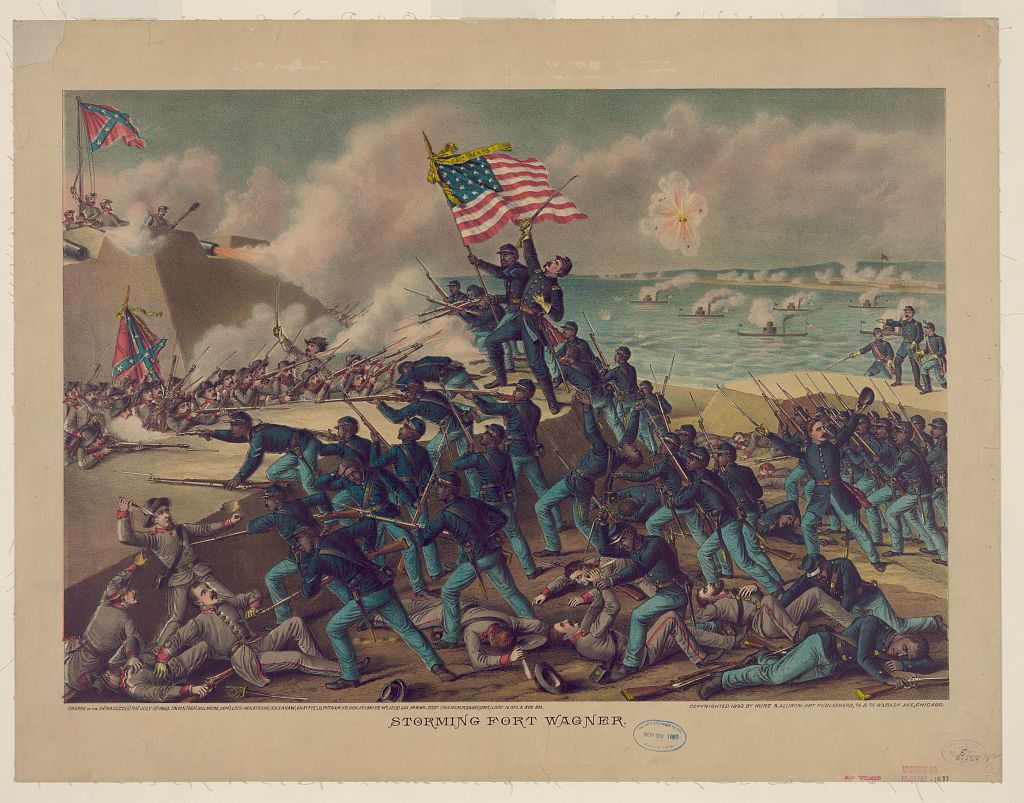
At dusk on July 18, the 54th Massachusetts advanced along the narrow beach toward Fort Wagner. The soldiers moved under fire from Confederate artillery and infantry. Their approach became increasingly disorderly as men fell, officers struggled to communicate and units encountered obstacles. Some reached the ditch and parapet, where close-range combat followed. These events are sometimes depicted as a neat line climbing the fort in unison. Contemporary testimony instead describes confusion, darkness and movement by separated groups of soldiers. The darkness did not protect the attackers from heavy defensive fire at close range.
Did Union troops reach the ramparts?
Yes. Men of the 54th Massachusetts and other Union formations reached parts of the defensive line and fought on or near the parapet. Their presence at the works shows that the assault was more than a failed advance across open sand. Nevertheless, the attackers could not consolidate a secure foothold or bring forward enough reinforcement to hold the position. Confederate defenders counterattacked and maintained control of the fort. This distinction matters: a soldier reaching the top of an earthwork was a significant personal achievement, but it did not mean the military objective had been captured.
What happened to Robert Gould Shaw?
Colonel Robert Gould Shaw was killed during the assault as the 54th fought at the fort. His death became one of the most widely discussed episodes in Union accounts. Confederate troops buried Shaw with Black soldiers killed nearby, apparently expecting the burial to dishonor a white officer. His family instead regarded the shared grave as an honorable resting place. Later memorials prominently portrayed Shaw, although historians increasingly emphasize the choices and sacrifices of the regiment’s Black enlisted men. For a broader account of their two-year service, see our 54th Massachusetts guide.
What did Sergeant William Carney do?
Sergeant William H. Carney of the 54th Massachusetts carried the United States flag during the assault and kept it from being captured despite being wounded. His actions became a celebrated example of individual bravery. Decades later, in 1900, Carney received the Medal of Honor. Because early popular accounts often highlighted white commanders, his story is especially important for recovering the actions of Black noncommissioned officers. A careful description distinguishes the historical award and eyewitness evidence from later embellished quotations. It should not imply that a single flag bearer explains the contributions of an entire regiment.
How many casualties occurred?
The National Park Service’s Civil War battle summary estimates 1,737 total casualties for the Second Assault on Fort Wagner: approximately 1,515 Union and 222 Confederate. The totals include military casualties as defined by the summary and should not be read as the number killed alone. Other historical accounts may differ because they refer to different time spans, units or reporting categories. The most reliable interpretation is that the Union attackers suffered exceptionally heavy losses and failed to take the fort. The disaster was costly to the 54th Massachusetts and to other participating federal units.
Why did the attack fail?
The Confederate defenses were strong, the approach was restricted and the preliminary bombardment did not eliminate defenders. Infantry approaching through sand and under intense fire struggled to maintain formations, while the attackers could not hold the points they reached. Reinforcement across the same narrow approach was difficult. Command decisions must also be considered, particularly the willingness to attempt another frontal assault after the July 11 failure. It is historically inaccurate to blame the outcome on the race or performance of the 54th Massachusetts. Contemporary observers recognized the regiment’s bravery even as they acknowledged the operation’s failure.
Did the Confederates keep Fort Wagner permanently?
No. The July 18 assault failed, but Union forces continued siege operations on Morris Island. Engineers built trenches and batteries, and sustained bombardment eventually made the fort untenable. Confederate forces evacuated Fort Wagner and Battery Gregg in early September 1863. The Union then gained control of Morris Island, allowing it to intensify attacks on Fort Sumter. This sequence is a reminder that one battle and an entire campaign can have different outcomes. The defenders won the immediate assault, while the Union ultimately occupied the island after extended siege work.
Did Union soldiers capture Charleston in 1863?
They did not. Taking Morris Island and damaging harbor defenses created new pressure on Charleston, but the city remained under Confederate control. Union siege operations, blockade activity and shelling continued without producing an immediate surrender of the city. Charleston was evacuated by Confederate forces in February 1865 during the wider collapse of their position in the Carolinas. A guide that treats September 1863 as the capture of Charleston confuses an important tactical gain with the eventual fall of the city. The distinction is essential to the longer chronology of the coastal war.
How did the battle influence Black enlistment?
The attack offered widely reported evidence of the fighting ability and determination of African American Union soldiers. That mattered in a country where racial prejudice had long shaped military policy. Many Black men had already enlisted or sought to enlist, and their performance at Fort Wagner helped strengthen the broader effort to recruit additional United States Colored Troops. The battle did not end discrimination, unequal pay or threats against captured Black soldiers. Instead it became one powerful episode in a larger story of Black participation in the destruction of slavery and defense of the Union.
How are the events shown in historical art?
The best-known images of Fort Wagner include late nineteenth-century lithographs depicting the 54th Massachusetts charging beneath flags and explosions. Such artworks helped create public memory of the attack, but they were made after the event and may simplify the battlefield’s layout, timing and participants. Photographs and engravings of the surrounding campaign offer different forms of evidence. It is misleading to caption a later painting as if it were a photograph taken during the charge. The image accompanying this article is explicitly identified as a retrospective illustration rather than contemporary camera evidence.
What is the legacy of the assault?
Fort Wagner is remembered both for the limits of frontal attacks against prepared Civil War earthworks and for the public significance of Black Union soldiers under fire. The 54th Massachusetts and its comrades failed to occupy the fort that night, yet their conduct challenged assumptions used to deny military responsibility to African Americans. The history is more complex than a simple tale of victory or defeat. It includes leadership decisions, costly tactical conditions, unequal treatment, military persistence and later battles over commemoration. A sound account recognizes the regiment’s courage without romanticizing the losses inflicted by the decision to assault.
Where can readers verify the battle?
The National Park Service battle record provides the result and casualty estimate. The NPS study of the 54th and the Second Battle of Fort Wagner explains the sequence and context. Researchers can compare these accounts with wartime military reports, soldiers’ letters and contemporary newspapers. The separate 54th Massachusetts regiment article focuses on recruitment and subsequent service, avoiding duplication of the battle’s tactical explanation.
Morris Island campaign timeline
| Date | Event |
|---|---|
| July 10, 1863 | Union troops occupy southern Morris Island. |
| July 11 | First major attack on Fort Wagner is repulsed. |
| July 16 | 54th Massachusetts fights Confederate troops on James Island. |
| July 18 | 54th leads the evening attack; Confederates retain Fort Wagner. |
| August 1863 | Union siege works and bombardment intensify. |
| Early September 1863 | Confederate forces evacuate Fort Wagner and nearby works. |