Liberty Ships in World War II: How America Mass-Produced Cargo Ships
Why U.S. yards built more than 2,700 Liberty cargo ships, how welded sections accelerated production, and what their achievements and structural weaknesses revealed.
Quick answer
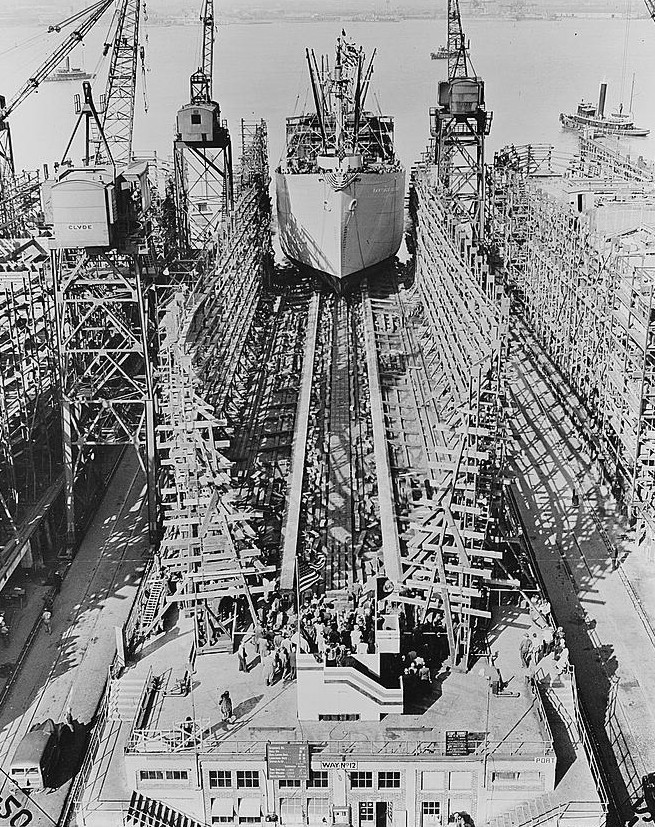
Liberty ships were standardized U.S. merchant cargo vessels mass-produced during World War II to replace shipping losses and move supplies overseas. The first, SS Patrick Henry, was launched September 27, 1941. More than 2,700 were built by 1945; published totals differ slightly depending on whether particular variants are included. Their relatively simple design, welded construction and prefabricated sections accelerated shipbuilding. The famous SS Robert E. Peary launch after roughly four days was a demonstration, not a typical production time. Liberty ships delivered vital cargo but also experienced problems such as brittle-fracture hull cracking.
Key facts
On this page
- Why the Allies needed thousands of cargo ships
- The Emergency Shipbuilding Program and a standardized design
- SS Patrick Henry and the first Liberty launches
- Henry Kaiser’s yards and the Richmond industrial complex
- Why prefabrication transformed production
- The four-day SS Robert E. Peary achievement
- Workers, women and the wartime shipyard labor force
- What Liberty ships carried and where they sailed
- Welded hulls and brittle-fracture problems
- Why Victory ships were built as successors
- What happened to Liberty ships after 1945
- Why Liberty ships were essential to Allied victory
- Timeline
- FAQs
- Sources
Why the Allies needed thousands of cargo ships
World War II depended on the movement of food, fuel, ammunition, vehicles and machinery across vast oceans. Britain required imported supplies to continue fighting, and later American troops needed continuous deliveries to bases and invasion areas. German submarines attacked merchant shipping in the Atlantic, destroying vessels and threatening the flow of vital cargo. Shipbuilding was therefore a strategic contest in which construction capacity had to exceed losses while also supporting an expanding Allied war effort.
Before American entry into the war, the United States was already supplying Britain under commercial arrangements and then the Lend-Lease program. The problem was not simply manufacturing tanks or aircraft; those goods were of little use if they could not reach Allied forces. Merchant ships were essential links in the global supply chain, even though they lacked the public glamour associated with aircraft carriers and battleships.
The Emergency Shipbuilding Program and a standardized design
The U.S. Maritime Commission sought a cargo vessel that could be built quickly and economically in a wide variety of shipyards. Designers adapted an earlier British merchant-ship concept rather than create every technical feature from scratch. The resulting Liberty ship used a relatively conventional hull and machinery arrangement suitable for large-scale industrial production. Standardization allowed yards to repeat work instead of constantly redesigning ships for individual owners.
The basic vessel was designed to carry approximately 10,000 deadweight tons of cargo and operate at a relatively modest speed around eleven knots. It was not intended to be a fast naval warship. Its value was in reliability, cargo space and the ability to manufacture enormous numbers. The Maritime Commission placed orders among yards in several states, creating a national construction program with suppliers producing steel plates, engines, equipment and fittings.
SS Patrick Henry and the first Liberty launches
The first Liberty ship, SS Patrick Henry, was launched on September 27, 1941, before the United States entered World War II. The ship’s name recalled the American revolutionary figure and reflected the practice of naming Liberties after prominent Americans. Several yards launched ships during widely publicized Maritime Day or Liberty Fleet ceremonies, presenting construction as a patriotic national effort.
The first ship took many months to complete by later wartime standards. It would be misleading to describe the entire early program as able to finish ships in four days. Techniques, yard layouts and worker experience improved gradually, reducing average construction time. Historical Maritime Commission records distinguish keel laying, launching and actual delivery; these dates should not be treated as identical stages of construction.
Henry Kaiser’s yards and the Richmond industrial complex
Industrialist Henry J. Kaiser became closely associated with rapid wartime shipbuilding, particularly through large yards in Richmond, California, and elsewhere on the West Coast. His companies helped organize manufacturing processes, recruit labor and coordinate suppliers for immense orders. The National Park Service’s Rosie the Riveter/WWII Home Front National Historical Park documents the Richmond shipyards and their workers.
Kaiser did not personally invent the entire Liberty ship or own every American shipyard involved in construction. Bethlehem-Fairfield in Baltimore and multiple other companies also built large numbers. The program combined federal procurement with different private shipbuilders, each adapting methods to its facilities. Recognizing the variety of yards prevents the history from turning into a one-man story about industrial genius.
Why prefabrication transformed production
Shipyards increasingly assembled components and sections away from the final building ways, then moved them by crane to be joined into the hull. This method allowed several teams to work simultaneously, reducing the time a nearly completed ship occupied scarce launching space. Standardized dimensions and repeated operations also made worker training and supply scheduling easier. Welding replaced much riveting, cutting assembly time when applied successfully.
Prefabrication demanded precise coordination. Poorly fitted components could delay completion, and yards still needed skilled specialists for machinery, piping, electrical systems and inspections. A floating ship was not necessarily ready for ocean service the moment it entered the water. Finishing work and sea trials remained essential. The achievement lay in making thousands of large industrial operations repeatable rather than eliminating craftsmanship.
The four-day SS Robert E. Peary achievement
In November 1942 workers at a Kaiser-operated Richmond yard assembled SS Robert E. Peary in an extraordinary demonstration lasting roughly four days and fifteen hours from keel laying to launch. The feat drew national attention and became one of the most memorable symbols of American industrial productivity. It required advance planning and extensive prefabrication, with materials and assemblies prepared beforehand.
The celebrated record should not be confused with average building times. U.S. Army historical research notes that typical production periods fell substantially as the program matured but were commonly measured in weeks rather than four days. The Robert E. Peary event was deliberately organized to show what coordinated workers and prepared parts could accomplish. It was an exceptional publicity milestone, not proof that all 2,700-plus ships were constructed in less than a week.
Workers, women and the wartime shipyard labor force
American shipyards recruited hundreds of thousands of workers as the production program expanded. Women entered trades including welding, machining and fitting, while Black Americans and migrants from many regions sought industrial wages. Training programs helped people acquire skills that shipyards urgently needed. The War Production Board coordinated materials priorities that supported these and other defense industries.
Opportunities were uneven. Racial discrimination affected hiring, promotion and housing, and women faced barriers in jobs traditionally held by men. Industrial accidents and exposure to hazardous materials created dangers that public recruiting posters often omitted. The familiar image of the cheerful wartime welder is part of the record, but so are labor disputes, exhaustion and the difficulties of accommodating rapidly growing communities near the yards.
What Liberty ships carried and where they sailed
Liberty ships transported food, ammunition, tanks, trucks, fuel-related cargo, clothing and other supplies across the Atlantic, Pacific and Indian Oceans. Cargoes supported Allied armies, naval bases and civilian populations dependent on imports. Most ships were ordinary merchant vessels operated through commercial or government arrangements, often sailing in convoys protected by warships and aircraft where possible.
Merchant crews faced submarine attacks, mines, aircraft strikes and dangerous seas. Their work could be lethal despite occurring outside combat formations. Convoy systems, naval escorts and improved antisubmarine tactics helped reduce some losses during the war, but cargo routes remained dangerous. The value of a ship was measured less by dramatic individual battles than by delivering thousands of tons to where soldiers and civilians needed them.
Welded hulls and brittle-fracture problems
Liberty ships’ extensive use of welded steel construction introduced a serious engineering problem. Some vessels developed cracks or brittle fractures, especially in cold conditions and around structural stress points. In several cases ships broke apart, raising concern about the behavior of steel, welds and hull design under heavy loading and rough seas. Investigations led to improvements in materials testing, structural details and fabrication practices.
The problem did not mean every Liberty ship was defective or that the program should never have used welding. Many operated successfully and carried vital supplies. Researchers later used these failures as important case studies in fracture mechanics and materials engineering. They illustrate the compromises involved in scaling a new industrial method very quickly, including risks that become apparent only after large numbers of ships enter service.
Why Victory ships were built as successors
Later in the war the United States developed Victory ships, which used improved designs and higher speeds for a changing strategic environment. Victory ships were not simply Liberty ships renamed for publicity; their machinery, hull characteristics and intended performance differed. The two classes overlapped in service, and the existence of a successor did not suddenly make all Liberties useless.
Improvements responded to experience with ship operations, convoy needs and material problems. Faster vessels could offer logistical advantages, while standardized merchant ships still fulfilled many essential transport missions. The evolution from Liberty to Victory ships demonstrates how wartime industry learned from production and operational feedback rather than remaining frozen in one original design.
What happened to Liberty ships after 1945
At the end of World War II the United States possessed a large merchant fleet. Many Liberty ships were sold, transferred, stored or used in postwar trade, while others served as reserve vessels. Individual ships continued operating for years, and some became training platforms or museum vessels. The government had to decide how to manage an immense wartime investment when commercial shipping demand changed.
Preserved ships such as SS Jeremiah O’Brien and SS John W. Brown help visitors understand the scale and working conditions of merchant maritime service. Museum interpretation distinguishes original wartime equipment from later restoration. Their survival also provides tangible evidence that these ships were more than symbols; they were practical cargo vessels designed for a global emergency and operated by crews who kept supply routes open.
Why Liberty ships were essential to Allied victory
Liberty ships show how manufacturing capacity, labor and logistical planning can be strategically important even when they receive less attention than battles. Their cargoes sustained operations from Britain to the Pacific, while standardized production helped the United States replace losses and expand shipping capacity. They connected factory output to deployed military power through the dangerous work of merchant crews.
The historical record supports both the achievement and its limits. Shipbuilding took time, the four-day launch was exceptional, and welded-hull problems exposed engineering risks. More than 2,700 vessels were produced through a vast public-private effort involving many yards. Their significance lies in that sustained capability rather than a single impressive construction record.
Timeline
- 1940: U.S. shipbuilders adapt British cargo-ship designs
- September 27, 1941: SS Patrick Henry launched
- 1942: U.S. production expands; Robert E. Peary rapid construction
- 1943: Liberty output reaches massive scale
- 1944–1945: Liberties supply global Allied operations
- 1945 onward: Merchant fleet demobilized, stored and sold
- Later decades: Preserved Liberty ships become floating museums
Frequently asked questions
What was a Liberty ship?
A standardized merchant cargo ship mass-produced by the United States during World War II.
How many were built?
More than 2,700; exact published counts can vary by definition.
What was the first Liberty ship?
SS Patrick Henry, launched September 27, 1941.
Did every ship take four days to build?
No. SS Robert E. Peary was an exceptional demonstration using prefabricated components.
Who built the ships?
Many shipyards, including Henry Kaiser-associated yards and Bethlehem-Fairfield.
What was a serious design problem?
Some welded hulls developed brittle fractures, prompting engineering investigation.
What was a Victory ship?
A later, generally faster merchant-ship design that followed the Liberty program.